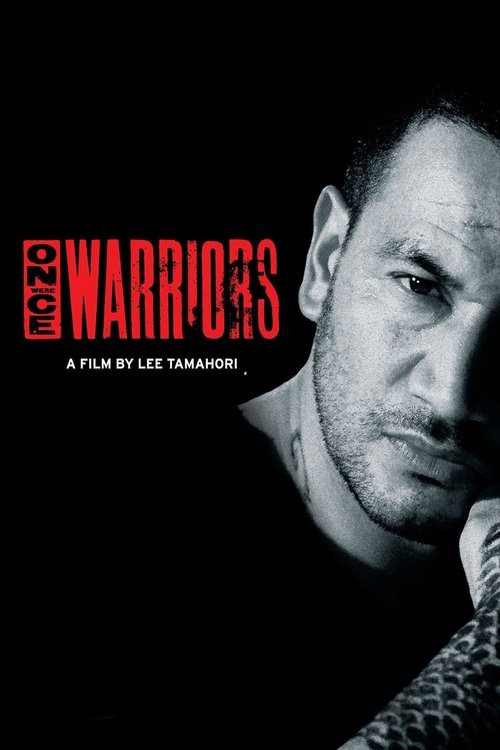
Once Were Warriors
1994 · Lee Tamahori
For when you want to be shaken, not soothed — a heavy, essential watch that demands emotional stamina and repays it. This is a challenge, not comfort; save it for a night you can sit with something hard.
What it's about
Beth Heke is raising five kids in a state-housing district of urban Auckland, married to Jake — magnetic, hard-drinking, and violent when crossed. As his rages and the neighborhood's pull threaten each of her children in different ways, Beth has to find the strength, and the connection to her Māori heritage, to save her family from the man she still loves. Adapted from Alan Duff's incendiary novel, it's a love story and a family tragedy at once.
The experience
Brutal and unflinching — the domestic violence hits with a force very few films risk — but it's carried by so much love and ferocity that it never feels like misery for its own sake. It will wring you out and leave you thinking about Beth for days.
Performances
Rena Owen and Temuera Morrison are both volcanic — Owen's Beth moves from battered endurance to blazing resolve, and Morrison makes Jake terrifying precisely because his charm is real. Their scenes together are some of the rawest domestic acting on film.
The craft
Lee Tamahori's debut has the confidence of a veteran: the film shifts from party warmth to sudden violence with sickening speed, so you live inside the family's constant vigilance. Its urban setting is framed against the memory of a warrior culture, giving the title its full, bitter weight.
Why it matters
It broke New Zealand box-office records, forced a national reckoning with family violence, and announced Māori cinema — and actors Rena Owen, Temuera Morrison, and Cliff Curtis — to the world.
Snapshot
Once Were Warriors is the story of the Heke family — Beth, Jake, and their five children — living in a state-housing district of urban Auckland, where the legacy of Māori displacement has curdled into poverty, alcohol, and domestic violence. Adapted from Alan Duff's incendiary 1990 novel, Lee Tamahori's debut feature compresses that social panorama into a domestic tragedy centered on Beth's slow reclamation of her own strength and her cultural inheritance. The film became a national event in New Zealand, breaking domestic box-office records, forcing family violence onto the front pages, and announcing a cohort of Māori screen talent — Rena Owen, Temuera Morrison, Cliff Curtis — to the wider world. It remains the defining popular work of Māori cinema and one of the most commercially consequential films ever made in New Zealand. Its power lies in a deliberate collision: the glossy, kinetic surface of a former advertising director against the unflinching ugliness of its subject, so that the film seduces and assaults in the same gesture.
Industry & production
The film was produced by Robin Scholes for Communicado, with financing from the New Zealand Film Commission — the state body that had underwritten the country's filmmaking since the late 1970s and whose support was effectively a precondition for any ambitious local feature. Tamahori, then in his forties, came to the project from a successful career directing television commercials, and Once Were Warriors was his first dramatic feature. Riwia Brown, a Māori playwright and screenwriter, adapted Duff's novel; her involvement is significant, because the screenplay materially reshaped the book's emphasis, foregrounding Beth's perspective and a redemptive arc of cultural return where Duff's prose had been bleaker and more polemically self-help in its diagnosis of Māori dysfunction.
The production was modest by international standards but generously resourced for New Zealand at the time. Its commercial performance was extraordinary: it became the highest-grossing locally made film in New Zealand history upon release, drawing audiences far beyond the art-house constituency that usually sustained domestic cinema, and it traveled internationally on the festival circuit, where it accumulated awards and built Tamahori's reputation enough to carry him to Hollywood within a few years. (Exact box-office and prize figures vary across sources; the record is firm on the scale of its domestic success even where individual numbers should be treated cautiously.)
Technology
Once Were Warriors is not a technically experimental film in the sense of new tools or formats. It was shot photochemically on 35mm in the conventional manner of mid-1990s narrative cinema, before the digital intermediate or digital capture had any foothold. What it imports is not new technology but a new sensibility about the deployment of existing technology: Tamahori's grounding in commercials brought an advertising-honed command of the expressive, high-contrast, saturated image and of rhythmically aggressive cutting to a story that the social-realist tradition would ordinarily have rendered in a grittier, more observational register. The "technology" that matters here is really craft discipline — the polish of the frame and the engineered impact of each beat — repurposed from selling product to delivering a punch to the gut. Honesty requires noting that there is little to say about innovation at the level of hardware or process; the film's interest lies almost entirely in technique.
Technique
Cinematography
The cinematography is by Stuart Dryburgh, who had shot Jane Campion's The Piano the previous year and whose work here could hardly be more different in register — proof of range. Dryburgh gives the film a hard, glossy, often neon-inflected palette: the pub and party interiors glow with amber and red, the domestic spaces are flatter and cooler, and the whole carries a sheen unusual for kitchen-sink material. The film's most discussed image is its opening: a serene vista of mountains and water that is revealed, as the camera pulls back, to be a roadside billboard beside a roaring motorway — an instantly legible thesis about the gulf between an idealized natural/ancestral Māoritanga and the concrete reality of the urban present. Camera movement is mobile and often handheld in the violent sequences, lending immediacy, while compositions elsewhere are carefully, almost commercially, designed.
Editing
Michael Horton's editing is central to the film's notorious intensity. The set-piece party scenes are built as slow accumulations of conviviality — drink, music, song, laughter — that the cutting gradually tightens until violence erupts, so that the audience is lulled into the warmth of the gathering before being trapped inside its turn to brutality. The film's rhythm enacts the cycle of abuse it depicts: charm, swelling pressure, explosion, remorse. The editing's willingness to hold on aftermath — and to let scenes of assault play at length rather than cutting away — is a deliberate refusal of comfort.
Mise-en-scène / staging
The film's spatial grammar is organized around a few charged locations: the cramped Heke house, the pub where Jake holds court, the gang "pad," and — set against all of these — the rural marae to which Beth ultimately returns. The Heke home is staged as a contested territory, warm when the family coheres and a trap when Jake's temper fills it. Costume carries meaning efficiently: Jake's singlet and physical bulk read as virile menace; the gang members' leather and moko (facial tattoo) signal a warrior identity that the film treats ambivalently — at once a degraded echo of ancestral mana and, for the son Nig, a route to belonging the family failed to provide. The contrast between the urban interiors and the open, communal space of the marae is the film's organizing visual argument.
Sound
Sound is where the film's cultural texture is densest. The soundtrack blends contemporary Māori and Polynesian-inflected music — soul, reggae, and original songs performed within the diegesis — with the ambient roar of the pub and the street, so that music functions both as communal pleasure and as the lubricant of the violence that pleasure curdles into. Songs performed in the film's social scenes are not mere decoration; they articulate community, longing, and identity. The precise composing credits are best stated with care, as sources differ on attribution; what is unambiguous is that music is treated as a load-bearing emotional and cultural element rather than as underscore.
Performance
The acting is the film's engine. Rena Owen's Beth is its moral and emotional center — a performance of endurance that moves from complicity and denial through grief to a hard-won refusal, never sentimental, always specific. Temuera Morrison's Jake "the Muss" is the film's most dangerous achievement: charismatic, funny, magnetic, and physically overwhelming, so that his charm makes the abuse more rather than less horrifying. The decision to cast Jake as genuinely likeable is the film's sharpest insight into how cycles of violence sustain themselves. Among the children, Mamaengaroa Kerr-Bell's Grace anchors the tragedy, and Cliff Curtis registers strongly in a supporting role. The ensemble's authenticity of voice and milieu was crucial to the film's reception as truthful rather than exploitative — though that judgment was, as below, contested.
Narrative & dramatic mode
The film operates in a hybrid mode: domestic melodrama fused with social realism. Its engine is the family unit under stress, and its structure tracks the fracturing of that unit across its members — Jake's descent into the pub and unemployment, the son Nig's drift into a gang, the son Boogie's removal into state welfare and his discovery of disciplined Māori mentorship there, and Grace's catastrophe. The dramatic turning point is a violation and a death within the family that detonates Beth's transformation; the film withholds easy catharsis, locating its resolution not in justice against Jake but in Beth's reclamation of agency and heritage. Grace's interiority — her writing, her inner life — provides a counter-voice to the adult chaos, and the film's emotional logic runs through the question of whether the children can be saved from the inheritance their parents are living out.
Genre & cycle
Once Were Warriors belongs to several overlapping genres at once: the social-problem film, the domestic-violence drama, the urban Indigenous melodrama. It can be read within the long tradition of kitchen-sink and social realism, but its commercial gloss and melodramatic intensity push it toward something more populist and confrontational than that tradition usually allows. It also belongs to a then-emerging cycle of Indigenous-authored cinema concerned with the urban present rather than the pastoral or historical past — a corrective to representations that located Māori (and other Indigenous peoples) safely in heritage or landscape.
Authorship & method
The film is fundamentally Tamahori's, and his authorship is inseparable from his commercials background: the propulsive style, the sensuous surfaces, the engineered emotional escalation. Tamahori is of Ngāti Porou descent through his father, a fact that shaped both the film's claim to cultural authority and the debates around it. But authorship here is genuinely collaborative. Riwia Brown's screenplay reoriented Duff's novel toward Beth and toward cultural return, softening the source's harsher politics. Stuart Dryburgh's photography supplied the glossy intensity; Michael Horton's editing supplied the rhythm of dread; Robin Scholes's production made the project possible. Duff's novel is the originating vision, and the tension between his bleaker, more accusatory diagnosis and the film's more hopeful arc is one of the most productive seams in the work. The result is a film whose method is to wrap social-realist content in commercial-cinema form — a strategy that delivered both mass audience and critical force.
Movement / national cinema
The film arrived at a high-water mark of New Zealand cinema's international visibility, alongside Campion's The Piano (1993) and Peter Jackson's Heavenly Creatures (1994), part of a small-nation cinema punching far above its weight. More specifically, it is a landmark of Māori cinema and a touchstone in debates about Indigenous self-representation — what the Māori filmmaker Barry Barclay theorized as a distinct mode of Indigenous filmmaking. Once Were Warriors sits productively inside and against that frame: authored substantially by Māori talent and grounded in Māori experience, yet made within mainstream industrial structures and aimed at a mass audience, which is part of why its politics were so vigorously argued over.
Era / period
Released in 1994, the film is a document of its specific moment: post-welfare-state retrenchment, urban Māori communities bearing the long consequences of twentieth-century migration from rural communities into cities and the resulting severance from marae, language, and kin networks. The film's diagnosis — that violence and dysfunction are downstream of colonization and dislocation rather than essential to its characters — is a 1990s articulation of arguments about intergenerational trauma and cultural loss that were live in New Zealand public debate. Its contemporaneity was, at the time, exactly the point: this was not a historical costume picture but a film about the streets outside the cinema.
Themes
The film's governing theme is announced by its title, drawn from the idea that Māori "once were warriors" — that an ancestral heritage of mana and spirit has been degraded, in figures like Jake, into mere brutality without dignity. Around this run its major concerns: domestic violence and the cyclical psychology that sustains it; alcohol as both communal glue and solvent of the family; the severance of urban Māori from cultural roots, and the marae as a site of possible return; mana wahine, the strength of women, embodied in Beth's arc; and intergenerational trauma, the question of what the children inherit. The film insists that cultural reclamation — not the warrior-as-thug but the warrior as bearer of spirit — is the route out, an argument that gives its devastating material a thread of hope.
Reception, canon & influence
The film's reception was seismic at home. It drew unprecedented audiences for a local production, and it catalyzed a national conversation about family violence that extended well beyond film criticism into social policy and public consciousness. Internationally it was widely praised for its raw force and its performances, and it carried Tamahori to a Hollywood career (Mulholland Falls, The Edge, the Bond film Die Another Day, and others). It launched Rena Owen, Temuera Morrison, and Cliff Curtis into international careers — Morrison and Owen would both later appear in the Star Wars prequels, and Morrison's screen warrior persona would recur across decades.
The reception was not uncritical. Some Māori commentators and cultural critics objected that the film, like Duff's novel, risked confirming a damaging stereotype of Māori as violent and dysfunctional, and the politics of the source author were themselves contested. Others defended the film's unflinching honesty and, crucially, Beth's empowering trajectory as a counterweight to despair. That argument — between the charge of negative representation and the defense of truth-telling — is part of the film's permanent critical afterlife.
In terms of influence ON the film, its lineage runs through social-realist and kitchen-sink drama and through the visceral domestic-violence cinema of directors like Scorsese, refracted through Tamahori's commercial visual idiom and grounded in Duff's literary source. Looking forward, its legacy is large: a direct sequel, What Becomes of the Broken Hearted? (1999), continued the Heke story; more broadly it demonstrated that Māori-centred stories could command mass audiences and travel internationally, helping clear ground for the subsequent flourishing of New Zealand Indigenous and Pasifika cinema — Niki Caro's Whale Rider (2002) and the later work of Taika Waititi among the most visible heirs, however different in tone. As the popular keystone of Māori cinema, Once Were Warriors remains the film against which that tradition's debates about representation, authorship, and audience continue to be measured.
A Deleuzian reading
The film opens on a postcard: blue mountains, still water, the New Zealand of tourism and whakapapa.
The full Deleuzian reading of Once Were Warriors →
Reception
A phenomenon in New Zealand on release in 1994 — it out-grossed Hollywood blockbusters locally and forced a national conversation about domestic violence — and it has only hardened into legend since, routinely topping polls as the greatest New Zealand film ever made.
How Once Were Warriors was received, from release to now →
Influences: the films it descends from and the films it influenced
- A Streetcar Named Desire (1951) — The template of the charismatic working-class domestic brute (Stanley Kowalski) rendered through raw Method performance, which Temuera Morrison's Jake directly channels — magnetic sexuality curdling into staged eruptions of violence within a single cramped dwelling.
- Saturday Night and Sunday Morning (1960) — The British kitchen-sink root the dossier cites: working-class anti-hero observed in pub/wage/domestic routine with documentary location texture, the social-realist content grammar Tamahori inherits and re-skins.
- A Woman Under the Influence (1974) — Performance-led domestic disintegration in which the camera refuses to cut away from a marriage coming apart in real emotional time — the 'refusal of comfort' editing ethic Michael Horton applies to Beth and Jake's kitchen.
- Mean Streets (1973) — The bar as social arena where pop/diegetic music scores sudden brawls, filmed with a restless prowling camera — the music-driven barroom-violence staging Tamahori transposes to the Heke local.
- Raging Bull (1980) — Explicitly the cited Scorsese model: spousal violence shot with kinetic handheld immediacy and percussive, dread-building cutting, the husband's jealousy detonating against wife and home — Jake Heke as Jake LaMotta.
- Smash Palace (1981) — The New Zealand precedent for unsparing marital-breakdown realism, locating domestic violence in a recognizably Kiwi vernacular landscape rather than imported melodrama.
- Ngati (1987) — The first Māori-authored feature, establishing the marae-versus-modern spatial staging and communal cultural authority that Warriors invokes as Beth's redemptive 'return' axis.
- Mauri (1988) — The first feature directed by a Māori woman, foregrounding mana wahine and intergenerational trauma as structuring forces — the gendered cultural lens Riwia Brown's screenplay reorients Duff's novel toward.
- What Becomes of the Broken Hearted? (1999) — The direct sequel continuing the Heke story and Jake's reckoning, extending the same social-realist-plus-mana framework into a tale of urban Māori warrior codes.
- Whale Rider (2002) — The most visible mana-wahine heir: a Māori-centred empowerment arc engineered for mass crossover audiences, proving the commercial viability Warriors first demonstrated.
- Boy (2010) — A Māori-centred domestic story working the ground Warriors cleared, inheriting its claim that Indigenous family narrative could command both home audiences and international travel — though pivoting tone toward comedy.
- Samson and Delilah (2009) — The Australasian Indigenous-cinema descendant extending the model of Indigenous-authored social realism that confronts addiction and dispossession without sentimental softening, in the trans-Tasman space Warriors helped open.
- Nil by Mouth (1997) — A parallel unflinching working-class domestic-violence drama built on the same refusal-of-comfort principle — long, escalating handheld scenes of a household's abuse cycle with no tidy catharsis.
- American History X (1998) — A commercials/music-video director applying glossy, high-contrast surface beauty to brutal domestic and social violence — the same strategy of wrapping social-realist content in commercial-cinema sheen that defines Tamahori's method.
- City of God (2002) — A commercials-trained director transmuting slum social-realism into kinetic, sensuously color-graded spectacle — the identical 'social content in advertising-grade form' wager Tamahori made eight years earlier.
- Boyz n the Hood (1991) — Frames community violence as a statistical/contextual cycle via an opening titled reveal, then grounds it in intergenerational household drama — a contemporaneous social-realist counterpart pairing data-frame openings with domestic stakes.
- What's Love Got to Do with It (1993) — Independently arrives at the abusive-marriage two-hander staged in confined domestic space, where the wife's exit is framed as reclamation of self rather than melodramatic rescue.
Similar films
- Warrior (2011) — shared sensibility
- Hunt for the Wilderpeople (2016) — shared sensibility
- Dangal (2016) — shared sensibility
- Tae Guk Gi: The Brotherhood of War (2004) — shared sensibility
- Atanarjuat: The Fast Runner (2002) — shared sensibility
- The Nightingale (2018) — shared sensibility
- Kill (2024) — shared sensibility
- Birds of Passage (2018) — shared sensibility