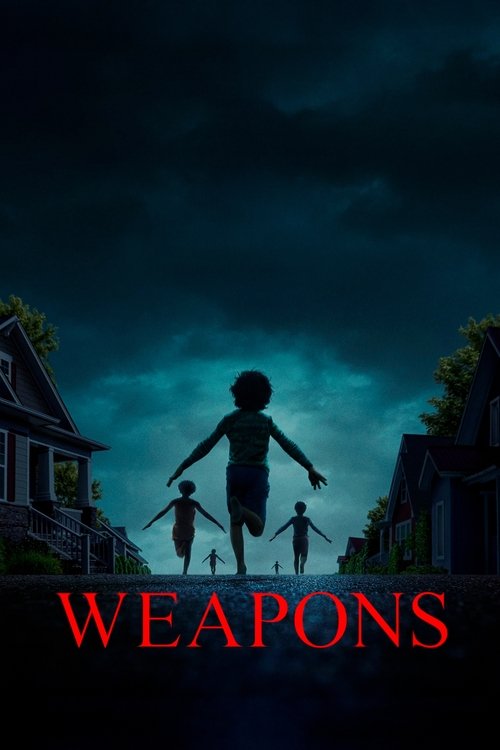
Weapons
2025 · Zach Cregger
Barbarian's don't-spoil-it marketing and Weapons' blockbuster horror opening made him the name in the "original horror is the last original blockbuster" conversation; studios' bidding war for Weapons was itself reported like a sports trade.
For when you're craving a real scare with an actual story attached — the kind you watch with friends and argue about after. Unsettling but a blast; horror-night territory, not trauma-night.
What it's about
At 2:17 one morning, every child in a single elementary-school class — except one — walks out of their homes and vanishes into the dark. The film moves through a shaken Pennsylvania town from several angles: the teacher everyone blames, grieving parents, the kid left behind, each chapter revealing a little more of what actually happened that night. It starts as a mystery about a community coming apart and slides steadily into outright horror.
The experience
Tense, disorienting, and blackly funny in places — it keeps yanking the rug out, switching perspective just when you think you've got the shape of it, then paying everything off in a genuinely wild final stretch. You'll spend most of it leaning forward.
Performances
Julia Garner and Josh Brolin anchor it — she as the teacher carrying the town's suspicion, he as a father who won't stop digging — both playing grief and obsession dead straight so the strangeness around them lands harder.
The craft
Zach Cregger builds the film as interlocking storylines that circle the same night, and the structure itself is the suspense engine — every chapter re-frames what you thought you saw. Striking nighttime imagery and a sound design full of wrongness make it worth the biggest, darkest screen you can find.
Why it matters
One of 2025's defining horror events, it cemented Cregger — after his breakout with a very different kind of shock hit — as the current master of the structural rug-pull in American genre film.
Snapshot
Weapons arrives as Zach Cregger's most anticipated follow-up to Barbarian (2022), the sleeper horror hit that announced him as one of contemporary American genre cinema's most structurally inventive directors. Where Barbarian confined its terrors to a single house in a Detroit ruin — a closed system of graduated revelation — Weapons expands the canvas to an entire community, deploying the premise of a simultaneous mass child disappearance to investigate collective trauma, the limits of rational explanation, and the particular dread of an event that cannot be contained or solved. The film positions itself within the wave of "elevated horror" that has defined genre filmmaking since the mid-2010s, while Cregger's instinct for structural misdirection and tonal volatility gives it a distinct fingerprint within that cycle.
Industry & production
The commercial and critical success of Barbarian — made on a lean budget and earning significant multiples at the global box office — afforded Cregger unusual leverage for a filmmaker still early in his horror career. Weapons appears to have been developed under more substantial studio infrastructure, reflecting the industry logic by which a proven genre auteur earns expanded resources and creative latitude for a second outing. The film clearly represents an escalation in scope from its predecessor: from a two-hander character study set largely underground to a community-ensemble narrative requiring sustained location work, multiple-family casting, and a production apparatus capable of staging an event that registers across an entire social world.
Cregger emerged from the sketch comedy world — he was a founding member of The Whitest Kids U' Know, the ensemble that produced television sketch comedy through the late 2000s — and made his first narrative feature, Miss March (2009), as a co-director with fellow troupe member Trevor Moore. That film, a raucous studio comedy, gave little indication of the horror filmmaker Cregger would become. Barbarian marked a decisive pivot, one he has attributed in interviews to deep engagement with screenwriting theory and a deliberate attempt to structure a horror film using techniques of information management and delayed revelation more typically associated with thriller construction. That intellectual approach to genre mechanics appears to be the core constant of his working method, carried forward into Weapons at larger scale.
Technology
Horror in the 2020s has been substantially shaped by the possibilities of digital cinematography — the ability to shoot in near-darkness using high-ISO sensors, the affordability of nimble camera packages enabling intimate and reactive coverage, and the post-production flexibility that allows color grading to reshape the emotional register of an image long after principal photography closes. The specific camera system, lens package, and post pipeline employed on Weapons are not confirmed in available sources, and rather than speculate, it is more useful to note that Cregger's approach in Barbarian demonstrated a sophisticated understanding of how lens choice and depth of field can be used to control the horror viewer's perceptual access to what lurks in the frame's margins.
The film's subject matter — a community-wide event, multiple affected households, presumably the full topology of a small town's public and private spaces — would have required a logistical and technological approach quite different from Barbarian's essentially single-location discipline. Rendering a suburb or small community coming apart in real time demands location work at a scale that tests both the production's organizational capacity and its ability to maintain tonal consistency across a sprawling physical canvas.
Technique
Cinematography
The cinematographer of record for Weapons is not confirmed in the available sources at this writing. On Barbarian, Cregger worked with Zach Kuperstein, whose handling of low-light practical photography in the film's basement sequences became one of its defining technical achievements — the camera's selective illumination functioning as an instrument of the narrative's own controlled revelation, showing audiences just enough to imagine the rest.
The cinematographic challenge Weapons poses is substantially different. If the community-horror model implied by its premise holds, the shift is from the claustrophobic compression of interior space to the more psychologically complex task of making familiar, open environments feel threatening. The horror of the mundane — daylight, recognizable streets, the school pickup line — requires different photographic strategies than the horror of the unknown dark. The best horror cinematography of the current era has demonstrated that de-dramatized, "objective" framings of horrific content — refusals of expressionism in favor of deadpan register — can generate unease more efficiently than conventional horror-movie stylization. Pawel Pogorzelski's flat, almost clinical work on Hereditary (2018) and Midsommar (2019) offers one model for this approach; whether Weapons pursues something similar remains to be assessed in relation to the finished film.
Editing
The editor's contribution to Weapons is similarly unconfirmed in available documentation. Barbarian's editing was responsible for one of its key structural gambits: the hard cut that abandons the protagonist mid-film and reintroduces the story from a temporally earlier and generically disconnected vantage point. This jarring reorientation — using the cut not merely to pace action but to fundamentally recontextualize what the viewer believes they are watching — is characteristic of Cregger's interest in weaponizing narrative expectation. Whether Weapons finds an equivalent structural maneuver is not established here, but the instinct it revealed is likely operative in any Cregger project at this stage of his career.
Mise-en-scène / staging
The community horror premise opens specific staging possibilities. Where Barbarian's mise-en-scène was essentially defined by a building's architecture — the spatial relationship between above-ground normality and below-ground revelation — Weapons must manage a topology of community: multiple households, the school itself, the public spaces where neighbors encounter one another's grief. The staging choices in these communal scenes carry implicit argument about collective failure or solidarity: who stands at the door, who looks away, how much physical distance adults maintain from one another in the aftermath of shared catastrophe.
Sound
Sound design in horror performs work the image cannot: it extends threat beyond the frame, manufactures unease in ostensibly neutral spaces, and — when deployed with precision — makes the absence of expected sound more horrifying than the presence of conventional cues. The simultaneously timed quality of the children's disappearance has an inherent sonic implication. A cut-off. A silence where there had been ambient presence. A sophisticated sound design would return to that originary silence throughout the film, using it as an anchor for the community's ongoing inability to restore what it lost. The film's composer is not confirmed in available sources.
Performance
Ensemble films organized around community catastrophe require a particular performance discipline: actors who can register grief and disorientation credibly, without the operatic display that reads as horror-movie acting rather than human behavior. Cregger's background in comedy has given him an acute sensitivity to the rhythmic and tonal registers of performance — the ability to modulate between naturalism and controlled artifice that Barbarian demonstrated with considerable skill across its principal cast. The specific performers in Weapons are not detailed in full in available sources, and individual character analyses await the record of the film itself.
Narrative & dramatic mode
The premise establishes Weapons in a dramatic mode that might be called the catastrophe procedural: a narrative organized around a community's attempt to process, investigate, and make sense of an event that may ultimately resist explanation. This mode has antecedents across film and prestige television alike. Twin Peaks (1990–1991) defined one version of it — a foundational missing-child mystery that generates an entire town's worth of uncanny revelation, in which the investigation of the crime becomes an investigation of the community's hidden life. The structural logic is similar here: a single event, at a single moment, cascading outward.
The child who does not vanish is a particularly rich device. In horror, the survivor figure carries the burden of witnessing — and frequently of not being believed, or of being suspected of complicity. Their testimony, colored by the event's inexplicability, positions them as the film's primary epistemological instrument: the audience's anchor in a situation that continuously resists rational stabilization. The question of why this child was spared is a question the narrative may refuse to answer, or may answer in ways that generate more horror than the disappearance itself.
Whether Cregger employs a linear or fractured temporal structure is not established, but his demonstrated interest in information management — in controlling what the viewer knows and when — suggests that the revelation of what is responsible will be calibrated as carefully as any element of the film's construction.
Genre & cycle
Weapons occupies a specific and identifiable position within the mid-2020s horror landscape. The genre has been shaped, since roughly 2015, by the critical and commercial success of films that fused horror conventions with psychological realism, thematic ambition, and the formal vocabulary of prestige drama. Films like The Witch (2015), Hereditary (2018), Midsommar (2019), and Barbarian itself belong to this cycle, which critics quickly labeled "elevated horror" — a term both descriptive and contested, since it implies that conventional horror requires elevation and tends to flatten important distinctions between films within the cycle.
The child-centered horror subgenre — films organized around the vulnerability or disappearance of children — carries a longer lineage: Village of the Damned (1960, dir. Wolf Rilla), based on John Wyndham's novel The Midwich Cuckoos, is a direct generic ancestor, structuring its horror around children who arrive in a community as a population of alien threat. The Omen (1976, dir. Richard Donner), Picnic at Hanging Rock (1975, dir. Peter Weir), and Prisoners (2013, dir. Denis Villeneuve) each work different variations on the formula of children lost, taken, or threatening. Weapons inherits this tradition while situating itself in an era when horror audiences are sophisticated readers of genre convention and resistant to unmediated sentiment.
The community-scale mystery also connects to the "event horror" structure — a single inexplicable incident reorganizing an entire social world — productive across both film and prestige television across the decade preceding Weapons.
Authorship & method
Cregger has positioned himself, across his public discussions of Barbarian, as a filmmaker deeply invested in structural craft — in the screenplay as an instrument of controlled revelation rather than merely a narrative vehicle. His accounts of developing Barbarian describe sustained engagement with screenwriting theory and a deliberate decision to engineer the film's information architecture before attending to its surface content. This approach — treating narrative structure as primary expressive tool — aligns him with a tradition of genre filmmakers who use established convention as a system of expectations to be strategically violated: Hitchcock's structuring of Psycho around a murder that eliminates the ostensible protagonist at the midpoint being the canonical precedent, and one Cregger has acknowledged as a reference point.
The specific collaborators on Weapons — cinematographer, composer, editor — are not fully documented in the available record. What can be said is that Cregger's previous work demonstrates an ability to recruit and direct technically accomplished collaborators in service of a coherent directorial vision, and that the expansion of scope in Weapons would have required substantial collaborative intelligence across departments.
Movement / national cinema
Weapons is a product of American horror, sitting within the specifically American tradition of suburban and community dread that stretches from Invasion of the Body Snatchers (1956, dir. Don Siegel) through Poltergeist (1982, dir. Tobe Hooper), The 'Burbs (1989, dir. Joe Dante), and into the prestige-horror wave of the 2010s. The American suburb as horror site has been a durable generic resource precisely because it represents an ideological formation — the promise of insulated safety, the protection of children as the community's primary civic function — whose violation registers with particular ideological force. When that formation fails, and fails completely, the horror implicates not just the mysterious external agent but the structure of community itself.
Cregger's engagement with questions of race, class, and spatial politics in Barbarian — using the geography of a condemned Detroit neighborhood as a map of America's social divisions — suggests a filmmaker whose genre interests are not separable from an interest in American social life. Whether Weapons extends that political dimension into the community catastrophe narrative remains to be assessed.
Era / period
Released in 2025, Weapons arrives at a moment of transition in the horror cycle. The elevated horror wave that crested around 2018–2020 has become sufficiently established to have generated its own counter-reactions — including knowing pastiches that treat elevated horror's thematic pretensions as a target, and a renewed audience appetite for more viscerally immediate genre pleasures. Cregger occupies an interesting position in this ecology: a filmmaker with evident structural ambitions who nonetheless demonstrated in Barbarian a genuine appetite for shock, body horror, and the kind of unmediated genre intensity that elevated horror sometimes sacrifices to prestige-film affect.
The film also arrives at a cultural moment when horror's engagement with community trauma — with catastrophe that befalls a social collective rather than an individual — has particular resonance. The specific cultural correlates are better left unspecified in a film-historical account, but the generic tradition of community horror has always drawn its energy from anxieties legible in the social context of its production.
Themes
The disappearance of children is among horror's most effective organizing anxieties because it targets something close to the biological and social core of human experience: the protection of the next generation as the community's irreducible obligation. When that protection fails — especially when it fails completely, simultaneously, and inexplicably — the horror is not only of loss but of a world revealed as indifferent or actively hostile to the most basic claims of care.
The time-stamped precision of the disappearance in Weapons — all at once, at exactly the same moment — adds the dimension of design. Precision implies agency. Something chose this moment, these children, this community. That shift moves the horror from accident to targeting, and from grief to paranoia: the conviction that an event this specific must have a logic, even if no available framework can disclose it.
The surviving child introduces the vertigo of exception. In theological and folk-horror traditions, the survivor of a catastrophe visited on a group is never simply lucky: they are marked, chosen, suspect, or burdened with testimony no one wants to hear. The question of why this child was spared may be the film's deepest question, and the horror genre's interest in refusing final answers — in preserving the inexplicable as inexplicable — suggests that Weapons, like Picnic at Hanging Rock before it, may treat that question's irresolvability as its core formal statement.
Reception, canon & influence
The full critical and commercial reception of Weapons is not available at this writing given the proximity of its 2025 release. What can be said is that Cregger entered the project carrying an unusually high level of critical investment: Barbarian generated a substantial critical afterlife, with ongoing reassessment of its structural sophistication, its use of geography as social commentary, and its management of tonal register across wildly different generic modes. Weapons therefore functions as a significant test of whether Barbarian represented a singular achievement or the first work of a consistent authorial sensibility.
The film's backward influences are legible through premise and method. The structural revelation techniques connect to Hitchcock's management of dramatic irony; the community horror to the tradition running from Invasion of the Body Snatchers through The Wicker Man (1973, dir. Robin Hardy) to contemporary ensemble horror; the missing-child mystery to George Sluizer's The Vanishing (1988) and to Picnic at Hanging Rock, both of which made the irresolution of disappearance their central formal principle. Cregger's tonal instability — horror inflected with dark comedy, genre conventions inverted — connects to a lineage of American horror that includes Wes Craven's late-career genre commentaries and the more recent smart-horror tradition.
The film's forward influence — what it shapes in the genre — cannot yet be assessed. If Weapons achieves the impact of Barbarian, it seems likely to accelerate the already-visible trend toward community-scale horror narratives, and to consolidate Cregger's position as one of the defining genre filmmakers of the decade. If it fails to replicate that precedent, it will likely be read as confirmation of the singular-film problem: the difficulty of reproducing a breakthrough that depended substantially on the element of surprise. The record, at this stage, remains open.
A Deleuzian reading
Start with the desk.
The full Deleuzian reading of Weapons →
Reception
No reappraisal needed — Weapons arrived pre-hyped off a legendary script bidding war and actually delivered, opening #1 and becoming one of 2025's biggest original horror hits with critics and audiences aligned from day one.
How Weapons was received, from release to now →
Influences: the films it descends from and the films it influenced
- Psycho (1960) — Structural elimination of the ostensible protagonist at the narrative midpoint — forcing the audience to rebuild its investment framework mid-film — is the information-architecture technique Cregger explicitly cites as foundational to Weapons' design.
- The Wicker Man (1973) — Community horror distributed evenly across all social actors rather than concentrated in a single antagonist; the outsider investigator's accumulating epistemological disadvantage within a self-concealing communal structure is the formal template for Weapons' collective-dread mechanism.
- Picnic at Hanging Rock (1975) — Disappearance rendered as formally unresolvable event; de-dramatized cinematography and ambient sound withhold explanatory closure, making irresolution itself the horror rather than a narrative deficit — cited in the dossier as a direct structural precedent.
- Blue Velvet (1986) — Suburban geography excavated as a screen concealing organized violence beneath legible normality; de-dramatized horror imagery withholds conventional generic fear signals while dread escalates structurally — the primary American-horror grammar Weapons inherits.
- Invasion of the Body Snatchers (1978) — Ensemble community horror in which the threat is indistinguishable from the social fabric; the progressive revelation of collective complicity through procedural discovery by an epistemically disadvantaged protagonist who cannot trust the community as witness.
- The Vanishing (1988) — The missing-person procedural structured so the investigative mechanism delivers accumulating dread without resolution; withholding closure as formal principle rather than genre convention, cited alongside Picnic at Hanging Rock as a structural precedent for Weapons' disappearance architecture.
- Twin Peaks: Fire Walk with Me (1992) — The missing girl as epistemological center around which a community's concealed violence is organized; survivor-epistemology as formal device in which past violence becomes legible only through fragmentary, unreliable testimony — the procedural framing of community horror Cregger's facets explicitly acknowledge.
- Funny Games (1997) — Genre subversion through structural misdirection in which horror conventions are primed and then weaponized against audience expectation; formal refusal of conventional horror satisfactions deployed as a statement about the mechanics of the genre itself.
- No Country for Old Men (2007) — Silence deployed as primary dread instrument; de-dramatized framing of violence that refuses conventional thriller grammar; the catastrophe-procedural mode in which violence is an ongoing community event rather than a discrete dramatic climax — the formal model for Weapons' sound and editing strategy.
- Barbarian (2022) — The direct creative prototype establishing Weapons' structural method: hard cuts between disconnected character threads, protagonist substitution mid-film, and the withholding of spatial information as primary horror mechanism — the immediate craft model the director carried into the larger-scale successor.
- Resident Evil (2026) — The chaptered, overlapping-witness construction — the same 2:17 a.m. re-entered from a new vantage until the timelines interlock — plus the Holladay Brothers' electronic score and Joe Murphy's habit of cutting late, is the exact machinery the seed applies to a single night in one building.
- Zodiac (2007) — The catastrophe-procedural mode applied to community-scale violence: procedural investigation as dramatic engine, de-dramatized framing, and structural hard cuts managing information across an ensemble without delivering conventional resolution or a final confrontation.
- Prisoners (2013) — Missing-child procedural using de-dramatized cinematography and silence as primary dread instruments; the investigative structure functioning as a container for distributed community trauma rather than a mechanism oriented toward closure.
- It Follows (2014) — Elevated American horror built on practical low-light cinematography in defamiliarized Midwestern suburban geography; de-dramatized horror framing that refuses conventional scare grammar, positioning threat as ambient condition rather than punctual event.
- The Witch (2015) — Practical low-light cinematography as the primary horror instrument alongside ensemble naturalism; horror that emerges from the community's own internal epistemological failure — the inability of its members to agree on what is real — rather than from an unambiguous external intrusion.
- Get Out (2017) — Structural misdirection in which one genre primes expectations that a concealed second genre subverts; community complicity as the disclosed horror mechanism; the structural reveal retroactively reframes all prior social interactions as a unified system of concealment.
- Hereditary (2018) — Collective trauma distributed across an ensemble performing at naturalistic register; structural hard cuts managing revelation across a family-scale catastrophe-procedural that withholds the full picture of communal violence and complicity until the architecture collapses in the third act.
- Midsommar (2019) — Community horror in which the social collective is the undisclosed threat; de-dramatized horror imagery withholds conventional fear signals by placing violence in full light without generic cueing — the photographic inverse of low-light horror grammar that achieves identical dread through over-exposure.
Similar films
- Barbarian (2022) — influence & lineage · same viewing thread
- Strange Darling (2024) — same viewing thread
- Bring Her Back (2025) — same viewing thread
- The Witch (2016) — same viewing thread
- Oddity (2024) — shared sensibility
- Terrifier 2 (2022) — shared sensibility
- Sound of Falling (2025) — shared sensibility
- The Texas Chain Saw Massacre (1974) — shared sensibility
All the films related to Weapons →
Watch it with: curated runs of related films
- Whatever's Wearing That Face — A run of horror-thrillers where the real terror is that you can't trust what a person appears to be — a double, a shapeshifter, a smiling stranger, the one you desire.