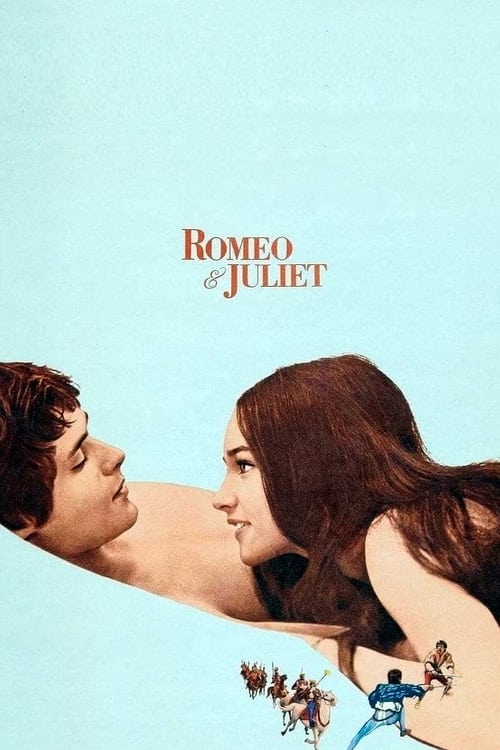
Romeo and Juliet
1968 · Franco Zeffirelli
For when you want to be swept off your feet and don't mind having your heart broken — a big, lush, unguarded romance for a night when you'd rather feel everything than nothing.
What it's about
In Renaissance Verona, two teenagers from families locked in a violent feud fall in love at first sight and marry in secret. Romeo is a Montague, Juliet a Capulet, and everything around them — parents, cousins, street brawls, arranged matches — conspires against a love they refuse to give up. It's the most famous romance ever written, played here by actors barely older than the characters themselves.
The experience
Sun-drenched, headlong, and emotionally direct — it moves with the reckless speed of first love, then tightens into dread as the adult world closes in. Even knowing where the story goes, it aches.
Performances
Leonard Whiting and Olivia Hussey, unknown teenagers when cast, play the lovers with a rawness no seasoned stage actor could fake — their youth is the whole point, and it lands.
The craft
Zeffirelli shoots Verona as a real, dusty, sweat-and-silk place rather than a stage set, with sumptuous Renaissance costumes and locations that make the play physical. Nino Rota's love theme is one of the most recognizable melodies in film music, and the whole thing rewards a big screen and good speakers.
Why it matters
It broke Shakespeare on film away from mannered, middle-aged theatrical tradition and handed the play to actual adolescents, becoming a major hit with the youth audience of 1968 and the default classroom Romeo and Juliet for decades.
Snapshot
Franco Zeffirelli's Romeo and Juliet is the mid-century screen adaptation that decisively broke Shakespeare away from the mannered, middle-aged, theatrically declaimed tradition and handed the play to actual adolescents. By casting the unknown Leonard Whiting (seventeen) and Olivia Hussey (fifteen at casting, sixteen during shooting) in the title roles, Zeffirelli made the tragedy legible to the youth audience of 1968 as a story about impulsive young love, generational conflict, and the lethal machinery of adult institutions. The film is lush, tactile, and emotionally direct — sun-struck Italian streets, Renaissance textiles, and Nino Rota's aching love theme fused into a sensory experience that critics of the day found either intoxicating or vulgar. It was a substantial commercial success, especially among younger viewers, and won Academy Awards for cinematography and costume design while earning nominations for Best Picture and Best Director — a rare feat for a Shakespeare film. It remains, for generations of students and teachers, the Romeo and Juliet.
Industry & production
The film was an Anglo-Italian co-production, financed largely through Paramount Pictures with British and Italian partners, and shot on location in Italy rather than in a studio recreation of Verona. Principal locations included the Tuscan and Umbrian towns of Pienza, Gubbio, Tuscania, and Artena (standing in for Verona's streets and piazzas), with interiors and set work coordinated around the Italian production base familiar to Zeffirelli from his stage and opera career and from his previous film.
The project arrived on the momentum of Zeffirelli's The Taming of the Shrew (1967), the Richard Burton–Elizabeth Taylor vehicle that had demonstrated a commercial appetite for accessible, star-driven Shakespeare. Where Shrew leaned on established megastars, Romeo and Juliet took the opposite gamble: relative unknowns in the leads, surrounded by seasoned British and Italian character players (Michael York as Tybalt, John McEnery as Mercutio, Milo O'Shea as Friar Laurence, Pat Heywood as the Nurse). The economic logic was that youthful authenticity, not star wattage, would sell the picture — a bet vindicated at the box office. The casting search itself became part of the film's publicity, framed as a wide hunt for genuinely young lovers.
The film also carried a note of controversy that shaped its later distribution history: a brief scene of nudity involving the teenaged leads. This was handled discreetly within the 1968 release and was consistent with the loosening of censorship at the tail end of the Production Code era, but it has generated significant legal and ethical discussion in recent decades. I note this as a matter of record without adjudicating the specifics.
Technology
Technically, the film is a conventional late-1960s color production shot on 35mm and released in a standard widescreen ratio, without recourse to novel processes or gimmicks. Its distinction lies not in hardware but in craft: naturalistic location shooting in available and warm Italian light, and a commitment to physical authenticity — real streets, heavy period fabrics, practical crowds — rather than the soundstage artifice that had characterized earlier Hollywood Shakespeare. Sound was post-synchronized in the standard manner of Italian-based productions of the era, and the English-language version layered Laurence Olivier's uncredited narration over the prologue (and, by well-documented accounts, some additional dubbing). The technological story here is essentially one of restraint: the tools are ordinary, deployed with unusual sensory discipline.
Technique
Cinematography
Pasqualino De Santis's Oscar-winning cinematography is the film's signature achievement and the clearest statement of its aesthetic. De Santis works in a warm, saturated palette — dust, ochre, terracotta, deep reds and blues in the costumes — and favors a mobile, physically present camera that moves through crowds, climbs to balconies, and presses close to the young faces. The Capulet ball is shot as a swirl of bodies, torchlight, and fabric; the street brawls are chaotic and sunlit rather than choreographed and stagey. The famous balcony scene trades theatrical framing for intimacy, using nocturnal softness and closeness to register the lovers' nervous immediacy. The visual grammar consistently privileges youthful skin, sweat, and heat over painterly composition-as-tableau, which is precisely what made the film feel modern.
Editing
Reginald Mills's editing serves the film's emotional and kinetic priorities. The action sequences — particularly the Mercutio–Tybalt duel and Romeo's revenge — are cut for confusion and momentum, so that a swordfight that begins as horseplay curdles into fatal accident with sickening speed. Elsewhere the cutting is patient, holding on faces and gestures during the love scenes to let performance and Rota's score do the work. The overall rhythm balances the play's public, violent register against its private, lyrical one, using pace as the primary lever between them.
Mise-en-scène / staging
This is where Zeffirelli's operatic and theatrical background is most visible. He stages Verona as a living, crowded, three-dimensional town — markets, alleys, balconies, and squares populated by a genuine populace, so that the feud reads as a civic disease rather than a private quarrel. Danilo Donati's Oscar-winning costumes are integral to the mise-en-scène: color-coded, heavy, tactile Renaissance dress that distinguishes the households and grounds the fantasy in material weight. The Capulet ball, with its Morris-dance formality and the song "What Is a Youth," is a set-piece of pure spatial and sensory orchestration. Zeffirelli's instinct is always toward the concrete and the sensuous — bodies in space, cloth against stone — rather than the abstract or emblematic.
Sound
Nino Rota's score is inseparable from the film's identity. Its central love theme — presented diegetically at the ball as the song "What Is a Youth" (music by Rota, lyrics by Eugene Walter) and recurring instrumentally throughout — became one of the most recognizable pieces of film music of its era and later circulated widely in a lyricized pop version ("A Time for Us"). Rota's melody functions as the emotional throughline, tender and elegiac, coding the lovers' story as doomed from its first statement. Beyond music, the soundscape of clamoring crowds, clashing steel, and church bells reinforces the film's tactile realism. The English-language prologue, spoken by Laurence Olivier, lends the opening a gravity that frames the youthful action to come.
Performance
The performances are calibrated to naturalism and youth rather than to classical elocution. Whiting and Hussey deliver the verse plainly and emotionally, prioritizing feeling and physical presence over rhetorical polish — a choice that some classicists faulted but that most audiences found refreshingly alive. The supporting cast supplies theatrical texture: John McEnery's Mercutio is mercurial and edged with something darker and more manic than usual, Michael York's Tybalt is a coiled aristocratic menace, Pat Heywood's Nurse is warm and comic, and Milo O'Shea's Friar Laurence is well-meaning and fatally ineffectual. The ensemble's seasoned playing gives the young leads a world to be young within.
Narrative & dramatic mode
The film follows Shakespeare's tragic architecture faithfully in shape while trimming and streamlining the text for pace and accessibility. The dramatic mode is romantic tragedy driven by dramatic irony: the audience knows the prologue's promise of "star-cross'd lovers" and death, so every hopeful turn is shadowed. Zeffirelli emphasizes the play's tempo — the terrifying speed with which infatuation, marriage, banishment, and death compress into days — and stages the mechanism of the tragedy (the miscarried message, the mistimed waking) as cruel accident rather than cosmic design. Crucially, he reframes the story generationally: the tragedy belongs to the young, and the adults — parents, prince, friar, nurse — are the well-meaning or malignant institutional forces whose feud and fumbling destroy them. This reading gave a four-century-old play immediate resonance in the year of global youth unrest.
Genre & cycle
The film sits at the intersection of the literary-adaptation prestige picture and the emerging youth film. It belongs to the 1960s cycle of commercially ambitious Shakespeare — bracketed by Zeffirelli's own The Taming of the Shrew (1967), Peter Brook's austere King Lear, and the broader postwar tradition of Olivier's and Orson Welles's screen Shakespeare. Against those, Zeffirelli's contribution defined a distinct sub-mode: the sensuous, youth-oriented, location-shot Shakespeare that treats the classical text as living emotional material rather than museum object. It also participates in the late-1960s vogue for romantic tragedy pitched at young audiences, and its aesthetic — beautiful doomed youth, folk-inflected score, period spectacle — would echo through subsequent literary romances.
Authorship & method
Zeffirelli's method is that of a theater and opera director translated to film: he builds meaning through staging, physical space, music, and design, orchestrating the whole into an emotionally saturated spectacle. His authorial signature is sensuous accessibility — the conviction that the classics should be felt viscerally and enjoyed sensually, not revered coldly. He works with a distinguished set of collaborators whose contributions are essential to the result:
- Pasqualino De Santis (cinematography), whose warm, mobile, youth-centered imaging won the Academy Award and set the film's tone.
- Nino Rota (music), the composer most associated with Fellini, whose love theme became the film's emotional and cultural calling card.
- Danilo Donati (costume design), whose Oscar-winning Renaissance wardrobe carries much of the film's storytelling and spectacle.
- Reginald Mills (editing), who shaped the film's alternation between violent kineticism and lyrical stillness.
- Screenplay by Franco Brusati, Masolino D'Amico, and Zeffirelli, adapting and condensing Shakespeare for the screen.
The authorship is genuinely collaborative, but the unifying sensibility — operatic, tactile, emotionally frank — is unmistakably Zeffirelli's.
Movement / national cinema
The film is a hybrid of British literary prestige and Italian filmmaking craft, and the Italian side is decisive. Its production base, its below-the-line talent (De Santis, Rota, Donati all central figures of Italian cinema), and its location shooting root it in the postwar Italian film industry even as its language and source are English. This is not neorealism, but it inherits neorealism's commitment to real places and physical texture, redirected toward romantic spectacle. Zeffirelli, himself formed in Italian theater, opera, and cinema (including early work with Visconti), embodies that crossover. The film is best understood as international art-commerce cinema of the late 1960s, made possible by the transnational financing and Italian craft ecosystems of the period.
Era / period
Released in 1968, the film is inseparable from its historical moment. That year of student uprisings, generational rupture, and anti-authoritarian ferment gave Zeffirelli's youth-centered reading its charge: a story of young people destroyed by their elders' inherited hatreds landed with obvious contemporary force. The film also arrives precisely as the old censorship regime was collapsing and a franker treatment of youthful sexuality became possible on screen. Aesthetically it belongs to the late-1960s taste for romantic, folk-inflected, visually opulent cinema. It is a period piece in setting but a document of 1968 in sensibility.
Themes
The film foregrounds several interlocking themes. Chief among them is youth versus age — the tragedy as an indictment of adult institutions (family, church, state) whose feuds and failures consume the young. Closely bound to this is love as impulsive, embodied, and doomed: Zeffirelli treats the lovers' passion as authentically adolescent, headlong and physical, and therefore both beautiful and fragile. Fate and accident run throughout, with the tragedy staged as a chain of contingencies rather than divine decree, sharpening its sense of waste. Violence as civic disease appears in the sunlit brawls that erupt from ordinary streets, framing the feud as a public sickness. And underlying all of it is a transience theme distilled in Rota's "What Is a Youth" — the beauty and brevity of young life set against inevitable loss.
Reception, canon & influence
Critically, the film was divisive in the familiar way of popularizing adaptations: many reviewers were moved by its beauty, freshness, and the vitality of its young leads, while classically minded critics objected that emotional immediacy came at the cost of the verse and the play's intellectual complexity. That debate — accessibility versus fidelity — has followed the film ever since. Commercially, it was a notable success, particularly with young audiences, and it earned significant industry recognition: Academy Awards for Best Cinematography (De Santis) and Best Costume Design (Donati), plus nominations for Best Picture and Best Director. I flag that precise box-office figures vary across sources, so I describe its success in qualitative rather than numerical terms.
Influences on the film (backward): Zeffirelli drew on the postwar Italian tradition of location realism and craft; on his own theatrical and operatic practice, which shaped his staging and his instinct for spectacle; on his mentorship under and association with figures of Italian cinema; and on the immediate precedent of his The Taming of the Shrew, which proved the commercial viability of accessible screen Shakespeare. Behind all of it stands the long lineage of filmed Shakespeare (Olivier, Welles) against which Zeffirelli defined himself by opposition.
Legacy (forward): The film became the default classroom and cultural reference point for the play for decades, and it established a template — young age-appropriate leads, sumptuous period design, a memorable romantic score, emotional over rhetorical delivery — that shaped subsequent Shakespeare adaptation and period romance. Its youth-forward approach set the terms against which Baz Luhrmann's radically different Romeo + Juliet (1996) would later define itself, and Rota's love theme entered the broader popular songbook well beyond the film. Zeffirelli himself extended the method in later literary adaptations. More than half a century on, its images — the balcony, the ball, the sunlit duels — remain among the most widely recognized in Shakespeare on film.
Reception
In 1968 it was a genuine phenomenon — a box-office smash, a Best Picture nominee, and hailed for finally casting actual teenagers as the teenage lovers. Today it's still the definitive 'traditional' screen version, but viewed with more ambivalence after its now-septuagenarian stars sued Paramount in 2022 over the nude scene shot when they were minors.
How Romeo and Juliet was received, from release to now →
Influences: the films it descends from and the films it influenced
- Henry V (1944) — The prestige-color Shakespeare template Zeffirelli defined himself against, rejecting Olivier's declamatory verse-forward delivery in favor of emotional immediacy over rhetorical clarity.
- Othello (1951) — Shot Shakespeare in real Mediterranean architecture and streets rather than studio sets, the location-Shakespeare precedent behind Zeffirelli's sunlit Verona and Tuscan townscapes.
- Chimes at Midnight (1965) — The Battle of Shrewsbury's fragmented, whirling combat montage is the editing model for Reginald Mills's kinetic sword-duel cutting between Mercutio, Tybalt and Romeo.
- Senso (1954) — Visconti, Zeffirelli's mentor, staged period melodrama in saturated color with an opera director's eye — the theater-and-opera-translated-to-film method Zeffirelli inherited directly.
- The Leopard (1963) — Its choreographed, crowded ballroom and sumptuous Italian period spectacle is the direct model for the Capulet ball's operatic massing of bodies, music and design.
- La Strada (1954) — Nino Rota's singable melodic-leitmotif method, honed with Fellini, is what produces the film's love theme as detachable emotional and cultural calling card.
- The Taming of the Shrew (1967) — Zeffirelli's own immediate precedent proving accessible screen Shakespeare's commercial viability, and the debut of Danilo Donati's Renaissance costume method and a Rota score.
- West Side Story (1961) — Recast Romeo and Juliet as age-specific youth tragedy with the duel staged as kinetically choreographed street combat — the youth-forward reframing Zeffirelli applies back onto the source text.
- Rome, Open City (1945) — Postwar Italian neorealist practice of shooting in real streets with available light supplies the location-realism craft base under Zeffirelli's mobile, on-location camera.
- Romeo + Juliet (1996) — Explicitly defines itself against Zeffirelli by radicalizing his own devices — age-appropriate teen leads, pop-scored emotional immediacy over verse, tragedy as accident of timing.
- Hamlet (1990) — Zeffirelli extends his own method — location castles, condensed accessible text, and an emotionally frank star (Gibson) delivering feeling over rhetoric.
- Brother Sun, Sister Moon (1972) — Carries forward the youth-cast, sunlit-location, Donati-designed medieval spectacle, applying the adolescent-naturalism formula to the young St. Francis.
- Titus (1999) — Design-saturated, operatic Shakespeare-as-spectacle descending from Zeffirelli's theater-and-opera-into-film staging, meaning built through costume, space and music.
- Much Ado About Nothing (1993) — Sunlit Italian-villa location Shakespeare with sensuous, naturalistic, accessible delivery — the visceral-enjoyment-of-the-classics sensibility Zeffirelli pioneered.
- Shakespeare in Love (1998) — Prestige Elizabethan romance built on Oscar-winning costume spectacle and emotionally frank, accessible handling of Shakespeare as felt rather than revered.
- Marie Antoinette (2006) — Youth-forward period film using adolescent naturalism, anachronistic emotional immediacy, and costume-as-storytelling in the sensuous, accessibility-over-fidelity mode Zeffirelli established.
- Withnail & I (1987) — Robinson's own experience acting in it (and the attentions it drew) is transmuted directly into Uncle Monty's blend of menace and heartbreak — a biographical craft source for the character.
- Macbeth (1971) — Location-shot, viscerally naturalistic Shakespeare with young age-appropriate leads (Finch, Annis), extending Zeffirelli's emotional-over-declamatory delivery into darker realism.
- A Special Day (1977) — Shares cinematographer Pasqualino De Santis, whose painterly, low-saturation palette and mobile framing method carries directly into A Special Day's desaturated-sepia look.
Similar films
- Macbeth (1971) — influence & lineage · often watched together
- Titus (1999) — influence & lineage · often watched together
- Othello (1951) — influence & lineage · often watched together
- West Side Story (1961) — influence & lineage
- The Leopard (1963) — influence & lineage
- Marie Antoinette (2006) — influence & lineage
- Senso (1954) — influence & lineage
- Chimes at Midnight (1965) — influence & lineage · often watched together