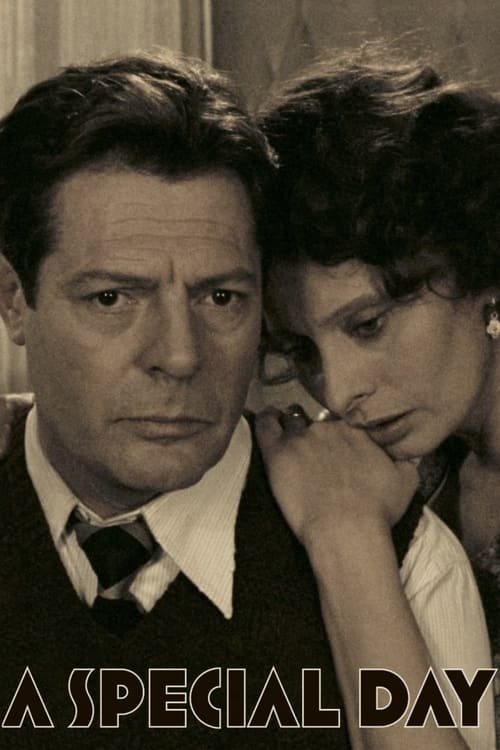
A Special Day
1977 · Ettore Scola
For a reflective evening when you want to feel something deep and true about loneliness and connection — a good cry earned honestly, not manufactured. It asks patience and repays it completely.
What it's about
Rome, May 1938: Hitler arrives to parade with Mussolini, and an entire apartment block empties out to cheer. Left behind are two strangers — Antonietta, an exhausted housewife raising six children for a regime that prizes her only as a mother, and Gabriele, a former radio announcer who has lost his job and is awaiting exile for being homosexual and anti-Fascist. Over one day, across a deserted courtyard, the two form a fragile, unexpected bond.
The experience
Quiet, intimate, and devastating in the gentlest way — a slow-building two-hander where the roar of the rally on the radio never stops in the background. It's tender and sad and humane, the kind of film that ends and leaves you sitting in silence.
Performances
Sophia Loren and Marcello Mastroianni, the most glamorous pair in Italian cinema, work brilliantly against type — she scrubbed of all glamour and worn down to the bone, he playing charm as a thin cover for despair. It's arguably career-best work from both.
The craft
Ettore Scola drains the film to a near-monochrome, faded-newsreel palette and confines it almost entirely to one building on one day, with the Fascist rally present only as sound bleeding through the walls. The long takes through empty stairwells and apartments are quietly virtuosic, and the restraint makes every small gesture land hard.
Why it matters
An Oscar-nominated landmark of Italian cinema and one of the earliest major films to portray a gay man under Fascism with full dignity — a touchstone for how intimate stories can carry the weight of history.
Snapshot
A Special Day (Una giornata particolare) is Ettore Scola's chamber drama set on 6 May 1938, the day Adolf Hitler arrived in Rome to be received by Mussolini amid a mass choreography of Fascist spectacle. While an entire apartment block empties out to line the parade route, two people are left behind: Antonietta (Sophia Loren), an exhausted housewife and mother of six, dutiful vessel of the regime's ideal of prolific womanhood; and Gabriele (Marcello Mastroianni), a former radio announcer, anti-Fascist and homosexual, awaiting deportation to internal exile. Over a single day the two strangers cross the deserted courtyard between their apartments and form a fragile, transformative bond. The film is a two-hander of extraordinary restraint, using an almost monochrome palette and a near-unity of time and place to turn a domestic vacancy into a meditation on Fascism, gender, and the private cost of political conformity. It reunited Italy's most iconic screen couple in roles that deliberately inverted their star personas, and it stands among the most respected works of late commedia all'italiana's turn toward historical seriousness.
Industry & production
The film was produced by Carlo Ponti — Loren's husband and one of postwar Italian cinema's dominant producers — through his Compagnia Cinematografica Champion, in co-production with the Canadian company Canafox Films, an arrangement typical of the internationally financed Italian pictures of the period. It arrived at a particular moment in Scola's career: having established himself first as a prolific screenwriter and then as a director of ambitious ensemble films, he was moving from broad satire toward the historically grounded, elegiac register that would define his mature work.
The casting is the production's central fact. Loren and Mastroianni had been paired repeatedly in the 1960s, most famously in Vittorio De Sica's Marriage Italian Style and Yesterday, Today and Tomorrow, as emblems of Italian glamour, appetite, and comic sensuality. Here both were cast against that history: Loren stripped of makeup and styled into a worn, mousy drudge, Mastroianni's celebrated Latin-lover charisma reassigned to a gentle, persecuted gay man. That inversion was itself an industrial and cultural gamble, trading on audience familiarity in order to subvert it. The production concentrated its resources on a confined setting rather than spectacle, a choice that kept the film economically contained while foregrounding performance and atmosphere.
The picture was widely honored on the international circuit. It won the Golden Globe for Best Foreign Language Film and the French César for Best Foreign Film, and it received Academy Award recognition, including a Best Actor nomination for Mastroianni and a nomination in the foreign-language category; it also figured prominently in Italy's David di Donatello awards. Exact box-office figures are not something I can responsibly cite here, but the film's strong awards profile and enduring reissue history mark it as a critical and prestige success rather than a commercial blockbuster.
Technology
A Special Day was shot on 35mm color stock in a standard widescreen ratio, but its most notable technological gesture is its refusal of color's ordinary richness. The image is drained toward a sepia-tinged near-monochrome, a desaturated palette produced through deliberate laboratory processing rather than shooting in black-and-white. This lets the film evoke the visual texture of period newsreels and faded photographs while retaining the subtle tonal gradations color film allows — flesh, fabric, and the ochre of the building read as muted, aged, almost pre-remembered.
The film also integrates archival technology directly into its fabric. It opens with an extended passage of authentic Istituto LUCE newsreel footage documenting Hitler's 1938 visit — the regime's own propaganda apparatus, reproduced at length before the fiction begins. The contrast between that grainy documentary record and the film's controlled desaturated fiction is a technological argument as much as an aesthetic one: the same historical day rendered first as state spectacle, then as intimate counter-history.
Technique
Cinematography
The cinematography is by Pasqualino De Santis, one of the leading Italian cinematographers of the era. His work here is defined by the desaturated, sepia register described above and by a mobile, exploratory camera that treats the apartment complex as a single continuous space. An early crane movement surveys the vast courtyard and the tiers of identical windows, establishing the building as a rationalist honeycomb — ordered, uniform, emblematic of the regime's architecture of conformity. Within the apartments the camera is more intimate, following the two figures across thresholds and through doorways, using the deep perspectives of corridors and the geometry of the courtyard to frame the immense loneliness of two people in an emptied world. The near-monochrome grade unifies these registers, so that exterior spectacle and interior confinement belong to the same faded photographic memory.
Editing
Edited by Raimondo Crociani, the film observes a near-classical unity of time — a single day — and place, and the cutting serves that concentration. Rather than accelerating, the edit tends to hold, allowing scenes to play in longer beats that let performance and silence accumulate. The pivotal structural cut is the transition out of the opening newsreel into the fictional apartment block, moving from the public, documentary register into private drama; from there the film's rhythm is patient and observational, the omnipresent radio broadcast supplying continuity across spaces so that even separate rooms feel bound into one unbroken afternoon.
Mise-en-scène / staging
The staging is essentially that of a chamber piece, and much of the film's power comes from its theatrical confinement. The action was set in and around a real Fascist-era rationalist apartment building in Rome, whose uniform façades and communal courtyard become a physical diagram of the regime's ideals. Interiors are cluttered with the material weight of Antonietta's domestic servitude — laundry, dishes, the paraphernalia of six children and an absent husband — while Gabriele's apartment reads as sparer, more cultivated. Scola stages the two performers with careful attention to proximity and distance: the crossing of the courtyard, the standing at windows, the shared coffee, the rooftop laundry lines all become blocking that measures the shrinking space between them. The near-empty building is itself the crucial staging choice, its silence and vacancy the condition that makes intimacy possible.
Sound
Sound is arguably the film's most inventive dimension. The radio broadcast of the Hitler-Mussolini parade runs almost continuously through the day, its announcer's fervent commentary seeping into every room — a disembodied voice of the regime that colonizes even the domestic interior. This diegetic loudspeaker becomes the film's antagonist-in-sound: the state made audible, inescapable, narrating a triumph the two protagonists have absented themselves from. Against it, the score by Armando Trovajoli is used sparingly, and the film makes expressive space for silence and for small domestic sounds. A brief interlude in which the two dance to a record on the gramophone offers a fragile counter-sound to the parade — private music set against public oratory. The tension between the broadcast voice and the quiet of the emptied building organizes the entire soundscape.
Performance
The film rests almost entirely on its two leads, and both deliver performances routinely counted among their finest. Loren, deglamorized, builds Antonietta through gesture and fatigue — the stoop of drudgery, the reflexive deference, and then the flickers of curiosity, desire, and wounded pride as the day opens a window onto a life she has never been permitted to imagine. Mastroianni's Gabriele is tender, ironic, and quietly despairing, his charm shadowed by the knowledge of his coming persecution; the performance withholds cliché and finds dignity in vulnerability. The two play in a register of intimate realism, and the film's emotional turns — misunderstanding, tenderness, the limits of what a single day can change — are carried almost entirely in their faces and pauses.
Narrative & dramatic mode
The dramatic mode is classical and concentrated: a unity-of-time, unity-of-place two-hander that unfolds in real proximity to a single historical day. The narrative frame — a great public event that voids the private world — is the engine of the whole design, turning absence into opportunity. There is little external plot; the drama is one of encounter and revelation, as two people initially defined by their assigned roles (the housewife, the stranger) gradually disclose their inner lives. Scola resists both melodrama and easy uplift. The bond the two form is real and transformative, but the film is clear-eyed that it cannot rescue either from the machinery closing around them: Antonietta returns to her marriage and her prescribed fertility, Gabriele to his fate under a regime that criminalizes who he is. The mode is intimate humanist tragedy staged against, and quietly resistant to, the noise of history.
Genre & cycle
The film sits at the sober end of the commedia all'italiana tradition — the Italian comedy of manners that, through the 1960s and 1970s, increasingly used social and historical criticism as its substance. By 1977 that cycle had matured into something graver, and A Special Day belongs to the strain of historically reflective Italian cinema reckoning with the Fascist past, alongside the broader wave of films examining the ventennio and its human costs. As genre it blends the intimate two-character romance-drama with the political film, using the domestic and the sentimental to interrogate the era's ideology. Within Scola's own filmography it forms a natural pair with his historically minded ensemble works, sharing their nostalgia-inflected but critical engagement with Italian collective memory.
Authorship & method
The film is a signature Scola work, both directed and co-written by him — the screenplay credited to Scola with his longtime collaborator Ruggero Maccari and Maurizio Costanzo. Scola's method, rooted in his long apprenticeship as a screenwriter, is visible in the film's tight construction and its trust in dialogue, character, and situation over incident. His authorial preoccupations — the intersection of private life and national history, the texture of memory, compassion for the socially defeated — are fully present.
The key collaborators shape the film's identity in equal measure. Cinematographer Pasqualino De Santis supplies the desaturated, mobile visual language. Composer Armando Trovajoli, a mainstay of Italian film music and a frequent Scola collaborator, provides the restrained score. Editor Raimondo Crociani sustains the film's patient rhythm and its crucial newsreel-to-fiction seam. The production design realizes the Fascist-era apartment world with documentary conviction. And the two stars function almost as co-authors of meaning, their against-type casting an interpretive act that the film's whole conception depends upon.
Movement / national cinema
As Italian national cinema, the film is heir to two lineages. The first is Neorealism and its afterlife: the attention to ordinary lives, domestic labor, and the pressure of history on the powerless descends from De Sica, Rossellini, and their successors — a debt underscored by the Loren-Mastroianni pairing, forged in De Sica's own films. The second is the socially critical comedy tradition in which Scola came of age. A Special Day synthesizes these into a film that is neither strictly realist nor comic but a humane historical drama. Its confrontation with Fascism also places it within the 1970s Italian cinema's broader effort to reexamine the nation's twentieth-century conscience.
Era / period
The film is set with unusual precision in a single day of 1938, at the high-water mark of the Rome-Berlin Axis, and it reconstructs that moment through architecture, costume, the LUCE newsreels, and above all the ideological atmosphere: the cult of the prolific mother, the militarization of daily life, the loudspeaker culture of mass mobilization. Made in 1977, it looks back at that period from a democratic republic still processing the memory of the ventennio, and its critical warmth reflects that vantage. The film is thus doubly periodized — a meticulous evocation of 1938 and a product of the reflective, politically engaged Italian cinema of the late 1970s.
Themes
Its central theme is the collision of the intimate and the totalitarian: how a regime reaches into bedrooms, kitchens, and the definition of a proper life. Antonietta embodies the Fascist ideal of woman as reproductive servant, and her awakening is a quiet interrogation of that role. Gabriele embodies the regime's persecuted margins — the anti-Fascist and the homosexual, targeted twice over — and his coming exile makes the personal cost of ideology concrete. Around these run themes of conformity and the pressure of the crowd (the parade that empties the building), solidarity between the marginalized, the loneliness inside prescribed lives, and the limits of individual tenderness against systemic force. The disembodied radio voice dramatizes propaganda's occupation of private consciousness, while the single shared day figures both the possibility and the fragility of human connection under authoritarianism.
Reception, canon & influence
A Special Day was received as a major achievement and remains one of Scola's most admired films and among the most celebrated pairings of Loren and Mastroianni — the latter often singled out for one of his most nuanced performances, Loren for a fearless departure from her glamorous image. Its strong international awards record, including the Golden Globe and César for best foreign film and Academy Award recognition, cemented its prestige, and its critical standing has held across decades of reappraisal and restoration.
Looking backward, the film draws on Neorealism's ethics of attention and on the Loren-Mastroianni screen history established in De Sica's comedies, inverting both to serious ends; it also draws on the socially critical Italian comedy that formed Scola. It is worth stating plainly that the specifics of Scola's intentions and process are best documented through his own interviews and the general scholarly record rather than reconstructed here beyond what that record supports.
Looking forward, the film's influence lies less in a school of imitators than in its enduring model of a particular form: the confined, two-character historical chamber drama that stages large political questions through intimate encounter, and the deglamorizing, against-type casting of stars to expose the human reality beneath a persona. Its early, honest treatment of homosexual persecution under Fascism gives it a continuing place in discussions of queer histories on film, and its reputation among cinephiles has only grown, sustained by restorations and its recurrent presence in canons of Italian cinema. It endures as a benchmark for how a single room and a single day can hold an entire era.
A Deleuzian reading
The radio is on in a kitchen full of dishes.
The full Deleuzian reading of A Special Day →
Reception
Acclaimed on arrival — Cannes 1977, a Best Foreign Film Oscar nomination, a Golden Globe win — it still spent decades as 'the other Loren–Mastroianni film' before a 2014 restoration and a Criterion release turned it into a modern cinephile essential.
How A Special Day was received, from release to now →
How to watch A Special Day: what to notice on a first viewing
- Notice the drained, almost sepia color across every scene. Scola and De Santis process the film toward a faded, near-monochrome register, so the parade's spectacle and the apartment's quiet share one bleached palette. The single palette links the public rally and the private rooms as one fading memory.
- Watch the opening crane rise over the courtyard's identical windows. An early crane shot surveys the apartment block's tiers of matching windows, laying out the building as an ordered honeycomb before any character speaks. The shot turns architecture into an image of conformity before the story needs to say so.
- Listen for the parade broadcast running under almost every scene. A radio announcer's fervent commentary on the rally fills empty rooms and private moments alike, one voice reaching every corner of the building. The broadcast turns the state into something you can hear whether or not anyone's listening.
- Watch how often the two leads meet across a doorway. Scola stages Antonietta and Gabriele's growing closeness through thresholds, windows, and the shared rooftop laundry lines, measuring the shrinking distance between two apartments. Their intimacy is built one crossed threshold at a time, not by any speech.
The whole guide to watching A Special Day, with the keys for a rewatch →
Influences: the films it descends from and the films it influenced
- Rome, Open City (1945) — Establishes the Neorealist blending of near-documentary street reality with fiction that Scola formalizes as an actual seam in his opening newsreel-to-fiction cut.
- Umberto D. (1952) — Zavattini's 'dead time' — patient real-time observation of a socially defeated, marginal figure moving through ordinary domestic actions — is the rhythmic ethic Scola sustains across his single day.
- Marriage Italian Style (1964) — Cements the glamorous, sparring Loren–Mastroianni comic screen personas that Scola deliberately inverts, deglamorizing both stars as an interpretive act of against-type casting.
- Il Sorpasso (1962) — The commedia all'italiana two-hander whose comic surface conceals tragic social critique — the exact tonal template Scola strips of comedy while keeping its intimate character-pairing structure.
- Rear Window (1954) — Confines drama to a single apartment block observed across a communal courtyard from windows; Scola's crane shots survey and connect the same courtyard geometry between two facing flats.
- Brief Encounter (1945) — Model of the restrained, doomed brief-encounter two-hander between people bound to lives elsewhere, its drama built on suppression and glance rather than incident.
- My Night at Maud's (1969) — Conversation-as-drama: a dialogue-driven two-hander largely confined to one room across compressed time, where talk between opposed temperaments is the entire dramatic action.
- The Conformist (1970) — Uses Fascist rationalist architecture — monumental EUR interiors and geometry — expressively to dwarf the individual, the architectural staging Scola adopts in his regime-built apartment block.
- We All Loved Each Other So Much (1974) — Scola's own prior film integrating archival/film-historical footage with private lives measured against national history — the authorial method of using found material as a seam onto fiction.
- Zelig (1983) — Extends the newsreel-to-fiction technique to its seamless limit, compositing invented characters into authentic period archival footage as A Special Day cuts from Luce newsreel into its drama.
- Reds (1981) — Interleaves documentary witnesses and archival texture with historical fiction, extending Scola's strategy of anchoring an intimate story inside a verifiable documentary record of its era.
- Before Sunrise (1995) — Builds an entire film on unity of time and place — a single day's walking conversation between two strangers — carrying forward the compressed encounter as complete dramatic structure.
- The Lives of Others (2006) — Stages the totalitarian state at chamber scale through the intimate encounter of marginalized individuals, dramatizing large political persecution via confined private space.
- Carnage (2011) — Obeys strict unity of place and near-real time inside a single apartment, distilling social conflict into a confined chamber-piece encounter of clashing personas.
- Monster (2003) — Deploys the deglamorizing against-type casting of a glamorous star (Theron) as an interpretive act exposing human reality beneath persona — the same casting logic Scola built the film upon with Loren.
- Romeo and Juliet (1968) — Shares cinematographer Pasqualino De Santis, whose painterly, low-saturation palette and mobile framing method carries directly into A Special Day's desaturated-sepia look.
- Death in Venice (1971) — Another De Santis collaboration whose elegiac desaturated period palette and slow, watchful camera define the muted historical-chamber visual language Scola inherits from the same DP.
- The Night Porter (1974) — Contemporary confined two-hander that binds a private, transgressive intimacy to Fascist history within enclosed rooms, staging the era through one charged relationship.
Similar films
- We All Loved Each Other So Much (1974) — influence & lineage
- Rome, Open City (1945) — influence & lineage
- Two Women (1960) — shared sensibility
- The Conformist (1971) — shared sensibility
- La Dolce Vita (1960) — shared sensibility
- L'Eclisse (1962) — shared sensibility
- Love and Anarchy (1973) — shared sensibility
- 1900 (1976) — shared sensibility