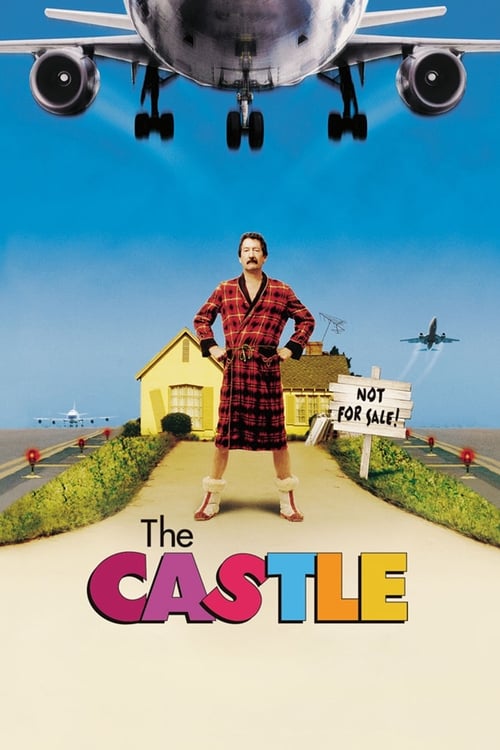
The Castle
1997 · Rob Sitch
For when you need a guaranteed laugh and a shot of faith in ordinary people — feel-good comfort viewing that goes down easy with a crowd. The kind of comedy you rewatch until you know the lines.
What it's about
The Kerrigans live in a proudly hand-built hodgepodge of a house right at the edge of Melbourne's airport runway, and patriarch Darryl thinks it's paradise. When the government moves to compulsorily acquire their land for an airport expansion, Darryl refuses the payout on principle — a man's home is his castle — and drags the fight all the way up the legal ladder with a hopeless suburban lawyer in tow. It's David versus Goliath, if David's slingshot were sheer stubborn decency.
The experience
Fast, endlessly quotable, and completely without meanness — the jokes come from how much the film loves this family, not from looking down on them. You'll laugh the whole way and be surprised how invested you get in a zoning dispute.
Performances
Michael Caton's Darryl Kerrigan is an Australian icon — boundless, unironic delight in his own life, played completely straight — and a young Eric Bana turns up in his film debut as the kickboxing son-in-law.
The craft
Shot in days on a shoestring by the TV comedy team Working Dog, and the speed shows as a virtue: the script is wall-to-wall with deadpan gems, and the tonal discipline — affection, never sneering — is what makes it work. Nothing fancy to look at, everything to listen to.
Why it matters
It became arguably the most quoted film in Australian cinema, its catchphrases lodging permanently in the national vocabulary, and turned a courtroom underdog farce into a folk parable about home and dignity.
Snapshot
The Castle is a modest, fast, affectionate Australian comedy that improbably became one of the most quoted films in the nation's cinema. Its story is small on paper — a working-class Melbourne family fights the compulsory acquisition of their home, which sits almost on the runway apron of Tullamarine Airport — but the film mines that scenario for something close to a folk parable about home, dignity, and the little person's stake in the machinery of the state. Made by the television collective Working Dog and directed by Rob Sitch, it wears its low budget and breakneck production as a kind of aesthetic honesty. Where a slicker film might have condescended to the Kerrigans, The Castle loves them without irony, and that tonal decision — comedy that never sneers at its subjects — is the source of both its warmth and its durability.
Industry & production
The film was produced by Working Dog Productions, the Melbourne company formed by Santo Cilauro, Tom Gleisner, Jane Kennedy, Rob Sitch and Michael Hirsh out of the earlier D-Generation and The Late Show comedy troupe. The Castle was the group's first feature, and it grew directly out of a television sensibility: quick shooting, ensemble writing, and a comic voice honed on sketch and satire (notably the newsroom send-up Frontline). The production is legendary for its speed and thrift — it is widely reported to have been shot in roughly two weeks on a very small budget (oft-cited figures put it under A$1 million; the precise accounting is not something to state with confidence here). What is certain is that the compressed schedule shaped the film at every level, from its unfussy coverage to its reliance on a tight ensemble who could hit comic rhythms in few takes.
Distribution in Australia came through Village Roadshow, and the film became a substantial domestic success, far outstripping expectations for so cheap a production. Internationally, it took a slower and more curious path: the film screened at the Sundance Film Festival (reported for the 1998 edition) and was picked up for the United States by Miramax. For the American release, portions of dialogue were re-recorded to soften or explain Australian idiom and references — a well-documented instance of the film's very localness being treated as a barrier to export. That episode is itself telling about the movie's identity: its comedy is so grounded in Australian vernacular and class texture that translation meant genuine alteration.
Technology
The Castle is a product of pragmatic, low-cost filmmaking technology rather than any technical showcase. Consistent with its budget and its makers' television background, it was shot on 16mm and finished for theatrical exhibition (reports describe a blow-up to 35mm); the exact format details are the kind of granular fact best left hedged rather than asserted. The point is that the film embraced a grainier, less pristine image than a studio comedy of the period, and did nothing to disguise it. There is no digital effects work of consequence, no elaborate optical trickery — the "technology" of the film is the technology of getting a good-looking, legible picture quickly and cheaply. That constraint is inseparable from the film's plainspoken texture.
Technique
Cinematography
The photography (credited to Miriana Marusic) is functional in the best sense: it serves character and joke rather than announcing itself. Much of the film favours a loose, observational framing — handheld or lightly mobile setups, unglamorous domestic interiors, and the family's cluttered, hand-improved house shot with a documentary plainness. The most quietly expressive images are the suburban-sublime ones the film treats with mock reverence: the Kerrigans surveying their backyard beneath the electricity pylons, or gazing out over Bonnie Doon, where the light and framing lend genuine, if gently comic, feeling to Darryl's contentment. The camera's refusal to prettify the Kerrigans' world is precisely what lets the film find beauty in it on the family's own terms.
Editing
Cut by Wayne Hyett, the film moves with a comic economy inherited from sketch television. Scenes are trimmed to their comic and emotional beats; the pacing is brisk, and the editing frequently works hand-in-glove with Dale's voiceover, cutting to illustrate the narration's deadpan literalism (Dale describing his father's enthusiasms while the images undercut or over-literalise them). The montage logic — a quick survey of the family's routines, meals and small triumphs — builds affection efficiently, so that by the time the legal threat arrives, the audience's investment in the house is already secured.
Mise-en-scène / staging
The production design is the film's secret weapon. The Kerrigan home is a dense archive of lower-middle-class Australian domesticity: the faux-Victorian ornaments, the "pool room" that enshrines trophies and gifts, the greyhound out back, the added-on rooms and the power lines overhead. Every surface characterizes. The staging clusters the family around the dinner table and the television, treating the household as a warm, noisy organism, and the running gags (Sal's cooking, Darryl's appraisal of every object as "what do you call it") are built into the set dressing as much as the script. The airport's looming proximity is staged as an absurd but affectionate fact of life rather than a horror — the family waves at the planes.
Sound
Sound design leans on the comic contrast between the family's cozy interior life and the roar of jet engines just beyond the fence — a joke and a thesis at once. Dale Kerrigan's first-person narration, delivered by Stephen Curry, is the film's defining aural device, framing the whole story as a loving, guileless recollection. The specifics of the musical score are among the less prominently documented crew credits, and rather than attribute it uncertainly, it's fair to say the music works mostly in a supporting, unobtrusive register; the soundtrack's memorable moments are less about scoring than about the film's use of dialogue and the ambient comedy of place.
Performance
Performance is where The Castle lives. Michael Caton's Darryl Kerrigan is the anchor — a man of relentless, uncynical enthusiasm whose pride in his home and family reads as neither stupidity nor saintliness but a coherent, dignified worldview. Anne Tenney's Sal grounds him with quiet warmth. The ensemble — Stephen Curry as narrator-son Dale, Anthony Simcoe as Steve, Sophie Lee as Tracey, Wayne Hope as the jailed Wayne — plays with a consistency of tone that keeps the family believable rather than cartoonish. Tiriel Mora's Dennis Denuto, the out-of-his-depth solicitor floundering through constitutional law, is a comic gem, and the film's late arrival of Charles "Bud" Tingwell as retired QC Lawrence Hammill supplies gravitas and an emotional turn. The film also carries Eric Bana in an early screen role (as Con Petropoulos), a footnote that later reading of his career has enlarged.
Narrative & dramatic mode
The film's mode is comic realism edged toward fable. Structurally it is a classic underdog legal drama — the David-and-Goliath fight against compulsory acquisition — but it is narrated as fond family memoir, which softens the genre machinery and keeps the emotional register domestic. The escalation is orderly: a happy status quo, the threat (the acquisition notice), a doomed local legal fight led by the hapless Denuto, defeat, and finally an appeal to the High Court where the constitutional principle of acquisition on "just terms" becomes the lever of victory. The film gets real comic and thematic mileage from Denuto's inability to articulate the law — his flailing appeal to "the vibe of the thing" is both a joke about legal amateurism and a sincere gesture toward a justice that ordinary people feel but cannot cite. The dramatic stakes stay human-scaled throughout; the film cares less about jurisprudence than about whether Darryl gets to keep his home.
Genre & cycle
The Castle belongs to the "Aussie battler" comedy — stories that celebrate the ordinary, working-class Australian standing up to power — and more broadly to the courtroom/underdog comedy. Within its national context it sits in the mid-1990s cycle of low-budget, character-driven Australian comedies that traveled internationally, and it can be read alongside the era's "quirky" Australian films even though its sensibility is warmer and more suburban than surreal. It is also a family comedy in the oldest sense: the household, not the individual, is the protagonist.
Authorship & method
The film is authored collectively as much as by any single hand. Rob Sitch directs, but the writing is credited to the full Working Dog quartet — Santo Cilauro, Tom Gleisner, Jane Kennedy and Rob Sitch — and the film bears the marks of their shared method: ensemble-generated comedy, an ear for Australian speech, and a satirical instinct disciplined into affection. The key collaborators include cinematographer Miriana Marusic and editor Wayne Hyett, whose television-honed efficiency suited the compressed shoot. The producing credit sits within the Working Dog structure (Debra Choate is credited as producer). The composer and some other department heads are less prominently recorded in the general historical account, and it is more honest to note that than to over-specify. The through-line of the method is speed married to warmth: a film written and shot fast, but never carelessly, by people who genuinely liked their characters.
Movement / national cinema
This is a landmark of 1990s Australian cinema and one of its most beloved comedies. It draws on a long domestic tradition of the larrikin and the "little Aussie battler," translating those cultural archetypes into a suburban idiom of home ownership and family. It arrived during a fertile stretch for Australian film abroad — the wake of Strictly Ballroom (1992), Muriel's Wedding (1994) and The Adventures of Priscilla, Queen of the Desert (1994) — a period when small, character-forward Australian pictures found international audiences. Yet The Castle is arguably the most inward-looking of these: where some of its contemporaries stylized or exoticized Australian life, this film simply documented it with love, which is part of why its export required literal re-dubbing.
Era / period
Made and set in the mid-1990s, the film captures a specific moment of Australian suburban life and a specific anxiety: the vulnerability of the "Great Australian Dream" of home ownership to infrastructure, development and corporate-government power. The Tullamarine expansion premise taps a real category of grievance — compulsory acquisition — and the film's constitutional resolution engages, in comic-populist form, the "just terms" guarantee of the Australian Constitution. Its period texture (the objects, the vernacular, the class markers) is so precisely rendered that the film now functions partly as a fond time capsule.
Themes
At its center is home — not property as investment but home as the accumulated meaning of a family's life, which is why "It's not a house, it's a home" carries the film's moral weight. Around that cluster its other themes: family solidarity and unglamorous love; class and dignity, with the film insisting the Kerrigans' taste and pride are worthy of respect rather than mockery; David-versus-Goliath justice, and the gap between the law as ordinary people feel it ("the vibe") and the law as it is technically argued; and a gentle nationalism of the everyday, locating Australian identity in serenity, mateship and a backyard under the flight path. Contentment itself is a theme — Darryl's capacity to find "serenity" wherever he is stands as the film's quiet ideal.
Reception, canon & influence
Domestically, The Castle was an outsized success and quickly passed into the culture: its lines — "Tell him he's dreamin'," "How's the serenity," "This is going straight to the pool room," "It's the vibe of the thing" — became durable Australian idioms, a rare case of a film feeding directly back into national vernacular. Over the years it has been repeatedly ranked among the best-loved Australian films in popular polls, and its standing as a comfort-classic has only grown. Internationally its reception was warmer among critics and cult audiences than at the mainstream box office, and the Miramax re-dubbing for the US market became a much-cited anecdote about the limits of translating hyper-local comedy.
Looking backward, the film's influences are less a matter of specific cited models than of tradition: the Australian battler comedy, the populist courtroom underdog story, and the ensemble sketch sensibility Working Dog brought from television. Looking forward, its legacy is substantial for its size. It confirmed Working Dog as a feature-film force, paving the way for their subsequent, similarly affectionate The Dish (2000). It stands as an early screen appearance for Eric Bana ahead of a major career. And more diffusely, it became a touchstone for a certain kind of warm, unpretentious Australian comedy — proof that a film made fast and cheap, with no ambition beyond loving its characters truly, could outlast far grander productions in the national memory.
Reception
An instant hit in Australia in 1997, it barely registered overseas — but at home it's only grown, graduating from beloved comedy to something closer to national scripture, routinely voted the most quotable Australian film ever made.
How The Castle was received, from release to now →
How to watch The Castle: what to notice on a first viewing
- Watch the camera stay loose and handheld inside the Kerrigan house. Marusic shoots the family's cluttered home with an observational, documentary plainness rather than glossy composition, never prettifying the space. The unpolished look lets the film find real affection in the house instead of asking you to laugh at it.
- Notice every object crammed into the family's pool room. Trophies, ornaments, and keepsakes fill the room the Kerrigans treat as sacred, and the production design turns clutter into a record of what the family values. You learn more about this family from their shelves than from most of the dialogue.
- Listen for jet engines roaring over the family's quiet moments. The airport's noise keeps intruding on ordinary domestic scenes, and the family simply waves at the planes instead of reacting to the intrusion. The joke and the argument arrive together: this absurd proximity is presented as just another fact of their happy life.
- Listen to Dale narrate his father's habits over shots that undercut them. The editing cuts to images that deadpan-literalize or gently contradict Dale's guileless voiceover, letting the visual joke sit right alongside the loving narration. You get two things at once, the family's own fond version of themselves and the funnier reality just visible under it.
- Watch Darryl's face every time he appraises a new object. Caton plays Darryl's relentless enthusiasm completely straight, never winking at the audience, so his pride reads as sincere rather than as a joke on him. The film never lets you laugh at him without also being asked to believe he is genuinely, quietly happy.
The whole guide to watching The Castle, with the keys for a rewatch →
Influences: the films it descends from and the films it influenced
- Passport to Pimlico (1949) — Supplies the Ealing engine of a tight-knit ordinary neighborhood physically digging in against the state and developers over its own patch of turf, resolved by a whimsical legal/constitutional vindication of the little community — the exact plot machine and affectionate communal-ensemble register The Castle runs on.
- Mr. Smith Goes to Washington (1939) — Models the Capra device of a guileless everyman making an unschooled, heartfelt appeal before the nation's highest institution, where naked sincerity is staged to trump legal sophistication — the template for the High Court climax in which 'the vibe' beats black-letter law.
- To Kill a Mockingbird (1962) — Establishes the courtroom-underdog set-piece of a plain-spoken decent-man advocate delivering a closing that appeals to fundamental fairness over technicality — the earnest legal-idealism beat The Castle first parodies (hapless Farouk) then redeems (Lawrence Hammill).
- The Adventures of Barry McKenzie (1972) — Foundational ocker comedy that mines broad gags directly from working-class Australian vernacular, establishing the affectionate-crude idiom and quotable-speech instinct Working Dog later disciplines into character.
- They're a Weird Mob (1966) — Earlier Australian suburban comedy built on delighting in local idiom and backyard/barbecue domestic texture, ancestor of The Castle's 'suburban sublime' — the observational eye that finds warmth in daggy household detail.
- A Christmas Story (1983) — Provides the nostalgic adult-narrator memoir voiceover that lovingly ironises a lower-middle-class family's domestic mythology, the direct model for Dale Kerrigan's deadpan, illustrative narration cut over household minutiae.
- Frontline (1994) — The same quartet's TV method incubator: ensemble-generated, improv-tightened satire disciplined into affectionate character and razor-accurate Australian speech — the authorship engine, honed for television speed, that The Castle transfers to features.
- The Dish (2000) — Direct descendant — Working Dog applying the identical speed-married-to-warmth method to another true-blue small-community-vs-big-institution tale, retaining the illustrative voiceover, ensemble affection and comic economy of The Castle.
- Kenny (2006) — Descendant that dignifies an unglamorous trade through deadpan observational comedy and first-person voiceover, ennobling a working-class battler exactly as The Castle ennobles the Kerrigans' household.
- Red Dog (2011) — Descendant trading unabashedly on national self-affection: a warm populist Australian community comedy-drama built, like The Castle, from vernacular and communal loyalty aimed straight at a home audience's shared memory.
- Utopia (2014) — The quartet's later bureaucracy satire extending the same ensemble-generated method and eye for institutional absurdity that The Castle first aimed at council, planning and compulsory-acquisition officialdom.
- Strictly Ballroom (1992) — Sibling in the suburban-Australian underdog fable: structures a daggy domestic milieu as a heightened crowd-pleasing fairy tale, the same comic-realism-as-fable register that lets The Castle play cartoonish yet tender.
- Muriel's Wedding (1994) — Contemporaneous portrait of Australian suburban family life mined simultaneously for cringe and warmth, sharing The Castle's satirical-yet-tender balance and its ear for vernacular household ritual.
- The Full Monty (1997) — Transnational sibling released the same year: a working-class ensemble underdog comedy that wrings dignity and heart from economic precarity in the identical affectionate-realist register, made fast and cheap around love of its characters.
- Little Miss Sunshine (2006) — Sibling in the loving-dysfunctional-family-vs-the-world comedy, where family solidarity is the emotional payload delivered through comic realism rather than sentiment — the 'we look after our own' core of The Castle.
Similar films
- Muriel's Wedding (1994) — influence & lineage
- The Full Monty (1997) — influence & lineage
- To Kill a Mockingbird (1962) — influence & lineage
- Little Miss Sunshine (2006) — influence & lineage
- Mr. Smith Goes to Washington (1939) — influence & lineage
- Rabbit-Proof Fence (2002) — shared sensibility
- The Big Lebowski (1998) — shared sensibility
- The Princess Bride (1987) — shared sensibility