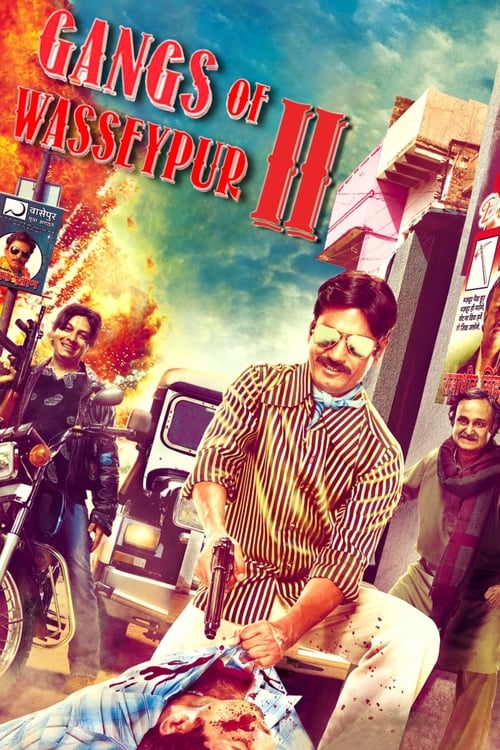
Gangs of Wasseypur - Part 2
2012 · Anurag Kashyap
For when you want to sink into a big, messy crime epic — a whole evening swallowed by one story — and you like your gangster movies with dark humor and real bite. It's a commitment, not a comfort watch, and it pays off best after Part 1.
What it's about
In the coal town of Wasseypur, a blood feud that has burned since the 1940s lands in the lap of Faizal Khan — the perpetually stoned son nobody expected to lead — after his father and brother are killed. He vows to wipe out the rival gang of politician Ramadhir Singh, and the vendetta tangles with coal mafia, scrap-iron rackets, and election-season politics. The wicked joke underneath: these gangsters grew up worshipping Bollywood heroes, and they model their swagger, romances, and shootouts on the movies.
The experience
Sprawling, violent, and unexpectedly hilarious — it swings from deadpan comedy to sudden brutality without warning, and the momentum barely lets up. You come out buzzing, half-thrilled and half-appalled at how much fun a revenge saga can be.
Performances
Nawazuddin Siddiqui, a bit player for a decade, seizes the role of Faizal and becomes a star before your eyes — sleepy-eyed and unreadable one minute, terrifying the next.
The craft
Anurag Kashyap directs with insurgent energy, packing decades of local history into a film that still moves like a thriller. Sneha Khanwalkar's soundtrack, stitched from field recordings and folk voices, is a character in itself — this one rewards good speakers as much as a big screen.
Why it matters
A landmark of Hindi cinema's independent wing that proved a crime epic could premiere at Cannes and still feel rooted in small-town India, and it launched Nawazuddin Siddiqui into stardom.
The back half of Anurag Kashyap's five-hour-plus revenge saga, split in two for release after its Directors' Fortnight premiere at Cannes: with the old generation gone, the chinsmoking, perpetually stoned Faizal Khan inherits a blood feud that has consumed the coal town of Wasseypur since the 1940s. Kashyap, the insurgent conscience of Hindi cinema's independent wing, uses the gangster epic to write a shadow history of India — coal mafia, iron scrap, electoral politics — but Part 2's masterstroke is cinephilia itself: these gangsters have grown up on Bollywood, model themselves on Bachchan and Khan, and die in ways the movies promised would be glorious. Nawazuddin Siddiqui, a decade-long bit player, seizes the role of Faizal and becomes a star in real time. Sneha Khanwalkar's soundtrack — recorded in the field, stitched from wedding bands, folk singers, and taunting street chants — is as essential as any performance. Western critics reached for Tarantino and The Godfather; the film's actual sources are pulpier and closer to home. Its most famous line is a warning about revenge; its lasting image is a hand refusing to let go of a gun.
Reception
Only a modest hit in Indian theaters in 2012, the two-part saga snowballed through DVD, torrents and streaming into consensus modern-classic status — by 2019 The Guardian was ranking Gangs of Wasseypur among the best films of the 21st century.
How Gangs of Wasseypur - Part 2 was received, from release to now →
Influences: the films it descends from and the films it influenced
- The Godfather Part II (1974) — Its interlocking multi-generational structure — a son inheriting and escalating his father's blood feud — is the architectural template Kashyap uses to carry the Khan-vs-Singh vendetta across three generations of Wasseypur.
- Once Upon a Time in America (1984) — Leone's operatic, decades-spanning gangster sprawl — where petty street crooks age into weary crime lords — models GoW's patient, elegiac view of the coal-belt underworld ripening over time.
- Sholay (1975) — The masala revenge-western grammar of the iconic dacoit villain, dusty-badlands widescreen, and vengeance-as-genre is directly quoted and subverted, with Definite's swagger a knowing riff on the Bollywood gunslinger.
- Deewaar (1975) — The 'angry young man' archetype of the working-class laborer radicalized into an outlaw by systemic injustice is the emotional DNA Kashyap inherits and mutates into Faizal's coal-mafia rise.
- Satya (1998) — Kashyap co-wrote this film's grimy, on-location Mumbai-underworld realism, and its refusal of star-glamour for grubby vernacular crime is the naturalist mode he brings back to Wasseypur.
- Company (2002) — Its handheld, procedural anatomy of a crime syndicate's business logic and internal succession disputes prefigures GoW's treatment of gangsterism as a family enterprise with org charts and turf economics.
- Pulp Fiction (1994) — The pop-culture-saturated dialogue, tonal whiplash between comedy and sudden brutal violence, and chapter-structured storytelling are the Tarantino devices Kashyap openly cites and threads through the film's cinephile texture.
- Goodfellas (1990) — Scorsese's needle-drop-driven rise-and-fall momentum, wall-to-wall period pop soundtrack, and matter-of-fact voice-of-the-milieu narration shape GoW's propulsive folk-music-scored ascent of Faizal.
- Gangs of New York (2002) — Its portrait of tribal turf warfare — rival clans feuding across generations over a contested piece of ground as the state looms in the background — is the historical-epic mode GoW localizes to Dhanbad's coalfields.
- Sonchiriya (2019) — Extends GoW's field-recorded, dialect-authentic badlands crime aesthetic into Chambal's dacoit country, prioritizing diegetic ambient sound and regional idiom over polished studio scoring.
- Udta Punjab (2016) — Carries forward Kashyap's model (he produced it) of the regionally-rooted, drug/crime-economy Hindi film grounded in a specific state's texture, slang, and folk-inflected soundtrack.
- Sacred Games (2018) — Kashyap directly transplants GoW's multi-generational gangster-saga structure and Nawazuddin-anchored underworld realism into long-form, expanding the split-release sprawl into episodic seasons.
- Mirzapur (2018) — A near-wholesale inheritance of GoW's UP heartland-mafia template — dynastic crime succession, mahua-and-guns regional flavor, and profane vernacular menace over an illicit local resource trade.
- Paatal Lok (2020) — Extends the Kashyap-lineage of caste-and-politics-soaked pulp crime with field-authentic Hindi-belt milieu, grimy naturalist violence, and a cast of character actors over stars.
- City of God (2002) — Shares the kinetic, generation-spanning chronicle of a marginalized locale's crime ecosystem told through cycling protagonists, cast largely from non-stars for lived-in authenticity.
- Gomorrah (2008) — A parallel de-glamorized regional-crime realism — dialect-heavy, place-specific, embedding violence in the mundane economics of an illicit resource trade, as GoW does with coal.
- Raman Raghav 2.0 (2016) — Kashyap's own continuation of the grubby, sound-forward crime idiom built around a Nawazuddin Siddiqui performance of unnerving vernacular menace, the same actor-director engine that powers Faizal.
Similar films
- Sholay (1975) — influence & lineage
- Satya (1998) — influence & lineage
- Gangs of Wasseypur - Part 1 (2012) — often watched together
- Dhurandhar (2025) — shared sensibility
- Nameless Gangster (2012) — shared sensibility
- RRR (2022) — shared sensibility
- Tumbbad (2018) — shared sensibility
- Kill (2024) — shared sensibility