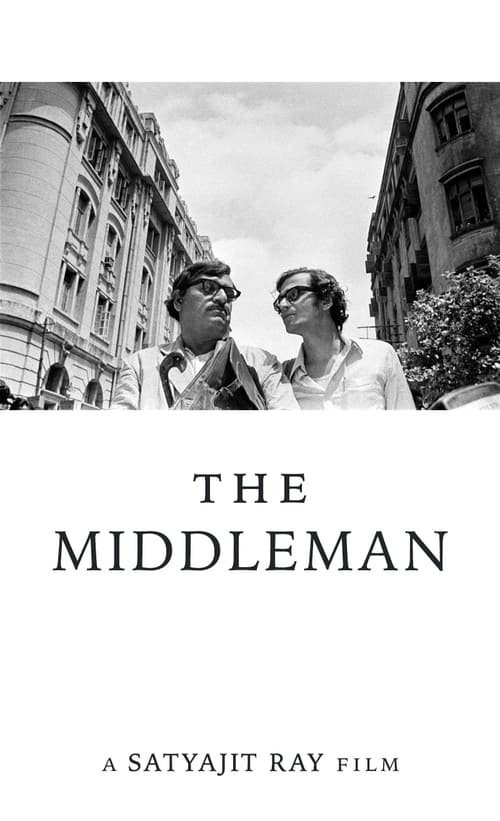
The Middleman
1976 · Satyajit Ray
For when you want a serious, clear-eyed film about work, compromise, and getting by — one that trusts you to sit with discomfort rather than resolve it. This is a challenge night, not a comfort watch, and it will follow you around afterward.
What it's about
A bright, bookish graduate in 1970s Calcutta does everything right — studies hard, sits the interviews, waits his turn — and still can't find a job in a city drowning in applicants. So he becomes a middleman, an order-supply broker hustling deals in the informal economy, and learns one contract at a time exactly what that world asks of a decent person. It's the closing chapter of Satyajit Ray's trilogy about educated young men trying to stay honest in a city that has stopped rewarding honesty.
The experience
Quiet, dry, and increasingly airless — it plays like a comedy of small humiliations that slowly hardens into something bleak. The pressure builds not through drama but through accumulation, until you realize how far the ground has shifted under the hero's feet.
The craft
Ray directs with surgical restraint: no melodrama, no underlining, just precisely observed offices, street corners, and negotiations that let the moral temperature drop degree by degree. The writing is the star — every transaction is character study, and the film's coldness is a deliberate, controlled effect from a director famous for warmth.
Why it matters
The bleak final panel of Ray's Calcutta Trilogy, it marked how far the great humanist was willing to go in indicting his own city's corruption, and it stands as one of cinema's sharpest portraits of unemployment and moral erosion in 1970s India.
Snapshot
Jana Aranya — literally something closer to "the forest of humanity" or "the human jungle," rendered in English as The Middleman — is Satyajit Ray's coldest and most disillusioned feature, the closing panel of what critics call his Calcutta Trilogy. Following Pratidwandi (The Adversary, 1970) and Seemabaddha (Company Limited, 1971), it completes a triptych anatomizing the moral condition of educated young men in a Calcutta gripped by unemployment, corruption, and political exhaustion in the early 1970s. Its protagonist, Somnath, a decent and bookish graduate, cannot find salaried work in a saturated market and drifts into the informal economy as an order-supply broker — a dalal, a middleman — before discovering that survival in that world requires him to procure a call girl for a client to close a deal. The film's devastation lies in the ordinariness of the descent: Ray offers no melodrama, only the quiet accounting of a good man learning the going rate for his conscience. It is widely regarded as the bleakest work in Ray's body of cinema.
Industry & production
The Middleman was produced within the Bengali film industry centered on Calcutta, where Ray worked for essentially his entire career, financing and distributing modestly by comparison with the Bombay mainstream. It was adapted from a Bengali novel by Mani Shankar Mukherjee, who wrote under the single name Shankar — the same author whose work had supplied Ray with Seemabaddha. The choice to return to Shankar underlines the continuity of the trilogy's concern with the compromised interior of Bengali commercial and clerical life.
The production sits at a charged political moment. The film was made and released during the Emergency that Indira Gandhi's government declared in June 1975 and maintained into 1977, a period of press censorship and suspended civil liberties. While Ray's film is set in the recognizable disorder of the early-1970s city rather than being an overt allegory of the Emergency itself, its portrait of a society in which institutions have decayed and private conscience is for sale read pointedly against that backdrop, and many commentators have noted the resonance. As with most of Ray's films of the period, the production was compact by industrial standards, shot substantially on location in Calcutta, drawing its texture from the city's real streets, offices, tea-stalls, and cramped middle-class flats.
Technology
The film was shot on 35mm black-and-white stock, a choice worth pausing on: by 1976 color had become the commercial default across Indian cinema, and Ray himself had worked in color (as in Kanchenjungha and later films). The monochrome of the Calcutta Trilogy is therefore a deliberate aesthetic and moral register — austere, documentary, unsentimental — rather than a technical limitation. Like most Indian features of the era, the film would have been finished with post-synchronized dialogue (dubbing) rather than location sync sound, the standard practice of the industry at the time; this permitted the extensive use of busy real locations. The technological signature of the work is not innovation but restraint: available-light-leaning location cinematography, portable enough to catch the crush of the job-seeking city.
Technique
Cinematography
The photography is by Soumendu Roy, who had become Ray's principal cinematographer after the departure of Subrata Mitra and who shot the whole of the Calcutta Trilogy. The visual approach is markedly plainer than the lyrical, bounce-lit compositions of Ray's earlier work: hand-held immediacy in the street and interview sequences, a gray and even tonality, framings that press the protagonist against crowds and corridors. The camera observes rather than editorializes, holding on faces long enough for discomfort to accumulate. Calcutta itself is photographed as an environment of attrition — queues, waiting rooms, staircases, the anonymity of the crowd — so that the city becomes an active antagonist rather than a backdrop.
Editing
Editing is by Dulal Dutta, Ray's lifelong collaborator who cut virtually all of his films. The cutting is unhurried and classical, built to let scenes play out to their full, often humiliating, length — the logic of a moralist who wants the audience to sit inside each compromise. The film's most discussed formal gesture is its ending, an abrupt and withholding close that denies the viewer any consoling resolution; the final beat lands on irony rather than catharsis, and the editing's refusal to soften or extend it is central to the film's power.
Mise-en-scène / staging
The staging is dense with the specific furniture of Bengali middle-class and petty-commercial life: the family flat where an unemployed son is a daily reproach, the broker's chaotic little office, the anterooms of men who can grant or withhold favors. Ray, who designed his own films meticulously and drew storyboards for every shot, stages the drama through gradations of physical space that map social power — who sits and who stands, who waits and who is waited upon. (Ray's longtime art director Bansi Chandragupta had by this period relocated to Bombay; the trilogy's look reflects a leaner design economy suited to its locations, though specific department credits should be checked against the prints rather than asserted here.)
Sound
Ray composed his own scores from the early 1960s onward, and The Middleman is scored sparingly. Music is used less as emotional underlining than as punctuation; long stretches run on the ambient sound of the city and the flat, unmusical rhythm of transactional speech. The relative silence is expressive — the withdrawal of the romantic musical warmth that had suffused films like the Apu Trilogy is itself a statement about the world Somnath is entering.
Performance
The performances favor restraint and recognizability over star charisma. Pradip Mukherjee plays Somnath as a diffident, essentially passive young man whose decency curdles into complicity by increments; the achievement of the performance is that we never see a villain, only a person adapting. The surrounding ensemble — Somnath's aging father and elder brother in the family household, the worldlier operators who tutor him in the mechanics of brokering, the "public relations" fixer who introduces him to the darker services a middleman must offer — is played in a naturalistic key that keeps the film's satire grounded in ordinary human behavior. Where the historical record on individual supporting casting is thin, it is better named as such than embellished; the ensemble's collective effect, in any case, is a gallery of people who have already made the accommodations Somnath is only now being asked to make.
Narrative & dramatic mode
The film's dramatic mode is ironic realism sliding toward tragedy — or, more precisely, toward the anti-tragedy of a man who survives by losing exactly what made him worth following. The narrative is picaresque in structure: Somnath moves through a series of encounters, each a lesson in how the system actually works, from an opening examination sequence in which his degree is effectively decided by an examiner who cannot properly read the scripts, through the grinding futility of mass job interviews, into apprenticeship as a broker. The through-line is education-by-corruption. The climax turns on a moral test disguised as a business errand, and the resolution is deliberately curdled: the deal succeeds, the family is pleased, and the success is indistinguishable from defeat. Ray withholds the redemptive turn the classical realist plot seems to promise, and the withholding is the point.
Genre & cycle
Generically the film is social-realist drama with a strong satirical current, and it belongs to two overlapping cycles. First, it is the terminal entry in Ray's own Calcutta Trilogy, a self-contained cycle about young men and the city: the student radical adrift in Pratidwandi, the ambitious executive who sacrifices principle for promotion in Seemabaddha, and now the graduate who becomes a broker of goods and, finally, of flesh. Read as a set, the three trace a darkening arc from private frustration to systemic complicity. Second, the film participates in the broader "angry Calcutta" cinema of the 1970s, the wave of politically charged filmmaking that responded to the Naxalite upheaval, mass unemployment, and urban despair — a milieu in which Ray's contemporary Mrinal Sen was working the same civic wound from a more overtly militant angle. Ray's contribution to the cycle is characteristically cooler and more diagnostic than agitational.
Authorship & method
This is a Ray film in the fullest auteur sense: he wrote the screenplay adapting Shankar's novel, composed the music, designed the shots, and directed. His method — total pre-visualization through storyboards and script, a repertory of trusted craftspeople, and a humane but unsparing moral attention — is fully present. The key collaborators are the ones who recur across his mature career: cinematographer Soumendu Roy, whose gray documentary realism defines the trilogy's surface; editor Dulal Dutta, whose classical cutting gives the film its patient, accumulating pressure; and Ray himself as composer, deploying music with deliberate scarcity. The literary source in Shankar matters to the authorship too — as with Seemabaddha, Ray is working from an insider's fiction of Bengali commercial life, and much of the film's specificity about the etiquette of favors and orders derives from that grounding. What Ray brings to the material is the tragic framing: the transformation of a satirical business novel into a parable of conscience.
Movement / national cinema
The Middleman belongs to Indian art cinema and, within it, to the Bengali tradition that Ray had done more than anyone to define internationally since Pather Panchali (1955). By the mid-1970s that tradition sat alongside the broader New Indian Cinema (or Parallel Cinema) movement — the state-supported, socially engaged alternative to the commercial mainstream — even though Ray predated and stood somewhat apart from it as its towering forebear. The film is also inseparable from the specific culture of Calcutta: its Bengali-language texture, its literary derivation, and its engagement with the city's particular crisis of educated unemployment mark it as national cinema in the most local sense, a portrait a Calcutta audience would recognize street by street.
Era / period
The film is a document of its exact moment: Calcutta in the first half of the 1970s, a city convulsed by the Naxalite insurgency and its violent suppression, by chronic joblessness among the educated, by strikes and load-shedding and institutional rot, and — at the point of the film's making — by the national Emergency. Ray's earlier optimism about individual striving, so warm in the Apu films of the 1950s, has by this period given way to a structural pessimism: the individual is no longer the master of his fate but a function of a diseased system. The Calcutta Trilogy is best understood as Ray's reckoning with that historical rupture, and The Middleman is its final, hardest word.
Themes
The governing theme is the commodification of everything, including the self. Somnath's journey dramatizes how idealism is not so much crushed as gradually priced out: each accommodation is rational, survivable, even socially rewarded, until the sum of them is a man who can procure a woman to secure an order and call it business. Adjacent themes cluster around it — the failure of the education system to deliver on its promises (established in the opening examination farce); the corrosion of male friendship and family loyalty under economic pressure; the gendered brutality of a marketplace in which women become the ultimate transactional commodity; and the quiet complicity of the respectable middle class, whose approval of Somnath's "success" is the film's final indictment. Running beneath all of it is Ray's abiding subject: the moral texture of ordinary compromise, examined without cruelty but without mercy.
Reception, canon & influence
Critically, The Middleman has long been received as one of Ray's major late works and the grimmest thing he made — the film in which his famous humanism turns almost bleak, and precisely for that reason a favorite of critics who resist the image of Ray as a purely lyrical, consoling artist. It is routinely grouped with Pratidwandi and Seemabaddha as a trilogy that constitutes Ray's most direct engagement with contemporary politics, and it has featured in retrospectives and restorations of his work that have kept it in circulation for later generations. (Where specific honors, festival placements, or figures are concerned, the safest course is to consult the archival record directly rather than assert particulars; this account does not attribute awards or numbers it cannot verify.)
Looking backward, the film's influences are Ray's own literary-realist lineage and the immediate pressure of the Calcutta crisis: the adaptation of Shankar's fiction, the inheritance of the socially observant Bengali novel and of Ray's earlier city films, and the unignorable reality of the streets he was shooting on. Looking forward, its legacy is twofold. Within Ray's career it stands as the culmination of his political turn and a touchstone for readings of the "dark Ray." Within the larger history of Indian cinema it belongs to, and helped legitimize, a mode of unsentimental urban realism that treated the educated young man's disillusionment as a serious national subject — a preoccupation it shares with, and helped frame against, the more radical Calcutta films of Mrinal Sen and the wider Parallel Cinema movement. For audiences who know Ray chiefly through the pastoral tenderness of the Apu Trilogy, The Middleman remains the essential corrective: proof that the same sensibility, turned on the marketplace, could produce one of world cinema's most quietly damning portraits of a good man's surrender.
A Deleuzian reading
An examiner sits with a pile of answer scripts he cannot properly read, and marks them anyway.
The full Deleuzian reading of The Middleman →
Reception
Overshadowed abroad by Ray's lyrical early work when it came out, it's since been reappraised — the Calcutta trilogy capper now regularly gets called his bleakest and one of his sharpest, a portrait of 1970s urban hustle that feels more current every year.
How The Middleman was received, from release to now →
Influences: the films it descends from and the films it influenced
- Bicycle Thieves (1948) — Supplies the neorealist template Ray builds on — a single man's episodic walk through the working city, his moral defeat staged in real streets with documentary available light rather than studio artifice.
- Pather Panchali (1955) — Founds Ray's own method that The Middleman darkens: available-light location shooting and naturalistic under-playing (later carried by Soumendu Roy and Dulal Dutta), here turned from pastoral tenderness to gray urban bleakness.
- Mahanagar (1963) — Earlier Calcutta film that pioneers Ray's motif of moral erosion through paid work — the domestic figure pushed into the marketplace — using patient interior blocking to register small ethical concessions.
- Pratidwandi (1970) — Opens the Calcutta Trilogy with the disillusioned, unemployed graduate as protagonist and formal disruption — jump cuts, negative-image inserts, dream flashes — a restlessness The Middleman inherits and then flattens into resignation.
- Seemabaddha (1971) — The immediate sibling-source: another Shankar adaptation rendering the insider etiquette of Bengali commercial life, where advancement is bought by a calculated moral surrender staged in polite drawing-room exchange.
- Ankur (1974) — Extends Parallel Cinema's naturalistic-restraint performance and location realism into a study of feudal-economic complicity, carrying forward the sober, unmusical observation of a good conscience compromised.
- Manthan (1976) — Contemporary heir that dramatizes commerce and the etiquette of favors as systemic realism, using an ensemble of restrained performances and available-light village/office spaces rather than melodrama.
- Aakrosh (1980) — Carries the trilogy's institutional pessimism forward — a system that grinds down the individual — through withholding, near-silent performance and documentary-gray cinematography descended from Soumendu Roy's surface.
- Salaam Bombay! (1988) — Inherits the city-as-engine-of-survival realism: hand-held location shooting and the episodic, picaresque drift of a figure commodified by the marketplace, staged in unmanaged real streets.
- Satya (1998) — Transposes the etiquette of favors and moral surrender for advancement into an urban milieu, using restless handheld location realism to trace an ordinary man's incremental accommodation to a corrupt economy.
- Court (2014) — Purest contemporary heir to Ray's method here: post-synchronized sound, sparse scoring, wide static social-space staging and a deliberately withheld, anticlimactic ending that indicts the system by refusing catharsis.
- The White Tiger (2021) — Reprises the picaresque of self-commodification and the servant's ironic rise through moral compromise, narrated with the same cold, complicit irony The Middleman applies to a good man's surrender.
- Bhuvan Shome (1969) — The film often credited with igniting Parallel Cinema — low-budget location realism, non-professional textures and ironic voice-over — establishing the unsentimental idiom The Middleman works within.
- Interview (1971) — Sen's self-reflexive Calcutta-unemployment film, breaking the fourth wall and using street-caught documentary footage; the radical counter-method Ray's more classical trilogy is measured against.
- Calcutta 71 (1972) — The overtly agitational Calcutta film — montage, direct address, historical collage — that frames Ray's quieter irony by contrast, both mapping the same Emergency-era city of educated despair.
- Meghe Dhaka Tara (1960) — Bengali social-realist counterpart handling the same economy of familial sacrifice, but through expressionist sound design and melodramatic staging — the alternative craft-answer to Ray's cool restraint.
Similar films
- Pather Panchali (1955) — influence & lineage
- Salaam Bombay! (1988) — influence & lineage
- Satya (1998) — influence & lineage
- The Big City (1963) — shared sensibility
- The World of Apu (1959) — shared sensibility
- Aparajito (1956) — shared sensibility
- The Music Room (1958) — shared sensibility
- Charulata (1964) — shared sensibility