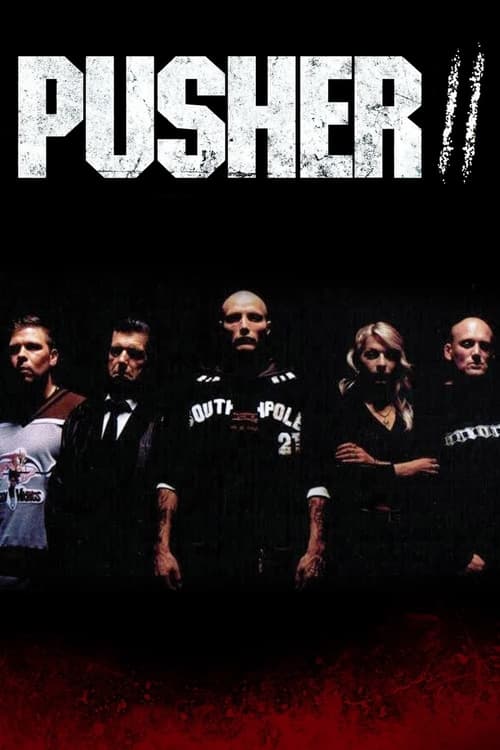
Pusher II
2004 · Nicolas Winding Refn
For when you want something raw and unvarnished — a night you're up for being gutted a little by a character study, not comforted. Definitely a challenge watch, and better for it.
What it's about
Tonny walks out of a Copenhagen prison with 'RESPECT' tattooed on his skull and a plan to finally straighten out his life — which means working for his father, a cold-blooded crime boss who has never once respected him. Between old debts, a baby he may have fathered, and a milieu of dealers and thieves that keeps pulling him back, going straight turns out to be the hardest job in the city.
The experience
Grimy, tense, and unexpectedly heartbreaking — a crime film that trades thrills for the slow ache of watching a man everyone has written off try to matter to someone. It's harsh viewing, but there's a bruised tenderness under all the squalor that sneaks up on you.
Performances
Mads Mikkelsen is astonishing as Tonny, playing a dim, desperate hanger-on with such physical vulnerability that a character who could have been a punchline becomes devastating — it's one of the defining performances of modern Danish cinema.
The craft
Refn shoots Copenhagen's underworld handheld and close, all sickly interiors and jittery energy, letting scenes breathe until the humiliation becomes almost unbearable. The writing is ruthlessly economical: a deceptively small story of debts and family that accumulates crushing weight.
Why it matters
Widely considered the strongest panel of Refn's Copenhagen crime trilogy, it announced Mikkelsen as a major actor and sharpened the themes of masculinity and paternal legacy that run through the rest of Refn's career.
Snapshot
Pusher II — released in Denmark under the fuller title Pusher II: With Blood on My Hands — is the middle panel of Nicolas Winding Refn's Copenhagen crime triptych, and for many critics its strongest. Where the 1996 original followed a mid-level dealer's week-long spiral, this sequel pivots to a peripheral figure from that first film: Tonny, the tattooed hanger-on whose skull was caved in with a baseball bat by his friend Frank. Refn resurrects him as the protagonist, casting Mads Mikkelsen in a role that would become one of the defining performances of Danish cinema's post-Dogme generation. The premise is deceptively small — an ex-convict tries to go straight and fails — but Refn uses it to excavate a theme he would return to across his career: the crushing weight of paternal legacy and the male hunger for respect. The film is grimy, handheld, and emotionally raw, and it emerged from a very particular crisis in its director's life, which shaped both its economics and its urgency.
Industry & production
The essential context for Pusher II is financial catastrophe. Refn's English-language third feature, Fear X (2003), starring John Turturro, was an artistic gamble that failed commercially and left the director's production company in severe debt; Refn has spoken openly about facing bankruptcy. He returned to the Pusher property — the franchise that had launched him as a wunderkind in the mid-1990s — explicitly to work his way out of that hole, shooting Pusher II and Pusher III in relatively quick succession in 2004–2005. This origin story is unusually well-documented because Phie Ambo's documentary Gambler (2005) followed Refn through precisely this period, capturing the financial desperation that underwrote the sequels' creation. The result is a film made under pressure, on modest Danish budgets, with the lean speed that such conditions impose.
Production remained rooted in Copenhagen's Vesterbro milieu and the local ecosystem of Danish film financing and crews that had sustained the original. I don't have reliable box-office figures to cite for the Danish theatrical run, so I won't invent them; what is clear from the historical record is that the sequels succeeded in their dual purpose — restoring Refn's finances and, critically, his reputation. The Pusher films were low-budget by international standards but punched far above their weight, and Pusher II in particular traveled the festival and arthouse circuit as evidence that Refn was a major talent rather than a one-hit provocateur.
Technology
Pusher II belongs to the tail end of the photochemical era of Danish independent cinema, before digital acquisition became the default. The trilogy's aesthetic is bound up with grainy, available-light, handheld shooting consistent with a Super 16mm workflow, though I'd flag that I can't confirm the precise gauge and stock with certainty. What matters technically is the deliberate embrace of texture and imperfection: the image carries visible grain, the camera breathes and hunts with the actors, and the lighting favours the sodium-and-fluorescent ugliness of real Copenhagen interiors — chop shops, flats, strip clubs — over any polished studio look. This is a film that uses the "limitations" of low-cost, naturalistic capture as an expressive resource rather than something to be concealed. The color and finishing are muted and unglamorous, a world away from the saturated neon Refn would later become famous for in Drive and Only God Forgives.
Technique
Cinematography
The camera is the film's nervous system. Working in a mobile, observational register — associated in the trilogy with cinematographer Morten Søborg, a frequent Refn collaborator, though I'd note attribution details should be checked against the credits — the photography keeps close to Tonny's body and face, favouring restless handheld framing over composed stillness. The effect is a kind of docudrama intimacy inherited from the American independent tradition: we are pinned to the protagonist's shoulder as he moves through a world that is always slightly out of his control. Long-lens and tight-lens proximity alternate to trap Tonny in cramped, unforgiving spaces. There is little of the formalist symmetry of Refn's later work; the visual grammar here is about immediacy, sweat, and duration.
Editing
The cutting favours the scene played out in real emotional time over montage compression. Refn lets confrontations run until they curdle — humiliations at his father's garage, a botched drug deal, a chaotic christening — so that the editing rhythm mirrors Tonny's inability to escape situations gracefully. Anne Østerud is associated with the editing of the later trilogy films (a detail worth verifying against the credits). The overall structure is episodic and behavioral rather than tightly plotted: a chain of encounters accreting toward a breaking point, with the pace tightening in the final act as consequences converge.
Mise-en-scène / staging
Refn stages Pusher II in a densely specific criminal underworld — the car-theft and chop-shop economy, the drug trade, the strip-club demimonde of Vesterbro. Production design leans on authenticity: worn leather, cheap gold, tracksuits, the tattoo culture of the milieu (Tonny's "RESPECT" neck tattoo is the film's central visual irony, a demand for something he is never granted). Blocking repeatedly places Tonny at the physical and social margin of the frame — hovering at the edge of his father's world, literally and figuratively unable to find a place at the table. The environments do characterization work the dialogue leaves implicit.
Sound
The soundscape is grounded and diegetic-heavy — the din of workshops, clubs, and crowded rooms — punctuated by a score that, in the trilogy tradition, uses electronic and rhythmic textures to lend the street material a pulse. The precise composer credit for Pusher II is something I'd want to confirm rather than assert, given that several composers worked across the trilogy; I won't guess at an attribution. What is audible and undeniable is the way sound design amplifies claustrophobia and volatility, keeping the viewer in a state of low-grade dread.
Performance
This is, above all, an actor's film, and Mads Mikkelsen's Tonny is its reason for being. Mikkelsen plays a man of limited intelligence and limitless need, and he finds enormous pathos in Tonny's incompetence — the pratfalls of a person who fails at crime as thoroughly as he fails at love and fatherhood. The performance is physical and inarticulate, built from wounded eyes, blurted apologies, and sudden violence, and it refuses to sentimentalize its subject even as it earns sympathy. The surrounding ensemble — Tonny's contemptuous crime-boss father (played by Leif Sylvester), the mother of his child, the low-life associates of his orbit — supplies a chorus of rejection against which Mikkelsen's yearning registers all the more sharply.
Narrative & dramatic mode
The dramatic mode is naturalist tragedy in a minor, almost pathetic key. Pusher II is not a heist plot or a rise-and-fall gangster arc; it is a character study of a man trying and failing to change. Tonny leaves prison determined to reform, seeks his father's approval and a role in the family car business, discovers he has fathered an infant son, and is met at every turn with humiliation and dismissal. The structure is a downward slalom of small disasters. Crucially, Refn withholds the redemptive machinery genre would ordinarily supply: there is no clever score to settle, no honor among thieves that will save Tonny. The film's power lies in its refusal of easy uplift — and in the ambiguous, quietly startling gesture of its ending, in which Tonny's failure as a son opens onto the terrifying possibility of his becoming a father himself.
Genre & cycle
Pusher II sits inside the crime-milieu drama, closer to the social-realist gangster tradition of Mean Streets than to the operatic mob epic. As the second entry in the Pusher cycle, it participates in a serial world-building project: recurring characters, a shared Vesterbro geography, and a consistent moral universe where the drug economy is less a source of glamour than a machine for grinding down the people caught in it. The trilogy as a whole is one of the signal achievements of Danish genre cinema, taking American gangster iconography and stripping it of romance until only the desperation remains.
Authorship & method
Pusher II is a Refn film in the fullest auteurist sense: he wrote and directed it, and it is stamped with his recurring obsessions — masculine violence, the terror of paternal judgment, the ritual language of respect and shame. Refn's method here is confrontational and behavioral, giving actors room to inhabit uncomfortable emotional states at length. The collaboration with Mikkelsen is the beating heart of the project; the two had worked together on the original Pusher, and the sequel expands a bit part into a full portrait. On the craft side, Refn worked with the Danish technical collaborators associated with the trilogy — cinematography in the mobile, naturalist mode noted above, editing that privileges duration, and a percussive, electronic-inflected score — though, as flagged, I'd recommend verifying the exact per-film credits against the film itself. What is not in doubt is that Pusher II was, for Refn, both a commercial rescue operation and a genuine artistic recommitment, and the tension between those two motives gives the film its raw honesty.
Movement / national cinema
The film is a product of the extraordinary flowering of Danish cinema in the 1990s and 2000s. Refn emerged alongside — but pointedly outside — the Dogme 95 movement of Lars von Trier and Thomas Vinterberg; the Pusher films are not Dogme-certified, and Refn cultivated a genre sensibility distinct from Dogme's austere rules. Yet he shares with that generation a taste for handheld immediacy, unglamorous realism, and morally uncompromising storytelling, and he benefited from the same robust Danish public-film infrastructure and the international attention it drew. Pusher II thus belongs to a national cinema that had, by the mid-2000s, become one of the most vital in Europe — and it helped establish Mikkelsen, soon to become Denmark's foremost cinematic export.
Era / period
Made in 2004, the film captures a specific moment: Refn at his most economically precarious, Danish cinema at a creative peak, and Mads Mikkelsen on the cusp of international stardom (his career-altering turn as Le Chiffre in Casino Royale would follow in 2006). The period texture is pre-gentrification Vesterbro, a working-class and criminal Copenhagen that the film documents with anthropological specificity. It is also a hinge point in Refn's own development — the last phase before Bronson (2008) and Drive (2011) would carry his stylized violence to an international audience.
Themes
The dominant theme is fatherhood as inheritance and as curse. Tonny craves his own father's love and is denied it; simultaneously he is confronted with a son of his own and the question of whether he can break the cycle of paternal failure. Around this core cluster related concerns: masculinity as a performance of dominance the protagonist cannot pull off; "respect" as a hollow idol (literalised in the neck tattoo); the impossibility of escaping one's environment and class; and shame as the film's true governing emotion. Refn treats the criminal underworld not as an aspiration but as a trap, and Tonny's tragedy is that his decency — such as it is — has no currency there. The final image, in which parental instinct flickers to life amid ruin, reframes the entire film as a question about whether love can be learned by someone who was never shown it.
Reception, canon & influence
Critically, Pusher II was widely and enthusiastically received, frequently singled out as the finest of the three films, with Mikkelsen's performance drawing particular acclaim; his Tonny is often cited among his greatest roles. He was recognized on the Danish awards circuit for the part — I'd point readers to the specific Bodil and Robert award records for the exact citations rather than rely on my memory of which trophy went where. The trilogy as a whole became a cornerstone of contemporary Danish crime cinema and a fixture of arthouse and cult film culture internationally.
Looking backward, the film's influences are unmistakably the American independent and gangster tradition — Martin Scorsese's Mean Streets above all, with its blend of Catholic guilt, street-level violence, and doomed loyalty, alongside the raw behavioral realism of John Cassavetes. Refn transposes that sensibility to Copenhagen and darkens it further.
Looking forward, Pusher II mattered enormously to what came next. It rehabilitated Refn commercially and creatively, clearing the runway for Bronson, Valhalla Rising, and the international breakthrough of Drive. It was pivotal in establishing Mads Mikkelsen as a leading man of global stature. And the Pusher brand itself proved durable enough to spawn remakes, including a 2012 English-language British version (which Refn produced), a testament to the enduring pull of the world he built. More diffusely, the trilogy helped define a template for gritty European crime drama that privileges character and milieu over plot mechanics — an influence visible across subsequent Scandinavian genre film and television. Pusher II endures as the emotional peak of that project: the moment Refn proved his lurid subject matter could carry genuine tragic weight.
A Deleuzian reading
The word is on the back of his neck.
The full Deleuzian reading of Pusher II →
Reception
Barely seen outside Denmark on release, it got a second life once Drive (2011) made Refn a name and Mads Mikkelsen became a star — cinephiles worked backwards and found what many now call the peak of the Pusher trilogy.
How Pusher II was received, from release to now →
How to watch Pusher II: what to notice on a first viewing
- Watch how close the camera stays to Tonny's body. Refn shoots in a mobile, handheld register that hunts and breathes at Tonny's shoulder, rarely pulling back to a composed, stable distance. The camera's closeness keeps you pinned to a man who can't get any distance from his own life.
- Watch for the word tattooed on the back of Tonny's neck. Tonny carries RESPECT in block capitals where he can never see it himself, though everyone standing behind him can read it instantly. He's demanding something with his own body that he has no way of checking for himself.
- Notice where Tonny stands in his father's garage. Blocking keeps placing Tonny at the physical edge of rooms, hovering near his father's world without ever being let fully inside it. The framing keeps telling you he doesn't belong here before anyone says so out loud.
- Notice how long Refn holds on an awkward confrontation. Scenes at the garage, at a deal, at a christening are allowed to run past the point of comfort, curdling instead of cutting away. The discomfort you feel watching is the point: the film refuses you an easy exit too.
- Listen to the workshop and club noise crowd out the dialogue. The soundscape stays grounded in the din of chop shops, clubs, and crowded rooms rather than a scoring voice telling you how to feel. The noise of the world presses in on Tonny the same way it presses in on you.
The whole guide to watching Pusher II, with the keys for a rewatch →
Influences: the films it descends from and the films it influenced
- Mean Streets (1973) — The template Refn openly copies: a roving handheld camera trailing small-time hoods through a single parish-like neighborhood, with plot subordinated to milieu, ritual displays of respect, and the tightening noose of unpayable debt.
- The Killing of a Chinese Bookie (1976) — Source of the behavioral method—holding an actor inside a decompensating criminal's discomfort for uncut minutes, letting the debt-and-obligation plot emerge from performance texture rather than from beats.
- A Woman Under the Influence (1974) — Model for real-time emotional duration: scenes that refuse to cut away from a character's shame and social failure until it becomes unbearable, the exact clock Refn runs on Tonny.
- Festen (1998) — Established the Danish Dogme grammar Pusher II inherits—Super-16 handheld shot in available light with diegetic sound, staging family judgment and humiliation with an intrusive, roving observational camera.
- Breaking the Waves (1996) — Legitimized the restless, off-balance handheld frame and desaturated naturalism as a serious tragic register in Danish cinema, the post-Dogme visual license Refn operates under.
- Nil by Mouth (1997) — Kindred handheld social-realist crime portrait built on cyclical paternal violence and inarticulate working-class masculinity, prioritizing behavioral truth and profane vernacular over narrative machinery.
- Naked (1993) — Precedent for improvisation-rooted, single-protagonist drift through an urban underworld, where extended verbal riffing and volatile masculine cruelty carry the film in place of plot.
- Pusher (1996) — The direct parent film: same Vesterbro underworld, Super-16 handheld and real-time drug-deal dread, out of which Tonny's bit part is expanded into a full portrait for the sequel.
- Bronson (2008) — Descends via the same confrontational-behavioral direction of a violent male lead, but trades Pusher II's naturalism for theatrical stylization—the freedom Tonny's success bought Refn to abstract the masculine-spectacle portrait.
- Valhalla Rising (2009) — Recruits Pusher II's Mads Mikkelsen into a near-wordless study of masculine violence, pushing the diegetic-heavy sound design and slow-duration observation of a mute brute to a formal extreme.
- Drive (2011) — The international payoff of Pusher II's rehabilitation: same austere criminal-loyalty tragedy and pulsing electronic score, now fused to elevated genre style, character and mood privileged over plot.
- Pusher (2012) — Refn-produced English-language remake that transplants the trilogy's real-time deal-gone-wrong structure and neon-scored Vesterbro underworld wholesale to London, a direct franchise continuation of the world he built.
- La Haine (1995) — Contemporary European sibling using episodic, near-real-time day-in-the-life structure and marginal-milieu blocking to follow disposable young men whose masculine posturing curdles into inevitable violence.
- Adam's Apples (2005) — Same-moment Danish-peak film built around Mads Mikkelsen's confrontational, physically committed performance, drawn from the tight Copenhagen ensemble of actors and writers surrounding the Pusher films.
- R (2010) — Directly extends the Pusher method into the prison film—Super-16-style handheld, available light, non-professional-inflected casting and diegetic naturalism mapping a closed underworld's respect-and-debt economy.
- Northwest (2013) — Later Danish crime realism carrying forward the naturalist-tragedy arc of a young man rising through petty crime toward doom, shot observationally in real Copenhagen margins with milieu over mechanics.
Similar films
- Pusher (1996) — influence & lineage · same viewing thread
- Drive (2011) — influence & lineage · same viewing thread
- La Haine (1995) — influence & lineage
- Pusher 3 (2005) — same viewing thread
- Eastern Promises (2007) — same viewing thread
- The Departed (2006) — same viewing thread
- Taxi Driver (1976) — shared sensibility
- Revanche (2008) — shared sensibility
All the films related to Pusher II →
Watch it with: curated runs of related films
- Undercover and Underworld — A run of cops, criminals, and the moles planted between them — watch these back-to-back for how loyalty curdles into betrayal across one corrupt city after another, from the Boston docks to Hong Kong to Marseille-by-way-of-New-York.