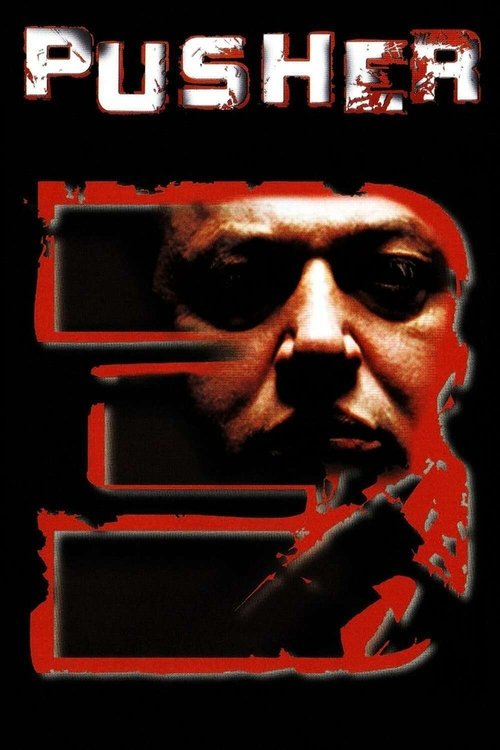
Pusher 3
2005 · Nicolas Winding Refn
For when you want crime stripped of all glamour — a hard, gripping watch for a night you're up for something bleak and unforgettable. Absolutely not comfort viewing.
What it's about
Milo, the aging Serbian drug lord of Copenhagen, is having the worst day of his life: he's cooking for his daughter's 25th-birthday party, white-knuckling his sobriety through Narcotics Anonymous meetings, and staring at a shipment of 10,000 ecstasy pills he was expecting to be heroin. As he improvises a way to offload product he doesn't understand to people he shouldn't trust, the day curdles, and his only lifeline is Radovan, the old friend and ex-enforcer he hasn't called in years.
The experience
A slow-tightening vice — it plays almost like dark domestic comedy for an hour, an old man juggling stews and pills, before descending into some of the most unflinching material in crime cinema. You feel the exhaustion in your bones, then the dread.
Performances
Zlatko Burić is extraordinary as Milo — shambling, charming, self-deluding, and finally terrifying, a performance built across three films that pays off entirely here.
The craft
Refn compresses the story into roughly one day and night, shooting with handheld, fly-on-the-wall realism that makes the criminal underworld feel like tedious, sweaty small business — which makes the violence, when it arrives, land with real weight. The banal detail work (recipes, party logistics, NA platitudes) is the film's secret engine.
Why it matters
It closed out the Copenhagen trilogy that made Refn's name and helped define a strain of grimy, de-glamorized European crime realism, setting up the stylistic leap of his later international career.
Snapshot
Pusher 3 — subtitled I'm the Angel of Death — is the final chapter of Nicolas Winding Refn's Copenhagen crime trilogy, which began with his 1996 debut and continued with Pusher II (2004). Where the first two films tracked low-level dealers scrambling upward, the third turns to the man who had loomed over the earlier films as a fixed point of authority: Milo, the Serbian heroin wholesaler, played across all three films by Zlatko Burić. The film compresses its action into roughly a single day and night. Milo is aging, ailing, and self-conscious about his sobriety; he attends a Narcotics Anonymous meeting, frets over cooking for his daughter Milena's 25th-birthday party, and discovers that an expected heroin shipment has arrived as thousands of ecstasy pills he has no market for. The improvised scramble to offload the pills, entangled with a trafficking transaction he wants no part of, drags him back into violence he thought he had aged out of, culminating in one of the most notorious body-disposal sequences in modern European crime cinema and a reunion with his old enforcer Radovan (Slavko Labović). It is a film about obsolescence — a boss discovering that the world he ruled has moved past him.
Industry & production
The production context of Pusher 3 is inseparable from Refn's own financial crisis, and this is one of the better-documented facts of the trilogy's history. After his 1996 debut made him a name in Danish cinema, Refn's English-language psychological thriller Fear X (2003), starring John Turturro, was a commercial failure that left the director and his production company in serious debt. Refn has spoken openly in interviews and in the documentary Gambler (2005, dir. Phie Ambo) about returning to the Pusher world specifically to work his way out of bankruptcy — making Pusher II and Pusher 3 in relatively quick succession as a survival measure. That candor colors any honest reading of the trilogy's back half: these are not films conceived from a master plan for a trilogy in 1996, but sequels generated nearly a decade later under economic pressure, which is part of what gives them their unsentimental, workmanlike intensity.
The films were made on modest Danish budgets with lean crews and Copenhagen locations, produced through Refn's own outfit (associated with the "NWR"/Refn production entities of the period). The trilogy's economy of means — real apartments, real streets in and around the Vesterbro district, small casts, handheld shooting — is both an aesthetic choice and a budgetary one. Precise budget and box-office figures for Pusher 3 are not something I can cite with confidence, and I will not invent them; the film's commercial profile was that of a specialty European release rather than a wide theatrical property.
Technology
Pusher 3 is a product of mid-2000s independent filmmaking, and its technical means are deliberately humble. The trilogy's signature look — grainy, handheld, available-light — is native to the low-budget European production of its moment. I am not able to state with certainty whether Pusher 3 was originated on film or digital, or the exact camera package used, and I will not guess; what is stylistically evident on screen is a preference for naturalistic light sources, high tolerance for grain and low-light noise, and mobile, shoulder-mounted framing rather than the controlled, dolly-and-crane grammar of studio crime pictures. This is filmmaking that treats its equipment as a means of getting close to bodies and faces in cramped rooms, not as a showcase for technique.
Technique
Cinematography
The visual method is intimate and reactive. The camera stays tight on Milo's heavy, tired face and follows him through kitchens, back rooms, restaurant offices, and cars, absorbing the texture of these enclosed spaces. Compositions are functional rather than beautified; the palette runs to sallow interior tones and the flat gray of Copenhagen daylight. The handheld approach produces a documentary pressure — the sense of a camera present in the room rather than orchestrating it. The trilogy's original cinematographer was Morten Søborg, a longtime Refn collaborator, and the third film continues that established handheld, naturalistic vocabulary; where I am uncertain of the exact per-film camera credit I flag it rather than assert it. The overall effect is claustrophobic realism: the frame rarely opens out, keeping the viewer inside Milo's shrinking world.
Editing
The cutting favors duration and endurance over acceleration. Refn's crime cinema of this period is notable for letting uncomfortable scenes run — the NA confession, the labor of cooking, and above all the extended disposal sequence — so that the audience experiences events closer to real time than to conventional thriller compression. The film's structure across a single day gives the editing a cumulative, tightening rhythm: mundane domestic preparation and criminal logistics are intercut and allowed to bleed into one another until the ordinary and the horrific occupy the same unbroken register. Refn's regular editor in the years around this period was Anne Østerud; I am not fully certain of the precise editing credit on Pusher 3 specifically and note that rather than overstate it.
Mise-en-scène / staging
Staging is built around confinement and physical labor. Milo is repeatedly framed in domestic and back-of-house spaces — the kitchen where he cooks Serbian food for the party, the cramped rooms where deals go wrong — so that the film's violence emerges from, and contaminates, the domestic. The most discussed staging in the film is the methodical dismemberment and disposal of bodies, presented with a flat, procedural clinicalness rather than horror-movie flourish; the shock comes precisely from how the film stages atrocity as ordinary work, continuous with the earlier scenes of Milo laboring in a kitchen. This continuity of labor — cooking, cutting — is the film's central staging idea.
Sound
The sound design leans toward the naturalistic and close, with the sparse, brooding electronic scoring characteristic of the trilogy. The music of the Pusher films is associated with the composing partnership that scored the series in this period (credited to Peter Peter and Peter Kyed on the later films, per the trilogy's music credits as I understand them); the scoring works in low, pulsing textures rather than melody, reinforcing dread without editorializing. Dialogue moves between Danish and Serbian, and the interplay of languages is itself a sonic marker of Milo's diaspora world — a Serbian criminal milieu operating inside, but apart from, Danish society.
Performance
Performance is the film's center of gravity, and Zlatko Burić's Milo is widely regarded as the trilogy's crowning turn. Burić plays Milo as weary, sentimental, vain about his sobriety and his cooking, and capable of sudden, exhausted brutality. The performance humanizes a figure who had been a menacing abstraction in the earlier films — the creditor to be feared — and finds in him pathos, comedy, and dread, often within a single scene. Slavko Labović's return as Radovan supplies a grounding counterweight, an old-world loyalty summoned back into service. The trilogy's use of largely naturalistic, physically credible performers — several with roots in the real immigrant Copenhagen the films depict — is essential to their texture.
Narrative & dramatic mode
Dramatically, Pusher 3 is a compressed, unity-of-time tragedy of decline. Its mode is realist crime melodrama stripped of glamour: the "action" is mostly waiting, negotiating, cooking, and cleaning up, punctuated by eruptions of violence. The screenplay — written by Refn, who authored all three films (the first co-written with Jens Dahl) — organizes the day around parallel obligations that cannot be reconciled: Milo the father, hosting his daughter's milestone birthday, and Milo the wholesaler, forced to move a product he never ordered. The birthday and the botched shipment are the two pincers of the plot, and the film's cruelty lies in how the family occasion and the criminal emergency keep colliding. Structurally it belongs to the "one bad day" tradition of crime storytelling, but its emphasis on aging, fatigue, and the humiliations of no longer being feared gives it the shape of a late-career reckoning rather than a rise-and-fall arc.
Genre & cycle
The film sits at the intersection of the crime picture and the social-realist drama. It is a gangster film with almost none of the gangster film's iconography of aspiration or style — no ascent, no empire, no cool. Within Refn's own cycle, it completes a trilogy that functions as a mosaic of the Copenhagen drug economy seen from three vantage points: the desperate dealer (film one), the failson trying to prove himself (film two), and the aging boss (film three). Each film hands a supporting figure from an earlier installment the lead, so the trilogy accretes into a portrait of a whole ecosystem rather than a single protagonist's saga. That structural design — a shared world revisited from shifting points of view — is one of the trilogy's most distinctive contributions to the crime cycle of its era.
Authorship & method
Pusher 3 is a Refn film in the fullest sense: he wrote and directed it, and it extends the raw, propulsive, confrontational sensibility of his debut while beginning to show the control and stylization that would define his later work. The method here is immersive and physical — close to the actors, tolerant of duration, willing to make the audience sit inside discomfort. Key collaborators define the trilogy's texture: cinematographer Morten Søborg, whose handheld naturalism established the series' look; the composing team associated with the later films' brooding electronic score; and Refn's editing collaborators of the period. (Where I am uncertain of a specific per-film crew attribution, I have said so rather than assert it.) Above the line, the decisive authorial partnership is between Refn and Zlatko Burić: Refn's willingness to hand the trilogy's final film to Milo, and Burić's ability to carry it, is the creative center of the project. Pusher 3 also sits at a hinge in Refn's career — made under duress, it immediately preceded the more overtly stylized, internationally visible run of Bronson (2008), Valhalla Rising (2009), and Drive (2011).
Movement / national cinema
The trilogy belongs to the resurgence of Danish cinema in the late 1990s and 2000s, the same broad moment as Dogme 95 and the international rise of Danish filmmaking, though the Pusher films are not Dogme works and do not follow that manifesto's rules. What they share with the era's Danish output is a commitment to gritty, location-based realism and morally unglamorous storytelling. Just as important, Pusher 3 is a film of immigrant Copenhagen: its Serbian-Danish milieu, its bilingual dialogue, and its attention to a diaspora criminal underworld make it a portrait of a multicultural Denmark not often centered in the national cinema of its time. The trilogy helped establish Refn as a leading figure of his filmmaking generation and a key export of Danish genre cinema.
Era / period
The film is fully of its mid-2000s moment. The plot device that the expected heroin arrives as ecstasy situates it precisely in a period when club drugs had reshaped the European narcotics market, leaving an old-school heroin man like Milo holding a product he doesn't understand and can't move through his existing network. That generational mismatch — a heroin-era boss stranded in an ecstasy economy — is the film's most pointed period marker, and it dovetails with its larger theme of obsolescence. The aesthetic, too, is that of pre-digital-slick independent European cinema: grainy, handheld, unpolished, of a piece with the low-budget realism of its years.
Themes
The governing theme is aging and obsolescence. Milo is a man whose authority once organized an entire criminal food chain and who now finds himself literally sickened by the work, attending recovery meetings, and outpaced by a drug economy he no longer commands. Sobriety and relapse run through the film as a moral and physical struggle: the NA meeting and Milo's slippage frame his day. Fatherhood and family obligation supply the film's tragic counterpoint — the birthday party is Milo's attempt to remain a father and a host, a normal man, even as the criminal emergency devours the day. Labor and the body form a third thread: the film insistently links cooking and butchery, domestic care and atrocity, so that Milo's competence with his hands becomes horrifying when redirected. And beneath all of it runs the theme of the migrant underworld — loyalty, language, and community among people operating outside the society they live within, embodied in the reunion of Milo and Radovan.
Reception, canon & influence
Critically, Pusher 3 was received as a strong, unsentimental capstone to the trilogy, with particular and near-universal praise directed at Zlatko Burić's performance as Milo, frequently singled out as the finest work in the series. I recall the film and Burić being recognized on the festival and awards circuit around its release, but I cannot cite specific award wins with confidence and will not fabricate them; the safe, verifiable claim is that Burić's Milo is broadly regarded as a highlight of 2000s European crime acting.
Looking backward, the film's influences are those of the trilogy as a whole: the gritty urban crime realism of Martin Scorsese's Mean Streets, the naturalistic street cinema of the 1970s, and the confrontational energy of early-1990s independent crime film — filtered through the specifically Danish, location-driven realism of Refn's own generation. The trilogy has often been discussed alongside British and American crime realism of the period rather than the more baroque or operatic gangster tradition.
Looking forward, the Pusher films' legacy is substantial. They launched Refn, who became one of the most distinctive stylists in world cinema, and the trilogy's reputation grew as his profile rose after Drive. The original film was remade internationally — including a 2012 British-set Pusher (dir. Luis Prieto), which Refn was involved with as a producer — a mark of the property's durable brand. Within Refn's own filmography, Pusher 3 reads in hindsight as a bridge: the last of his early, survival-driven realist works before the stylized, elliptical, internationally financed cinema that followed. And Zlatko Burić's Milo endures as one of the memorable creations of modern European crime film — an aging boss whose tragedy is not that he falls, but that he is no longer feared. Where the historical record on specific figures and credits is genuinely thin, I have flagged it rather than filled it in.
A Deleuzian reading
A big man is cooking.
The full Deleuzian reading of Pusher 3 →
Reception
Barely seen on release outside Denmark — the quiet, low-budget capper to a trilogy Refn made out of necessity — but once Drive (2011) turned him into a name, cinephiles worked backwards and a striking number now call this the best of the three.
How Pusher 3 was received, from release to now →
Influences: the films it descends from and the films it influenced
- Mean Streets (1973) — The roving handheld camera embedded in the day-to-day hangout texture of low-level neighborhood criminals, treating milieu and loitering rather than plot as the real subject — the explicit model Refn built the trilogy on.
- The Killing of a Chinese Bookie (1976) — Available-light long takes trailing a mid-level nightclub/underworld operator through mundane obligations, letting duration and the actor's face carry dread instead of incident — the template for Milo's day-in-decline.
- The French Connection (1971) — Documentary-grade handheld shot in real streets under available light, establishing the grimy procedural texture of dealing and pursuit that Morten Søborg's camerawork inherits.
- Bicycle Thieves (1948) — Neorealist unity-of-a-single-day structure in which an ordinary man's economic desperation pushes him step-by-step toward a criminal act, shot on location with nonprofessional texture — the 'one bad day' social-realist DNA.
- Get Carter (1971) — Cold British location realism around a professional criminal, the un-operatic, workmanlike treatment of underworld violence the dossier ties the trilogy to over the baroque gangster tradition.
- Reservoir Dogs (1992) — Early-90s independent crime's confrontational, contained aftermath-not-heist staging — bloody problem-solving in mundane rooms — anticipating Pusher 3's kitchen dismemberment set-piece.
- Gomorrah (2008) — Immersive handheld, available-light multi-strand realism that plants the camera inside a migrant-inflected criminal economy without genre uplift or moralizing.
- A Prophet (2009) — Naturalist immersion in an ethnically stratified underworld with multilingual dialogue as the marker of migrant power — the mirror-image ascension to Milo's obsolescence.
- Bronson (2008) — Refn's immediate next film, where the immersive physicality of the Pusher method tips into overt performative stylization — the career hinge the dossier names.
- Drive (2011) — The brooding electronic score and stillness-punctured-by-sudden-violence, elliptical and internationally financed, that matured directly out of Pusher 3's sonic texture and restraint.
- Only God Forgives (2013) — Extends the Pusher underworld into pure ritualized tableau and synth-scored tableaux, the endpoint of Refn's trajectory away from survival-driven realism.
- Pusher II: With Blood on My Hands (2004) — The immediately preceding trilogy entry that hands a whole film to a former supporting figure (Tonny/Mads Mikkelsen) exactly as Pusher 3 hands it to Milo — the shared-world 'minor character's bad day' architecture.
- The Celebration (Festen) (1998) — Dogme 95 handheld, available-light shooting that stages a domestic ritual/family gathering as the arena of violence — the Danish-resurgence toolkit Refn's generation shares.
- In China They Eat Dogs (1999) — The same late-90s Copenhagen crime-comedy underworld ensemble — including Zlatko Burić and Kim Bodnia — from which the Pusher films draw their cast, milieu, and bilingual street tone.
- La Haine (1995) — Strict unity-of-time descent following marginalized outsiders through one deteriorating day toward violence, carried by immersive handheld immediacy.
- The Death of Mr. Lazarescu (2005) — Near-real-time long-take handheld observation of a man's steady physical and social deterioration across one night — the contemporaneous European 'one bad day' naturalism running parallel to Milo's.
- The Wrestler (2008) — Handheld follow-cam shadowing an aging, physically obsolescent man through the bodily labor of his trade, locating tragedy in decline and no-longer-being-feared rather than downfall — Milo's theme in another key.
Similar films
- Drive (2011) — influence & lineage · same viewing thread
- Only God Forgives (2013) — influence & lineage
- La Haine (1995) — influence & lineage
- Gomorrah (2008) — influence & lineage
- The French Connection (1971) — influence & lineage · same viewing thread
- Pusher (1996) — same viewing thread
- Pusher II (2004) — same viewing thread
- Eastern Promises (2007) — same viewing thread
All the films related to Pusher 3 →
Watch it with: curated runs of related films
- Undercover and Underworld — A run of cops, criminals, and the moles planted between them — watch these back-to-back for how loyalty curdles into betrayal across one corrupt city after another, from the Boston docks to Hong Kong to Marseille-by-way-of-New-York.