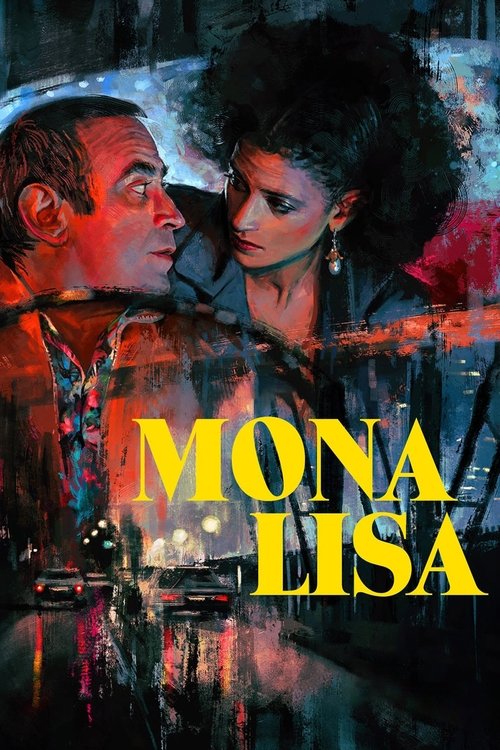
Mona Lisa
1986 · Neil Jordan
For a late night when you want atmosphere and heartbreak with your crime — something grown-up and melancholy rather than slick. More wounding than comforting, but deeply human.
What it's about
George walks out of prison into a mid-80s London that has no use for his old-school tough-guy act, and takes the only work going: driving Simone, an elegant high-class call girl, between hotel jobs. The two bicker, then bond, and when she asks him to track down a young friend from her street days, George descends into Soho's clip joints and King's Cross pavements — into trouble he doesn't understand until he's deep in it.
The experience
A slow-burn crime story that's really a bruised love story — seedy and tense, but what stays with you is the ache of a man falling for someone he can't read. It gets darker and sadder as it goes, with flashes of rough humor.
Performances
Bob Hoskins gives the performance of his career: a bulldog of a man whose whole face keeps betraying the softness underneath, funny and heartbreaking often in the same scene. Cathy Tyson's cool, guarded Simone is the perfect enigma opposite him.
The craft
Neil Jordan transplants American hard-boiled noir into an unmistakably English world of class resentment and Thatcher-era rot, and the locations do half the storytelling — neon Soho, grim service stations, gilded hotel corridors. The writing keeps the mystery personal: every clue costs George something.
Why it matters
The film that confirmed Neil Jordan as a major filmmaker and made Bob Hoskins an international star — a cornerstone of British neo-noir's 1980s revival.
Snapshot
Mona Lisa is the film that confirmed Neil Jordan as a major British-Irish talent and gave Bob Hoskins the defining role of his career. A neo-noir set in the seamy interzones of mid-1980s London — Soho clip joints, King's Cross pavements, motorway service stations, and the gilded hotel suites where high-class prostitution intersects with old gangland money — it transposes the conventions of American hard-boiled crime fiction onto a recognizably English landscape of class resentment, decayed criminal hierarchies, and Thatcher-era social rot. At its center is George (Hoskins), a small-time ex-convict newly released into a world that has moved on without him, hired as the driver and minder for an elegant call girl, Simone (Cathy Tyson), and gradually consumed by a love he cannot make her return and a mystery he is not equipped to solve. The film is at once a tender, doomed romance and a descent into a sexual underworld of exploitation and violence; its power lies in the friction between Jordan's romantic sensibility and the squalor he refuses to sentimentalize. Critically embraced on release and crowned by a Best Actor award for Hoskins at Cannes, Mona Lisa remains a touchstone of 1980s British cinema and one of the most fully realized neo-noirs of its decade.
Industry & production
Mona Lisa was produced by HandMade Films, the company founded by former Beatle George Harrison and his business partner Denis O'Brien, which by the mid-1980s had become one of the most important sources of finance for independent British cinema. HandMade had begun in 1979 by rescuing Monty Python's Life of Brian and had gone on to back a run of distinctive British pictures including The Long Good Friday — the 1980 gangland thriller that had already established Bob Hoskins as a formidable screen presence and whose hard-edged London criminality is Mona Lisa's most obvious domestic forebear. Patrick Cassavetti and Stephen Woolley are credited as producers; Woolley, through Palace Pictures, was emerging as a key figure in the resurgent British independent sector and would become Jordan's most enduring production partner across subsequent decades.
The film arrived at a particular moment in Neil Jordan's career. An Irish novelist and short-story writer by formation, Jordan had moved into film with Angel (1982, known in some territories as Danny Boy) and the gothic fairy-tale anthology The Company of Wolves (1984). Mona Lisa was his third feature and his first to achieve substantial international visibility. The screenplay was written by Jordan with David Leland, a writer-director then much concerned with English social texture and sexuality (he would direct Wish You Were Here and write Personal Services around the same period). The collaboration married Leland's feel for English class and milieu to Jordan's romantic-mythic instincts.
Casting was central to the film's success. Hoskins, fresh from his earlier breakthrough, was the anchor; the role of Simone went to Cathy Tyson, a young actress with a Royal Shakespeare Company background and limited screen experience, whose poised, guarded performance proved a revelation. Michael Caine took the supporting role of Mortwell, the pornographer-pimp who controls the underworld George stumbles into — a piece of casting-against-image that uses Caine's geniality to chilling effect. The film was shot on location in London, drawing much of its charge from real and unglamorized city geography.
Technology
Mona Lisa is a conventionally photographed mid-1980s production shot on 35mm film, and it makes no claim to technological novelty; its means are entirely in service of mood and performance. What is worth noting technically is its commitment to location shooting under available and practical light, which gives the film its texture of authenticity — the sodium glare of London streets at night, the fluorescent ugliness of cheap hotels and peep-show arcades, the gray diffusion of English daylight. The film belongs to a tradition of naturalistic location cinematography rather than studio artifice, and its visual identity comes from the photochemical rendering of real, often unlovely, urban surfaces rather than from any optical or effects innovation. The record offers no indication of unusual technical apparatus, and it would be invention to claim otherwise.
Technique
Cinematography
The cinematography is by Roger Pratt, an important figure in 1980s British film who had shot Terry Gilliam's Brazil and would go on to a major career. Pratt's work on Mona Lisa is a study in controlled atmosphere: the palette runs to nocturnal blues and the sickly amber of streetlight, with the city's neon and reflective wet surfaces exploited for a glistening, noirish surface that never tips into stylization for its own sake. The camera tends to stay close to George, frequently framing the action from within or beside his car — the vehicle becoming a mobile vantage from which he, and we, observe a world he does not understand. Pratt distinguishes registers visually: the romantic interludes carry a softer, more lyrical light, while the descent into the King's Cross underworld grows progressively harsher and more clinical. The seaside coda at Brighton introduces an open, daylit clarity that pointedly contrasts with the claustrophobic nocturnal city.
Editing
The editing, by Lesley Walker, organizes the film as a gradual revelation structured around George's limited point of view. We learn what George learns, at his pace, and the cutting withholds the full shape of Simone's world until George — and the audience — has been drawn deep enough to be implicated. The film's rhythm is patient in its first half, building the odd-couple relationship between George and Simone through accumulated small scenes, then tightens as the search for the missing girl, Cathy, accelerates into the thriller mechanics of the final act. The editing's restraint is part of the film's strategy: it allows performances to breathe and refuses to hurry the emotional turns, so that the late revelations land with the force of betrayal rather than mere plot.
Mise-en-scène / staging
Jordan's staging draws a sustained contrast between worlds, and the film's production design maps a social geography of 1980s London with precision. Simone's milieu is one of expensive hotels, restaurants, and clothes — a surface of luxury that George, in his loud and dated wardrobe, conspicuously fails to match, the costuming itself dramatizing his class and temporal displacement (a tough guy whose image, as the premise notes, is out of date). Against this stand the genuinely degraded spaces of the lower underworld: the peep shows, the cheap hotels where young and underage girls are held and used, the King's Cross streets. The staging repeatedly places George as an intermediary figure shuttling between strata he belongs to neither — too coarse for Simone's clientele, too sentimental for the predatory world he is sent into. Recurring visual motifs, including a white rabbit George carries and the kitschy romantic iconography the title invokes, thread an almost fairy-tale symbolism through the grime, consistent with Jordan's career-long interest in fable.
Sound
The film's most celebrated sonic element is its use of Nat King Cole's recording of "Mona Lisa," the standard from which the film takes its title and its central irony — the song's image of an enigmatic, unknowable beauty mapped onto Simone, whom George idealizes and fundamentally misreads. The needle-drop functions thematically rather than decoratively, framing George's romantic projection and its inevitable collapse. The original score is by Michael Kamen, a composer equally at home in film and rock, whose music underscores the romance without overwhelming the film's harder textures. The sound design otherwise favors the naturalistic ambience of the city — traffic, rain, the hum of the car — grounding the melodrama in lived environment.
Performance
Performance is the film's summit. Hoskins gives one of the great screen performances of the decade as George: pugnacious, sentimental, baffled, and finally heartbroken, a physically small man whose bantam aggression masks a romantic naïveté that the film treats with great tenderness and ultimately destroys. The performance is built from contradictions — tenderness toward his estranged daughter and toward the prostitutes he tries to protect, set against a quick temper and an inability to comprehend the world he is moving through — and Hoskins modulates between comedy and pathos without a false note. The Cannes Best Actor award and the subsequent run of international acting honors were richly earned. Cathy Tyson's Simone is the necessary counterweight: cool, watchful, self-protective, allowing the audience (like George) to project onto her a depth that the film's revelations complicate. Michael Caine's Mortwell is a study in suave menace, his affability curdling into genuine threat. The supporting playing — including Robbie Coltrane as George's friend Thomas, a source of warmth and comic relief — rounds out a uniformly strong ensemble.
Narrative & dramatic mode
Mona Lisa's dramatic mode is that of the romantic tragedy disguised as a detective story. Structurally it follows the noir template of the investigation: a man is hired for a task — to find a missing girl from Simone's past — and the search draws him steadily into a corruption far larger and darker than he anticipated. But the engine of the film is not the mystery; it is George's love for Simone, and the central irony, established by the Nat King Cole song, is that George constructs an idealized image of Simone (the unreadable, virtuous lady) that the truth of her life and desires will shatter. The film's great structural turn — handled here without spoiling its specifics for those who have not seen it — recasts everything George has assumed about Simone's motives and his own place in her affections, transforming his quest from chivalric rescue into a confrontation with his own self-deception. This is melodrama in the serious sense: a drama of feeling and recognition, in which the protagonist's emotional blindness is the true subject. The thriller plot, with its violence and its rescue, resolves; the romance does not, and the film's lasting ache comes from the gap between what George wants and what is possible.
Genre & cycle
The film is a neo-noir, and it participates self-consciously in the international revival of film noir's themes and iconography during the late 1970s and 1980s. It belongs specifically to a British strand of the crime film that runs through Get Carter (1971) and HandMade's own The Long Good Friday (1980) — pictures that relocate American gangster and noir conventions into a distinctly English context of class, regional identity, and a criminal underworld in decline. Mona Lisa updates the cycle for the Thatcher era, its underworld now organized around pornography, prostitution, and drugs rather than the old protection rackets, and its imagery saturated with the social anxieties of a divided 1980s Britain. It also belongs to the cycle of films about the relationship between an innocent or out-of-his-depth man and a mysterious woman who proves to be the femme fatale of the noir tradition reconfigured — though Jordan complicates the femme fatale archetype considerably, refusing to reduce Simone to a manipulator and granting her her own oppression and agency. Within Jordan's own work it sits alongside his recurring fascination with disguise, mistaken identity, and erotic misrecognition, themes he would pursue most famously in The Crying Game (1992), of which Mona Lisa is in many respects a clear precursor.
Authorship & method
Mona Lisa is most legible as a Neil Jordan film, and it crystallizes the preoccupations that define his authorship: romantic obsession, the gap between idealization and reality, the eruption of fairy-tale and myth within gritty realism, and characters who fall in love across barriers of class, knowledge, or identity. Jordan's literary background — he came to film as a published fiction writer — shows in the film's interest in interiority and irony, and in its willingness to let a genre framework carry an essentially novelistic study of a single deluded consciousness. The collaboration with co-writer David Leland brought a complementary strength: a documentary-grade feel for English social milieu and sexuality that grounds Jordan's romanticism in convincingly observed reality.
Among the key collaborators, cinematographer Roger Pratt supplied the film's controlled noir atmosphere; editor Lesley Walker shaped its patient, point-of-view-bound revelation; and composer Michael Kamen, together with the inspired deployment of the Nat King Cole standard, set its romantic-ironic tone. The producing partnership with Stephen Woolley initiated one of the most durable director-producer relationships in modern British and Irish cinema. But the film's authorship is, above all, a meeting of director and lead actor: Hoskins's George is so completely realized that the performance functions as co-authorship, the character's contradictions giving Jordan's themes their flesh. It would overstate the record to attribute specific scenes to improvisation absent clear documentation, but the fit between Hoskins's screen persona and Jordan's conception is the film's central creative fact.
Movement / national cinema
Mona Lisa is a landmark of the 1980s revival of British independent cinema, a period in which companies like HandMade Films, Palace Pictures, Goldcrest, and the newly influential Channel Four Films underwrote a wave of distinctive, often socially engaged features after the lean years of the British industry in the 1970s. It is simultaneously an early and significant entry in the body of work of Neil Jordan, an Irish filmmaker whose career straddles British, Irish, and American production. The film's England is observed with the slightly outsider's eye characteristic of Jordan's British-set work — attentive to class and to the textures of a society under strain. As national cinema, it belongs to the moment when British film was rediscovering commercial and artistic confidence, and when its crime and social-realist traditions were being reinvigorated by directors willing to fuse genre with auteurist ambition.
Era / period
The film is a precise artifact of mid-1980s Britain, and its underworld is unmistakably a product of the Thatcher era: an economy and society marked by visible inequality, the decay of older communities, and a flourishing of vice industries at the margins. The King's Cross of the film — a district then notorious for street prostitution before its later redevelopment — locates the story in a specific, now-vanished London geography. The film's anxieties about prostitution, pornography, the trafficking and abuse of young and underage girls, and drug addiction reflect contemporary social concerns, and its portrait of a criminal economy organized around sex and exploitation rather than the old armed-robbery and protection rackets registers a real transformation in the period's underworld. George's status as a man whose tough-guy code is obsolete — released from prison into a world that no longer recognizes his kind of villainy — is itself a comment on the period: the older, almost sentimental criminal masculinity giving way to a colder, more corporate and predatory order embodied by Caine's Mortwell.
Themes
The film's governing theme is the danger of idealization — the way George, like the viewer of the Mona Lisa, projects onto Simone a fantasy of unattainable, virtuous womanhood that the reality of her life refuses to confirm. Around this orbit several interlocking concerns. There is the theme of class and displacement: George is a man out of his time and out of his depth, too coarse for the luxury world he chauffeurs through and too tender for the predatory one he is sent to investigate. There is the theme of innocence and corruption, embodied in the missing girls and in George's quixotic, ultimately futile, impulse to rescue and protect. There is the recurring Jordan preoccupation with misrecognition and the instability of identity — the discovery that another person's interior life is not what one has assumed, a theme the film's late revelation makes its emotional crux. And there is the persistent fairy-tale undertone — the chivalric knight on a rescue, the beauty who is not what she seems, the romantic symbols (the white rabbit, the song) scattered through the squalor — that frames the whole as a dark modern fable about love built on illusion. Beneath all of it runs an unsentimental vision of exploitation, in which tenderness survives but cannot redeem the world it inhabits.
Reception, canon & influence
Mona Lisa was met with strong critical acclaim on its 1986 release, and the response coalesced overwhelmingly around Bob Hoskins's performance, which won the Best Actor prize at the Cannes Film Festival that year and went on to gather further international recognition, including an Academy Award nomination for Best Actor. Critics praised the film's fusion of hard-edged realism and romantic feeling, Jordan's confident direction, and the breakthrough performance of Cathy Tyson; the picture is generally regarded as one of the finest British films of its decade and a high point of the 1980s independent revival.
Influences on the film run backward to the American hard-boiled and film-noir tradition — the private-eye narrative of investigation, the femme fatale, the corrupt city — and, domestically, to the British crime cinema of Get Carter and The Long Good Friday, the latter sharing both Hoskins and the HandMade Films pedigree. The Nat King Cole standard and the broader iconography of romantic popular song supply the film's central conceit. Jordan's literary-mythic sensibility draws on the fairy-tale and fable traditions that also animate his The Company of Wolves.
Its influence forward is felt most directly within Jordan's own career: the film's concerns with disguised identity, romantic misrecognition, and the collision of tenderness with a violent underworld anticipate The Crying Game (1992), the film that would bring Jordan his greatest international success and an Academy Award for its screenplay. Mona Lisa also helped consolidate the template of the British neo-noir that fuses gangland genre with auteurist character study, an approach later filmmakers in British crime cinema would inherit. For Bob Hoskins, the role became the cornerstone of an international career. More broadly, the film stands as a durable model of how a genre framework — the detective thriller — can be hollowed out and refilled with serious emotional and social content, and it retains a secure place in the canon of 1980s British cinema and of the neo-noir more generally.
A Deleuzian reading
A man sits in a parked car at night, watching a lit hotel doorway.
The full Deleuzian reading of Mona Lisa →
Reception
A critical hit from the start — Cannes prize, Oscar nomination — and it's largely held that reputation, now standing as a peak of 1980s British cinema and the film people reach for when arguing Bob Hoskins was one of the great screen actors.
How Mona Lisa was received, from release to now →
Influences: the films it descends from and the films it influenced
- The Big Sleep (1946) — Supplies the private-eye investigation structure Mona Lisa inverts — a hired man drawn through a corrupt city's underworld by a woman whose true agenda is withheld until the noose tightens.
- Out of the Past (1947) — Establishes the romantic-fatalist femme fatale template — the smitten man who reads tenderness into a woman's deception — that Jordan revises by making George's idealization, not the woman's treachery, the engine of doom.
- Vertigo (1958) — Pioneers the obsessive POV-bound romantic misrecognition — a man constructing a fantasy image of a woman who is not what he imagines — that Jordan's editing (Lesley Walker's patient revelation) reworks for George and Simone.
- Klute (1971) — Directly prefigures the detective-and-prostitute neo-noir as character study, fusing investigative plot with location naturalism and a humane interest in the sex worker's interior life over genre mechanics.
- Taxi Driver (1976) — Models the lonely, deluded male consciousness who casts himself as rescuer of a woman in the underworld, the narrative bound to his unreliable idealization until violence erupts from it.
- Get Carter (1971) — Founds the British gangland location-naturalism that grounds Jordan's romanticism — real streets, sex trade, and class texture photographed with documentary specificity rather than studio noir.
- The Long Good Friday (1980) — Shares Bob Hoskins and the HandMade pedigree, establishing the Hoskins gangland persona — coiled menace over wounded vulnerability — that Mona Lisa hollows out into tenderness.
- The Company of Wolves (1984) — Jordan's own prior film working the fairy-tale-and-fable symbolism within a constructed reality, the mythic-romantic sensibility he transplants into gritty London crime.
- The Crying Game (1992) — Jordan's direct successor, inheriting Mona Lisa's disguised identity, romantic misrecognition, and the POV-revelation editing that lets a tender bond collide with a violent underworld.
- Leon: The Professional (1994) — Carries forward the chaste protector-and-vulnerable-innocent dyad amid criminal violence, the hardened man's unspoken tenderness driving a romantic-tragic structure.
- Croupier (1998) — Revives British neo-noir as auteurist character study built on an unreliable first-person narration, the genre frame subordinated to one deluded consciousness's self-mythology.
- Sexy Beast (2000) — Inherits the template Mona Lisa consolidated — gangland genre hollowed out and refilled with intense psychological character study and stylized performance over plot.
- Dirty Pretty Things (2002) — Extends the social-geography staging of London's hidden underworld and exploited outsiders, grounding genre suspense in observed immigrant-and-sex-trade milieu.
- Drive (2011) — Carries the needle-drop romantic neo-noir to its apex — a taciturn driver's tender idealization of a woman, pop-standard scoring against sudden violence, building to romantic tragedy.
- The American Friend (1977) — A contemporaneous European auteur neo-noir that refills the crime-thriller frame with an unlikely tender male bond and existential interiority rather than plot mechanics.
- Stormy Monday (1988) — Extends the same British neo-noir current, using music as romantic-ironic counterpoint and Newcastle location atmosphere to wrap a love story inside gangland menace.
Similar films
- The Long Good Friday (1980) — influence & lineage
- Taxi Driver (1976) — influence & lineage
- The Crying Game (1992) — influence & lineage
- Get Carter (1971) — influence & lineage
- Drive (2011) — influence & lineage
- Dressed to Kill (1980) — shared sensibility
- The Postman Always Rings Twice (1981) — shared sensibility
- The Element of Crime (1984) — shared sensibility