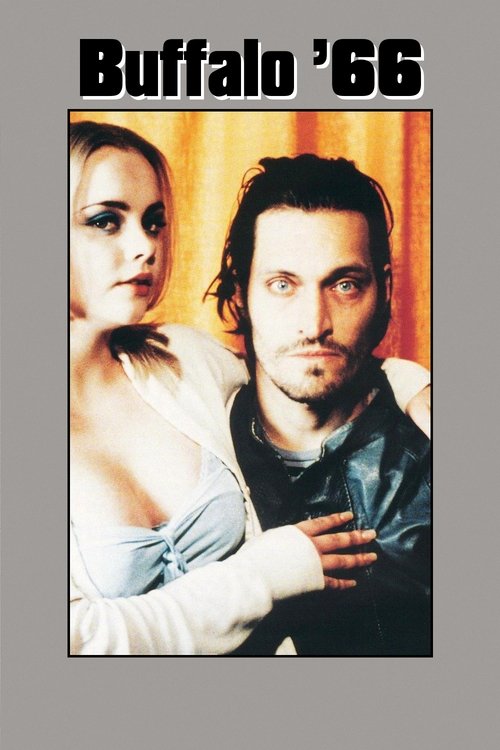
Buffalo '66
1998 · Vincent Gallo
For when you want something prickly and personal, not comfort food — a film to argue about afterward. Reach for it when you're in the mood for a character study that earns its sweetness the hard way.
What it's about
Billy Brown walks out of a five-year prison stretch into a freezing Buffalo winter with nowhere to go and a lie to maintain: his parents think he's been off succeeding at life, with a wife. So he kidnaps a young tap-dance student and orders her to play the part for one dinner at his childhood home — where the real wound, a family that barely registers his existence, sits waiting at the table.
The experience
Abrasive and squirm-inducing one scene, unexpectedly tender the next — it keeps daring you to give up on its hostile hero and then showing you exactly why he is the way he is. Funny in a bone-dry, uncomfortable way, and strangely moving by the end.
Performances
Vincent Gallo makes Billy a raw nerve — needy, cruel, and pitiable all at once — while Christina Ricci does remarkable, mostly wordless work as the captive who decides, inexplicably and touchingly, to stay. Anjelica Huston and Ben Gazzara are chilling as parents with a football game where their hearts should be.
The craft
Gallo writes, directs, stars, and co-composes, and the film looks like nothing else from its era — grainy, wintry color, flashbacks that bloom inside the frame, and reality that stops dead for spotlight musical reveries. The needle drops and the frozen Buffalo locations give it a handmade, melancholy texture that rewards close attention.
Why it matters
It became a touchstone of the late-nineties American indie boom — the model of the abrasive, autobiographical, one-man-band debut — and a cult object whose look and attitude echo through independent film and fashion photography alike.
Snapshot
Buffalo '66 is Vincent Gallo's feature directorial debut, a caustic, tender, and formally idiosyncratic American independent film built almost entirely around its maker. Gallo writes, directs, co-composes the score, and stars as Billy Brown, a damaged man-child released from a five-year prison stretch who immediately kidnaps a young tap-dance student, Layla (Christina Ricci), and coerces her into impersonating his wife during a visit to his monstrously indifferent parents. Out of this absurd premise the film extracts something unexpectedly raw: a study of arrested masculinity, of a man so unloved that he can only imagine intimacy as hostage-taking. Released in the high tide of the late-1990s American indie boom, it became a touchstone of a particular auteurist sensibility — abrasive, autobiographically charged, visually painterly — and remains the work by which Gallo as a filmmaker is principally remembered.
Industry & production
The film was produced independently on a modest budget and distributed in the United States by Lions Gate Films, then an aggressive young distributor building its identity on edgy independent fare. It premiered at the Sundance Film Festival in January 1998, the festival that functioned as the central marketplace and validating institution for American independent cinema in that decade, and opened theatrically in the summer of 1998. Precise budget and box-office figures vary across sources and I will not assert a specific number; what is reliably established is that the film was made cheaply, on a compressed schedule, and on the strength of Gallo's control over nearly every creative department.
Gallo, already known as a downtown New York figure — musician, painter, model, and actor in films by Claire Denis, Emir Kusturica, and others — leveraged that visibility into the financing and casting of his own project. The casting itself is a study in stunt-perfect mid-budget assembly: established character actors and faded stars (Ben Gazzara, Anjelica Huston, Mickey Rourke, Rosanna Arquette, Jan-Michael Vincent) lend weight far beyond the film's resources, while Christina Ricci, then transitioning from child stardom into adult indie roles, supplied contemporary cachet. The production was shot on location in and around Buffalo, New York — Gallo's actual hometown — in winter, a choice that fused the film's budget logic with its emotional climate.
Technology
The defining technological decision of Buffalo '66 is its capture medium: the film was shot on reversal stock rather than conventional negative. Reversal stock — a positive-image film more associated with slides and older documentary and home-movie practice — yields higher contrast, denser blacks, a narrower exposure latitude, and a distinctive grain and color rendition. The result is the film's instantly recognizable look: bleached, slightly sickly, wintry, with skies and snow that read as flat overcast and skin tones that feel chilled. This is a case where a technical and economic choice (reversal can be cheaper in certain workflows and forgiving of nothing, demanding precise exposure) becomes an aesthetic signature. The texture evokes faded photographs and degraded memory, which the film's themes of nostalgia and self-mythology directly exploit. Beyond the stock, the production relied on largely available-light and practical-light shooting in real Buffalo interiors and exteriors, consistent with low-budget independent practice of the period rather than any novel apparatus.
Technique
Cinematography
The cinematography is by Lance Acord, for whom Buffalo '66 was an important early calling card before his celebrated collaborations with Sofia Coppola and Spike Jonze. Acord and Gallo build the image around stillness and frontality. Compositions are frequently locked-off and symmetrical, with characters placed dead-center as if posed for a snapshot — a formal rhyme with the family-photo motif that recurs throughout. The reversal stock's contrast is embraced rather than corrected: figures are isolated against blown-out windows and gray Buffalo light. The camera is patient, favoring long held takes over coverage, which throws enormous pressure onto performance and blocking. Even the bravura set pieces are achieved through controlled, almost theatrical staging rather than restless movement.
Editing
The film was edited by Curtiss Clayton. Its most discussed editorial device is its handling of memory and subjectivity through in-frame inset images: when a character recalls or imagines something, a smaller picture appears within the larger frame — a picture-in-picture flashback that behaves like a thought balloon or a photograph surfacing in the mind. This refuses the conventional grammar of the cutaway flashback and instead literalizes memory as something layered onto the present, intrusive and simultaneous. Elsewhere the cutting is deliberately unhurried, letting scenes — the opening sequence of Billy desperately searching for a bathroom after release, the long static dinner-table confrontation — run past the point of comfort, mining awkwardness and duration for both comedy and dread.
Mise-en-scène / staging
Staging is where the film's theatrical instincts are clearest. The parents' house is a claustrophobic shrine to dysfunction and Buffalo Bills fandom, and Gallo blocks the dinner scenes like a chamber play, with the camera held back and the actors arranged in stiff tableaux. The frontal, centered framing turns ordinary rooms into stages and the characters into figures posing for a portrait they cannot get right. Color and decor are managed for a lower-middle-class, rust-belt period feel — wood paneling, dated furnishings, kitsch — that locates the film simultaneously in the present and in the unshakable past Billy carries. The recurring image of the posed family photograph organizes the whole mise-en-scène: the film is about people performing a family that does not exist.
Sound
Sound and music are central to Gallo's authorship, since he is himself a musician. He contributes original score, and the film makes pointed use of progressive-rock needle-drops, most famously King Crimson's "Moonchild," used in Layla's spotlit tap-dance number in the bowling alley, and Yes's "Heart of the Sunrise." These choices align the film with a specific 1970s sonic palette — the era of Billy's wounded childhood — and lend its most lyrical sequences an unexpected grandeur that cuts against the squalor of the story. Dialogue is mixed close and intimate, and the film tolerates long stretches of strained near-silence in the dramatic scenes, so that the musical interludes land as releases of feeling the characters cannot otherwise express.
Performance
Performance carries the film. Gallo's Billy is a study in defensive aggression: fast-talking, self-pitying, bullying, and transparently terrified, a man whose every cruelty is a botched bid for love. It is a performance willing to be genuinely unlikeable. Ricci plays Layla with a watchful, almost beatific passivity that the film asks us to read as emerging affection — a choice that has drawn both admiration and critique (see Themes and Reception). Anjelica Huston and Ben Gazzara are extraordinary as the parents: Huston's mother is a Bills fanatic so consumed by the team that she resents her son's birth for having made her miss the one game they won, and Gazzara's father is a menacing, self-regarding former crooner. Their scenes give the film its psychological foundation — the visible source code of Billy's damage — and their stature grounds Gallo's stylization in lived-in human ugliness.
Narrative & dramatic mode
The narrative operates in a register that braids deadpan comedy, hostage thriller, family melodrama, and fairy-tale romance. The inciting premise is a crime — kidnapping — but the film treats it almost entirely as psychodrama, draining the thriller of suspense and refilling it with pathos. The structure is essentially a single extended day-and-night odyssey through Billy's hometown and past, punctuated by the inset memory-images that fold backstory into present action without conventional flashback breaks. The dramatic engine is a slow inversion: the captive becomes the agent of the captor's healing, and what begins as coercion is reframed, by the film's logic, as the first relationship in which Billy is truly seen. The backstory — Billy's incarceration as the result of a lost bet on the Buffalo Bills' Super Bowl, a debt to a bookie, and his agreement to take a prison fall — supplies the wound and the revenge plot (his obsession with the placekicker he blames for the loss) that the climax must resolve.
Genre & cycle
Buffalo '66 belongs to the late-1990s American independent cycle, the post-sex, lies, and videotape, post-Tarantino moment when Sundance, Miramax, and distributors like Lions Gate turned personal, low-budget, stylistically assertive filmmaking into a viable commercial category. Within that cycle it sits in the auteur-as-self-portrait strain — alongside the era's many films built around a singular creator's sensibility — and crosses the indie romance with the dysfunctional-family drama and the regional, hometown-decay film. It also participates, more loosely, in a tradition of American films about wounded, voluble, self-mythologizing men. Its tonal instability — its refusal to settle as comedy, romance, or character study — is itself characteristic of the period's appetite for genre hybridity.
Authorship & method
This is an auteur film in the most concentrated sense: Gallo directs, stars, co-writes (the screenplay is credited to Gallo with Alison Bagnall), and contributes music, drawing on his own Buffalo origins. The method is autobiographical and total — the film reads as an act of self-examination and self-mythology at once, with Gallo casting himself as both protagonist and victim of the story. His key collaborators temper and translate that vision: cinematographer Lance Acord, whose handling of the reversal stock and frontal compositions gives the film its painterly stillness; editor Curtiss Clayton, who realizes the inset-memory grammar and the film's patient rhythm; co-writer Alison Bagnall, who shares story and screenplay credit; and the music, which Gallo shapes personally as composer and curator. The veteran cast — Gazzara, Huston, Rourke, Arquette, Jan-Michael Vincent, with Kevin Corrigan in support — functions as another authorial instrument, Gallo importing decades of screen history into a debut feature. The collaboration with Christina Ricci, then a magnet for indie projects, was equally strategic, supplying both presence and contrast to Gallo's abrasiveness.
Movement / national cinema
The film is firmly American, and specifically regional: it is a Buffalo film, rooted in the rust-belt landscape of western New York, its gray skies, its decaying industrial-town textures, and its near-religious football culture. Nationally it belongs to the American independent movement of the 1990s, but Gallo's sensibility was also shaped by European art cinema and the downtown New York avant-garde, and he would soon become a figure as identified with European auteur circles (working with Claire Denis, among others) as with Hollywood's margins. Buffalo '66 thus sits at a hinge between American indie naturalism and a more European-inflected formalism — local in subject, cosmopolitan in influence.
Era / period
Though made and set in the late 1990s, the film is saturated with an earlier era. Its emotional clock is set to the Buffalo Bills' Super Bowl heartbreak — the team's famous loss decided by a missed field goal — which serves as Billy's foundational trauma and the cause of his imprisonment, and to the 1970s textures of its music and its parents' world. The reversal stock's faded-photograph look reinforces this temporal doubling: the film feels like a memory of the recent past even as it unfolds in the present. It is a period piece about the inescapability of period — about a man who cannot leave the year of his greatest wound.
Themes
At its core the film is about wounded masculinity and the impossibility of love for someone never taught how to receive it. Billy's bravado, his lies, his kidnapping of Layla, and his murderous fixation on the placekicker he blames are all expressions of a single deficit: he was not loved by his parents, and he has organized his entire identity around grievance and self-pity. The family scenes diagnose the disease — a mother who openly prefers a football team to her child, a father who is all narcissistic menace. Against this, the film proposes redemption through being seen: Layla's improbable, almost saintly tenderness offers Billy the recognition he has never had, and the climax turns on his choice to abandon revenge in favor of a small, hopeful gesture of connection.
These themes are also the film's principal critical fault line. Its romance is built on coercion, and Layla's near-instant devotion to her kidnapper has been read by many critics as a male wish-fantasy — the captive who heals the captor — that the film never fully interrogates. Whether Buffalo '66 is a clear-eyed portrait of toxic male need or a film partly seduced by it remains the central interpretive debate around it, and the honest scholarly position is that the film holds both readings at once.
Reception, canon & influence
Buffalo '66 was received as a striking, divisive debut. Critical response was substantial and largely admiring of its formal audacity, its performances — Huston and Gazzara especially — and Ricci's work, while frequently registering discomfort with Gallo's persona and the film's gender politics. It established Gallo as a genuine, if polarizing, filmmaking voice and became a defining indie title of 1998. (I am avoiding specific award and grosses claims where the record I can reliably cite is thin.)
Its backward influences are legible: European art cinema's patience and frontality, the American tradition of voluble, self-destructive male protagonists, and the downtown New York avant-garde and music culture from which Gallo emerged. The needle-drop use of 1970s progressive rock and the painterly, photograph-like image both point to a cinephile and music-collector sensibility steeped in earlier decades.
Its forward legacy is real but specific. The film became a cult object and a frequent reference point for a strain of 2000s American independent cinema that prized handmade visual texture, deadpan-meets-tender tone, and idiosyncratic music supervision — and it helped consolidate the careers around it, most consequentially that of cinematographer Lance Acord, whose subsequent work with Sofia Coppola and Spike Jonze carried forward a related attention to light, stillness, and atmosphere. For Gallo, it remains the defining directorial achievement; his only other feature as director, The Brown Bunny (2003), proved far more controversial, which has had the effect of making Buffalo '66 the stable center of his reputation behind the camera. Its image of Billy and Layla, its bowling-alley tap dance, and its bleached Buffalo winter persist as enduring icons of late-1990s American independent film.
A Deleuzian reading
A man walks out of prison and the first thing he needs is a bathroom.
The full Deleuzian reading of Buffalo '66 →
Reception
A Sundance-buzz indie debut that critics mostly embraced in 1998 (with a loud minority finding Gallo insufferable), it has since been fully canonized by the internet generation — its Tumblr-to-Letterboxd afterlife is arguably bigger than its theatrical life ever was.
How Buffalo '66 was received, from release to now →
Influences: the films it descends from and the films it influenced
- The Killing of a Chinese Bookie (1976) — Gallo imports Ben Gazzara directly from the Cassavetes stock company and inherits its method of behaviorally raw, self-destructive masculinity sustained in unbroken, protracted long takes.
- Mean Streets (1973) — Establishes the rock needle-drop as interior monologue for a volatile, self-lacerating male, the curated-record-collection scoring Gallo transposes onto 1970s prog.
- Taxi Driver (1976) — Model for the abrasive, unlikeable loner the film both indulges and indicts — self-mythologizing wounded masculinity built around a single alienated point of view.
- Pickpocket (1959) — Source of the anti-psychological frontal framing and blank, model-like performance register, where everyday actions play out in protracted, undramatized duration.
- Tokyo Story (1953) — Origin of the static frontal-symmetrical compositions and family-photo tableau, with characters posed near-frontally to camera in held, low, balanced frames.
- Jeanne Dielman, 23 quai du Commerce, 1080 Bruxelles (1975) — Codifies protracted real-time duration and locked-off frontal tableau as the primary dramatic device rather than a stylistic flourish.
- Chelsea Girls (1966) — The downtown-NY avant-garde milieu Gallo came from, whose static endurance shots and split-screen simultaneity prefigure his picture-in-picture inset and durational stillness.
- Annie Hall (1977) — Pioneers the inset subjective-memory grammar in which the present self steps into and watches his own remembered scene, the structure of Billy's flashbacks.
- Stranger Than Paradise (1984) — Template for American-indie deadpan delivered in single-take tableaux across a bleached, desolate Americana, scenes sealed off as discrete held shots.
- Love Streams (1984) — Gallo casts intimates and himself, shoots a wounded family reunion in charged domestic interiors, and lets discomfort run untrimmed — a direct heir to Cassavetes' collapse of distance between maker and role.
- Punch-Drunk Love (2002) — Extends the abrasive wounded male whose rage and tenderness coexist, healed by a love interest, inside saturated formal stylization and tonal whiplash.
- Lost in Translation (2003) — Lance Acord carries forward the film's available-light stillness and atmospheric, photograph-like naturalism into his signature cinematographer's voice.
- The Brown Bunny (2003) — Gallo's own follow-up reprises the total authorship — direct, star, shoot, score — with grainy reversal-stock texture and protracted highway duration.
- Garden State (2004) — Inherits the wounded-male homecoming odyssey scored by emotionally architectural indie music supervision in a deadpan-meets-tender key.
- Trees Lounge (1996) — Contemporary indie of the self-destructing man circling his blue-collar hometown, staffed with veteran character actors as importable screen history.
- Gummo (1997) — Parallel 1990s pursuit of handmade, bleached working-class Americana through abrasive anti-naturalism and collage-like tonal hybridity.
- Rushmore (1998) — Shares the frontal-symmetrical framing, theatrical tableau staging, and curated period needle-drops deployed as a precise authorial signature.
- Jesus' Son (2000) — Shares the period-warmed, grainy subjective photography and the blank, wounded male lead whose interiority is carried by texture and stillness rather than exposition.
- Mikey and Nicky (1976) — Descendant in Cassavetes-derived behavioral rawness — long takes, available light, a jittery damaged man performing bravado — carrying the actor-first independent lineage into the '90s.
Similar films
- Stranger Than Paradise (1984) — influence & lineage
- The Killing of a Chinese Bookie (1976) — influence & lineage
- Punch-Drunk Love (2002) — influence & lineage · often watched together
- Rushmore (1998) — influence & lineage · often watched together
- Strange Darling (2024) — often watched together
- The Godfather (1972) — often watched together
- Sorry, Baby (2025) — often watched together
- Blue Heron (2026) — shared sensibility
All the films related to Buffalo '66 →