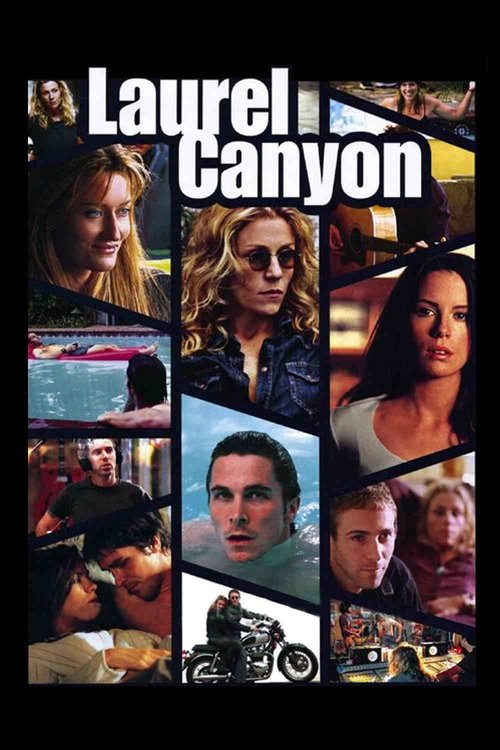
Laurel Canyon
2003 · Lisa Cholodenko
For a grown-up night in when you want something sexy, talky, and character-driven — temptation and family friction instead of fireworks. Comfortable on the surface, quietly provocative underneath.
What it's about
An uptight young psychiatry resident and his Harvard-academic fiancée move to Los Angeles expecting an empty house — and instead find his mother still in it. Jane is a veteran record producer, mid-album, sharing the place with the younger British rocker she's producing and sleeping with. What follows is a slow, sun-baked dissolution of boundaries as the strait-laced couple are each drawn, separately, toward the household's sensual disorder.
The experience
Loose, warm, and quietly charged — less a plot than a mood that keeps tightening. It simmers rather than explodes, and the tension between control and letting go gets under your skin.
Performances
Frances McDormand is the whole reason to watch: her Jane is magnetic, unapologetic, and completely lived-in, a middle-aged woman written and played with an ease movies rarely allow. Christian Bale does fine, coiled work as the son trying not to become — or want — anything in that house.
The craft
Cholodenko builds the film around atmosphere: the canyon house, the pool, the endless golden-hour haze of a record being made. The studio scenes have a real musician-clubhouse texture, and the film's laid-back rhythm is itself the seduction.
Why it matters
It cemented Lisa Cholodenko as a distinctive chronicler of desire and family disorder, and gave Frances McDormand one of her most celebrated non-Coen roles.
Snapshot
Laurel Canyon is Lisa Cholodenko's second feature, a chamber drama of generational and erotic friction set in the eponymous Hollywood Hills enclave long associated with the singer-songwriter culture of the late 1960s and early 1970s. The premise is deceptively schematic: Sam (Christian Bale), a buttoned-down psychiatry resident, and his fiancée Alex (Kate Beckinsale), a Harvard doctoral candidate in genomics, arrive in Los Angeles expecting to have his mother's house to themselves, only to find that Jane (Frances McDormand) — a veteran record producer mid-album with a younger British rocker and lover, Ian (Alessandro Nivola) — has not vacated. What follows is less a plot than a slow dissolution of boundaries, as the buttoned-down couple are drawn, separately, toward the sensual disorder of the household. The film belongs to a strain of early-2000s American independent cinema preoccupied with desire as a destabilizing rather than redemptive force, and it remains best known for McDormand's performance and for crystallizing Cholodenko's recurring subject: the porousness of supposedly settled sexual and domestic identities.
Industry & production
The film was an American independent production released by Sony Pictures Classics, the specialty arm that had become a reliable home for auteur-driven mid-budget dramas. Antidote Films (producer Jeff Levy-Hinte) was central to the production; the project carried the imprimatur of the late-1990s/early-2000s indie ecosystem in which Cholodenko had emerged with High Art (1998), a Sundance prize winner. Laurel Canyon premiered on the festival circuit and opened theatrically in the United States in early 2003.
The budget was modest by studio standards, and the production reflects the economics of the form: a contained number of principal locations (the canyon house above all), a small ensemble, and a shooting schedule organized around character scenes rather than spectacle. The casting is itself a production story — McDormand, an Oscar winner from Fargo, anchored the film's marketability, while Bale and Beckinsale were ascending names, and Nivola and Natascha McElhone (as Sara, a colleague to whom Sam is drawn) filled out a deliberately international ensemble. I should note that precise budget and box-office figures for the film are not something I can state reliably, and rather than guess I'll leave them unattributed; the film's commercial profile was that of a well-reviewed specialty release rather than a breakout.
Technology
Laurel Canyon was shot photochemically on 35mm film, consistent with the standard for American narrative features of its moment, before the wider migration to digital capture later in the decade. Its technical ambitions are not in the apparatus but in the controlled naturalism of the image: available-feeling light, a warm Southern California palette, and a recording-studio milieu that the production renders with some specificity. The film's engagement with "technology" is arguably more thematic than instrumental — the recording studio, the mixing board, the labor of producing a rock album are staged as a world of craft and sensual immersion, and the apparatus of music-making becomes a site of seduction. Beyond that, the picture makes no special claim on technical innovation, and it would misrepresent it to imply otherwise.
Technique
Cinematography
The cinematography is by Wally Pfister, shortly before he became indelibly associated with Christopher Nolan (Memento preceded this; the Batman films and Inception, for which he won an Academy Award, followed). His work here is markedly different from the high-contrast architecture of those later films: warm, soft, sun-soaked, attentive to skin and to the hazy light of the canyon. The camera favors intimacy — close framing of faces in conversation, a sensitivity to the choreography of bodies in shared domestic space. Pfister lights the pool, the studio, and the cluttered house as zones of comfort and temptation, and the visual register tilts toward sensuality without tipping into glamour. The contrast between the cool, contained spaces associated with Sam and Alex and the looser, golden environments of Jane's world is one of the film's quiet organizing principles.
Editing
Amy E. Duddleston edited the film. The cutting is unhurried and character-led, built to track shifting attention and gathering temptation rather than to generate momentum. The film's structure depends on parallel drift — Sam pulled toward Sara, Alex pulled toward Ian and Jane's orbit — and the editing sustains both lines without forcing melodramatic collision. Scenes are allowed to breathe; the rhythm is that of observation, with the pool-party and studio sequences in particular relying on duration to let discomfort and arousal accumulate.
Mise-en-scène / staging
The house is the film's central design statement and effectively a character. Production design renders Jane's home as lived-in, bohemian, layered with the accreted clutter of a life in music — a space whose disorder is itself an argument about how to live. Staging repeatedly places the rigid younger couple inside this environment as intruders who slowly acclimate; the pool becomes the recurrent stage for transgression, a site where clothing, hierarchy, and propriety loosen. Cholodenko's blocking tends to keep characters in physical proximity that the dialogue has not yet earned, generating tension through bodies before words.
Sound
Music is foundational, not decorative. The diegetic spine of the film is the album Jane is producing with Ian's band, and the recording-studio scenes integrate performance, playback, and the act of listening into the drama. The score is credited to Craig Wedren, formerly of the band Shudder to Think, who also contributed to the film's original songs for Ian's fictional group; the soundtrack draws on a contemporary indie/alt-rock sensibility rather than period pastiche, a deliberate choice given the canyon's historical associations. I'd flag that the exact division of labor on individual songs and performances is a detail I can't fully verify, and I won't invent specifics. What matters technically is that sound design and music are used to mark the boundary between Sam and Alex's controlled world and the immersive sonic environment that seduces them.
Performance
Performance is the film's principal achievement. McDormand's Jane is the gravitational center — unapologetic, charismatic, maternal and rivalrous at once — and the role is built to resist easy judgment of the libertine mother. Beckinsale gives one of her most interesting performances as Alex, charting an intelligent, repressed woman's awakening with restraint that makes the unraveling credible. Bale plays Sam's rigidity from the inside, locating the anxiety beneath the control. Nivola is persuasive as Ian, both as a musician and as an object of desire, and McElhone supplies a counterweight in Sara. The ensemble works in a register of underplayed naturalism; the drama lives in glances, hesitations, and the management of attraction.
Narrative & dramatic mode
The film operates in the mode of the realist relationship drama, structured around parallel temptations rather than a single engine of conflict. There is no villain and no catastrophe; the stakes are internal — whether Sam and Alex's relationship, and their inherited assumptions about discipline and desire, can survive contact with Jane's world. Cholodenko withholds tidy resolution, ending on ambivalence rather than reconciliation or rupture. The dramaturgy is chamber-scaled and behavioral, closer to the European art film's interest in unresolved moral situations than to the three-act arc of mainstream romance. The mother-son-fiancée triangle, complicated by the lover Ian and the colleague Sara, functions as a controlled experiment in how proximity to uninhibited living reshapes those who think themselves immune.
Genre & cycle
Nominally a drama-romance, Laurel Canyon sits within an early-2000s American independent cycle of adult relationship films concerned with sexual fluidity, infidelity, and the instability of bourgeois coupledom. It is in conversation with the broader queer and post-queer independent cinema of the period — Cholodenko's own work foremost — in which bisexual desire and the renegotiation of monogamy are treated as ordinary dramatic material rather than as transgression to be punished. The film resists the redemptive arc typical of the studio romance; if it belongs to a cycle, it is the one that uses the romance framework to interrogate rather than affirm. Its specific texture — the music-industry setting, the canyon mythology — also links it to films about Los Angeles bohemia and the afterlife of the 1960s counterculture.
Authorship & method
Laurel Canyon was written and directed by Lisa Cholodenko, and it is best read as the central panel of an authorial triptych running from High Art (1998) through Laurel Canyon (2003) to The Kids Are All Right (2010). Across these films Cholodenko returns insistently to the same concerns: desire that crosses the lines of orientation, age, and propriety; the seductiveness of artistic or unconventional milieus; and the strain such desire places on couples and families. Her method is observational and actor-centered, favoring ambiguity over judgment and behavioral nuance over plot mechanics.
Her key collaborators on this film extend its reach. Cinematographer Wally Pfister brought a warm naturalism that predates his more famous high-style work with Nolan. Editor Amy E. Duddleston shaped the film's patient, dual-track rhythm. Composer Craig Wedren, drawing on his alt-rock background, grounded the film's musical world in a contemporary rather than nostalgic idiom — a notable authorial choice for a film set in a place defined by its past. The collective signature is one of restraint deployed in service of sensual subject matter: a film about excess made with control.
Movement / national cinema
The film is a product of American independent cinema in its specialty-distribution era, when companies like Sony Pictures Classics, Fox Searchlight, and Focus Features sustained a market for auteur dramas between the studios and the avant-garde. Cholodenko is also a significant figure in American queer cinema's movement, in the 2000s, from the margins toward a more mainstream, naturalistic register — a shift away from the confrontational New Queer Cinema of the early 1990s toward films in which non-normative desire is woven into recognizable domestic and professional life. Laurel Canyon embodies that transition: stylistically conventional, thematically unorthodox.
Era / period
Made and set in the early 2000s, the film is contemporary to its production, but it is haunted by an earlier era. "Laurel Canyon" as a place name carries the weight of the late-1960s and early-1970s singer-songwriter scene — the mythology of a creative community that the film invokes through Jane's character and milieu without literally depicting. The drama thus stages a confrontation between two periods: the residual countercultural ethos that Jane embodies and the careerist, credentialed sensibility of her son's generation. The film's interest is precisely in what survives, curdles, or seduces across that gap, making "era" not just a setting but a theme.
Themes
The governing theme is the porousness of the self under the pressure of desire — the discovery that discipline, fidelity, and identity are less fixed than the disciplined believe. Adjacent to this is the mother-son dynamic, with Jane's libertine self-possession functioning as both rebuke and temptation to Sam's order. The film examines generational inheritance and rebellion: the child of bohemia who has fled into propriety, and the threat that proximity to his origins poses. Creativity and sensuality are linked — the recording studio is figured as a space where work and desire blur. And throughout runs an inquiry into monogamy and its discontents, treated without moralism. Cholodenko refuses to resolve whether the loosening her characters undergo is liberation or loss, and that refusal is the film's intellectual signature.
Reception, canon & influence
Critically, Laurel Canyon was received as an intelligent, well-acted, somewhat cool adult drama — admired especially for McDormand's performance and for Cholodenko's refusal of easy resolution, while some critics found the film's ambivalence a degree too restrained to fully ignite. It consolidated Cholodenko's reputation as a serious director of relationship drama between her debut and her later breakout. I'd characterize its standing as that of a respected secondary work rather than a canonical landmark, and I won't overstate a consensus that the record doesn't support.
Looking backward, the film's influences are legible: the European-inflected relationship drama of unresolved moral situations; the LA-bohemia and music-scene film; and the mythos of the 1960s–70s canyon culture, which the film treats as ambient inheritance rather than subject. Cholodenko's own High Art is its most direct antecedent in theme and method.
Looking forward, Laurel Canyon's most significant legacy is internal to Cholodenko's career: its concerns with desire, family, and the instability of coupledom mature into The Kids Are All Right (2010), her widest critical and commercial success, which can be read as a more resolved companion piece. The film also sits within the lineage that helped normalize fluid and bisexual desire in mainstream-adjacent American drama, and it remains a touchstone for discussions of Cholodenko's authorship and of early-career Wally Pfister cinematography. Its broader influence on subsequent filmmakers is diffuse rather than traceable to specific descendants — a film whose afterlife is more a matter of reputation and rediscovery than of a school it founded.
A Deleuzian reading
Start with the pool.
The full Deleuzian reading of Laurel Canyon →
Reception
Landed in 2003 as a warmly reviewed but 'minor' indie — everyone praised Frances McDormand, fewer championed the film — and it's since aged into a low-key favorite, rediscovered by fans working backwards from The Kids Are All Right through Cholodenko's earlier work.
How Laurel Canyon was received, from release to now →
Influences: the films it descends from and the films it influenced
- High Art (1998) — Cholodenko's own template: an observational, actor-centered drama in which a charismatic older woman embedded in a seductive bohemian-artistic milieu destabilizes a younger couple's certainties, desire crossing orientation and propriety without authorial judgment.
- The Graduate (1967) — Establishes the pool-as-transgression staging and the older-woman/younger-partner seduction shot against sun-bleached California affluence, the swimming pool framing erotic drift and aimlessness.
- Shampoo (1975) — The LA-bohemia sexual-fluidity ensemble built on behavioral nuance over plot mechanics, a counterculture milieu treated as ambient inheritance rather than subject.
- La Piscine (1969) — The swimming pool as the literal stage of languid erotic transgression — bodies, heat, and idleness choreographed around water as the site where coupledom comes undone.
- La Collectionneuse (1967) — The sun-soaked moral tale of temptation deferred — a will-they/won't-they ethical situation observed with restraint and refused a tidy resolution, the model for Cholodenko's unresolved ending.
- Scenes from a Marriage (1973) — Anatomizes monogamy-and-discontents through long, underplayed two-handers that privilege the micro-shifts of behavior, the naturalist register Cholodenko applies to her couples.
- Five Easy Pieces (1970) — BBS-era American-independent naturalism rooted in a music-world milieu and ambivalent class/bohemia tension, behavioral observation displacing dramatic resolution.
- Days of Heaven (1978) — Néstor Almendros's warm, available-light naturalism — the golden-hour, un-stylized palette that is the touchstone for Pfister's warm naturalism here, before his later high-style work.
- The Kids Are All Right (2010) — The matured, more resolved companion piece: same parallel-temptation structure and instability of coupledom and family, the observational method refined and given a settled ending.
- Take This Waltz (2011) — Monogamy-and-discontents told as the slow drift of temptation against a settled couple, behavioral restraint sustaining ambivalence toward an unresolved close.
- Concussion (2013) — Post-New-Queer-Cinema suburban drama of mid-life bisexual awakening rendered in Cholodenko's observational, non-judgmental register, fluid desire as quiet domestic rupture.
- Vicky Cristina Barcelona (2008) — Extends the parallel-temptations narrative and fluid bisexual desire among an artistic-bohemian circle, leaving the romantic accounting deliberately unresolved.
- Margot at the Wedding (2007) — The house-as-character family drama of corrosive, underplayed naturalism, where domestic space stages the porousness and intrusion of desire between intimates.
- Lovely & Amazing (2001) — American-independent observational family/relationship drama built on underplayed naturalism and ensemble behavioral nuance rather than plot, the same restraint applied to sensual material.
- Almost Famous (2000) — The LA canyon music-scene film organized around a diegetic-music spine and milieu — sibling treatment of the same world, nostalgic where Cholodenko insists on a contemporary idiom.
- The Safety of Objects (2001) — Post-New-Queer-Cinema ensemble suburban drama using house-as-character interiors and intercut parallel storylines to map desire's porousness across households.
Similar films
- High Art (1998) — influence & lineage
- 3 Women (1977) — shared sensibility
- The Hours (2002) — shared sensibility
- Mommy (2014) — shared sensibility
- Certain Women (2016) — shared sensibility
- Laurence Anyways (2012) — shared sensibility
- Dogville (2003) — shared sensibility
- Lady Bird (2017) — shared sensibility