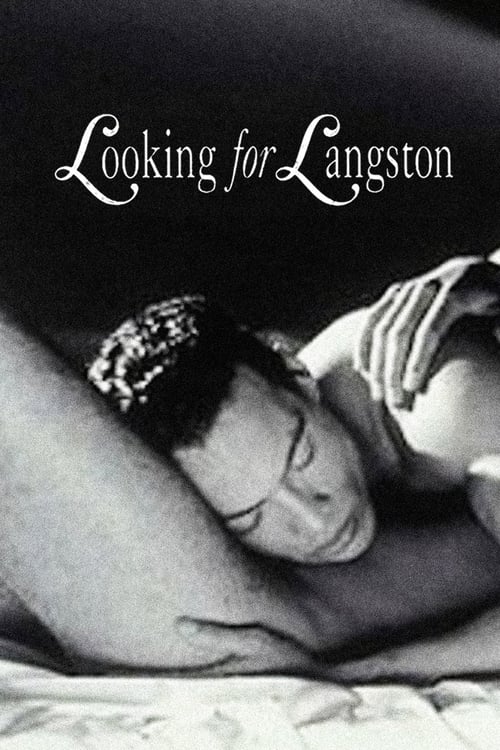
Looking for Langston
1989 · Isaac Julien
For when you want something short, ravishing, and contemplative — a late-night art film to watch slowly, not a story to follow. More gallery than multiplex, and gorgeous about it.
What it's about
A forty-five-minute black-and-white reverie on Langston Hughes and the queer life of the Harlem Renaissance. A wake unfolds upstairs while tuxedoed men dance in an elegant bar below, and a dreamer drifts through champagne rooms, archival newsreels, and fields of calla lilies in pursuit of a figure called Beauty. Less a biography than a séance — history remembered as a dream.
The experience
Sensuous, drifting, and hypnotic; it works on you like a poem, all image and rhythm rather than plot. You come out of it as if surfacing from someone else's dream.
The craft
The pearl-gray monochrome photography is among the most beautiful of its decade, set against Essex Hemphill's poetry on the soundtrack and archival footage threaded through the staged scenes. Every frame is composed like a photograph — it rewards a dark room and full attention.
Why it matters
A landmark of Black British filmmaking and a founding text of queer cinema's late-80s breakthrough, it said plainly what official memory had smothered — and weathered the Hughes estate's attempts to cut it — to become the touchstone it is now.
Isaac Julien's forty-five-minute meditation on Langston Hughes and the Harlem Renaissance is less a biography than a séance: a wake unfolds above, tuxedoed men dance below, and a dreamer moves through champagne bars, archival newsreels, and fields of calla lilies in search of a figure called Beauty. Made with Britain's Sankofa collective in 1989, it dared to state plainly what official memory had smothered — the queerness threaded through the Renaissance — and drew the wrath of the Hughes estate, which forced cuts to the poet's words in American prints. Julien answers censorship with sumptuousness: pearl-gray monochrome photography that ranks with the most beautiful of its decade, Essex Hemphill's poetry on the soundtrack, Robert Mapplethorpe's photographs interrogated on screen even as the film borrows their gleam. Alongside Tongues Untied and Julien's own Young Soul Rebels, it laid the foundation for what would soon be named New Queer Cinema, and its imagery echoes forward into Moonlight and beyond. Julien went on to a career spanning galleries and features; this remains his most quoted work — an archive turned into a dream.
Reception
In 1989 it arrived trailing controversy — the Langston Hughes estate objected to its portrayal of Hughes as a gay icon, and US screenings were hobbled by rights battles over his poetry. Now it's canonized as a founding text of New Queer Cinema and Black British film, restored by the BFI and hung in museums like an artwork.
How Looking for Langston was received, from release to now →
Influences: the films it descends from and the films it influenced
- The Blood of a Poet (1930) — Its statuary tableaux vivants and slow-motion poet-in-reverie establish the dream-logic staging Julien restages in his hushed black-and-white afterlife and nightclub scenes.
- Fireworks (1947) — A solitary man's homoerotic dream conjuring desiring sailors gives Julien the template for coded queer fantasia rendered as ritualized tableau rather than narrative.
- Meshes of the Afternoon (1943) — Its trance-film grammar — the looping dreamer, veiled recurring figures, elliptical match-cuts — underwrites Julien's non-linear oneiric editing.
- Un Chant d'amour (1950) — Silent, censored, lyrical prison homoeroticism supplies the poetic-erotic male gaze that Julien's Mapplethorpe-inflected nude imagery directly descends from.
- La Jetée (1962) — Meditative first-person voiceover laid over still and archival images — memory assembled as montage — is the essay-film register Julien adopts for his elegy.
- The Angelic Conversation (1985) — Languid homoerotic tableaux scored to recited verse (Shakespeare's sonnets) prefigure Julien's fusion of spoken-word poetry with slow, desiring images of Black men.
- Territories (1984) — Julien's own earlier Sankofa collage of archive, sound and fractured image around Black British spectacle is the immediate workshop prototype for Langston's method.
- Poison (1991) — A founding New Queer Cinema work that, like Langston, builds a Genet-derived fragmented poetic structure interleaving distinct visual registers rather than linear plot.
- Nitrate Kisses (1992) — Excavates suppressed queer history by montaging censored archival footage against contemporary bodies — the archive-as-elegy strategy Julien pioneered for Black queer memory.
- Young Soul Rebels (1991) — Julien extends Langston's Black-queer-British milieu and its charged looking between men into a feature narrative register.
- The Watermelon Woman (1996) — Fabricates a pseudo-archive to recover an erased Black queer figure, extending Julien's tactic of imaginatively reconstructing histories the record refused to keep.
- Moonlight (2016) — Its sculptural close-ups and reverie-drenched staging of Black queer desire draw on Julien's poetic image-making, a debt Jenkins has openly acknowledged.
- Love Is the Message, The Message Is Death (2016) — A gallery-scaled montage of Black-life archive cut to music as elegy and rapture, continuing the essayistic archival-collage lineage Julien moved between cinema and the museum.
- Madame Satã (2002) — Frames Black queer history through an archival, lyrical register rather than plot, prefiguring Madame Satã's opening archival-record framing of a real historical figure.
- Handsworth Songs (1986) — The Black British workshop-movement method — weaving archive, poetry and voiceover to reclaim erased history — is the collective essayistic practice Sankofa shared with Black Audio.
- Tongues Untied (1989) — Released the same year, it montages Black gay men's spoken-word poetry (including Essex Hemphill, shared with Julien) with performance and archive as both elegy and affirmation.
- Blue (1993) — Builds queer mourning out of voiced poetry laid over static tableaux and archive rather than dramatized scenes, making the elegy a sound-led montage — the New Queer Cinema method Blue pushes to its limit.
Similar films
- Moonlight (2016) — influence & lineage
- Resurrection (2025) — shared sensibility
- Paris Is Burning (1991) — shared sensibility
- Last Year at Marienbad (1961) — shared sensibility
- Caravaggio (1986) — shared sensibility
- If Beale Street Could Talk (2018) — shared sensibility
- Blue (1993) — shared sensibility
- Moulin Rouge (1952) — shared sensibility