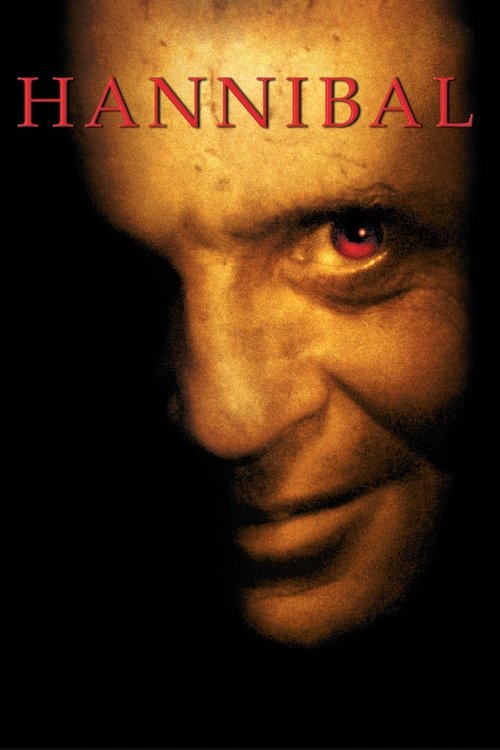
Hannibal
2001 · Ridley Scott
For when you want horror with velvet upholstery — something lavish, macabre, and unashamed of its excesses. Reach for it on a night you want to be scandalized rather than merely scared; the squeamish should sit this one out.
What it's about
A decade after escaping custody, Hannibal Lecter is living elegantly in Italy under a false name, passing as an art scholar — until someone recognizes him and the hunt resumes. Back in America, Clarice Starling's FBI career is being dismantled by a vindictive rival, and one of Lecter's surviving victims, hideously disfigured and obscenely rich, is plotting an elaborate revenge. All three orbits start to converge.
The experience
Opulent and grisly in equal measure — a slow, perfumed thriller that keeps erupting into genuinely shocking violence. It's less about suspense than about lurid spectacle: you watch it wide-eyed, half-seduced and half-appalled.
Performances
Anthony Hopkins returns to Lecter with relish, playing him now as a courtly predator at leisure, and Julianne Moore brings a bruised, flinty resolve to a Clarice Starling under siege from her own institution.
The craft
Ridley Scott shoots it like a Renaissance painting gone rotten — candlelit Italian piazzas, opera, and old-master compositions framing outbursts of Grand Guignol gore. It's a feast for a big screen and good speakers, gorgeous right up until it makes you look away.
Why it matters
A huge, hotly debated hit that transformed a taut procedural franchise into baroque horror-opera, cementing Lecter as a pop-culture icon big enough to carry a film as its dark star rather than its monster.
Snapshot
Hannibal is the decade-delayed sequel to Jonathan Demme's The Silence of the Lambs (1991), and the strangeness of that lineage defines it. Where the earlier film was a taut, interiorized procedural that won the five major Academy Awards, Hannibal is a lavish, operatic horror-spectacle steeped in Renaissance art, Old World decay, and graphic Grand Guignol. Adapted from Thomas Harris's 1999 novel, it reunites Anthony Hopkins as Dr. Hannibal Lecter but recasts the central role of Clarice Starling — Jodie Foster did not return — with Julianne Moore. Ridley Scott, coming directly off Gladiator (2000), brought a painterly, monumental sensibility that recast the franchise as a perverse aesthete's fairy tale. The result divided critics and delighted audiences, opening to enormous business while drawing sharp debate about its gore, its moral posture toward its monster, and the changes it made to Harris's already polarizing source. It is best understood as a transitional sequel: a film about appetite, taste, and connoisseurship, made by filmmakers consciously elevating pulp into something baroque.
Industry & production
The project's gestation was driven less by an auteur's passion than by the gravitational pull of a literary event. Producer Dino De Laurentiis, who controlled the film rights to the Lecter character (he had produced Michael Mann's 1986 Manhunter, the first screen Lecter), held the property and pushed the sequel forward when Harris finally delivered his long-awaited novel in 1999. The book's commercial success made a film inevitable, but the key creative principals of Silence declined to return. Demme passed, reportedly uneasy with the material's violence and trajectory; Foster, the actress most identified with Starling, also declined, citing scheduling and — by various accounts — discomfort with the character's arc, though the precise weighting of her reasons remains a matter of secondhand report rather than settled record. Scott was approached and committed after Gladiator, and Julianne Moore was cast as Starling.
The screenplay passed through notable hands: David Mamet wrote an early draft, and Steven Zaillian (Schindler's List) substantially rewrote it; both share screen credit. Their central problem was the novel's notorious ending, in which Starling, drugged and psychologically reconfigured, becomes Lecter's willing companion. The filmmakers rejected this resolution as untenable for the screen Starling, substituting a climax in which she resists him — Lecter escaping after severing his own hand rather than hers. The change is the single most consequential adaptation decision in the film and the clearest sign of the production negotiating between Harris's transgression and mainstream expectations.
Financing and distribution were split: MGM and Universal shared the picture, reflecting the franchise's tangled rights history. The film was shot substantially on location in Florence and at sites evoking Washington and Virginia, with interiors and the climactic dinner sequence staged on built sets. Released in February 2001, it became a major commercial success and one of the strongest openings of that season; precise grosses should be checked against trade records rather than asserted here, but the picture was unambiguously a hit, validating the gamble of a prestige-scaled horror sequel.
Technology
Hannibal was made within a largely photochemical, 35mm tradition, and its visual ambition is rooted in classical craft — lighting, lenses, and production design — rather than digital novelty. Where effects appear, they serve grotesque set-pieces: prosthetic makeup for Mason Verger's ruined face (Gary Oldman beneath extensive appliances) and the practical-plus-digital execution of the film's signature horrors, including the climactic scene of Lecter feeding a sedated man portions of his own exposed brain. That sequence combines animatronic and prosthetic work with digital cleanup; the film leans on tactile, physical effects supervised by experienced makeup and creature artists rather than wholesale CGI, consistent with Scott's preference for in-camera substance. The Florentine sequences exploit real architecture and natural and practical light, and the period of production sits just before the wholesale digital-intermediate workflows that would soon standardize feature color grading, so the film's lushness is largely an achievement of optics and laboratory timing rather than software.
Technique
Cinematography
John Mathieson, fresh from Gladiator, shot the film, and his work is the production's signal achievement. The Florence material is rendered in warm, golden, almost edible light — amber stone, candle-glow interiors, the saturated dark of the opera and the Capponi library — establishing a visual rhetoric of beauty as Lecter's natural habitat. Mathieson and Scott repeatedly frame the doctor within compositions borrowed from painting and architecture, so that his refinement is argued visually before it is spoken. By contrast the American scenes carry a cooler, harsher institutional palette. The camera is mobile but composed, favoring elegant craning and tracking over the handheld intimacy Demme used; the effect is to make us observers of a spectacle rather than participants in a hunt.
Editing
Pietro Scalia, another Gladiator collaborator and a two-time Oscar winner, cut the film. His editing sustains a deliberate, almost stately rhythm across the long Florence midsection — patient enough to let suspense build through Inspector Pazzi's surveillance of Lecter — then tightens for the set-pieces of violence. Scalia's challenge was structural: the narrative braids three locations and several agendas (Verger's revenge, Pazzi's greed, Krendler's malice, Starling's disgrace) before converging, and the cutting works to keep these threads legible while preserving the film's unhurried, savoring tone.
Mise-en-scène / staging
Production and costume design carry much of the film's meaning. Florence is staged as a living museum, its art and history continually implicating Lecter as a creature of high culture; the hanging and disembowelment of Pazzi from the Palazzo Vecchio deliberately rhymes with the historical fate of his ancestors in the 1478 Pazzi conspiracy against the Medici, a piece of staging that fuses scholarship and atrocity. Verger's estate, with its decaying grandeur and its trained, man-eating boars, is staged as gothic excess. Throughout, Scott composes around thresholds, frames, and reflective surfaces, presenting violence as a kind of curated tableau.
Sound
Hans Zimmer's score is central to the film's elevated register. It draws on classical sources — most famously the Aria from Bach's Goldberg Variations, associated with Lecter since Silence — and features "Vide Cor Meum," an aria composed by Patrick Cassidy with Zimmer, with a text drawn from Dante's La Vita Nuova, performed in the film's Florentine opera sequence. The choice binds Lecter to Dante's poetry of consuming love and situates his sensibility within a European high-art tradition. Sound design elsewhere is precise and often restrained, letting silence and ambient detail sharpen the moments of shock.
Performance
Hopkins returns to Lecter with the role now fully iconic, and his performance leans further toward seductive control and dark wit than the caged menace of 1991; the danger is more dispersed, the charm more foregrounded. Moore's Starling is grounded, weary, and principled, building a credible continuity with Foster's character while making the role her own under impossible comparison. Giancarlo Giannini gives Pazzi a poignant, fatal venality; Ray Liotta plays the loathsome Justice Department official Paul Krendler; Gary Oldman, heavily disguised and initially uncredited, makes Mason Verger a grotesque of pure malice; Frankie Faison reprises Barney, one of the few returning faces.
Narrative & dramatic mode
The film operates in a register of gothic melodrama and dark fairy tale rather than the realist thriller mode of its predecessor. Its dramatic engine is not detection but pursuit and temptation: multiple parties hunt Lecter for incompatible reasons, while the central, slow-burning question is the nature of his bond with Starling. The narration is dispersed across locations and points of view, and the storytelling savors atmosphere and tableau over momentum. This is a deliberate inversion of Silence's claustrophobic two-hander; Hannibal is expansive, even leisurely, more interested in the texture of Lecter's world and the moral squalor surrounding Starling than in conventional suspense mechanics.
Genre & cycle
Hannibal sits at the intersection of the serial-killer thriller, gothic horror, and the prestige literary adaptation. It belongs to the Lecter screen cycle — Manhunter (1986), The Silence of the Lambs (1991), Hannibal (2001), and the later Red Dragon (2002) and Hannibal Rising (2007), with the television series Hannibal (2013–15) extending the figure further. Within that cycle it marks the pivot at which Lecter shifts from supporting antagonist to center of gravity, and the franchise tilts from procedural toward baroque horror. It also reflects the turn-of-the-millennium taste for elevated, art-conscious genre filmmaking, treating pulp horror with operatic seriousness.
Authorship & method
The film is a Ridley Scott production in its visual monumentality and its conviction that genre material rewards painterly scale. Scott's method here — assembling a trusted craft team carried over from Gladiator (Mathieson, Scalia, and Zimmer) — produces a coherent house style of golden light, classical music, and composed violence. Authorship, however, is genuinely shared and contested. The screenwriters Mamet and Zaillian shaped the film's most debated departure from Harris; producer De Laurentiis was the prime mover and rights-holder; Hopkins's star authorship over the Lecter character is itself a creative force the film must accommodate. The collaboration of composer and director is especially load-bearing: the integration of Dante, Bach, and original aria writing is as much an authorial statement as any image.
Movement / national cinema
Hannibal is a studio-financed American production, but it is consciously Europhile, with a substantial Italian setting, Italian collaborators (Giannini), and a sensibility steeped in Renaissance art and European opera. It does not belong to a film movement; rather it exemplifies a strain of internationalized Hollywood prestige filmmaking around 2000 that drew on European locations and high-cultural reference to lend genre material gravitas. Scott, an English director working within the American studio system, is himself emblematic of that transatlantic mode.
Era / period
The film arrives at the start of the 2000s, a decade that would see the serial-killer thriller both peak and mutate, and just before the full digital transformation of theatrical production. It reflects late-period analog craft and a pre-9/11 confidence in lavish, transgressive spectacle. It is also a product of franchise consciousness at a moment when studios were aggressively mining established literary and cinematic properties; Hannibal is among the more prestige-minded examples of that impulse, distinct from the cheaper horror sequels of its era by virtue of its budget, talent, and ambition.
Themes
The film's governing theme is appetite refined into connoisseurship — the unsettling continuity between high culture and cruelty. Lecter is figured as the perfect aesthete whose taste in music, art, and food is inseparable from his cannibalism; the film repeatedly stages beauty and horror in the same frame to implicate refinement itself. Related themes include corruption and hypocrisy (Krendler, Verger, and Pazzi are each morally rotten, so that Lecter's selective predation reads as a grotesque form of judgment), revenge, and the disgrace of the principled woman within institutions run by venal men. Above all the film concerns temptation: Lecter's project is less to harm Starling than to seduce her into recognizing the corruption around her and crossing toward him — a dynamic the film treats as a dark courtly romance, underscored by its Dantean music.
Reception, canon & influence
Critically, Hannibal was sharply divided and is generally regarded as a lesser work than The Silence of the Lambs. Detractors objected to its extreme gore, its perceived indulgence of Lecter as antihero, and the loss of the procedural tension and moral seriousness that distinguished Demme's film; admirers praised Scott and Mathieson's visual command, Zimmer's score, and the film's willingness to pursue a genuinely operatic, perverse vision. Commercially it was a strong success, demonstrating the enduring draw of the character and of Hopkins's performance.
Looking backward, the film's influences are layered: most immediately Demme's Silence and Mann's Manhunter; Harris's novel and its saturation in Dante, Florentine history, and Renaissance art; and a broader gothic and operatic tradition that Scott channels through European location and classical music. The Pazzi sequence's grounding in real fifteenth-century history exemplifies the source material's habit of fusing erudition with horror.
Looking forward, Hannibal helped consolidate Lecter as a culture-spanning icon and arguably licensed the further mythologizing of the character. It was followed by Brett Ratner's Red Dragon (2002), a return to the Silence-era register, and Hannibal Rising (2007), an origin story; the most significant downstream descendant is Bryan Fuller's television series Hannibal (2013–15), whose lush, aestheticized, art-conscious treatment of the character owes an evident debt to Scott's vision of Lecter as connoisseur. Within film history Hannibal stands as a fascinating, flawed elevation of pulp — a sequel that chose excess and beauty over restraint, and whose reputation remains contested precisely because of that choice.
A Deleuzian reading
Start with the body of Inspector Pazzi swinging from the Palazzo Vecchio, viscera unspooling onto the floodlit stone, the very wall his ancestor was hanged from in 1478.
The full Deleuzian reading of Hannibal →
Reception
It opened to a record-breaking February box office in 2001 but critics recoiled, calling it a lurid betrayal of The Silence of the Lambs; two decades on, it's been steadily reappraised as a gorgeous, operatic gothic — Grand Guignol as art film.
How Hannibal was received, from release to now →
Influences: the films it descends from and the films it influenced
- The Silence of the Lambs (1991) — Establishes Hopkins's Lecter and Demme's flat-on, eyeline-matched direct-address close-ups, which Scott inherits and inverts from procedural restraint into operatic indulgence.
- Manhunter (1986) — First screen incarnation of the character (Lecktor) and the serial-killer-as-cold-aesthete framing that Scott escalates into full connoisseurship.
- Gladiator (2000) — Supplies the exact carried-over craft team — DP John Mathieson, editor Pietro Scalia, composer Hans Zimmer — and the golden-light painterly monumentality applied here to genre horror.
- Blade Runner (1982) — Scott's signature atmospheric chiaroscuro and slow craning/tracking camera gliding over densely textured environments, recycled as the Florence connoisseur's gaze.
- The Conformist (1970) — Vittorio Storaro's painterly, architecturally framed compositions and curated period tableaux that Mathieson's saturated Florentine interiors directly echo.
- The Godfather (1972) — Gordon Willis's amber low-key palette and the operatic cross-cut climax (baptism/murder) modeling Scott's braided structure and composed, ceremonial violence.
- Death in Venice (1971) — Classical-music-scored decadent connoisseurship and the aestheticization of an old European city as a stage for refined mortality and temptation.
- Barry Lyndon (1975) — Stately editing rhythm and Old-Master tableau compositions scored to pre-existing classical pieces, the template for Scott's gallery-painting staging.
- Suspiria (1977) — Italian baroque-horror tradition in which gore is staged as saturated, operatic set-piece spectacle rather than realist shock.
- Red Dragon (2002) — Immediate franchise sequel reverting to the Silence procedural register but trading entirely on Hannibal's consolidation of Hopkins-as-Lecter icon.
- Hannibal Rising (2007) — Origin myth extending the Renaissance-erudition-meets-horror aesthetic and European-location refinement Scott foregrounded.
- Hannibal (TV) (2013) — The fullest downstream extension: lush, art-conscious aestheticization of Lecter and elaborate corpse-as-tableau staging directly indebted to Scott's connoisseur vision.
- Bram Stoker's Dracula (1992) — Gothic-operatic monster recast as courtly seducer, with the temptation/courtly-romance register and lush orchestral scoring Scott applies to Lecter and Clarice.
- Se7en (1995) — Murders staged as deliberately authored compositions, advancing the killer-as-erudite-artist whose crimes demand curatorial reading.
- The Cell (2000) — Contemporaneous treatment of a killer's interior world as painterly curated tableaux, sharing the era's turn toward beautifying murder.
- Pan's Labyrinth (2006) — Fuses erudition (folklore) with grotesque beauty through painterly golden-amber compositions and violence framed as composed, fairy-tale-baroque spectacle.
Similar films
- The Silence of the Lambs (1991) — influence & lineage
- Manhunter (1986) — influence & lineage
- Suspiria (1977) — influence & lineage
- Gladiator (2000) — influence & lineage
- Bram Stoker's Dracula (1992) — influence & lineage
- The Godfather (1972) — influence & lineage
- Deep Red (1975) — same viewing thread
- The Cook, the Thief, His Wife & Her Lover (1989) — shared sensibility
All the films related to Hannibal →
Watch it with: curated runs of related films
- The Killer You Can't Look Away From — A run of murder mysteries where obsession — the witness's, the investigator's, the killer's own — curdles into pure style, from the gloved-hand giallo that invented the look to the modern heirs still working the vein.