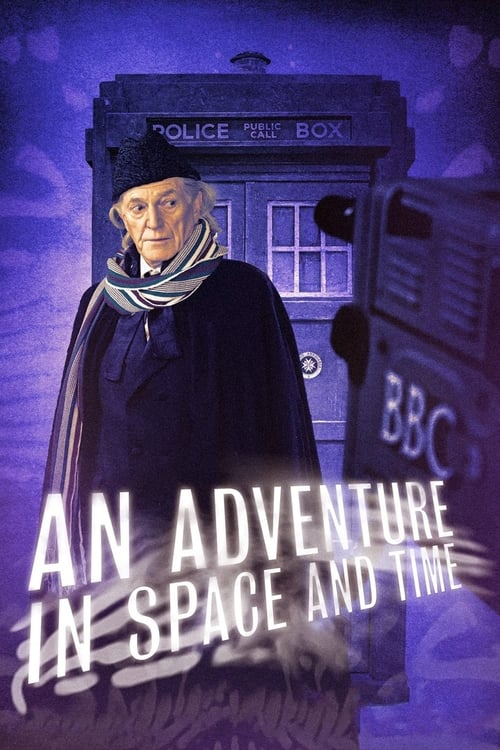
An Adventure in Space and Time
2013 · Terry McDonough
For a cozy night in when you want to be moved by people making something against the odds — comfort viewing with a real lump in the throat. Reach for it when you're nostalgic for the messy, hopeful beginnings of things.
What it's about
London, 1963. William Hartnell is a character actor weary of playing sergeants and thugs; Verity Lambert is a young woman the BBC keeps passing over. Both get their shot at the same unlikely project: a Saturday tea-time science fiction serial nobody at the corporation believes in. The film follows the scrappy team — Lambert as the BBC's first female drama producer, novice director Waris Hussein, and blustery drama chief Sydney Newman — as they will Doctor Who into existence, and Hartnell as the role of a lifetime slowly becomes his whole life.
The experience
Warm, funny, and quietly heartbreaking — it starts as a plucky underdog workplace story and deepens into an elegy about what it costs to be loved for one thing. Even if you've never seen a minute of Doctor Who, the last stretch lands hard.
Performances
David Bradley is extraordinary as Hartnell, playing the gruffness, vanity, and growing tenderness of a man who found late-life joy in a children's hero — and the terror of losing it. Jessica Raine gives Verity Lambert a bright, determined charm that carries the film's first half.
The craft
Mark Gatiss's script is a love letter written with clear eyes, and the production lovingly rebuilds 1963 television — cramped studios, wobbling sets, cigarette haze — so you feel how handmade early TV really was. The recreations of the original series' first days are done with museum-level care and real affection.
Why it matters
Broadcast as the centerpiece of Doctor Who's fiftieth anniversary, it reframed the show's origin as a story about outsiders — a woman, a young Indian director, an aging actor — and restored Verity Lambert's place in television history for a mass audience.
Snapshot
An Adventure in Space and Time is a feature-length British television drama, written by Mark Gatiss and directed by Terry McDonough, made by BBC Cymru Wales and broadcast on BBC Two on 21 November 2013 as the centerpiece of the corporation's fiftieth-anniversary celebration of Doctor Who. It dramatizes the show's origins in 1963, centering on two outsiders inside the BBC: William Hartnell (David Bradley), the character actor typecast in tough-guy parts who became the program's first Doctor, and Verity Lambert (Jessica Raine), the BBC's youngest and first female drama producer. Around them move Canadian Head of Drama Sydney Newman (Brian Cox), who conceived the series, and director Waris Hussein (Sacha Dhawan), who made its first episodes. Elegiac rather than triumphalist, the film is at once a making-of story and a study of aging, replacement and the accidental birth of something that outlives its makers. It is best understood not as cinema in the theatrical sense but as prestige anniversary television — a love letter written with unusual craft.
Industry & production
The film is a product of the modern Doctor Who production apparatus turned upon its own past. It was made by BBC Cymru Wales — the Cardiff-based operation that has produced the revived series since 2005 — which gave the production institutional access to props, design references and continuity knowledge that an outside company could not have matched. Mark Gatiss, a writer and actor on the revived series and a lifelong fan, had championed the project for years; he wrote the script and served as an executive producer alongside then-showrunner Steven Moffat, with Matt Strevens producing. The commission was explicitly tied to the fiftieth anniversary and was timed to sit beside the anniversary special The Day of the Doctor, forming part of a coordinated BBC event.
The economics are those of British public-service television rather than the feature market: there is no box office to report, and I will not invent viewing figures, but the film was positioned as a flagship anniversary broadcast on BBC Two and later circulated internationally (including via BBC America) and on home video. Its production challenge was one of reconstruction — recreating early-1960s BBC television-making, from Lime Grove and the old Television Centre milieu to the original TARDIS control room and the first Daleks — on a television budget and schedule. That the show's own custodians controlled the archive and the intellectual property made this feasible.
Technology
As a 2013 production the film was shot digitally and finished for high-definition broadcast, consistent with BBC drama practice of the period; I have no specific camera or lens documentation to cite and will not fabricate a package. Its more interesting technological dimension is diegetic: the film is partly about the technology of 1963 television. It stages the world of live and as-live videotape production, multi-camera studio shooting, the physical construction of sets and the electronic sorcery of the BBC Radiophonic Workshop, whose realization of Ron Grainer's theme (associated with Delia Derbyshire) is treated as one of the era's small miracles. The production's task was to render obsolete broadcast technology convincingly — cameras, monitors, gallery equipment — as period texture, and to reproduce props (the console, the Daleks) that are themselves now cultural artifacts. The contrast the film draws is thematic as much as technical: fragile, ephemeral early television giving rise to something permanent.
Technique
Cinematography
The film's visual strategy is warm, burnished and period-conscious, favouring the golden, slightly nostalgic palette common to BBC memory-dramas of the era rather than a documentary flatness. Interiors of studios and BBC corridors are lit to feel both institutional and intimate, and the camera tends toward classical coverage — controlled, unshowy, organized around performance and faces. I do not have a reliable director-of-photography credit in recall and will not attribute one rather than risk error, but the discernible approach is one of restraint: the images serve the actors and the reconstruction, and the film reserves its rare stylistic flourishes for emotionally charged moments.
Editing
The cutting follows a conventional, legible biographical-drama rhythm, tracking the parallel arcs of Lambert's rise and Hartnell's decline across roughly a decade. It is patient in its dialogue scenes and builds cumulative feeling rather than momentum. The most celebrated editorial gesture is the film's closing juxtaposition, which cuts across fifty years of the program's history in a single emotional bridge — a montage-and-match strategy that fuses 1966 and 2013. I cannot confirm the editor's name from memory and decline to guess.
Mise-en-scène / staging
Reconstruction is the film's central craft achievement, and its production and costume design carry much of the load: the early-sixties BBC is realized in wood-panelled offices, smoke-filled galleries, studio floors and the fabricated TARDIS interior. Staging repeatedly places its protagonists as outsiders within these spaces — Lambert framed against rooms full of older men, Hussein marked as the young Indian-born director in an overwhelmingly white institution, Hartnell increasingly isolated within the very world he helped create. The recreated Dalek and console sequences are staged with fannish precision but also with an awareness of their strangeness, so that the audience sees these now-iconic objects through the doubtful eyes of the people inventing them.
Sound
Sound design leans on period specificity — the clatter of studio production, the textures of the Radiophonic Workshop — and above all on the Doctor Who theme itself, whose eerie electronic swoop functions as both historical subject and emotional trigger. The film's original score (credited, to the best of my recall, to Edmund Butt, though I flag some uncertainty on the crew credit) works in a restrained, melancholic register, ceding pride of place to Grainer's theme at key moments. The soundtrack thus does double duty: reconstructing the show's sonic birth and mobilizing the audience's memory of it.
Performance
Performance is the film's greatest strength. David Bradley's William Hartnell is its center — a portrait of a prickly, insecure, physically declining actor who finds unexpected tenderness and belonging in the role, and whose fear of being discarded gives the film its tragic weight. Jessica Raine plays Verity Lambert with poise and steel, resisting caricature as either victim or trailblazer. Brian Cox brings brisk, cigar-chewing charisma to Sydney Newman, and Sacha Dhawan gives Waris Hussein a watchful sensitivity. The ensemble is populated with recognizable British character actors, and the film draws poignancy from casting performers to play the original Doctor Who company. Bradley's work in particular was singled out, and it carried a striking afterlife (see Reception).
Narrative & dramatic mode
The film operates in the mode of the biographical "making-of" drama, structured as intertwined character studies rather than a plot-driven account of a television production. Its dramatic engine is dualistic: the ascent of Verity Lambert, breaking a professional glass ceiling, set against the slow fall of William Hartnell, whose triumph in the role curdles into ill health, difficulty and enforced departure. The tone is nostalgic and elegiac, and the narrative is candid about failure and loss — creative compromise, institutional condescension, the indignity of being written out. Gatiss's screenplay uses the well-known milestones of the show's early history as beats but keeps the emotional focus on interior experience: the loneliness of the pioneer and the terror of obsolescence. The result is a memory-drama that treats television history as human tragedy softened by affection.
Genre & cycle
An Adventure in Space and Time belongs to a distinctly British television genre: the dramatized account of the making of a beloved cultural institution. It sits directly alongside The Road to Coronation Street (2010), which likewise cast a woman producer as the protagonist of a founding-of-a-program story, and within the broader BBC tradition of biographical dramas about entertainment history (the run of BBC Four films about figures such as Kenneth Williams, Tony Hancock and the Steptoe and Son actors). It also arrives in the same year as the theatrical Saving Mr. Banks, part of a wider early-2010s appetite for behind-the-scenes stories about the origins of cherished popular art. Within these cycles the film distinguishes itself by its double focus on a female pioneer and a dying leading man, and by the meta-layer of being made by the very franchise it depicts.
Authorship & method
The controlling authorial voice is Mark Gatiss (writer/executive producer), whose fandom, historical knowledge and affection shape the film's every choice; it is as much an act of curatorship as of screenwriting, and its authority derives from Gatiss's insider standing within Doctor Who. Terry McDonough, an experienced television director, executes the material with tact, keeping the reconstruction from tipping into pastiche and foregrounding performance. Executive producer Steven Moffat, then running the parent series, lent the project institutional weight, and producer Matt Strevens managed its realization. Below the line, the film's method is one of meticulous reconstruction — production and costume design recreating the period BBC, props teams rebuilding the console and Daleks. I have thin reliable recall of the individual cinematographer, editor and composer credits and have chosen to flag that uncertainty rather than assign names I cannot verify; the surviving impression is of a craft team serving the script's dual demands of historical fidelity and emotional intimacy.
Movement / national cinema
The film is squarely a work of British public-service television, not of any cinematic movement. It embodies the BBC's long tradition of authored single dramas and prestige factual-adjacent drama, and it is inseparable from the specific institution it portrays — a self-reflexive artifact in which the national broadcaster dramatizes its own history. Its sensibility, its funding model, its broadcast context and its cultural assumptions are all national in the most literal sense: it addresses a British audience's collective memory of a program woven into the country's Saturday-evening life.
Era / period
Two eras are in play. The film was made in 2013, at the height of the revived Doctor Who's cultural prominence and amid a wider vogue for origin-story dramas. Its setting is the early-to-mid 1960s — 1963 and the years immediately following — a period the film treats with both fidelity and gentle critique: the casual sexism Lambert confronts, the racial singularity of Hussein's position, the deference of institutional hierarchy. The gap between the two eras is itself the film's subject, and its final passage collapses the fifty intervening years into a single emotional gesture.
Themes
The film's dominant theme is mortality and replaceability. Hartnell's departure from the role — the show's on-screen "regeneration" allowing the character to continue in another body — becomes a mirror for the actor's own displacement, and the drama treats being written out, replaced and forgotten as a species of death. Running alongside is the theme of the outsider: Verity Lambert as a woman in a man's institution, Waris Hussein as an immigrant in a white one, Hartnell as an aging man clinging to relevance. Nostalgia and ephemerality structure the whole: the paradox that fragile, throwaway television gave rise to something enduring, and the bittersweet awareness that the people who made it did not know what they were making. Finally, the film celebrates creative collaboration — the unlikely alliance of misfits who, together, build something none could have built alone.
Reception, canon & influence
Critically, the film was warmly received as one of the strongest tributes of the anniversary year, praised in particular for its screenplay's balance of affection and honesty and for David Bradley's performance as Hartnell, widely regarded as its finest element. Reviewers responded to its emotional generosity and its refusal to sentimentalize the industry's treatment of its pioneers. I will not cite specific ratings figures or awards I cannot verify, but its standing as a fan-and-critic favorite of the anniversary is secure.
Influences on the film (backward): it draws on the British making-of-drama tradition exemplified by The Road to Coronation Street, on the BBC Four biographical-drama cycle, and on the archive and iconography of Doctor Who itself — the theme music, the Daleks, the TARDIS — as both source material and emotional vocabulary. Its release alongside Saving Mr. Banks situates it within a shared moment of interest in the origins of popular art.
Legacy (forward): the film's most remarkable afterlife is a matter of casting becoming canon. David Bradley's portrayal was so admired that he was later cast as the First Doctor within the actual series — reprising William Hartnell's character opposite Peter Capaldi in the 2017 Christmas special — a rare case of a docudrama performance folding back into the fiction it depicted. More broadly, the film consolidated a model for how a franchise can dramatize and honor its own history, and it endures as the definitive screen account of Doctor Who's creation and of Verity Lambert's and Waris Hussein's foundational, long-underacknowledged roles. As anniversary television that outgrew its occasion, it has become a small classic of the making-of genre in its own right.
Reception
A warmly received centerpiece of Doctor Who's 50th anniversary in 2013, it's grown even more beloved since — fans now watch it as an accidental prophecy, given how many of its cast were later pulled into the show itself.
How An Adventure in Space and Time was received, from release to now →
Influences: the films it descends from and the films it influenced
- The Road to Coronation Street (2010) — The direct template Gatiss follows: a BBC single-drama reconstruction of the birth of a British television institution that dramatizes the off-screen commissioning battles and casting struggles with warm, exacting period fidelity rather than nostalgia alone.
- Ed Wood (1994) — Gatiss-acknowledged model in which Martin Landau's fading Bela Lugosi — an aging actor confronting obsolescence — supplies the exact template for Bradley's Hartnell, and both films locate real pathos in cheap, hand-built genre production.
- Sunset Boulevard (1950) — Supplies the mortality-and-replaceability engine: the industry's quiet disposal of its own pioneers and the performer clinging to a role that the machine has already moved past.
- Kenneth Williams: Fantabulosa! (2006) — Exemplar of the BBC Four biographical-drama cycle the film descends from — an actor impersonating a beloved British performer to expose the private melancholy hidden behind public affection.
- The Curse of Steptoe (2008) — BBC backstage tragedy about the making and unmaking of a TV institution, establishing the elegiac single-drama register and the honesty-about-cruelty tone that Gatiss's screenplay balances against affection.
- Shadow of the Vampire (2000) — A making-of reconstruction of a landmark early genre production (Nosferatu) that foregrounds the physical labor, improvisation and myth of pioneering low-tech filmmaking — the same fascination with how the artifact was actually built.
- RKO 281 (1999) — Docudrama of a single production battle (Citizen Kane) staged inside a studio hierarchy, dramatizing creative outsiders against institutional power — the Lambert/Hussein-versus-BBC dynamic in embryo.
- My Week with Marilyn (2011) — Meticulous on-set reconstruction of a real production delivered through an outsider's framing perspective, the same device Gatiss uses to give the audience a way into the studio floor.
- The Disaster Artist (2017) — Extends the making-of-with-affection method: an actor scrupulously recreating a real filmmaker on a rebuilt set, choosing tenderness toward flawed, low-budget creation over mockery.
- Stan & Ollie (2018) — Carries forward the elegiac register of aging performers facing obsolescence and mortality, with a lead impersonation prized as the film's finest element — the same tender end-of-career portraiture as Bradley's Hartnell.
- Film Stars Don't Die in Liverpool (2017) — A later British elegiac-memory drama built on the fading star confronting death and diminished relevance, using the nostalgic period palette and intimate two-hander pathos this film helped codify.
- Twice Upon a Time (2017) — The literal afterlife of the film's casting: Bradley's docudrama Hartnell is folded back into the fiction as the First Doctor, a docudrama performance becoming canon within the very series it reconstructed.
- Saving Mr. Banks (2013) — The explicit contemporaneous sibling — an origins-of-a-beloved-franchise drama released the same season that mines the personal cost and emotional history behind a piece of popular family art.
- Hitchcock (2012) — Making-of drama about the fraught birth of a genre landmark (Psycho) that centers the underacknowledged creative partner behind the credited auteur — structurally the same recovery of Verity Lambert's and Waris Hussein's erased authorship.
- The Five(ish) Doctors Reboot (2013) — The other 50th-anniversary metatext, turning the franchise's own production history and iconography into affectionate reconstruction — the same act of a series dramatizing itself that Gatiss's film performs in earnest.
Similar films
- Ed Wood (1994) — influence & lineage
- Sunset Boulevard (1950) — influence & lineage
- Galaxy Quest (1999) — shared sensibility
- About Time (2013) — shared sensibility
- Arrival (2016) — shared sensibility
- The Martian (2015) — shared sensibility
- The Oldest Person in the World (2026) — shared sensibility
- 1984 (1956) — shared sensibility