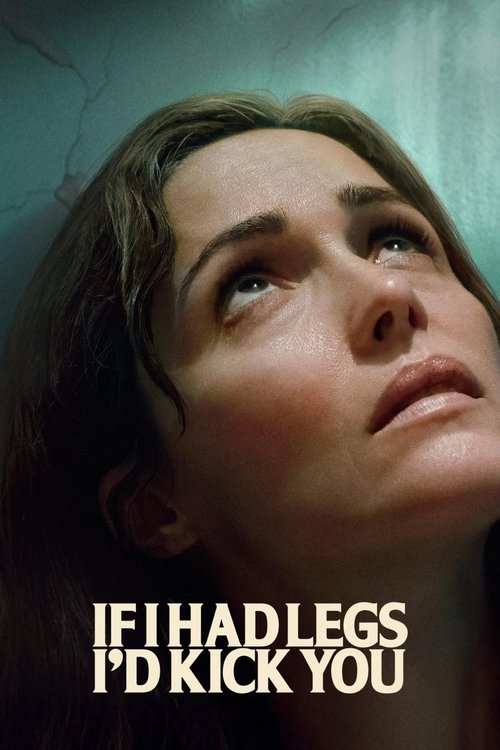
If I Had Legs I'd Kick You
2025 · Mary Bronstein
When you're craving intensity — something that grabs you by the collar and doesn't let go — or when you want motherhood shown with all the screaming panic movies usually sand off. Absolutely a challenge, not a comfort watch.
What it's about
Linda is a Long Island therapist whose life is collapsing on every front at once: her young child has a serious, mysterious illness no one can name, her husband is perpetually away, a burst pipe has driven mother and child out of their apartment and into a motel, and her sessions with her own therapist are curdling into open hostility. The film rides shotgun through her unraveling as she tries — furiously, imperfectly — to keep it all upright.
The experience
A sustained anxiety attack of a movie — claustrophobically close, darkly funny, and almost physically stressful, with flashes of surreal dread. It's exhilarating the way a held breath is; you come out shaken and a little grateful.
Performances
Rose Byrne is volcanic — a career-best performance delivered largely in unbroken close-up, funny and frightening and heartbreaking by turns; Conan O'Brien is startlingly effective cast against type as her needling therapist.
The craft
Mary Bronstein's boldest move is what she withholds: the camera presses relentlessly into Byrne's face while the sources of Linda's distress — most pointedly the sick child — stay offscreen or out of focus, so her panic becomes yours. The sound design does as much work as the images; watch it with good speakers and no distractions.
Why it matters
Arriving seventeen years after her micro-budget debut, it announced Bronstein as a major filmmaker and became one of the most argued-about portraits of motherhood in recent American cinema.
Snapshot
If I Had Legs I'd Kick You is Mary Bronstein's second feature as writer-director, arriving roughly seventeen years after her micro-budget debut Yeast (2008). It is a portrait of maternal breakdown rendered as sustained nervous-system assault: Linda (Rose Byrne), a therapist herself, tries to hold together a life that is collapsing along several axes at once — a child with a serious, ill-defined medical condition; a husband who is perpetually away; a flooded apartment that forces mother and child into a motel; and a fraying relationship with her own therapist. The film's signal formal gamble is one of withholding and proximity: it presses relentlessly close to Byrne's face while keeping the apparatus of Linda's distress — most pointedly the sick child — largely off-screen or out of focus, so that the audience experiences caregiving as a field of demands that never resolve into a visible object. The result is a comedy-adjacent drama of dread, closer in temperature to a panic attack than to the conventional "difficult mother" character study. It premiered at the Sundance Film Festival in January 2025 and was distributed by A24, with Byrne's central performance drawing the bulk of the critical attention and major festival awards.
Industry & production
The film sits squarely within a particular strain of American independent cinema: the post-Safdie New York milieu, in which abrasive, anxiety-driven realism is produced through small, trusted creative networks rather than studio infrastructure. Josh Safdie is among the producers, and the project's sensibility — claustrophobic, performance-forward, allergic to reassurance — is legible as kin to the Safdie brothers' work. A24 served as the film's distributor in the United States, placing it on the prestige-independent circuit alongside that company's other auteur-driven dramas.
Casting is one of the production's more striking decisions. Alongside Byrne, the film features Conan O'Brien — better known as a late-night television host than as a dramatic actor — in a substantial role as Linda's therapist, and the musician A$AP Rocky (Rakim Mayers) in a supporting role connected to the motel setting. These are casting choices that generate friction and unfamiliarity rather than star comfort, consistent with the Safdie-adjacent taste for using non-traditional or against-type performers to keep a scene unpredictable.
On the financial specifics — exact budget, precise box-office returns — the public record available to me is thin, and I will not invent figures. What can be said with confidence is that this is a modestly scaled independent production whose commercial profile was built around festival acclaim and a lead performance rather than spectacle.
Technology
If I Had Legs I'd Kick You belongs to the contemporary independent tradition that uses photochemical or photochemical-looking imagery and tight optics to produce intimacy and unease. The film's most discussed technological-aesthetic choice is its handling of focus and framing: extremely shallow planes, faces filling the frame, and a deliberate refusal to give the viewer clean establishing geography. Whether captured on film stock or digitally finished to read as grainy and tactile, the image is engineered to feel close, warm, and slightly suffocating rather than clinical. I should be candid that I cannot verify the exact capture format (specific camera bodies, stock, or lenses) from the established record, so I will not assert particulars; the salient point is that the technology is subordinated to a single expressive goal — keeping the spectator pinned inside Linda's perceptual bubble.
Technique
Cinematography
The cinematography is the film's defining technical signature. Shot by Christopher Messina — a cinematographer associated with this downtown-New York independent scene — the film commits to oppressive proximity: long-held close-ups on Byrne, frequently in motion, with the surrounding world reduced to smeared bokeh or fragments at the edge of frame. The camera tends to stay with Linda's body and face rather than cutting away to what she sees, so that other characters — the child above all — register as voices, hands, or blurred presences rather than fully visualized people. This is not coverage in the conventional sense but a sustained optical strategy: the audience is denied the relief of looking at the problem and is instead trapped with the person experiencing it. The handheld or semi-handheld restlessness reinforces a sense that there is no stable vantage from which Linda's situation could be surveyed and managed.
Editing
The cutting works against catharsis. Scenes tend to extend past the point of comfort, holding on Linda's reactions and on the dead air of bureaucratic, medical, and therapeutic encounters until the discomfort becomes the content. Rather than building toward clean dramatic beats, the editing accumulates pressure — one unresolved demand stacked on the next — so that the film's rhythm mimics the experience of a day in which nothing concludes and everything compounds. Transitions are often abrupt, dropping the viewer into a new crisis without orienting connective tissue, which sustains the sense of a life that has lost its load-bearing structure.
Mise-en-scène / staging
The film's spaces are central to its meaning. A flooded apartment displaces Linda and her child into a motel, and the motel becomes the film's primary stage: a transient, impersonal environment that externalizes Linda's loss of secure ground. Staging repeatedly isolates Linda within frames cluttered by the apparatus of care and crisis, and the recurring strategy of keeping the child unseen turns domestic space into something closer to a haunted or besieged interior — a home defined by an absent center. The choice to withhold the husband and to render the child as an off-screen source of need converts ordinary parenting locations into sites of dread.
Sound
Sound carries much of the film's anxiety. The child's needs, cries, and demands frequently arrive as off-screen audio, so that the soundtrack becomes the primary channel through which the caregiving emergency is felt — a constant, un-ignorable acoustic pressure. The film leans on this asymmetry between what is heard and what is shown. On the specifics of the musical score and its composer, I do not have reliable information and will not fabricate an attribution; what is clear is that the sound design's emphasis on intrusive, unresolved off-screen demand is integral to the film's effect.
Performance
The performances are the film's engine. Rose Byrne's Linda is a near-continuous study in barely managed disintegration — exhaustion, rage, guilt, and gallows wit held in unstable suspension — and the film's close-up grammar makes her face the literal landscape of the movie. The performance earned the film's most significant honors and was widely singled out by critics. Around her, Conan O'Brien's casting as the therapist supplies an unnerving register: a familiar comic presence redeployed as a figure of unhelpful authority, his ordinariness making the therapeutic encounters more uncomfortable rather than less. A$AP Rocky's supporting turn contributes to the film's texture of unpredictable, slightly off-kilter human contact.
Narrative & dramatic mode
The film operates in a mode of accumulating crisis rather than conventional plot. Its dramatic engine is not a quest or a mystery to be solved but the sheer density of simultaneous, irresolvable demands — a sick child, an absent spouse, a missing person, a hostile therapist, a destroyed home. The TMDB synopsis frames these as a checklist of catastrophes, but the film's organizing principle is subjective: events matter insofar as they press on Linda. This is closer to a clinical study of overwhelm than to melodrama. The withholding of key visual information — most importantly the child — is itself a narrative strategy, refusing the viewer the stabilizing knowledge that would let them assess the "true" severity of each crisis. We are kept, like Linda, in a state of not-quite-knowing, which is where the film locates its terror.
Genre & cycle
Nominally a drama, the film is most precisely described as an anxiety film or a maternal-horror-adjacent psychological drama with threads of bleak comedy. It belongs to a recent cycle of films that treat caregiving, domesticity, and mental load as sources of genuine dread — adjacent to the "elevated" maternal-horror conversation around motherhood and breakdown, but staying on the realist side of the line rather than crossing into the supernatural. Its closest generic kin are the Safdie brothers' pressure-cooker character studies and a broader contemporary tendency to render ordinary modern stress in the grammar of the thriller.
Authorship & method
Mary Bronstein is the film's authorial center as writer and director. Her debut Yeast (2008) established her within the same DIY New York independent circle that produced the Safdies, and If I Had Legs I'd Kick You reads as a return to feature direction with vastly amplified resources and ambition while preserving that scene's commitment to abrasive intimacy. Her method here is one of constraint as expression: the rigorous withholding of the child, the refusal of conventional coverage, and the decision to anchor nearly every shot to her lead actor's face are all authorial choices that subordinate plot to phenomenology.
Among collaborators, cinematographer Christopher Messina is the most consequential, translating Bronstein's withholding strategy into a coherent optical system of proximity and blur. Josh Safdie's role as producer situates the film within a specific aesthetic lineage. Rose Byrne functions as something close to a co-author of the film's effect, given how completely the movie is built around her presence. On the composer and editor, I do not have verified credits and decline to guess.
Movement / national cinema
The film is a product of contemporary American independent cinema, and more specifically of the downtown-New York, Safdie-adjacent strain that has become one of the most identifiable "movements" in 2010s–2020s US indie filmmaking. That strain is characterized by handheld intimacy, anxiety as primary affect, unconventional casting, and realist textures pushed toward the unbearable. If I Had Legs I'd Kick You extends this sensibility from the brothers' typically masculine, street-level milieus into the domestic and maternal, which is part of what makes it feel like both a continuation and an expansion of the school.
Era / period
Released in 2025, the film is firmly a work of its moment in two senses. Formally, it participates in the post-pandemic indie taste for claustrophobia, dread, and films built around a single overwhelmed consciousness. Thematically, it speaks to a contemporary discourse around caregiving burden, maternal mental health, the invisibility of domestic labor, and the failures of therapeutic and medical institutions to actually hold the people who lean on them. It reads as an artifact of a period acutely conscious of "mental load" as a cultural concept.
Themes
The film's central theme is the overwhelm of caregiving — the experience of being the load-bearing person for others' needs while one's own support structures (spouse, therapist, home) fail or vanish. From this flow several others: the invisibility and unrepresentability of maternal labor, literalized by keeping the dependent child off-screen; the inadequacy of the therapeutic relationship, embodied in a hostile or unhelpful therapist who mirrors Linda's own profession back at her; and the dissolution of secure domestic ground, staged through the flooded home and the displacement to a motel. Underneath runs a darkly comic strain about the absurdity of being asked to function normally inside an unsurvivable situation — the title itself gestures at impotent, frustrated aggression. The film is finally about the gap between how much a person is required to hold and how little visible acknowledgment that holding receives.
Reception, canon & influence
Critically, If I Had Legs I'd Kick You was received as a formally bold and emotionally punishing film anchored by an exceptional lead performance. It premiered at Sundance in January 2025 and was widely praised; Rose Byrne's work in particular drew strong notices and was recognized with major awards on the festival circuit, becoming the dominant point of critical consensus around the film. (Where I am uncertain of the exact award citations and statuettes, I flag that rather than risk misstatement, but the broad fact of significant festival recognition for Byrne is well established in the film's reception.)
Looking backward at influences on the film: the most direct lineage is the Safdie brothers' anxiety cinema (Good Time, Uncut Gems), with their producer-level involvement making the connection explicit, and behind that the broader tradition of John Cassavetes — especially A Woman Under the Influence — as the foundational American film about a woman's psychological unraveling within domestic and marital pressure. Bronstein's own Yeast and the DIY ethos of her independent cohort form the more immediate biographical antecedent. The strategy of withholding and off-screen dread also resonates with a wider contemporary interest in maternal horror and in films that locate terror in ordinary domestic life.
Looking forward, the film's legacy is still forming — too recent to assess with any finality. Its most likely contribution is as a high-profile demonstration that the Safdie-school grammar of proximity and dread can be turned on maternal and caregiving experience, and as a showcase that repositioned Rose Byrne, long associated with comedy, as a major dramatic performer. Whether it becomes a durable reference point for subsequent films about motherhood and mental load will depend on a reception history that has only begun. On any claim of specific downstream influence, the record is genuinely too early to support, and I leave it there rather than overstate.
A Deleuzian reading
The camera is too close.
The full Deleuzian reading of If I Had Legs I'd Kick You →
Reception
It premiered at Sundance 2025 as the festival's word-of-mouth endurance test, and within a year Rose Byrne had swept from Berlin's Silver Bear to a Golden Globe, an Indie Spirit and an Oscar nomination — critics were at 92% while audiences stayed far shakier, and it's already settling in as the defining 'anxiety cinema' entry of its year.
How If I Had Legs I'd Kick You was received, from release to now →
How to watch If I Had Legs I'd Kick You: what to notice on a first viewing
- Watch the camera stay locked on Linda's face. The film holds long close-ups on Rose Byrne, often in motion, while everything around her blurs into smeared bokeh at the edge of frame. You are kept inside her experience rather than given a clear view of the problem she is facing.
- Notice the child stays blurred or just out of frame. The camera almost never cuts away to what Linda sees, so the child registers only as hands, a voice, or an unfocused shape at the frame's edge. Withholding the person she is caring for turns caregiving into a demand you can never fully assess.
- Listen for the child's cries arriving without a picture. The child's needs and demands come through almost entirely as off-screen sound, so the soundtrack carries the emergency that the image withholds. You are asked to feel the weight of a crisis you are never allowed to see and judge for yourself.
- Watch a scene run past the point where it should end. The cutting holds on dead air in bureaucratic, medical, and therapeutic encounters, letting discomfort accumulate instead of resolving into a clean dramatic beat. The rhythm of the film starts to feel like the rhythm of a day in which nothing actually concludes.
- Notice the motel room's generic, impersonal furnishings. A flooded home pushes Linda and her child into a motel, a transient space that externalizes her loss of any secure ground to stand on. The setting itself becomes evidence that nothing in her life currently has a stable foundation.
The whole guide to watching If I Had Legs I'd Kick You, with the keys for a rewatch →
Influences: the films it descends from and the films it influenced
- A Woman Under the Influence (1974) — The template of building an entire feature around an actress's facial labor as she comes apart under domestic pressure, with handheld coverage that chases performance rather than blocking plot.
- Faces (1968) — Relentless grainy close-ups that crowd the frame with skin and reaction until psychological space replaces geographic space — the abrasive-intimacy grammar Bronstein inherits.
- The Passion of Joan of Arc (1928) — Severs the suffering face from any coherent surrounding geography, forcing the viewer into restricted knowledge of where the body actually is — the formal root of Bronstein anchoring nearly every shot to one face.
- Persona (1966) — Treats the female face as the film's entire landscape and uses optical abstraction (blur, isolation) to render a woman's interior crisis rather than illustrate it.
- Wanda (1970) — DIY 16mm handheld pursuit of a drifting, overwhelmed woman — the indie-female-authorship antecedent for Bronstein's constraint-as-expression method.
- Rosemary's Baby (1968) — Locates terror in ordinary domestic caregiving by restricting the audience to the mother's paranoid, partial knowledge — the maternal-horror withholding strategy.
- Yeast (2008) — Bronstein's own debut establishing her abrasive, claustrophobic close-quarters chamber style within the DIY New York scene that produced the Safdies.
- Heaven Knows What (2014) — The Safdies' proximity-and-dread system — long lenses pinned to a flailing protagonist, ambient chaos pressing in — that the producers carry directly into this film.
- Good Time (2017) — Anxiety cinema of unbroken proximity and escalating panic; Josh Safdie's producer role makes this the explicit grammatical parent of the seed's dread.
- Uncut Gems (2019) — The accumulating-crisis structure — overlapping dialogue, layered off-screen pressure, no relief — turned by Bronstein from gambling onto caregiving.
- We Need to Talk About Kevin (2011) — Maternal terror built from elision and subjective sound, withholding the crucial event so dread metastasizes in the mother's head rather than on screen.
- You Were Never Really Here (2017) — Pushes violence and event into off-screen space and substitutes a tactile, subjective sound design for coverage — the off-screen-audio device the seed leans on.
Similar films
- Room (2015) — same viewing thread · often watched together
- Anatomy of a Fall (2023) — same viewing thread · often watched together
- Beau Is Afraid (2023) — same viewing thread
- Hard Truths (2024) — same viewing thread
- Deaf (2025) — same viewing thread
- Persona (1966) — influence & lineage · often watched together
- Sorry, Baby (2025) — often watched together
- Urchin (2025) — often watched together
All the films related to If I Had Legs I'd Kick You →
Watch it with: curated runs of related films
- When the Family Comes Undone — Watch these when you want intimate, one-household dramas where love and grief are the same thing — a parent fading, a marriage on trial, a child at the center of the wreckage.