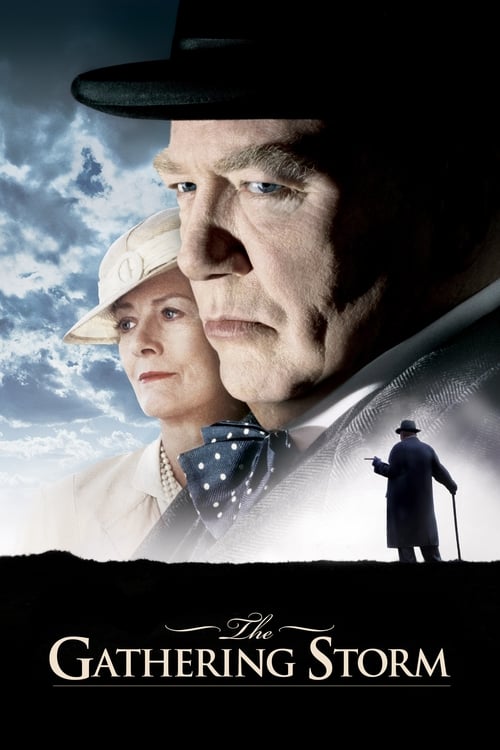
The Gathering Storm
2002 · Richard Loncraine
For a quiet, civilized evening when you want great actors going toe to toe in beautiful rooms — history as comfort viewing with real substance underneath. An easy watch that still gives you something to talk about after.
What it's about
In the mid-1930s, Winston Churchill is out of power, out of fashion, and nearly out of money — a backbench politician mocked for his warnings about German rearmament. The film follows him through these wilderness years at home in Chartwell, where his marriage to Clementine is both his refuge and its own quiet battlefield. It's the portrait of a famous man before the legend: painting, brooding, sneaking intelligence from sympathetic civil servants, and testing his wife's patience.
The experience
Intimate, talky, and surprisingly warm — more a marriage story than a war story, with flashes of wit and real melancholy. It moves at the pace of a good stage play and leaves you feeling you've actually met the man.
Performances
Albert Finney disappears into Churchill — the growl, the self-pity, the sudden charm — in what many consider the definitive screen version of the man, and Vanessa Redgrave matches him as Clementine, giving the marriage genuine friction and tenderness.
The craft
A BBC–HBO prestige production directed by Richard Loncraine with handsome period detail and a script that finds the drama in domestic life rather than speeches. Its strength is the writing's intimacy: the film trusts two faces in a room over spectacle.
Why it matters
A high-water mark of the prestige television film, widely garlanded on both sides of the Atlantic, and the standard against which later Churchill portrayals get measured.
Snapshot
The Gathering Storm is a prestige television film — a co-production of the BBC and the American premium cable channel HBO, with Scott Free (the Ridley and Tony Scott production company) attached — that dramatizes a circumscribed slice of Winston Churchill's life: the "wilderness years" of the mid-1930s, when he sat outside government, politically marginalized, and warned with mounting urgency about German rearmament. The title is borrowed directly from the first volume of Churchill's own six-part history The Second World War (1948), and the film is consciously a portrait of the man before the legend hardened — out of office, out of fashion, financially strained, and dependent on his marriage to keep his footing. Albert Finney plays Churchill and Vanessa Redgrave plays his wife Clementine, and the film's true subject, as the TMDB grounding note signals, is less the political thriller of leaked intelligence than the intimate weather of a long marriage under pressure. It premiered on HBO and the BBC in 2002 and was received as one of the most decorated television movies of its year, sweeping major Emmy categories and winning Finney a clutch of lead-actor awards. It is, in the taxonomy of British screen biography, a chamber piece about a public colossus.
Industry & production
The production sits at a specific and revealing institutional crossroads. By the early 2000s, HBO had established itself as the premier American home for the "event" television film — long-form, theatrically ambitious, built around marquee performances — and the BBC remained the world's most credentialed manufacturer of period biography and heritage drama. The Gathering Storm is a textbook fruit of that transatlantic marriage: British subject, British cast and crew, British locations and production craft, financed and distributed with American premium-cable money and reach. The involvement of Scott Free lent the project further commercial credibility. The economic logic is characteristic of the form: a television budget deployed with feature-film discipline, concentrated into a relatively short shooting schedule and a limited number of standing locations, with the bulk of the resources visibly channeled into casting, costume, and production design rather than spectacle. Where the historical record on precise budget figures is thin, I will not invent them; what is clear from the result on screen is the prestige-television model of front-loading prestige — securing actors of Finney and Redgrave's stature and surrounding them with a deep bench of British character players.
Technology
The Gathering Storm belongs to the last phase of the photochemical era of television production: it was made before digital acquisition had displaced film for high-end drama, and it bears the grain, latitude, and tonal warmth of a project shot on film stock and finished for broadcast. There is no technological novelty being foregrounded here — no innovation in capture or post-production that the film is "about" or that announces itself — and it would be dishonest to manufacture one. The relevant technological fact is rather a negative and contextual one: this is a production that uses entirely conventional, mature tools (film cameras, practical and supplemented period lighting, traditional art-department construction and dressing) in the service of historical illusion. Its ambitions are representational, not technical. The craft investment goes into the seamless reconstruction of a 1930s English world — Chartwell, Westminster, Foreign Office corridors — rather than into any apparatus that would call attention to itself.
Technique
Cinematography
The visual scheme is the disciplined, slightly burnished naturalism of upper-tier British period drama. The film favors warm, low-key interiors — firelit studies, lamplit drawing rooms, the amber gloom of Chartwell — against the cooler, harder light of public and official spaces, so that the architecture of the image quietly maps the film's central opposition between domestic refuge and political exile. The camera is patient and largely unobtrusive, organized around the actors; it frames Finney and Redgrave to let performance breathe, holding on faces and on the small physical business of a shared life. I cannot, with confidence, attribute the cinematography to a named director of photography without risking error, and I will not guess; the achievement on screen, regardless of attribution, is a controlled, classical photographic register that subordinates style to character.
Editing
The cutting is measured and theatrical in the best sense — it trusts scenes to run, gives dialogue its full arc, and resists the nervous compression of much contemporary television. The film cross-cuts between two registers: the marital and domestic on one side, and the political-conspiratorial thread of Churchill's clandestine information sources on the other, building a rhythm in which private intimacy and public dread are braided together. The pacing is deliberate, befitting a story whose tension is psychological and historical rather than kinetic.
Mise-en-scène / staging
This is where the film's resources are most visibly concentrated. Chartwell — Churchill's Kent home, with its gardens, brick-laying, study, and the famous menagerie of domestic detail — functions almost as a third lead, the physical embodiment of the man's appetites, anxieties, and need for a private kingdom while the public one rejects him. The staging repeatedly places Churchill within domestic frames (at table, in the bath, in his study) that humanize and shrink the monument, and the period decor is dense without tipping into museum sterility. The blocking is essentially that of a stage director: characters arranged for the play of voices and looks, with the household — servants, secretaries, family — populating the edges to establish the texture of a particular class and era.
Sound
The soundtrack works in the heritage-drama idiom: a score that underscores melancholy and resolve without overwhelming the drama, and a sound design attentive to the acoustic intimacy of interiors. Dialogue is paramount — this is a writer's and actor's film — and the mix privileges the spoken word and the small domestic sounds of a household over any large sonic effect. I cannot reliably attribute the musical score to a specific composer without risking error, so I leave that open rather than assert it.
Performance
Performance is the film's reason for being, and Finney's Churchill is its triumph. He resists pure impersonation: the voice, the stoop, the cigar and the growl are all present, but Finney plays the vulnerability beneath the icon — the depressive "black dog," the financial worry, the wounded pride of a man certain he is right and unable to make anyone listen. It is a portrait of greatness in eclipse, and it earned Finney the year's principal lead-actor honors in American and British television awards. Redgrave's Clementine is its essential counterweight: clear-eyed, exasperated, loving, the partner who manages the man's moods and finances and keeps him tethered. Their scenes together supply the film's emotional spine. Around them, a deep ensemble of British actors fills out the world; the production is also notable for including one of the final screen appearances of the comic actor Ronnie Barker, as a member of the Churchill household — a small role given quiet weight by the casting.
Narrative & dramatic mode
The dramatic mode is the intimate biographical chamber play. Rather than the cradle-to-grave sweep of conventional biopic, the script — by Hugh Whitemore, a dramatist long associated with intelligent, psychologically acute historical and biographical writing for stage and screen — chooses a tight window and a low-key key. Two narrative engines run in parallel: the marriage, with its strains, separations, and reconciliations, and the political thriller of Churchill's campaign against appeasement, fed by secret information about German rearmament passed to him by sympathetic insiders within Whitehall. The drama's tension comes not from whether Churchill is right — the audience knows the catastrophe that is coming — but from the spectacle of Cassandra-like foresight going unheard, and from the personal cost of that isolation. It is a tragedy played in reverse: we watch the man at his nadir, knowing his vindication lies just outside the frame.
Genre & cycle
The film belongs to the durable cycle of British heritage and biographical drama, and within that to the more specific lineage of Churchill portraiture, which has been a recurring fixation of British screen culture. It sits within HBO's parallel cycle of prestige historical television films of the late 1990s and 2000s. Its particular generic signature is the fusion of the marriage drama with the political-historical thriller — a hybrid that lets it satisfy both the appetite for intimate domestic realism and the appetite for the corridors-of-power intrigue of the appeasement era.
Authorship & method
The governing authorial intelligence is double: director Richard Loncraine and writer Hugh Whitemore. Loncraine is a versatile British filmmaker whose most celebrated prior work, the 1995 Richard III with Ian McKellen, demonstrated both his comfort with reframing English history and his actor-centered method; his subsequent career ranged across commercial features. His method here is self-effacing and performance-serving — he subordinates directorial flourish to the actors and the script, an approach well suited to material this dependent on two towering central turns. Whitemore's screenplay supplies the architecture: the choice of window, the braiding of private and public, the refusal of hagiography. On the specific identities of the cinematographer, editor, and composer I decline to assert attributions I cannot verify, in keeping with the principle of not inventing the record; what can be said with confidence is that the production assembled a high-caliber British craft team in the heritage-drama tradition and pointed all of it at the central performances.
Movement / national cinema
This is firmly a work of British national screen culture, made within and for the heritage tradition that British film and television have exported with singular success — the meticulous reconstruction of the national past, organized around class, institutions, and the English country house. But its hybrid financing marks it equally as a product of the transatlantic prestige-television economy of the early 2000s, in which British creative labor and subject matter met American premium-cable distribution. It is, in that sense, a characteristic artifact of a particular globalized moment in quality television.
Era / period
Two eras bear on the film. Its setting is the mid-1930s — the "low, dishonest decade," the years of appeasement, German rearmament, and Churchill's political exile — and the film is steeped in that period's atmosphere of complacency and gathering dread. Its moment of production, 2002, places it in the early-2000s flowering of the television film as a vehicle for serious, theatrically ambitious work, just before digital production and the long-form serial drama would reshape the landscape. The choice to dramatize the 1930s warnings carried, in 2002, an implicit resonance about the costs of ignoring foresight, though the film keeps such parallels submerged rather than declared.
Themes
The film's central theme is the private cost of public conviction: the toll that prophetic, unheeded warning exacts on a man and on the marriage that sustains him. Adjacent to it run several others — the loneliness of being right too early; the depressive temperament ("the black dog") as the shadow side of a heroic personality; marriage as a working partnership and a site of mutual rescue; and the relationship between domestic refuge (Chartwell) and political wilderness. There is also a quieter theme of conscience and risk in public service, embodied in the Whitehall insiders who jeopardize their careers to feed Churchill the information that confirms his fears. Above all the film insists on the human scale of the monumental — it is interested in Churchill precisely at the point where he is least monumental.
Reception, canon & influence
Critically and within the awards economy, The Gathering Storm was among the most honored television films of its year, taking top honors at the Emmys for the made-for-television movie form and winning Finney the principal lead-actor awards across American and British television-awards bodies, with Redgrave's performance also drawing strong recognition; I state these as the broad and well-attested shape of its reception rather than reciting a precise ledger of trophies I cannot fully verify. The critical consensus centered, predictably and correctly, on Finney's performance as the definitive achievement, with the film as a whole praised as intelligent, restrained, and adult.
The influences on the film flow from two directions. One is the long British tradition of Churchill portraiture and of heritage biography generally — the film inherits its visual grammar, its country-house iconography, and its actorly mode from decades of such work. The other is Churchill's own self-authored myth: by taking its title and its framing from his memoir, the film both draws on and gently interrogates the version of events Churchill himself bequeathed to history.
Looking forward, the film's most direct legacy is its own quasi-sequel, Into the Storm (2009), an HBO/BBC follow-up that carried Churchill from the wilderness into the war premiership, though with a different lead (Brendan Gleeson) and a substantially different creative team — a continuation of the franchise concept rather than of the specific artistic ensemble. More broadly, The Gathering Storm stands as a high-water mark in the early-2000s cycle of prestige television biography and as a reference point in the crowded modern field of screen Churchills, distinguished by its deliberate smallness of scale and its insistence that the man is most revealing when caught at his lowest, in the company of his wife, waiting for a vindication the audience already knows is coming.
A Deleuzian reading
Churchill is in the bath.
The full Deleuzian reading of The Gathering Storm →
Reception
A prestige HBO/BBC event in 2002 — it swept the Emmys (including Outstanding Made for TV Movie) and won Albert Finney the Emmy and BAFTA — but its 'TV movie' status has kept it half-forgotten; it now mostly resurfaces whenever a new screen Churchill needs a yardstick.
How The Gathering Storm was received, from release to now →
Influences: the films it descends from and the films it influenced
- Richard III (1995) — Loncraine's own prior reframing of English history establishes his self-effacing, actor-first method — building the film's grammar around a single magnetic lead (McKellen) the way he later builds everything around Finney.
- A Man for All Seasons (1966) — Robert Bolt's chamber architecture of a public man defined at his most private — measured, dialogue-driven scenes weighing private conscience against public duty — is the template for Whitemore's braiding of Churchill's domestic life and political exile.
- The Lion in Winter (1968) — Two titanic actors sparring as a long-married historical couple in firelit interiors (O'Toole/Hepburn) is the precise two-hander dynamic Finney and Redgrave reproduce as Winston and Clementine.
- The Remains of the Day (1993) — Merchant-Ivory's use of the English country house as a near-character — rooms, grounds and household routine carrying emotional weight — directly informs Chartwell's staging as the film's 'third lead.'
- Howards End (1992) — Establishes the heritage-drama visual grammar of low-key naturalistic interiors and country-house iconography that The Gathering Storm inherits wholesale.
- The Madness of King George (1994) — A stage-derived portrait of a powerful man unraveling privately (Hawthorne's Nigel Hawthorne turn), pointing a high-caliber British craft team entirely at one central performance — the same prestige-theatre-to-screen model.
- 84 Charing Cross Road (1987) — Hugh Whitemore's own epistolary screenplay method — restrained, literate, structured around correspondence and small domestic rooms rather than spectacle — is the writerly hand behind The Gathering Storm.
- Longford (2006) — HBO/Channel 4 chamber biography that, like The Gathering Storm, subordinates direction to a virtuoso lead (Broadbent) and finds the public figure most revealing in quiet, low-key two-handers.
- The Queen (2006) — Extends the same prestige model of catching a public figure at an unguarded private juncture, with self-effacing direction serving an actor's interior study of duty under strain.
- The King's Speech (2010) — Chamber-scaled royal biography organized around a two-hander and the private cost of a public role — and literally extends the same historical milieu, featuring Churchill on the eve of war.
- The Iron Lady (2011) — Carries forward the formula of a single bravura impersonation (Streep) framing a Prime Minister through domestic, interior moments rather than the public record.
- Into the Storm (2009) — The direct HBO/BBC quasi-sequel continuing the franchise premise, carrying Churchill from the wilderness into the war premiership in the same prestige-TV biography register.
- Churchill (2017) — Reprises The Gathering Storm's deliberately small scale — Churchill in private anguish and the company of his wife on the eve of a known historical outcome — privileging the man's lowest, most uncertain hours.
- Darkest Hour (2017) — Builds outward from the same 'Black Dog' interiority and private-cost-of-conviction theme, anchoring a transformative lead performance (Oldman) to the wilderness-to-power arc this film first dramatized.
- Breaking the Code (1996) — Whitemore again dramatizing a brilliant Englishman's private torment against public stakes (Turing), the same chamber-play scale and 'private cost of public conviction' theme.
- Mrs Brown (1997) — BBC/heritage intimate royal portraiture built on a single towering performance (Dench) and the monarch seen in private grief — the same prestige-TV biography mode pitched at character actors over event.
Similar films
- Darkest Hour (2017) — influence & lineage
- The Queen (2006) — influence & lineage
- The Iron Lady (2011) — influence & lineage
- The King's Speech (2010) — influence & lineage
- Richard III (1995) — influence & lineage
- Mrs. Miniver (1942) — shared sensibility
- Conspiracy (2001) — shared sensibility
- Path to War (2003) — shared sensibility