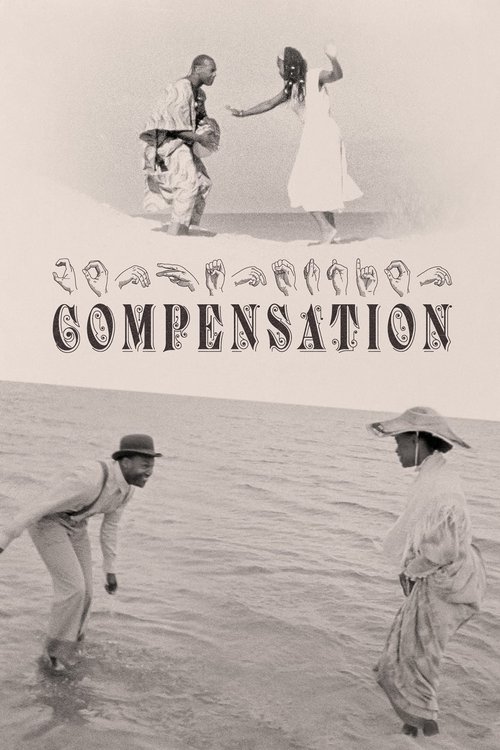
Compensation
1999 · Zeinabu irene Davis
For a contemplative evening when you want something rare and quietly beautiful — a film to watch attentively rather than half-see. It asks for patience and repays it with tenderness.
What it's about
Two love stories, told in parallel and played by the same two actors: a Deaf woman and a hearing man falling for each other in Black Chicago in the early 1900s, and another couple navigating the same city, and similar divides, in the 1990s. Across both eras, the film watches love negotiate language, illness, and the distance between two worlds.
The experience
Hushed, handmade, and unexpectedly playful — it moves at the deliberate pace of an old photograph coming to life. The stillness is the point: it makes room for gestures, glances, and sign language to carry everything, and it leaves you with a deep, bittersweet calm.
Performances
Michelle A. Banks, a Deaf actress of remarkable stillness and wit, anchors both eras — two different women, one unmistakable presence.
The craft
Zeinabu irene Davis borrows the grammar of silent cinema — intertitles, archival photographs of Black Chicago, direct address — so Deaf and hearing audiences experience the film on genuinely equal terms, a formal choice that doubles as an act of hospitality. A decade in the making, and every frame shows the care.
Why it matters
One of the last major works of the LA Rebellion, the UCLA-trained movement that remade Black American cinema; long hard to see, it has been rediscovered as a landmark of both Black independent film and Deaf representation.
Zeinabu irene Davis, one of the last filmmakers to emerge from the LA Rebellion — the UCLA-trained generation that remade Black American cinema from the ground up — spent a decade completing this independent feature, and its patience shows in every frame. Two love stories unfold in parallel: a Deaf woman and a hearing man in early-1900s Chicago, and another couple, played by the same actors, navigating the same city in the 1990s. Davis borrows the grammar of silent cinema — intertitles, archival photographs of Black Chicago, direct address — so that Deaf and hearing audiences experience the film on equal terms, a formal choice that doubles as an act of hospitality. Michelle A. Banks, a Deaf actress of remarkable stillness and wit, anchors both eras. The title comes from a Paul Laurence Dunbar poem, and the film shares his sense of grief and grace held in the same breath. Nearly impossible to see for twenty years, it circulated as a rumor among cinephiles until its 2025 restoration finally returned it to screens.
Reception
It premiered at Sundance in 2000, then went essentially unseen for a quarter-century after distributors passed — until a 4K restoration by Criterion and the UCLA Film & Television Archive gave it its first real theatrical run in 2025, landing it instantly on best-rediscovery lists and in the National Film Registry.
How Compensation was received, from release to now →
Influences: the films it descends from and the films it influenced
- Within Our Gates (1920) — Founding race-film that narrates Black interior life through intertitles and a past/present flashback structure — the silent race-film grammar Davis deliberately reactivates for her 1900s timeline.
- Body and Soul (1925) — Cast Paul Robeson in a dual role, establishing the Black-cinema device of one performer doubling across characters that Davis extends by having Michelle Banks and John Earl Jelks play both eras.
- The Scar of Shame (1927) — Race-film melodrama of Black class and respectability built on static tableau staging and title-card moralizing — the melodramatic register Compensation revives for its period love story.
- Sunrise: A Song of Two Humans (1927) — Model of expressive silent grammar — iris, gesture-driven acting, lyric intertitles carrying a love story with almost no dialogue — the visual vocabulary Davis borrows for the deaf-legible 1900s sequences.
- The Passion of Joan of Arc (1928) — Silent film that stakes narrative meaning on the human face in close-up and sparse intertitles — precedent for Davis making emotion legible without sound for deaf viewers.
- Johnny Belinda (1948) — Early mainstream film to center a Deaf protagonist and render sign language and silence as narrative content rather than pathos alone — an ancestor to Davis's deaf-hearing equal-access design.
- Killer of Sheep (1978) — L.A. Rebellion cornerstone: non-professional actors, location shooting, and elliptical everyday poetics of Black working-class life that shaped Davis's UCLA-trained independent aesthetic.
- Bush Mama (1979) — L.A. Rebellion experiment in sound/image counterpoint and politicized Black narrative form — part of the workshop lineage Davis directly emerged from.
- Medicine for Melancholy (2008) — Contemporary Black independent two-hander love story built on intimate location shooting and a controlled muted palette — extending the L.A. Rebellion's small-scale relational realism Davis carried forward.
- Pariah (2011) — Character-driven Black independent feature privileging interior emotional legibility and expressive framing over plot — inheriting the intimate, poetically composed authorship Davis modeled.
- Cloud Atlas (2012) — Binds parallel eras by recasting the same actors across every timeline — the identical continuity device Davis pioneered with Banks and Jelks doubling as 1900s and 1990s lovers.
- Daughters of the Dust (1991) — Fellow L.A. Rebellion film using painterly tableau composition, a photographic period palette, and Black women's historical memory — the closest formal sibling to Davis's archival-photograph, dual-era design.
- Sankofa (1993) — Bridges historical past and present through a protagonist crossing timelines, using ancestral memory as structural device — a dual-timeline strategy parallel to Compensation's two eras.
- The Watermelon Woman (1996) — Black independent feature that mobilizes (and fabricates) archival photographs to construct a usable Black history — the same evidentiary use of still images Davis threads between her timelines.
- Eve's Bayou (1997) — Black memory-melodrama that renders the Southern/period past as photographic reverie framed by women's storytelling — a contemporaneous kindred to Davis's grief-and-grace register.
- Beloved (1998) — Contemporaneous adaptation braiding a haunted historical past into the present through recurring figures — parallel dual-temporality staging of Black grief and inheritance.
Similar films
- Sankofa (1993) — influence & lineage
- Daughters of the Dust (1991) — influence & lineage
- Deaf (2025) — shared sensibility
- Losing Ground (1982) — shared sensibility
- The Watermelon Woman (1997) — shared sensibility
- Sambizanga (1973) — shared sensibility
- If Beale Street Could Talk (2018) — shared sensibility
- Sorry, Baby (2025) — shared sensibility