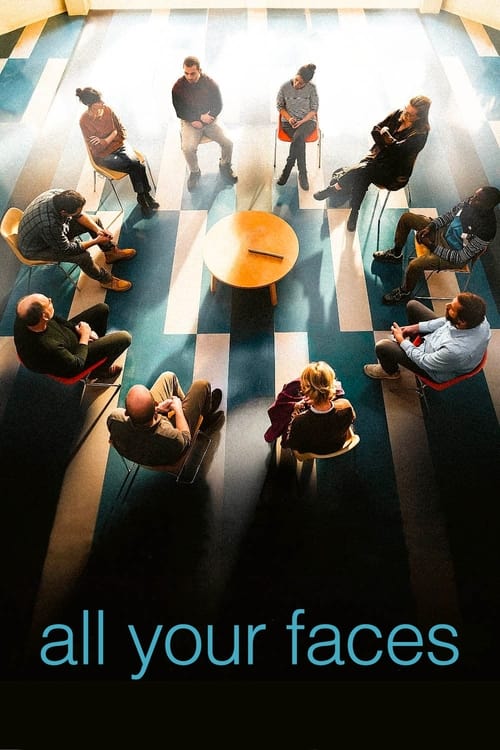
All Your Faces
2023 · Jeanne Herry
For when you want a film to take seriously — a demanding, deeply humane watch for a night you're ready to think about forgiveness and what it costs. Challenge, not comfort, but the kind that restores your faith in the effort.
What it's about
France's restorative-justice program puts victims and offenders in the same room, under supervision, to talk. The film follows two strands: a discussion circle where three victims of violent robberies sit across from three men convicted of the same kind of crime, and Chloé, a survivor of childhood sexual abuse, preparing for a far more personal reckoning. No verdicts, no courtroom — just people learning to speak and, harder still, to listen.
The experience
Almost unbearably attentive — built nearly entirely from faces listening, it generates courtroom-level tension out of chairs in a circle. You come out wrung out and strangely hopeful, having watched people do the hardest kind of talking there is.
Performances
A who's-who of French acting — Adèle Exarchopoulos (who won a César for it), Gilles Lellouche, Leïla Bekhti, Élodie Bouchez, Dali Benssalah — all playing at the pitch of documentary plainness, no showboating, which makes every crack in a voice land like a blow.
The craft
Jeanne Herry turns the format itself into the form: cinema as moderated conversation, the camera trained on the person listening as often as the person speaking. The writing carries a documentarian's fidelity to how these sessions actually work, and the restraint of the direction is the point — nothing is dramatized that the faces can carry alone.
Why it matters
A word-of-mouth success in France that brought the country's restorative-justice program into public conversation, and confirmed Herry as a leading chronicler of French institutions at their most humane.
France's restorative-justice program — which since 2014 has seated victims and offenders in the same room, under supervision, to talk — gives Jeanne Herry a subject and, more radically, a form: cinema as moderated conversation. Herry, an actor before she was a director (her mother, Miou-Miou, appears here) and previously the maker of the adoption drama In Safe Hands, builds the film almost entirely from faces listening. One strand follows a discussion circle of robbery victims and convicted robbers; another follows Chloé, preparing for a far more intimate reckoning. The ensemble is a who's-who of contemporary French acting — Adèle Exarchopoulos, Gilles Lellouche, Leïla Bekhti, Élodie Bouchez, Dali Benssalah — all playing at the pitch of documentary plainness, and Exarchopoulos took a César for it. The lineage is French cinema's institutional humanism, The Class by way of 12 Angry Men's faith in the room itself. Herry's craft signature is patience: she lets silence do the arguing, and films the exact moment a face changes its mind.
Reception
A word-of-mouth hit in France in spring 2023 — warm reviews, strong box office, and eventually nine César nominations — it crossed borders slowly, arriving abroad as a 'why is nobody talking about this?' discovery.
How All Your Faces was received, from release to now →
Influences: the films it descends from and the films it influenced
- 12 Angry Men (1957) — Establishes the single-room deliberation drama where the camera studies faces reacting to speech, and the moral turn is engineered through seating, listening, and accumulating close-ups rather than plot.
- The Passion of Joan of Arc (1928) — The foundational grammar of the listening face in tight close-up, where the drama lives in a person absorbing another's words rather than in action — Herry's 'faces-listening' cinematography descends directly from this.
- The Class (2008) — Confines a fraught negotiation to one institutional room with semi-improvised, documentary-plain ensemble performance and coverage that cuts on reaction, the exact register Herry adopts for the mediation circle.
- Secrets & Lies (1996) — Builds long, unbroken confrontation scenes out of rehearsed-into-naturalism performance, letting emotional exposure surface in real time — the actorly method behind Herry's 'documentary plainness.'
- Two Days, One Night (2014) — Structures the whole film as a series of repeated one-on-one moral appeals, each a variation on the same conversation, mirroring Herry's parallel-strand accumulation of mediation encounters.
- Scenes from a Marriage (1973) — Proves that sustained two-person talk, shot patiently on faces with silence weaponized between lines, can carry an entire drama — the model for 'silence-as-argument.'
- A Separation (2011) — Stages moral conflict as mediated testimony before an institutional figure, granting each party unbroken argument so the audience adjudicates — the same balanced-listening ethic as restorative mediation.
- S-21: The Khmer Rouge Killing Machine (2003) — Physically places victims and perpetrators in the room of the crime to speak to each other, pioneering the restorative-justice confrontation as cinematic form that Herry dramatizes.
- A Prophet (2009) — Grounds French institutional drama in the observed textures of a closed system and its power dynamics, an ancestor for treating a bureaucratic apparatus (here prison) as the film's true subject and set.
- Saint Omer (2022) — Extends the courtroom into a study of faces absorbing testimony, holding on listeners in near-documentary stillness and trusting silence to indict — French plainness pushed to austerity.
- Anatomy of a Fall (2023) — Contemporaneous French drama that lets adversarial testimony play out at length, privileging the reactive face and the unresolved argument over verdict — sibling in the 2023 conversation-as-drama mode.
- The Night of the 12th (2022) — Frames a crime through the patient, procedural rooms of French institutions and the weary faces working them, sharing the movement's cool humanist attention to process over spectacle.
- Two Is a Family (Pupille) (2018) — Herry's own prior film built the same French institutional-humanism method: an ensemble of caseworkers and clients rendered with procedural warmth, faces at work inside a bureaucratic care system.
- 120 BPM (2017) — Turns the activist meeting room into a stage for collective deliberation, cutting among faces as argument builds — the same faith that a room of people debating in real time is inherently cinematic.
- Custody (2017) — Opens on a family-mediation session shot with clinical patience, letting a neutral room and two constrained parties generate dread — the identical staging premise of 'the room itself.'
- The Measure of a Man (2015) — Uses non-professional faces and long fixed takes in institutional settings (job interviews, disciplinary panels) to extract social-issue drama from plain, unperformed listening.
Similar films
- Anatomy of a Fall (2023) — influence & lineage
- A Place for Her (2026) — same viewing thread
- It Was Just an Accident (2025) — same viewing thread
- Goodbye Julia (2023) — same viewing thread
- Black Box Diaries (2024) — same viewing thread
- Violet Perfume: Nobody Hears You (2001) — shared sensibility
- Close Your Eyes (2023) — shared sensibility
- Sound of Falling (2025) — shared sensibility
All the films related to All Your Faces →
Watch it with: curated runs of related films
- Living With What Was Done — Watch these together for how differently a society answers harm — a room built for restorative justice, a survivor turning the camera on her attacker, a torture victim face-to-face with his interrogator — a run about testimony, guilt, and the slow labor of repair.