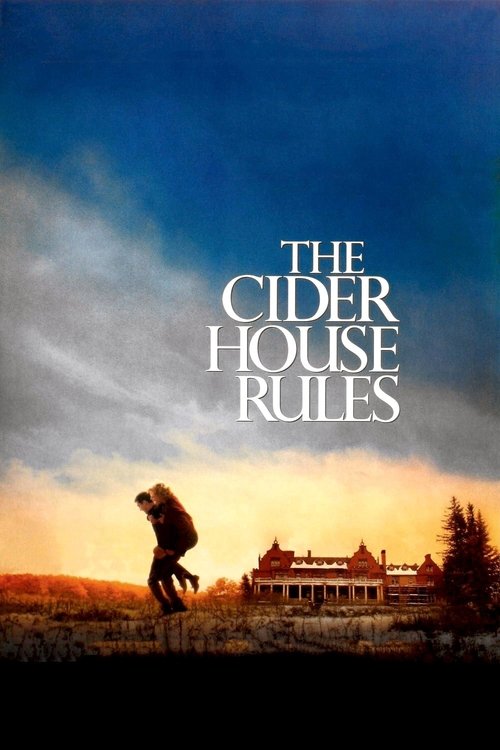
The Cider House Rules
1999 · Lasse Hallström
For a reflective night in when you want an old-fashioned, handsomely made story with real ideas in it — cozy in texture, thought-provoking underneath.
What it's about
Homer Wells grows up at a remote Maine orphanage, twice returned by adoptive families, and is raised almost as a son by Dr. Larch, the ether-addicted director who trains him in medicine — including procedures Homer refuses to perform. Restless for a life he's chosen himself, Homer leaves for an apple orchard on the coast, where work, first love, and the rules other people write for you all put his convictions to the test.
The experience
Gentle, novelistic, and autumnal — it unfolds like a good long book, warm on the surface while quietly wrestling with hard moral questions. It's a film that comforts and troubles you at the same time.
Performances
Michael Caine, in Oscar-winning form, makes Dr. Larch both saintly and compromised — his benedictions to the orphans are quietly devastating. Tobey Maguire's stillness suits Homer's watchfulness, and Charlize Theron brings warmth to a role that could have been a plot device.
The craft
John Irving adapted his own sprawling novel, and the compression gives the film a clean fable-like shape; Lasse Hallström directs with a soft, burnished New England palette of orchards, snow, and lamplight. The score and cinematography wrap difficult subject matter in real visual comfort.
Why it matters
A centerpiece of late-'90s Oscar season, it won Academy Awards for Caine and for Irving's screenplay, and remains one of the few mainstream American films to engage its central moral controversy directly.
Snapshot
The Cider House Rules is a literary prestige drama, adapted by John Irving from his own sprawling 1985 novel and directed by the Swedish humanist Lasse Hallström for Miramax at the height of that studio's Oscar-season dominance. It follows Homer Wells (Tobey Maguire), an orphan twice returned to the St. Cloud's orphanage in rural Maine, who is raised and informally trained in obstetrics by the ether-addicted director Dr. Wilbur Larch (Michael Caine). Larch quietly performs abortions alongside deliveries; Homer, who declines to, leaves to find a life of his own among apple pickers on the coast, falling in with Candy (Charlize Theron) while her fiancé is at war and confronting the gap between inherited rules and lived moral necessity. The film won two Academy Awards — Caine for Best Supporting Actor and Irving for Best Adapted Screenplay — from seven nominations including Best Picture and Best Director. It stands as a representative example of the late-1990s Miramax mode: tasteful, emotionally accessible, morally serious literary cinema engineered for awards.
Industry & production
The film's defining production fact is its protracted, author-driven development. Irving's novel had been in adaptation limbo for roughly thirteen years, a saga Irving himself documented in his 1999 memoir My Movie Business. The project passed through multiple directors — the Canadian filmmaker Phillip Borsos was long attached before falling ill and dying in 1995 — and Irving, unusually, retained deep creative involvement, ultimately writing the screenplay himself and exercising significant input over casting and final shape. This authorial control is central to understanding the film: it is one of the rare cases where a major novelist successfully adapted his own dense, multi-decade narrative for the screen.
Production was anchored at Miramax under Harvey Weinstein, with Richard Gladstein producing. By 1999 Miramax had refined a house strategy of acquiring or producing mid-budget literary dramas and campaigning them aggressively through the awards calendar — The English Patient (1996) and Shakespeare in Love (1998) had just won Best Picture in consecutive years. The Cider House Rules fit the template precisely. Shot largely on location in New England — Vermont and Massachusetts standing in for 1940s Maine — the production leaned on autumnal landscape and period reconstruction of an orphanage, an apple orchard, and the migrant workers' cider house. I do not have reliable budget or box-office figures to cite precisely, so I will not invent them; the film is generally understood to have been a solid prestige performer rather than a blockbuster.
Technology
The film was a conventional late-1990s 35mm production with no notable technological novelty; its ambitions were entirely classical. It used photochemical capture and traditional optical/lab finishing rather than the digital intermediates that would become standard only a few years later. There is no significant use of visual effects, and the period setting is achieved through practical means — location, costume, art direction, vehicles. In this respect the film is deliberately anti-technological in sensibility, a work whose entire aesthetic argument rests on the tactile and the handmade. Where the historical record on its specific lab and finishing processes is thin, I note that rather than speculate.
Technique
Cinematography
Oliver Stapleton, the British cinematographer best known for his long collaboration with Stephen Frears, shot the film and would go on to work with Hallström again. His work here is in the warm, naturalistic, classically composed register that Miramax prestige drama favored. The palette is autumnal — apple-orchard golds and reds, the muted browns and whites of the snowbound orphanage — and the lighting tends toward soft, motivated sources that flatter faces and landscape alike. Stapleton's camera is largely unobtrusive, prioritizing legibility of performance and emotional clarity over visual flamboyance. The New England seasons function almost as a structuring visual device, the cycle of harvest and winter mapping onto Homer's departure and return.
Editing
Lisa Zeno Churgin edited the film and received an Academy Award nomination for it. The central editorial challenge was compression: Irving's novel spans decades and a large cast, and the film had to telescope this into a roughly two-hour arc without losing the sense of a life unfolding over time. Churgin's cutting maintains a measured, unhurried rhythm appropriate to the material's literary pacing, using elisions and time jumps to cover Homer's maturation while preserving emotional continuity. The editing is in service of clarity and feeling rather than rhythmic display.
Mise-en-scène / staging
The film's two principal worlds are sharply distinguished in their staging. St. Cloud's is enclosed, institutional, warm but airless — a world of corridors, dormitories, and Larch's ether-scented office, where the children's nightly ritual ("Goodnight, you princes of Maine, you kings of New England") gives the space a tender, ceremonial quality. The orchard and cider house are open, seasonal, and laborious. The cider house itself, with its posted list of rules that the illiterate migrant workers cannot read, is the film's central spatial metaphor made physical: a humble bunkhouse whose authority is a piece of paper nobody who lives there can decode. Hallström stages performance with ensemble warmth, favoring the actorly and the domestic over the spectacular.
Sound
Rachel Portman's score (discussed below) is the dominant element of the soundtrack, and the sound design otherwise is naturalistic and period-appropriate — the hiss of ether, the sounds of orchard labor, radio broadcasts marking the wartime setting. I have no specific technical details about the sound mix to report and will not manufacture them; the film's aural strategy is conventional and emotionally supportive rather than experimental.
Performance
Performance is the film's greatest strength and the engine of its awards success. Michael Caine's Dr. Larch is a study in gruff, wounded tenderness — a man whose ether addiction and moral certainty coexist with deep love for his charges. Caine adopted a New England accent for the role (his second Best Supporting Actor Oscar, after Hannah and Her Sisters), submerging his characteristic Cockney entirely. Tobey Maguire's Homer is deliberately quiet and watchful, a still center around which the moral questions revolve; the performance trades on his gift for soulful reticence. Charlize Theron brings luminous warmth to Candy, and Delroy Lindo gives the film's most disturbing and complex turn as Mr. Rose, the orchard crew boss whose paternal authority conceals incest — a storyline that supplies the film's darkest moral test. Paul Rudd plays Wally, and the singer Erykah Badu appears as Rose Rose. The ensemble's collective naturalism is characteristic of Hallström's actor-centered method.
Narrative & dramatic mode
The film operates as a coming-of-age Bildungsroman fused with a moral-philosophical drama. Its dramatic mode is essentially that of the literary novel translated to screen: episodic, character-driven, organized around an education in the world rather than a tight causal plot. The governing structure is departure and return — Homer must leave St. Cloud's, encounter the world's hard cases, and ultimately choose to come back and assume Larch's role, including the abortions he had refused to perform. The narrative withholds melodrama in favor of accumulated moral weight; its climactic crisis (the discovery of Rose Rose's pregnancy by her father) forces Homer to act on a principle he had resisted in the abstract, dramatizing the film's central thesis that rules written by people who do not live your life cannot govern it. A gentle voice-of-experience tone, inherited from Irving's prose, suffuses the whole.
Genre & cycle
The film belongs to the cycle of mid-budget literary adaptations that defined American prestige cinema in the 1990s — the Merchant-Ivory inheritance as channeled through Miramax. It is at once a period drama, a coming-of-age story, and an issue-driven social drama (its frank treatment of abortion is unusually direct for a mainstream Oscar contender). Within Hallström's own filmography it forms part of a loose run of warm-hearted, ensemble humanist dramas about outsiders and surrogate families — bracketed by What's Eating Gilbert Grape (1993) before it and Chocolat (2000) after, the latter another Miramax awards play. The film is a near-paradigmatic example of the "quality" middlebrow drama: serious themes rendered accessible, handsome, and emotionally consoling.
Authorship & method
Authorship here is genuinely shared between director and source-author. Lasse Hallström, who broke through internationally with My Life as a Dog (1985), brought his signature sensibility — gentle, observational, generous toward eccentric and wounded characters, allergic to cynicism. His method foregrounds performance and emotional truth over directorial flourish, which suits Irving's humanism well, though it has also drawn the criticism that his films can sand the hard edges off difficult material. John Irving, as screenwriter, performed the more radical authorial act: he cut and reconfigured his own novel drastically, largely excising the Melony subplot and compressing the timeline, and his memoir My Movie Business is a candid record of that surgery and the long road to production. The collaboration of cinematographer Oliver Stapleton, editor Lisa Zeno Churgin, and composer Rachel Portman completes the authorial picture. Portman — who had won the Original Score Oscar for Emma (1996) — supplied a lyrical, pastoral score that was itself Oscar-nominated and that does much to establish the film's tone of tender melancholy. The film is best understood as the meeting of Hallström's directorial warmth with Irving's authorial control.
Movement / national cinema
The film is an American studio (specialty-division) production and belongs to no formal movement, but it carries a transnational authorship worth noting: a Swedish director and a British cinematographer working on quintessentially American material. Hallström belongs to a generation of European art-cinema directors absorbed into the American prestige-drama system in the 1990s, where his Scandinavian humanism was repackaged for an Anglo-American literary audience. The film thus sits at the intersection of American independent-adjacent production (Miramax) and an imported European sensibility, without being an example of any national cinematic school.
Era / period
Released in December 1999, the film arrived at the close of the decade that the Miramax model had largely defined, just before the 2000s consolidation and the eventual collapse of the mid-budget adult drama as a theatrical staple. Its diegetic period is the early-to-mid 1940s, with World War II providing the backdrop that removes Wally to the Pacific and clears narrative space for Homer and Candy. The film's nostalgic, autumnal evocation of a pre-war/wartime rural America is itself an artifact of late-1990s prestige taste, which prized handsome historical reconstruction. Its abortion theme, however, made it pointedly contemporary: released into the still-live American culture war over reproductive rights, the film's sympathetic portrait of a clandestine abortion provider gave a 1940s story unmistakable present-tense charge.
Themes
The film's master theme is announced by its title: the gap between codified rules and the lived authority to make moral choices. The literal cider house rules — posted for migrant workers who cannot read them, written by an absent owner who does not live there — become a metaphor for all externally imposed moral law, including the laws governing abortion. The film argues, through Homer's arc, that those who actually inhabit a situation must write their own rules. Surrounding this are the film's other Irving preoccupations: orphanhood and the constitution of family by choice rather than blood; mentorship and inheritance (Larch literally engineers Homer to succeed him, forging credentials and a false history); the ethics of abortion handled with conspicuous compassion and without easy resolution; and the tension between safety and self-determination, the orphanage as both refuge and cage. The motif of being "of use" — Larch's insistence that Homer make himself useful — threads the whole. Addiction (Larch's ether), abuse and incest (the Rose family), and the costs of wartime absence give the warmth its necessary shadow.
Reception, canon & influence
Critically, the film was warmly if not universally received; it was widely praised for Caine's performance and Irving's screenplay and embraced by awards bodies, while some critics found Hallström's treatment too soft and consoling for material this dark — a recurring charge against his prestige work. Its awards record is the clearest measure of its standing: seven Academy Award nominations (Picture, Director, Supporting Actor, Adapted Screenplay, Art Direction, Film Editing, Original Score) with wins for Michael Caine and John Irving. Caine's was his second Supporting Actor Oscar; Irving's win is notable as a case of a major novelist honored for adapting his own work.
The influences on the film are primarily literary and authorial: Irving's own Dickensian narrative manner — orphans, coincidence, sprawling life-stories, moral earnestness — is the dominant inheritance, and the orphanage scenes consciously evoke Dickens (whom Larch reads aloud to the children). Cinematically it descends from the Merchant-Ivory and broader literary-adaptation tradition, and from Hallström's own earlier outsider dramas. Looking forward, its direct legacy is most visible in the continued Hallström–Miramax partnership, immediately in Chocolat (2000) and later The Shipping News (2001), and in its consolidation of the late-1990s template for the prestige literary adaptation. As a piece of cultural argument it retains a specific afterlife in debates over abortion in American cinema, frequently cited as one of mainstream Hollywood's most openly sympathetic portrayals of an abortion provider. It did not found a movement or revolutionize technique; its influence is that of an exemplary, well-made specimen of its moment — a film that shows the Miramax prestige drama operating at full, polished capacity.
A Deleuzian reading
Start with the piece of paper tacked to the wall of the cider house.
The full Deleuzian reading of The Cider House Rules →
Reception
A warmly received Best Picture nominee and double Oscar winner in its day, it's since been recast as the poster child for late-90s Miramax awards-machine prestige — the 'safe' 1999 nominee cinephiles bring up when lamenting what Fight Club, Magnolia and Being John Malkovich didn't get.
How The Cider House Rules was received, from release to now →
Influences: the films it descends from and the films it influenced
- The World According to Garp (1982) — The first screen translation of Irving's cradle-to-grave bildungsroman, establishing the device — which Irving's own adaptation refines — of compressing a sprawling life-novel into a chain of tonally distinct vignettes.
- My Life as a Dog (1985) — Hallström's breakthrough fixed his signature method — observing a wounded child-outsider with unsentimental tenderness and a performance-first, low-flourish camera — which he transplants directly onto Homer Wells and the orphanage.
- Oliver Twist (1948) — Lean's canonical Dickensian-orphanage idiom (cavernous institutional interiors, the Victorian text read aloud) is the visual-literary vocabulary the film consciously invokes when Dr. Larch reads Dickens to the boys at lights-out.
- My Beautiful Laundrette (1985) — Where cinematographer Oliver Stapleton developed his naturalist, available-light, character-led realism with Frears — the unfussy observational eye he later trains on the cider-house bunkroom and apple orchards.
- A Room with a View (1985) — Sets the Merchant-Ivory prestige-adaptation grammar — pastoral natural-light cinematography wedded to literary fidelity and ensemble decorum — that defines the genre Cider House operates within.
- The Remains of the Day (1993) — The template for codified-rules-versus-lived-authority drama, rendering duty and restraint through understated ensemble performance — the formal mode the film's posted 'cider house rules' literalizes.
- Emma (1996) — Rachel Portman's Oscar-winning, woodwind-led pastoral score, whose lyrical idiom she carries almost wholesale into Cider House's tone of tender melancholy.
- Chocolat (2000) — The immediate continuation of the Hallström-Miramax partnership: same warm ensemble of wounded eccentrics and gentle village-fable staging, scored again by Rachel Portman in her pastoral register.
- The Shipping News (2001) — Hallström again adapting a prize literary novel of departure-and-return through an autumnal, weathered palette and an ensemble of damaged outsiders observed without cynicism.
- The Hours (2002) — Extends the Miramax-era literary-prestige template into interwoven life-stories braided by editing, paired with a delicate minimalist score — the polished adaptation machine Cider House helped consolidate.
- The Door in the Floor (2004) — Another Irving adaptation that mirrors the author's own method — surgically extracting and compressing a single strand (here from A Widow for One Year) rather than filming the whole novel.
- Atonement (2007) — Carries the prestige literary adaptation forward through pronounced temporal compression and authorial-control narration, with Dario Marianelli's lyrical, instrument-foregrounded score echoing Portman's tonal function.
- The English Patient (1996) — Miramax's flagship prestige literary adaptation, defining the operating template Cider House follows — lush cinematography, multi-craft Oscar nominations, and a dense novel surgically compressed for the screen.
- Shakespeare in Love (1998) — The companion Miramax awards-campaign prestige drama of the exact same moment, sharing the studio's polished, performance-forward, art-direction-heavy house style.
- Snow Falling on Cedars (1999) — A same-year prestige novel-to-screen adaptation built on a seasonal, weather-saturated palette and reticent ensemble restraint — the parallel specimen of the 1999 literary-prestige mode.
Similar films
- The Hours (2002) — influence & lineage
- The Remains of the Day (1993) — influence & lineage
- What's Eating Gilbert Grape (1993) — shared sensibility
- The Age of Innocence (1993) — shared sensibility
- Long Day's Journey Into Night (1962) — shared sensibility
- The Notebook (2004) — shared sensibility
- The Heiress (1949) — shared sensibility
- Misery (1990) — shared sensibility