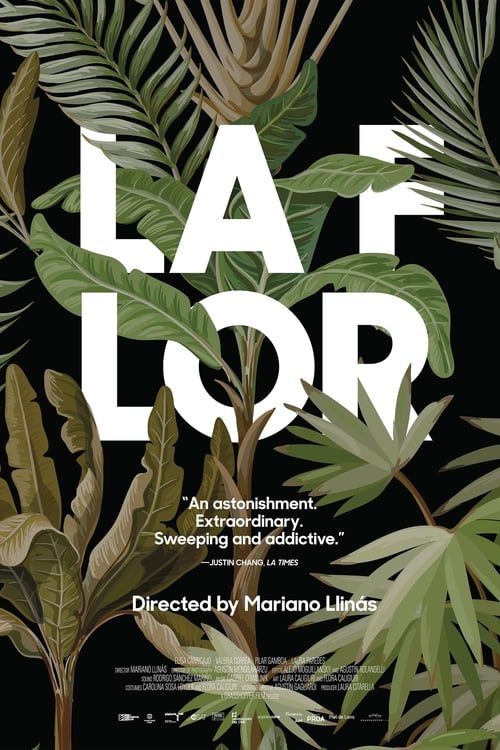
La Flor
2019 · Mariano Llinás
For when you want a project, not a movie — a long weekend or a week of evenings given over to something vast, playful, and unrepeatable. This is deep-end viewing for the adventurous; if you want tidy resolution, it will drive you mad.
What it's about
Six unrelated stories, one after another, all built around the same four actresses — members of a Buenos Aires theater collective — who reappear across wildly different worlds: a B-movie about a cursed mummy, a musical melodrama entangled in a conspiracy over scorpion venom, a globe-spanning spy epic, a tale of a film shoot falling apart, and more. In a filmed prologue the director appears with a notebook and sketches the plan: stories that begin and never end, one complete story, one that is only an ending. Drawn out, the diagram looks like a flower. It runs nearly fourteen hours, and it means to.
The experience
Watching it feels like binging an entire imaginary film history with one repertory company — pulpy one hour, lush and melodramatic the next, then patient and hypnotic for long stretches. The length stops being a stunt and becomes the point: you settle into its time, and the four faces returning in new guises start to feel like old friends showing up in your dreams.
Performances
Elisa Carricajo, Valeria Correa, Pilar Gamboa, and Laura Paredes carry the entire fourteen hours, reinventing themselves from genre to genre — mummy-movie scientists, feuding singers, spies — a sustained ensemble feat with almost no equivalent in modern cinema.
The craft
Shot over roughly a decade, it moves through a different visual register for each episode — pulp horror, musical melodrama, widescreen espionage, and finally a wordless black-and-white passage remaking a French classic. The pleasure is in the shifts themselves: narration, genre, and image style are constantly rebuilt from scratch, and the sheer craft of keeping it coherent across 808 minutes is part of the show.
Why it matters
It became an instant legend of independent Argentine cinema and of festival culture generally — proof that a tiny collective working outside the industry could produce something at a scale studios wouldn't dare, and the defining monument of Llinás's narrative-mad school of filmmaking.
Snapshot
La Flor is a roughly 808-minute Argentine film — just under fourteen hours — built from six discrete episodes that share nothing except four actresses: Elisa Carricajo, Valeria Correa, Pilar Gamboa and Laura Paredes, all members of the Buenos Aires theater collective Piel de Lava. In a filmed prologue, director Mariano Llinás appears with a notebook and sketches the film's governing diagram: four stories that begin and never end, one story with both a beginning and an end, and one story consisting only of an ending. Drawn, the shape resembles a flower. What follows is a B-movie about a cursed mummy; a musical melodrama shadowed by a conspiracy involving scorpion venom; a five-hours-plus espionage epic; a metafictional account of a film shoot collapsing; a wordless black-and-white remake of Jean Renoir's Partie de campagne; and a nearly imageless nineteenth-century captivity narrative shot through degraded, pinhole-soft optics. Shot piecemeal over roughly a decade by the self-financing collective El Pampero Cine, it is at once an argument about genre, a durational experiment, and a decade-long portrait of four faces.
Industry & production
La Flor is inseparable from the production model of El Pampero Cine, the Buenos Aires collective founded in the early 2000s by Llinás with Laura Citarella, Alejo Moguillansky and Agustín Mendilaharzu. El Pampero's defining principle is refusal of the standard Argentine financing path: it works outside the subsidy and pre-approval apparatus of the INCAA (Instituto Nacional de Cine y Artes Audiovisuales), which since the 1990s has been the engine of most Argentine feature production. The trade-off is explicit and, in the group's own account, deliberate. Without state money there is no committee to satisfy, no script to lock, no delivery date — but also no crew of any size, no scheduled shoot, and no guarantee of completion. What El Pampero buys with that constraint is time.
La Flor spent it. Shooting began around 2010 and continued intermittently for years, with post-production carrying the film to completion in 2018. Citarella produced. The crew was small enough to travel; the espionage episode in particular ranges well beyond Argentina, though the English-language record on specific locations and schedules is patchy and should not be reconstructed with false precision. No reliable budget figure exists in the public record, and no meaningful box-office comparison is possible: a fourteen-hour film is not distributed on the terms that produce such numbers.
The completed film reached audiences through the festival circuit in 2018 and an international rollout that extended through 2019 — the year most commonly attached to it — including a US theatrical release in three parts via Grasshopper Film. The tripartite division follows the episode structure: the mummy story and the musical occupy the first part, the spy epic takes the entirety of the second, and the final three episodes plus the closing credits make the third. Exhibitors could program it across days or as an endurance event, and both happened. That flexibility is a production fact as much as a distribution one: Llinás built a film that could be consumed in units without pretending the units were separate films.
Technology
The decade-long shoot means La Flor was made across a period of unusually rapid change in digital acquisition, and the film bears the marks. It is not a work of technical showmanship; it is a work made possible by cheap sensors, cheap storage and non-linear editing, and it knows it. The specific camera bodies used across the years are not well documented in the English-language record, and it would be inventing detail to name them. What is clear from the images is a range: episodes differ visibly in resolution, latitude and grain, and the film treats that unevenness as expressive rather than as error.
Two episodes push hardest. The Renoir remake is rendered in black-and-white and pitched at the register of silent cinema, which digitally is a matter of grading and framing rather than of stock. The final episode is shot through soft, heavily vignetted optics widely described as a pinhole effect, producing an image so degraded that faces dissolve into shape and light — the visual equivalent of a document surviving from before photography properly existed. Whether this was achieved in-camera, in post, or both is not something the available record settles.
The larger technological point is distributive. A fourteen-hour film is only exhibitable at all because of DCP and, subsequently, streaming; the era of physical prints would have made La Flor a logistical impossibility outside a handful of cinematheques. Duration became affordable to make and, separately, affordable to show, at more or less the same moment.
Technique
Cinematography
Agustín Mendilaharzu is the film's principal cinematographer, and his work here is essentially six jobs. The mummy episode adopts the flat, functional coverage of low-budget horror — fluorescent institutional interiors, unglamorous close-ups. The musical is warmer, more mobile, closer to television melodrama. The spy episode is the most conventionally "cinematic," with long lenses, controlled compositions and a globe-trotting sense of place that pastiches Cold War thrillers without quite parodying them. The metafictional fourth episode is loose and documentary-adjacent, the camera behaving like a crew member. The fifth is composed as silent pastoral tableaux; the sixth abandons legibility entirely.
Running underneath is the pampa — the flat, horizon-dominated Argentine plain that Llinás has treated as a landscape of narrative possibility since Historias extraordinarias (2008). When La Flor opens out, it opens onto emptiness, and the film's most sustained images are of women moving across land that offers no cover and no destination.
Editing
Alejo Moguillansky — himself a director of note (El escarabajo de oro, El loro y el cisne) — is the film's editing intelligence, and the assembly is where the project's argument actually lives. The espionage episode is the showpiece: a present-tense mission repeatedly suspended for extended flashbacks that give each of the four agents a backstory, so that the "main" narrative becomes a spine for digression rather than a line to be followed. The cutting is patient without being slack; scenes are allowed to run to their natural end, but the macro-structure is aggressively interrupted.
The film's most discussed editorial gesture is its last: a closing credit sequence reported at roughly forty minutes, unspooling over landscape imagery. It functions as decompression, as a joke about labor and duration, and as a final refusal to let the audience leave on cue.
Mise-en-scène / staging
The organizing device is substitution. The same four women appear in every episode as entirely different people, and the transformation is effected almost entirely by costume, wig, posture and accent — the frankly theatrical apparatus, never disguised as anything else. Sets are modest: provincial laboratories, recording studios, safe houses, roadside stops, fields. Llinás does not attempt to counterfeit the production values of the genres he is invoking. The spy film looks like a spy film the way a well-mounted stage production looks like the world, by agreement.
Sound
Gabriel Chwojnik, El Pampero's regular composer, scores the film, including the songs that carry the second episode's musical melodrama — a register that requires the music to work straight, as pop, not as pastiche with quotation marks. Voice-over is a signature Llinás instrument, used here as it was in Historias extraordinarias: not to explain images but to run parallel to them, supplying narrative the camera declines to dramatize. The espionage episode moves between languages and makes dubbing and translation part of its texture. The final two episodes are effectively dialogue-free, the fifth carried by music and gesture, the sixth by narration over near-abstraction.
Performance
Carricajo, Correa, Gamboa and Paredes are the film's subject as much as its instrument. Piel de Lava's collective theater practice — devised, ensemble-driven, built on long collaboration — shows in a performance style that is presentational and precise rather than naturalistic, comfortable with genre attitudes worn openly. Because production stretched across years, the actresses visibly age within the film, and Llinás makes no attempt to hide it. The result is a documentary substrate: whatever the fiction claims, we are watching four specific women spend a decade of their working lives on one project.
Narrative & dramatic mode
La Flor is organized around a withheld ending. Four of its six stories simply stop, some of them at the point where a conventional film would begin resolving. The fifth is complete; the sixth is nothing but conclusion, an ending arriving without the story that earned it. Llinás states the scheme up front, which converts the audience's relationship to the film from suspense to observation: knowing no resolution is coming, one watches for texture instead.
This is serial logic rather than dramatic logic — the folletín, the feuilleton, the movie serial, forms that ran on perpetual continuation and were structurally incapable of ending well. It is also a combinatorial logic, closer to literature than to film: a fixed set of elements (four performers) permuted across variable frames (six genres). The Borgesian resonance is unavoidable and clearly intended; so is the influence of Raúl Ruiz, whose films treat narrative as a proliferating system rather than an arc.
Genre & cycle
Each episode is a costume worn by the same four bodies, and the choice of costumes is pointed. Horror, musical melodrama, espionage: these are precisely the popular genres that Argentine cinema has historically produced sparsely or not at all, genres received as imports. By staging them at length with local performers, provincial settings and visible modesty of means, La Flor asks what happens when a national cinema tries on forms it never industrially possessed. The result is neither parody nor homage but something more like earnest impersonation — the genres are played straight enough to work and imperfectly enough to show the seams.
The last two episodes shift the ground. The Renoir remake reaches for a specific canonical text of European art cinema; the closing captivity narrative reaches instead for a foundational Argentine myth, the cautiva — the white woman taken by Indigenous raiders on the frontier, a figure central to Echeverría's poem La cautiva (1837), to nineteenth-century Argentine painting, and to Borges. Having spent twelve hours in imported genres, the film ends inside a national one.
Authorship & method
Llinás wrote and directed, and appears on camera as both narrator and, in the fourth episode, a fictionalized version of himself whose production disintegrates around him. Son of the poet Julio Llinás and a graduate of Buenos Aires's Universidad del Cine (FUC), he had already established a long-form, voice-over-driven mode with Historias extraordinarias (2008), a 245-minute triptych that functions as La Flor's clear precursor. He has also worked as a screenwriter for other directors, notably in collaboration with Santiago Mitre.
But authorship here is genuinely distributed. Citarella produced and would go on to direct Trenque Lauquen; Mendilaharzu shot; Moguillansky edited; Chwojnik scored. All four are filmmakers in their own right, and El Pampero operates as a rotating collective in which each takes the lead in turn. The four actresses supply the only continuity the film has. Any account of La Flor as the vision of one man is contradicted by the film's own fourth episode, in which the director is abandoned by the collaborators who were making his film possible.
Movement / national cinema
La Flor descends from the Nuevo Cine Argentino of the late 1990s — Pizza, birra, faso (1998), Mundo grúa (1999), La ciénaga (2001) — and from the FUC pedagogy that fed it. That generation broke with the state-approved literary-adaptation mode; Llinás's generation broke again, this time with the funding structure itself. El Pampero's independence from INCAA is not a stylistic detail but the enabling condition of the film's form: no financing body approves a fourteen-hour feature with four unfinished stories.
Internationally, La Flor landed in a moment already attentive to extreme duration — Lav Diaz in the Philippines, Wang Bing in China — and it consolidated Argentina's place in that conversation while pursuing a different aim. Diaz's length is testimonial; Llinás's is combinatorial and, often, comic.
Era / period
The film is a document of the 2008–2018 decade in cinema: consumer-grade digital capture, laptop post-production, festival programming increasingly hospitable to long-form work, and the arrival of streaming as a viable home for films that cinemas could not easily schedule. It is also a document of prestige television's dominance in the same years, and reads partly as a rebuttal — serialized, episodic, hours long, but structured to frustrate exactly the resolution-hunger that serial television cultivates.
Themes
Time is the material: time spent watching, time spent shooting, time visible on four faces. Genre is treated as costume — provisional, borrowed, revealing in its ill fit. Incompletion is elevated from failure to method, the film insisting that beginnings are where the energy is and endings are a contractual obligation. Conspiracy and paranoia recur across episodes as narrative engines that promise coherence and never deliver it. And beneath everything sits collaboration itself: what four actresses and a handful of filmmakers owe each other across ten years, dramatized most directly in the episode where that arrangement breaks down.
Reception, canon & influence
Backward. The acknowledged ancestors are the serial and the combinatorial: Feuillade's silent serials, Rivette's Out 1 as the reigning precedent for the very long, actor-generated, plot-suspicious film, Ruiz's proliferating narrative poetics, Borges. Renoir is quoted outright. Argentine literary melodrama and the cautiva tradition supply the national spine. Within Llinás's own work, Historias extraordinarias is the direct rehearsal.
Critical reception. La Flor was received on the festival circuit and in specialist criticism as a major event, playing prominent slots at leading festivals in 2018 and appearing widely on critics' year-end lists across 2018 and 2019. The tenor of the response was consistent: admiration for its ambition and its generosity, some impatience with the espionage episode's length, and near-universal recognition of the four performances as the achievement that holds it together. It was never a wide-audience film and was not distributed as one. Specific poll placements and individual critics' verdicts are easy to misreport, and the granular record is better consulted than summarized.
Forward. The clearest legacy is institutional. La Flor raised El Pampero Cine's international profile decisively, and the collective's subsequent work — most visibly Laura Citarella's Trenque Lauquen (2022), a four-hour-plus film built with and around Laura Paredes — extends the same method: long form, small crew, no state money, an actress as co-author. Beyond that circle, La Flor functions as a standing proof of concept: that duration is available to filmmakers without capital, and that a film can decline to end and still be finished. Its influence on other filmmakers is real but recent, and any confident account of what it shaped would be premature.
A Deleuzian reading
Before anything else happens, someone sits down with a notebook and draws a flower.
The full Deleuzian reading of La Flor →
Reception
It premiered at Argentina's BAFICI festival in 2018, took the top prize, and was instantly framed less as a movie than an event; a few years on it's settled into legend status — the 14-hour film people plan whole weekends around rather than merely watch.
How La Flor was received, from release to now →
How to watch La Flor: what to notice on a first viewing
- Watch Llinás sketch the film's whole shape in a notebook. Before any story starts, the director draws a flower on camera, four petals that begin and never finish, one with a beginning and a close, and one that is only a final note. The film tells you its own shape up front, so you watch for texture instead of a resolution.
- Watch the same four faces become entirely new people. Wig, costume, posture, and accent transform Carricajo, Correa, Gamboa, and Paredes into new characters each episode, with the theatrical apparatus never hidden or disguised as anything else. You are never fooled into thinking it's magic, only shown four women changing costume in front of you.
- Notice how differently each episode is shot and lit. One episode looks like flat, functional low-budget horror, another like warm television melodrama, another like a controlled Cold War thriller, each register switching completely with the story. Six episodes, six different cameras, so the style itself tells you which genre you're currently inside.
- Notice how often women cross the empty pampa. The flat, horizon-dominated Argentine plain recurs across episodes, offering no cover and no destination, whenever the film steps outside its provincial rooms and sets. The landscape itself becomes a feeling, not just a backdrop the characters happen to walk through.
- Listen for a voice-over that runs beside the image. Llinás narrates alongside what you see rather than explaining it, supplying story the camera declines to dramatize, so sound and image never simply illustrate each other. The narration carries plot so the camera is free to just watch a face or a field.
The whole guide to watching La Flor, with the keys for a rewatch →
Influences: the films it descends from and the films it influenced
- Historias extraordinarias (2008) — The direct rehearsal: a 245-minute triptych in which an omniscient third-person voice-over carries plot the images decline to dramatize, freeing a tiny crew to shoot pampa exteriors and let narration do the work of production value — the exact engine La Flor scales to fourteen hours.
- Les Vampires (1915) — The folletín machinery La Flor's second and third episodes run on: episodic crime-serial installments built around disguise, wigs and alias substitution, a masked female operative as the continuity device, and chapter-ends that withhold resolution as a structural principle rather than a failure.
- Out 1 (1971) — The reigning precedent for the plot-suspicious epic: thirteen hours generated from actors' own improvised material, in which a conspiracy is set running purely to keep the performers in motion and is then abandoned unresolved — duration substituted for dramaturgy.
- Céline and Julie Go Boating (1974) — Establishes the actress-as-co-author method Llinás hands to Piel de Lava — the fiction is written outward from what two performers invent together, so the women, not the story, become the film's only load-bearing structure.
- Mysteries of Lisbon (2010) — Ruiz's proliferating narrative poetics in serial form: every new character halts the film to deliver a backstory that spawns another, so flashback becomes a generative rather than explanatory device — the precise architecture of La Flor's espionage episode.
- The Saragossa Manuscript (1965) — The nested-digression structure taken to the point of vertigo — tales opening inside tales, several levels deep, with the frame narrative never properly closed — which La Flor's third episode reproduces as a chain of agents' origin stories that keeps deferring its own return.
- Une partie de campagne (1946) — Quoted outright: La Flor's fifth episode is a silent black-and-white remake of it, replaying the riverside picnic and the swing in Renoir's staging while stripping the sound, turning homage into a formal exercise in what survives when dialogue is removed.
- Invasión (1969) — The Argentine literary-conspiracy film — scripted by Borges and Bioy Casares — that models resistance-cell genre pastiche written by writers rather than by the genre, with a siege that never arrives; the national precedent for La Flor's spy apparatus and its Borgesian refusal of denouement.
- Cat People (1942) — The Lewton-unit economy that La Flor's first episode pastiches: a B-horror in which the monster is kept off-screen and dread is manufactured from sound, shadow and actor reaction because the budget forbids the creature — poverty converted into a house style.
- Evolution of a Filipino Family (2004) — Llinás's fourteen-hour epic, partitioned into discrete episodes and shot over a decade with a fixed company of four actresses whose faces visibly age between segments, is the clearest inheritance of Evolution's fusion of extreme duration, modular structure and decade-long production.
- Trenque Lauquen (2022) — The method's direct continuation by La Flor's producer: four-plus hours in two parts, made by the same tiny El Pampero crew without state money, built with and around Laura Paredes as co-author, and driven by found texts and digressions toward a disappearance it declines to solve.
- Los delincuentes (2023) — Takes up La Flor's proof of concept in the same industry: three hours structured as two mirrored halves with doubled characters and anagram names, abandoning its heist for long stretches of Córdoba landscape — duration and formal symmetry claimed without a studio behind them.
- Jauja (2014) — Runs the same two devices as La Flor's sixth episode — the frontier captivity-and-search plot dissolved into pure landscape traversal, and a deliberately archaic frame (boxed Academy ratio with rounded corners) used as period optics in place of period reconstruction, the equivalent of Mendilaharzu's pinhole degradation.
- Ostende (2011) — The El Pampero prototype for Paredes as a watching, inventing protagonist who generates plot by hypothesis rather than event — the collaborative actress-authorship La Flor institutionalizes across four performers.
- El escarabajo de oro (2014) — By La Flor's editor, and the collective's other metafiction: a film about its own funding and its own shoot collapsing, where the production apparatus is dragged into the fiction — the same move as La Flor's fourth episode, in which Llinás plays a director abandoned by his crew.
- La Cordillera (2017) — Llinás as screenwriter exporting his genre architecture — conspiracy scaffolding, withheld information, a thriller shape imposed on non-thriller material — into a fully financed production, showing the pastiche technique detached from El Pampero's poverty.
- Arabian Nights (2015) — The contemporaneous portmanteau serial: six-plus hours released in volumes, tales framed by an intrusive narrator, each shifting genre register and even shooting format, with an announced structure the film openly fails to complete.
- Happy Hour (2015) — Five-plus hours built entirely on a quartet of women developed through long workshops with non-professionals, where the ensemble's accumulated screen time — not plot — is the film's material; the same wager as La Flor's decade of shooting four actresses visibly aging.
- Argentina 1985 (2022) — The co-screenwriter's fourteen-hour anti-narrative genre decomposition; the dialectic between Llinás's experimental architecture and classical procedural form is what reportedly sharpened the script's structure.
Similar films
- Extraordinary Stories (2008) — influence & lineage
- Céline and Julie Go Boating (1974) — influence & lineage
- Trenque Lauquen (2023) — shared sensibility
- Satantango (1994) — shared sensibility
- Evolution of a Filipino Family (2004) — shared sensibility
- 8½ (1963) — shared sensibility
- The Currents (2025) — shared sensibility
- La Ciénaga (2001) — shared sensibility