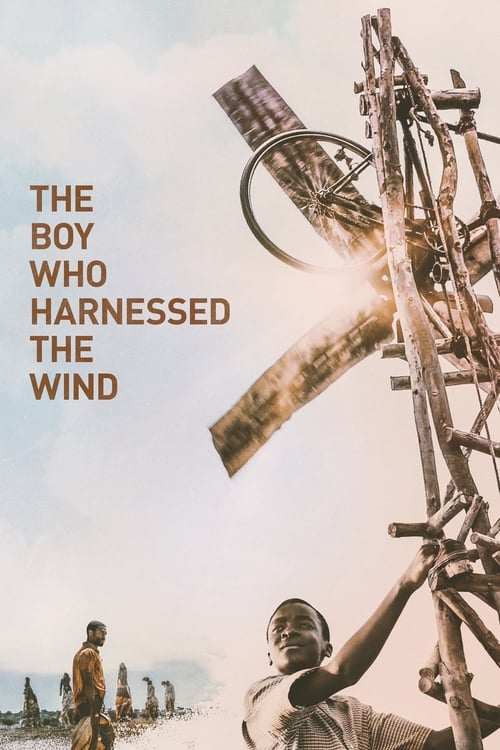
The Boy Who Harnessed the Wind
2019 · Chiwetel Ejiofor
For when you need proof that ingenuity and stubbornness can actually change something — an inspiring family-appropriate watch with real weight behind it. Comforting in the end, but honest about hardship on the way there.
What it's about
In a Malawian farming village in the early 2000s, thirteen-year-old William Kamkwamba is pulled out of school when his family can no longer pay the fees — just as drought and a failed harvest push the region toward famine. Sneaking into the school library, he becomes convinced he can build a wind turbine from bicycle parts and scrapyard junk to pump water for his family's fields. First he has to convince his exhausted, proud father to sacrifice what little they have left on a boy's idea. It's a true story.
The experience
Patient and grounded, it earns its uplift the hard way — the hunger and family strain are portrayed honestly, so the hope, when it comes, feels real rather than sweetened. Expect to be moved without feeling manipulated.
Performances
Chiwetel Ejiofor, directing himself, gives a moving performance as William's father — a proud man being ground down, whose resistance to his son's idea is understandable rather than villainous. Maxwell Simba brings a quiet, watchful determination to William.
The craft
Ejiofor's directorial debut was shot on location in Malawi with much of the dialogue in Chichewa, and that commitment to place gives every frame authenticity — the land, the weather, and the village life are characters in themselves. The filmmaking is unshowy and confident, trusting the story's own force.
Why it matters
A well-received Sundance debut released globally by Netflix, it announced Ejiofor as a filmmaker and brought William Kamkwamba's story — already a beloved memoir — to a worldwide audience.
Snapshot
The Boy Who Harnessed the Wind is the directorial debut of the British actor Chiwetel Ejiofor, who also wrote the screenplay and takes a substantial supporting role. It adapts the 2009 memoir of the same name by William Kamkwamba and the journalist Bryan Mealer, dramatizing the true story of Kamkwamba, a Malawian teenager who, during the catastrophic famine of 2001–2002, built a wind turbine from salvaged bicycle parts and scrapyard materials to pump water and irrigate his family's failing maize crop. The film premiered in competition at the Sundance Film Festival in January 2019 and was released by Netflix, which distributed it globally in March 2019 with a limited theatrical run. Shot on location in Malawi and performed substantially in Chichewa, it belongs to a lineage of humanist "true story" dramas about ingenuity and endurance in the Global South, but it is distinguished by its insistence on rooting that uplift in a granular, materially specific account of rural agrarian crisis. It is a modest, earnest film — closer in temperament to social-realist drama than to the inspirational sports-movie template its logline might suggest.
Industry & production
The project sits at the intersection of two industrial currents of the late 2010s: the streaming era's appetite for prestige "issue" dramas with festival pedigree, and a slowly widening space for African-set stories told with African locations, languages and performers. Ejiofor developed the adaptation over several years, having been drawn to Kamkwamba's memoir; the film was produced through Participant (the company associated with socially engaged cinema such as Spotlight and An Inconvenient Truth) together with BBC Films and Potboiler Productions, with Netflix acquiring distribution. That configuration — a public-service broadcaster's film arm, a mission-driven American producer, and a streamer as global distributor — is characteristic of how mid-budget non-U.S.-set dramas found financing and audiences at the time, when theatrical exhibition for such films had contracted sharply.
Production took place in Malawi itself, an unusual commitment for a film of this scale and one that shaped its texture decisively: real village settings, local extras, and Chichewa-language performance lend the film a documentary grounding. The choice to shoot in the country the story depicts, rather than a more production-friendly substitute, is the single most consequential industrial decision behind the film. I do not have reliable figures for the production budget or box-office/viewership performance to cite, and Netflix's characteristic opacity around viewing data means any such numbers should be treated cautiously; I will not invent them.
Technology
The film was shot digitally, as was standard for a production of this budget and vintage, though I cannot confirm the specific camera system used and will not guess at a model. What matters technologically is less the capture format than the production's logistical undertaking: mounting a feature in rural Malawi, with the attendant demands on power, transport and infrastructure, in service of authenticity. There is a pointed thematic rhyme here — a film about improvised, salvaged, appropriate technology made under conditions that themselves demanded resourcefulness. The turbine at the story's center is a low-technology marvel assembled from a bicycle frame, a dynamo, PVC piping, tractor parts and a wooden tower, and the film treats this bricolage with a craftsman's attention, foregrounding the physical labor of fabrication rather than compressing it into a montage of easy triumph. The post-production — grade, sound mix, score — was completed through conventional professional pipelines outside Malawi, but the film's technological argument is emphatically about vernacular, bottom-up innovation over imported solutions.
Technique
Cinematography
The cinematography is by Dick Pope, the veteran British director of photography best known for his long collaboration with Mike Leigh (Secrets & Lies, Mr. Turner, for which he received particular acclaim). Pope's presence is one of the film's most significant craft credentials, and his sensibility — attentive to natural light, landscape and the weathered materiality of place — suits the material. The film reads the Malawian landscape across the agricultural year: the saturated greens and open skies of the growing season give way to the parched, dust-toned palette of drought and famine, so that the land itself becomes a barometer of the family's fortunes. Pope favors a grounded, largely naturalistic approach, letting the environment and faces carry the frame rather than imposing stylistic flourish, with the widescreen compositions used to situate figures within the scale of the fields and sky on which their survival depends.
Editing
The editing is credited to Valerio Bonelli, whose credits include Philomena and Darkest Hour. The film's cutting is patient and classical, allowing scenes of labor and domestic life to breathe; its central technical challenge is the construction and operation of the turbine, which must be legible enough that the audience understands the mechanical logic without the sequence collapsing into montage shorthand. The film generally resists the temptation to rush, building its climax through accumulated process rather than a single cathartic cut.
Mise-en-scène / staging
The staging is anchored in the physical world of a Malawian farming village — the Kamkwamba family compound, the maize fields, the local school, the market and the trading center. Production and costume design (specific department heads I cannot confidently attribute, and will not invent) render this world without picturesque softening: the film shows the granary, the tools, the diminishing food stores, the encroachment of hunger on daily routine. Ejiofor stages the family as a working economic unit, so that scenes of planting, harvesting and rationing carry dramatic weight. The turbine and its wooden tower become the mise-en-scène's culminating object, a hand-built structure rising against the flat horizon.
Sound
The sound design supports the film's realist register — the sounds of wind, agricultural labor, and rural life — and the wind itself carries obvious thematic and dramatic charge, the invisible resource the boy learns to capture. The score is by the Brazilian composer Antonio Pinto (City of God, Central Station, Lord of War), whose music leans toward restraint and lyricism rather than swelling uplift, underscoring the emotional current without overwhelming it. The film's bilingual soundtrack — Chichewa and English — is itself an authorial choice with weight, insisting on the linguistic reality of its setting.
Performance
The performances are pitched toward naturalism. Newcomer Maxwell Simba plays William with a watchful, interior quality — a boy defined by curiosity and quiet determination rather than precociousness. Ejiofor himself plays Trywell, William's father, a proud farmer whose skepticism about his son's scheme is rooted in the desperate logic of scarcity; the father–son relationship is the emotional spine of the film, and Ejiofor gives the father dignity and stubbornness rather than making him a simple obstacle. Aïssa Maïga plays the mother, Agnes, and Lily Banda plays the sister, Annie, whose own storyline — a romance and departure — registers the ways famine and constraint bear differently on the family's young woman. The ensemble, drawing on local performers, sustains the film's grounded texture.
Narrative & dramatic mode
Structurally, the film is a realist coming-of-age drama braided with a survival narrative. Its dramatic engine is not the invention itself but the mounting pressure of famine: crop failure, food riots, the exhaustion of the family's reserves, the withdrawal of the boy from school when fees can no longer be paid. The turbine is a third-act solution earned through a first and second act of deprivation, so that the film's uplift is heavily mortgaged against real suffering. The mode is broadly classical and cause-and-effect driven, with the father's arc — from refusal to grudging faith in his son — providing the internal conflict that the external plot (drought, hunger) makes urgent. The film largely eschews the triumphalist beats of the inspirational genre in favor of a more sober register, though its resolution necessarily bends toward hope.
Genre & cycle
The film occupies the "based-on-a-true-story" inspirational drama, a durable commercial cycle, but inflects it through social realism and the conventions of Global-South-set humanist cinema. It can be placed alongside other real-life-ingenuity narratives and famine/survival dramas, and within the streaming era's wave of internationally set prestige dramas. Crucially, it inverts a common pattern of Western-facing African stories: there is no white-savior intermediary at its center; the agency, intelligence and solution belong to the Malawian family. That places it in dialogue with a broader corrective movement in 2010s cinema toward stories of the Global South told without an external guide-figure.
Authorship & method
The film is most legible as an authorial project of Chiwetel Ejiofor, who wrote, directed and acted in it — a triple role that marks it as a personal undertaking rather than a work-for-hire debut. His method, evident on screen, prioritizes fidelity to place, language and lived economic reality over genre gratification; the decision to shoot in Malawi and in Chichewa is the clearest signature of that authorship. He surrounds himself with senior craft collaborators whose experience anchors a first-time director: cinematographer Dick Pope, whose naturalist landscape sensibility shapes the film's look; editor Valerio Bonelli, bringing prestige-drama structure; and composer Antonio Pinto, whose restrained, world-inflected score resists sentimentality. The screenplay is Ejiofor's own adaptation of the Kamkwamba–Mealer memoir. The overall method is that of an actor-turned-director foregrounding performance, environment and human dignity, deploying the resources of professional filmmaking in service of a grounded, non-exoticizing portrait.
Movement / national cinema
The film sits awkwardly but productively between national cinemas. It is, by financing and key creative personnel, a British production (BBC Films, a British-born director, a British cinematographer) with American distribution and producing partners; yet by setting, language and much of its cast it reaches toward Malawian and, more broadly, African cinema. It is not a product of an indigenous Malawian film industry — which is small — but its on-location, Chichewa-language commitment aligns it with a wider push in the 2010s for African stories to be told on African soil with African performers. It is best understood as a transnational, diaspora-authored film that consciously works against the extractive tendencies of outside-in filmmaking about Africa.
Era / period
Released in 2019, the film is a product of the mature streaming era, when Netflix in particular was investing in festival-launched prestige dramas as a route to awards attention and subscriber prestige. Its Sundance premiere and Netflix release exemplify the distribution pathways that had, by then, largely replaced theatrical exhibition for mid-budget international drama. Thematically, the film revisits the early 2000s — the 2001–2002 Malawian famine — and thus also functions as a period piece, reconstructing a specific recent historical crisis with attention to its political and economic context, including gestures toward governance, land, and the pressures of a subsistence economy exposed to climate and market shocks.
Themes
The film's central theme is education as liberation — William's access to a library and a physics textbook, and his exclusion from school by poverty, are the hinges of the plot, making literacy and knowledge literally life-saving. Adjacent to this runs a theme of appropriate, vernacular technology: the argument that solutions to crisis can be improvised from local materials and local intelligence rather than awaited from outside. Famine, climate vulnerability and the fragility of subsistence agriculture supply the film's material substrate, giving it an ecological and political dimension — deforestation, land pressure and drought are shown as interlocking causes. The father–son relationship dramatizes a generational negotiation between tradition and innovation, faith and empiricism. And underlying all of it is a theme of dignity and self-determination: the family's survival is authored from within.
Reception, canon & influence
Critical reception was generally warm, with praise concentrated on Ejiofor's assured, sincere direction, the strength of the performances (particularly the father–son dynamic between Ejiofor and Maxwell Simba), Dick Pope's cinematography, and the film's commitment to authenticity of place and language. Some criticism noted the familiar contours of the inspirational-true-story shape and a certain conventionality of construction — that the film is admirable and moving without being formally adventurous. I am summarizing the broad tenor of contemporaneous critical response rather than citing specific reviews or aggregate scores, which I cannot reproduce reliably here.
The influences on the film run backward to two distinct traditions: the humanist social-realist drama (the attention to labor, environment and ordinary endurance recalls a broadly Loachian/naturalist British lineage, filtered through Pope's Mike Leigh pedigree), and the corrective wave of Global-South storytelling that seeks to displace the white-savior template. Its source, of course, is the Kamkwamba–Mealer memoir, itself an outgrowth of Kamkwamba's TED-talk-era fame as an emblem of grassroots innovation.
Its influence forward is best measured not in stylistic imitators but in what it modeled: a prestige-scale, streamer-backed drama shot on location in an African country, in an African language, with local agency at its narrative center and no external guide-figure. As a proof of concept for that model within the Netflix ecosystem, and as a high-profile actor-to-director transition for Ejiofor, it contributed to a broader 2010s–2020s normalization of such stories. Its longer-term canonical standing remains modest — it is respected rather than landmark — but its significance lies in the ethics of its making as much as in the film on screen. Where the historical record of its downstream influence is genuinely thin, as it still is given the film's recency, that thinness should be acknowledged rather than papered over.
Reception
It premiered warmly at Sundance 2019 — winning the Alfred P. Sloan Prize — then slipped quietly into the Netflix catalog; today it's less a cinephile talking point than a beloved classroom and family-night staple.
How The Boy Who Harnessed the Wind was received, from release to now →
Influences: the films it descends from and the films it influenced
- Bicycle Thieves (1948) — Establishes the neorealist template the film runs on — location shooting, a largely non-professional cast, and a father–son bond stressed by rural economic precarity carrying the drama in place of plot mechanics.
- Kes (1969) — Models the unsentimental social-realist coming-of-age around a poor boy and a self-taught project, using regional vernacular and observational patience rather than uplift-genre beats.
- Central Station (1998) — Antonio Pinto's restrained, folk-inflected scoring here defines the minimal, anti-sentimental musical grammar he brings to Ejiofor's film.
- City of God (2002) — Another Antonio Pinto score, and the model of a Global-South story told from inside the community with local agency at its center rather than through an outside observer.
- Mr. Turner (2014) — Dick Pope's available-light, painterly widescreen landscape method — the naturalist eye for weather, dust and horizon — is the same cinematographic signature carried to Malawi.
- Secrets & Lies (1996) — The Leigh–Pope pedigree of performance-first, unhurried framing that privileges faces and lived domestic space over coverage flourishes.
- Philomena (2013) — Editor Valerio Bonelli's patient, classical prestige-drama cutting — letting scenes breathe to build dignity — is the structural rhythm he imports into the film.
- Whale Rider (2002) — Indigenous-language coming-of-age driven by a rural child's defiance of tradition, told entirely from within the culture with no external guide-figure.
- Tsotsi (2005) — A township-set, local-language (Tsotsitaal/Zulu) drama that proved an African-language, on-location production could reach international prestige circuits.
- Yesterday (2004) — Entirely Zulu-language rural realism centering an ordinary African protagonist's endurance, prefiguring the film's commitment to Chichewa and non-exoticizing place.
- Slumdog Millionaire (2008) — Shares the memoir-to-prestige pipeline: adapting a Global-South up-from-poverty true-ish story with local-language texture into an internationally distributed inspirational drama.
- Half of a Yellow Sun (2013) — An African literary adaptation shot on the continent with Ejiofor in the cast, part of the same push to bring African-authored narratives to screen with local casts.
- Timbuktu (2014) — On-location Sahel realism in local languages, foregrounding ordinary lives and landscape with the same refusal of the outsider's mediating perspective.
- Beasts of No Nation (2015) — The direct proof-of-concept for a Netflix-backed, on-location West African production in local vernacular — the streamer-prestige model Ejiofor's film extends without a white protagonist.
- Queen of Katwe (2016) — An East-African-set inspirational true story of a self-taught child prodigy, shot in-country with local actors and language and no external savior guiding the arc.
- Difret (2014) — Ethiopian-language, based-on-true-events social realism where local characters drive their own emancipation, sharing the film's education/liberation and local-agency ethic.
- Rafiki (2018) — Contemporary Kenyan filmmaking asserting local authorship and youth agency on location, part of the same corrective wave displacing outside-narrated African stories.
Similar films
- My Father's Shadow (2025) — shared sensibility
- A Sun (2019) — shared sensibility
- Minari (2021) — shared sensibility
- The Wind Rises (2013) — shared sensibility
- Yeelen (1987) — shared sensibility
- Boy & the World (2014) — shared sensibility
- The Breadwinner (2017) — shared sensibility
- Weathering with You (2019) — shared sensibility