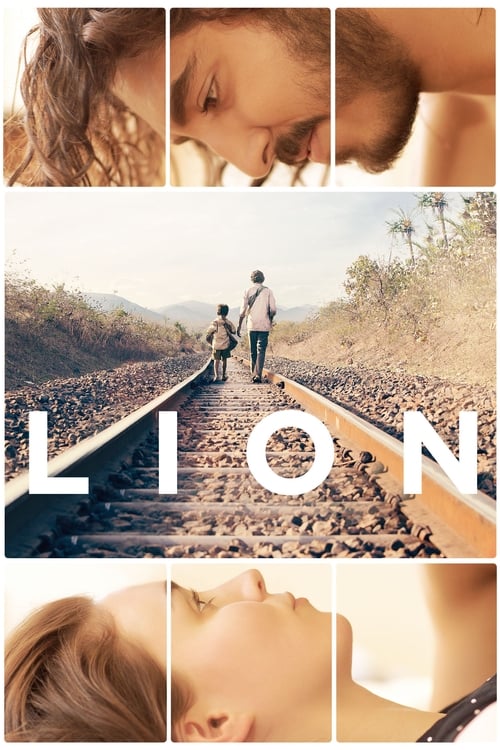
Lion
2016 · Garth Davis
For when you want to be emotionally wrecked by something true — a big, sincere cry with a real story underneath it. Bring tissues, not cynicism.
What it's about
A five-year-old boy from a poor family in rural India falls asleep on a train and wakes up over a thousand miles away in Calcutta, unable to say where home is. He survives the streets, passes through institutions, and is eventually adopted by a couple in Tasmania. Twenty-five years later, haunted by fragments of memory, he begins scouring satellite imagery for the hometown he can barely remember — a search that threatens to consume his adult life and the family who raised him.
The experience
The first hour is nearly wordless and grips like a thriller — you're five years old and lost, and the film never lets you forget it. The second half trades that immediacy for a slow-burning ache about identity and belonging, building to an ending that flattens most audiences.
Performances
Young Sunny Pawar carries the entire first half on his shoulders and is astonishing; Dev Patel gives his breakthrough dramatic performance as the adult Saroo, and Nicole Kidman does quietly devastating work as his adoptive mother.
The craft
The bifurcated structure is the masterstroke: a child's-eye survival film shot largely in Hindi and Bengali, then an English-language adult drama about memory. The Calcutta sequences have documentary-level texture, and the widescreen photography of both India and Tasmania makes the sheer distance of the story physical — it rewards a big screen.
Why it matters
A six-time Oscar nominee that turned Saroo Brierley's memoir into a global phenomenon and drew real attention to India's lost and trafficked children; it made Dev Patel a serious dramatic lead.
Snapshot
Lion is a two-part memory film built on a true story of separation and return. It adapts Saroo Brierley's memoir A Long Way Home, tracing how a five-year-old boy from a poor family in Madhya Pradesh became lost on a decommissioned train that carried him roughly a thousand miles to Calcutta, survived months on the street and in institutions, was adopted by a Tasmanian couple, and — as an adult — reconstructed his origins using satellite imagery and fractured childhood memories. The film's formal signature is its bifurcation: a nearly wordless, child's-eye first movement shot largely in Hindi and Bengali, followed by a more conventionally dramatic adult second movement in English. It was the feature debut of Garth Davis, a commercial and television director, and became a substantial awards-season presence, earning six Academy Award nominations, including Best Picture. Its cultural footprint is intertwined with a specific piece of technology — Google Earth — which the narrative treats not as a gimmick but as the instrument of an almost archaeological act of self-recovery.
Industry & production
Lion was produced principally by See-Saw Films, the Anglo-Australian company of Iain Canning and Emile Sherman, whose earlier The King's Speech (2010) had won Best Picture, in partnership with the Australian outfit Aquarius Films (Angie Fielder). The project was an Australian–American–British co-production, with financing that drew on Australian sources including Screen Australia and the state agencies, reflecting the country's incentive-driven production ecology. The Weinstein Company held distribution rights and shepherded the film through the North American awards campaign — a fact that has since acquired an uncomfortable retrospective cast given the 2017 collapse of that company, though it bears on the film's marketing history rather than its making.
Luke Davies, an Australian novelist and screenwriter (Candy), adapted Brierley's memoir. The production shot on location in India — Kolkata and the Madhya Pradesh region around Khandwa, standing in for Saroo's home village and the railway journeys — and in Australia, chiefly Tasmania, where the real Brierleys lived and where the adult story is set. Casting the child lead required an extensive search across India that surfaced Sunny Pawar, a young non-professional from Mumbai; the adult Saroo was played by Dev Patel, with Nicole Kidman and David Wenham as the adoptive parents and Rooney Mara as Saroo's partner. The budget was modest by studio standards — reported in the low tens of millions — and the film performed strongly relative to that scale, though precise grosses should be checked against distributor records rather than asserted here.
Technology
Two technological registers matter. The first is diegetic and thematic: Google Earth is effectively a co-protagonist of the second half. The film dramatizes how consumer satellite mapping — a tool of casual global surveillance — becomes, for a displaced person, a means of pattern-matching remembered landmarks (a water tower, a rock formation, the shape of tracks) against a searchable planet. That the resolution of a decades-old trauma hinges on an app is one of the film's genuinely novel contributions to the "search for origins" tradition, and it dates the story precisely to the early-2010s moment when such tools became ubiquitous.
The second register is the production technology. Lion was shot digitally by Greig Fraser, an early and articulate advocate of digital capture who has spoken publicly about matching sensor and lens choices to emotional texture. The film's handheld intimacy in the Calcutta passages and its cleaner, cooler Australian material reflect deliberate technical calibration rather than a single house look.
Technique
Cinematography
Greig Fraser's cinematography is the film's most lauded craft element and earned an Academy Award nomination. His strategy is bifurcated to match the script. The Indian first act is shot close, low, and mobile — frequently at the child's eye level — so that platforms, crowds, and train interiors loom with the disorienting scale a lost five-year-old would perceive. Focus is often shallow, isolating Saroo within blurred, threatening surrounds; the camera stays with him rather than establishing geography, which reproduces his own inability to place himself. The Australian material, by contrast, opens up: wider framings, more stable compositions, cooler and more even light, a landscape that is beautiful but also emotionally muffled. Fraser uses aerial and elevated imagery — the God's-eye view that rhymes with the satellite motif — to bind the two worlds visually, so that the film's climactic technology (looking down at the Earth) is prefigured in its very grammar of shots.
Editing
Alexandre de Franceschi's editing carries the film's structural gamble: sustaining a long, dialogue-sparse first act driven by a child's experience, then modulating into an adult drama of interiority in which the "action" is largely mental. The film's recurring device is the memory-fragment — brief, sensory flashes (a face, a station, a phrase) that surface unbidden in the adult Saroo and that the editing seeds early so their later return lands with recognition. The cross-cutting in the climax, between database searching and imagined childhood, converts a fundamentally undramatic activity — scrolling a map — into suspense. The pacing of the first act, in particular, resists conventional momentum in favor of accretion and endurance.
Mise-en-scène / staging
The staging draws a sharp material contrast between worlds without editorializing either into caricature. Saroo's home village is rendered with attention to texture and labor rather than picturesque poverty; the Calcutta sequences stage genuine threat — trafficking, institutional indifference, predatory adults — largely through blocking and implication rather than explicit incident, keeping the film within a register accessible to a broad audience while communicating danger. The Tasmanian home is comfortable, ordered, and quietly haunted, its very ease part of the adult Saroo's guilt. The production's commitment to shooting in actual Indian and Australian locations gives the mise-en-scène a documentary grounding that a studio reconstruction could not supply.
Sound
The score, by Volker Bertelmann (who records as Hauschka) and Dustin O'Halloran, is central to the film's emotional operation and was Oscar-nominated. It favors piano — including Bertelmann's characteristic prepared-piano textures — and restrained strings, avoiding the swelling orchestral cue in favor of a more intimate, cyclical minimalism that mirrors the theme of return. Sound design does heavy narrative work in the Calcutta act, where the roar of stations and trains and the babble of an unfamiliar language (Saroo speaks Hindi and cannot make himself understood in Bengali-speaking Calcutta) dramatize his isolation acoustically. Language itself is a sound-design element: the child's linguistic exile is one of the film's most effective and least sentimental devices.
Performance
Performance is the film's other most-celebrated dimension. Sunny Pawar, a non-professional child, anchors the entire first hour with a largely reactive, non-verbal performance of endurance — a considerable achievement given how much narrative weight rests on a face rather than dialogue. Dev Patel, cast against his earlier ingénue image, plays adult Saroo with a banked interiority and physical transformation (accent, build, bearing) that earned him an Academy Award nomination for Best Supporting Actor and a BAFTA win in that category. Nicole Kidman, as adoptive mother Sue Brierley, delivers a contained, un-showy performance built around a single monologue about choosing to adopt rather than bear children; it earned her a Best Supporting Actress nomination. Rooney Mara's role is comparatively thin — a limitation of the adaptation more than the performance — and several critics noted that the girlfriend character exists largely to register Saroo's withdrawal.
Narrative & dramatic mode
The film operates in the register of the true-story emotional drama, but its architecture is more unusual than that label suggests. The first movement is closer to a survival narrative or neorealist odyssey — episodic, observational, driven by a protagonist too young to have goals beyond safety. The second movement is a drama of memory and guilt, in which the external quest (finding home) is inseparable from an internal one (reconciling two identities and the debt owed to two mothers). The dramatic engine of the back half is not obstacle-based but psychological: the tension between Saroo's love for his adoptive parents and the compulsion to search, and the shame that keeps him from telling them. The film's mode is fundamentally sincere and affective — it seeks catharsis, and its detractors argue it engineers it — but its willingness to spend an hour on a near-silent child before delivering any conventional dramatic payoff is a real structural risk.
Genre & cycle
Lion sits within several overlapping cycles. It belongs to the awards-season prestige biopic/true-story drama that dominated mid-2010s specialty distribution — films sold on emotional authenticity and "based on a true story" credibility. It also participates in a cycle of Western films engaging India as setting and subject, a lineage that runs through Slumdog Millionaire (2008) — with which Lion shares Dev Patel, a Mumbai-street milieu, and a rags-to-resolution shape, and to which it is inevitably compared. Thematically it joins the enduring "search for origins" genre of adoption and lost-family narratives. Its Google Earth climax gives it a small claim as an early example of films metabolizing consumer digital tools into their emotional machinery.
Authorship & method
Lion is a first feature, and its authorship is best understood as collaborative rather than singularly auteurist. Garth Davis came from a decorated career in advertising and had co-directed (with Jane Campion) the acclaimed miniseries Top of the Lake (2013); that background shows in the film's image-craft and its patience with landscape and face. His method here privileges restraint and location authenticity, and he has spoken of building the first act around a child's sensory experience. His subsequent features — Mary Magdalene (2018) and the science-fiction drama Foe (2023) — have been more coolly received, which has led some to read Lion as a case where an exceptional subject and collaborators aligned. Greig Fraser, the cinematographer, is the most consequential collaborator; Lion sits in a career that also includes Zero Dark Thirty, Rogue One, and later the Dune films and The Batman, marking him as one of his generation's major image-makers. Screenwriter Luke Davies made the structural decision to hold the adult story's exposition until the audience has lived the child's ordeal. Editor Alexandre de Franceschi and composers Volker Bertelmann and Dustin O'Halloran shaped the film's rhythm and affect. The source author, Saroo Brierley, and his adoptive and birth families are the ultimate authors of the material, and the film's fidelity to the memoir is part of its claim on audiences.
Movement / national cinema
The film is most usefully placed within contemporary Australian cinema and its internationalized, co-production model. See-Saw and Aquarius represent an Australian industry that leverages state funding and global talent to make English-language films of international scale, and Lion's Tasmanian settings, Australian creative leads (Davis, Fraser, Davies), and Australian institutional backing mark it as an Australian film even as half its story and cast are Indian. It is not a product of any Indian film movement — it is a Western production shot partly in India — and it is worth stating plainly that its perspective on India is that of the adoptee and the outside filmmaker, a framing that shapes both its sympathies and its blind spots.
Era / period
Lion is a film of the mid-2010s prestige-independent moment, made when specialty distributors still built theatrical awards campaigns around emotionally resonant true stories and when the technological premise it dramatizes — locating a childhood home from a laptop — had become newly plausible. Its story spans roughly the late 1980s (Saroo's childhood, per the real chronology) to the early 2010s, and the film is attentive to that period gap: the adult sections are set in a recognizably contemporary, connected world whose very connectivity makes the reunion possible.
Themes
The film's governing themes are memory, belonging, and the arithmetic of love between two families. It is centrally concerned with the ethics of adoption — Kidman's monologue reframes adoption as a chosen, non-substitutive act — and with the guilt of the survivor who has been given a good life at the cost of the one he lost. Displacement and language operate as a linked motif: to be lost is, in the first act, to be linguistically unintelligible, spoken to in a tongue one cannot answer. Class and global inequality run beneath the surface, in the gulf between a Madhya Pradesh village and a Tasmanian home. And the film meditates, finally, on identity as something that can be split rather than replaced — Saroo remains both the village child and the adopted Australian, and the reunion resolves the search without dissolving the doubleness. The film's title, revealed at the close to be the meaning of the protagonist's actual birth name, ties these threads to a single act of self-recognition.
Reception, canon & influence
Critical reception was broadly positive, weighted heavily toward the film's performances, cinematography, and score, with the most common reservation being that the picture leans hard on emotional manipulation and that its second half is more conventional than its remarkable first. It converted that reception into a major awards presence: six Academy Award nominations, including Best Picture, Best Supporting Actor (Patel), Best Supporting Actress (Kidman), Best Adapted Screenplay, Best Cinematography, and Best Original Score, and comparable recognition at the BAFTAs, where Patel and Davies won. It did not win Oscars in a competitive year, and its longer-term canonical standing is that of a well-regarded, widely seen emotional drama rather than a formally influential landmark.
Influences on the film (backward): Lion draws on the neorealist tradition of the endangered-child narrative and on the Western-in-India lineage most immediately embodied by Slumdog Millionaire, whose success plausibly helped make Lion financeable and whose lead it shares. Its two-part, memory-driven structure echoes a broad tradition of adoption and return narratives across literature and film.
Legacy (forward): The film's clearest downstream effects are extra-cinematic and career-based. It consolidated Dev Patel's transition to serious adult leading roles and confirmed Greig Fraser as a major cinematographer entering his most prominent decade. It raised public awareness of child displacement and the adoptee experience, and it stands as an early, prominent instance of a film building its climax around a consumer digital tool — a small but real contribution to how later films imagine technology as an emotional instrument. Its influence on film form, as opposed to on careers and public conversation, is modest; the honest assessment is that Lion is remembered as an affecting adaptation and a showcase for its craft and cast rather than as a work that reshaped its genre.
Reception
A six-Oscar-nomination crowd-pleaser in the 2016–17 awards season that went home empty-handed, it has since settled into 'reliable tearjerker' status — less awards-canon than cry-canon, the film people recommend with a box of tissues.
How Lion was received, from release to now →
How to watch Lion: what to notice on a first viewing
- Notice how low and close the camera stays to young Saroo. Fraser shoots the Indian first act at child's-eye height with shallow focus, so crowds and trains loom blurred and threatening around Saroo. You experience the world at a five-year-old's scale instead of watching from above it.
- Listen for when Saroo's Hindi gets no answer in Calcutta. The city around him speaks Bengali; his own words repeatedly fail to connect, against a soundscape of station roar and crowd noise. Being lost becomes something you hear happening, not just a fact the story states.
- Watch Sunny Pawar's face in the scenes with no dialogue. Pawar, a non-professional child actor, carries nearly the entire first hour through reaction alone, no lines required. A child's fear and endurance become legible through the face, with nothing explained by script.
- Track how long the film waits before adult Saroo speaks freely. The first movement stays nearly wordless in Hindi and Bengali; only later does the film shift fully into English dialogue and adult interiority. The break in language and mode makes you live two separate childhoods inside one story.
The whole guide to watching Lion, with the keys for a rewatch →
Influences: the films it descends from and the films it influenced
- Slumdog Millionaire (2008) — Established the template Lion inherits — Dev Patel as lead and a kinetic, child-POV chase through Indian railway platforms and slums shot with saturated, on-the-ground immersion, plus the Western-financed-story-of-Indian-poverty model that made Lion bankable.
- Pather Panchali (1955) — Originates the child's-eye-level framing of rural Bengal with non-professional child actors and patient landscape/train imagery that Davis rebuilds in the first act's sensory ordeal.
- Bicycle Thieves (1948) — Neorealist method of casting non-professionals and dramatizing a search by walking a vulnerable figure through real, indifferent urban space — the structural DNA of Saroo's lost-in-the-city sequences.
- Salaam Bombay! (1988) — Directly precedes Lion's depiction of homeless street children in India, using non-professional child performers embedded in actual station and slum locations rather than sets.
- Central Station (1998) — Provides the cross-country search-for-family road structure pairing an untrained child with the landscape, resolving on reunion — the emotional-journey architecture Luke Davies adapts.
- Rabbit-Proof Fence (2002) — Contemporary Australian precedent for lost children traversing vast terrain to return home, using aerial/wide landscape photography of the child against enormous distance as the film's central formal gesture.
- Walkabout (1971) — Founds the Australian-cinema grammar of a child stranded in overwhelming landscape, with god's-eye and sun-flared imagery translating disorientation into visual scale.
- The 400 Blows (1959) — Model for building a film around a child's subjective sensory experience and a non-professional lead's face, holding on the child's ordeal before any adult framing arrives.
- Zero Dark Thirty (2012) — Greig Fraser's earlier work here forged the naturalistic, available-light digital handheld idiom — shallow focus on faces amid documentary-real environments — that he carries into Lion's cinematography.
- Top of the Lake (2013) — Davis's own co-directed apprenticeship, where he developed the patience with landscape and human face and the restrained location realism that defines his approach on Lion.
- Philomena (2013) — Extends the forced-separation search into a records-and-database procedural whose reunion is deliberately underplayed — no swelling reveal, just two people in a doorway — an anticlimactic-revelation strategy Philomena had just proved commercially survivable.
- Capernaum (2018) — Carries forward the endangered-non-professional-child-in-the-megacity mode, staging a small boy's survival through real streets with handheld intimacy directly downstream of Lion and Slumdog.
- Searching (2018) — Builds its entire emotional climax around a consumer digital interface as an instrument of reunion, extending Lion's innovation of making a Google-tool search the site of catharsis.
- Dune (2021) — Greig Fraser scales the large-format digital naturalism and shallow-focus-face-against-immense-landscape compositions he refined on Lion into his signature blockbuster style.
- All Quiet on the Western Front (2022) — Volker Bertelmann carries the prepared-piano and minimalist-motif scoring approach he developed on Lion into an award-winning score built on percussive, muted-string emotional restraint.
- Foe (2023) — Davis's later feature reprises his Lion signatures — restrained landscape framing, shallow-focus close-ups on faces, and a slow-burn emotional-drama pace — now applied to speculative material.
- Nobody Knows (2004) — Parallel method of eliciting a naturalistic, near-wordless performance from a real child navigating abandonment, privileging small sensory detail over plot exposition.
- Beasts of No Nation (2015) — Contemporary companion in casting an untrained child (Abraham Attah) as an endangered lead and shooting his ordeal on location with immersive digital cinematography.
- The Florida Project (2017) — Extends the child's-eye-level camera height and non-professional child performance to render poverty through a kid's wonder rather than adult pity, the same POV discipline as Lion's first act.
Similar films
- Slumdog Millionaire (2008) — influence & lineage
- Pather Panchali (1955) — influence & lineage
- Searching (2018) — influence & lineage
- Life of Pi (2012) — shared sensibility
- Kannathil Muthamittal (2002) — shared sensibility
- Moonlight (2016) — shared sensibility
- Blue Heron (2026) — shared sensibility
- All That's Left of You (2025) — shared sensibility