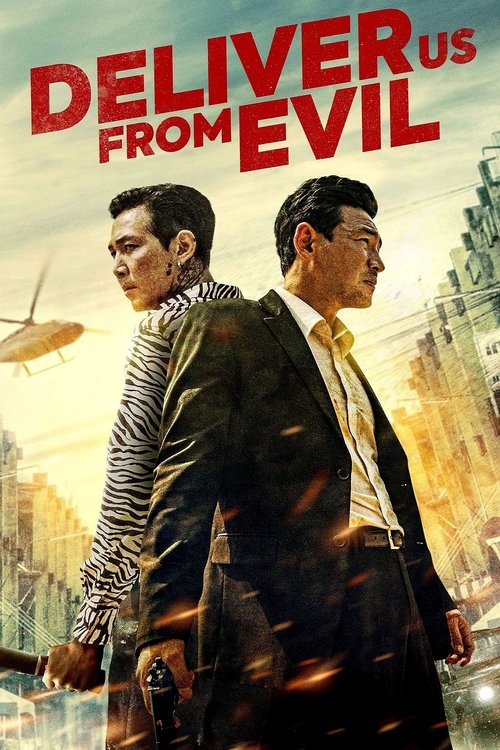
Deliver Us from Evil
2020 · Hong Won-chan
For when you want a lean, mean action-thriller night — no homework, just momentum, grit, and a rescue mission with real stakes. Comfort food for genre fans, though the brutality asks for a strong stomach.
What it's about
A contract killer on the verge of disappearing for good learns two things at once: he has a daughter he never knew about, and she's been taken by child traffickers operating out of Bangkok. He goes to get her back. Hunting him through the city is a Korean-Japanese gangster with his own blood debt to settle — the brother of the man the killer took out on his final job — while a local fixer named Yui becomes his unlikely guide and the story's one source of warmth.
The experience
Relentless and hard-edged, a manhunt that keeps tightening — sweaty Bangkok streets, brutal close-quarters fights, and a pursuer who simply will not stop. The violence is punishing, but the film keeps a pulse of desperation under it that makes the chase feel personal rather than mechanical.
Performances
Hwang Jung-min plays the killer with weary, coiled economy, while Lee Jung-jae goes gleefully feral as his pursuer — a showy, scene-stealing turn. Park Jung-min brings unexpected tenderness as Yui, the fixer who gives the film its heart.
The craft
Hong Won-chan stages the action with hard-boiled clarity — car chases, knife fights, and apartment brawls that favor impact over flash, shot across Incheon, Tokyo, and a vividly humid Bangkok. It's a film built for a big screen and loud speakers: the hits land heavy and the chases roar.
Why it matters
Released into a COVID-gutted 2020 market, it became South Korea's biggest domestic hit of the year and confirmed the Korean hitman thriller as a reliable international export.
Snapshot
Deliver Us from Evil is a transnational Korean hitman thriller in which a retired contract killer, In-nam (Hwang Jung-min), discovers on the eve of his intended disappearance that he has a daughter, and that she has been taken by a child-trafficking ring operating out of Bangkok. He goes to retrieve her. Trailing him is Ray (Lee Jung-jae), a Korean-Japanese gangster whose brother In-nam killed in the film's opening job — a pursuer as implacable as the man he pursues. Between them stands Yui (Park Jung-min), a Korean-Thai trans woman who works as a fixer, driver and interpreter, and who becomes the film's only source of warmth.
It arrived in Korean theaters in August 2020, into a market that COVID-19 had gutted, and became the year's biggest domestic hit — a distinction earned in a collapsed exhibition landscape but meaningful nonetheless, since it demonstrated that the mid-budget Korean action picture could still summon an audience when almost nothing else could. Critically it was received as a superbly made piece of genre machinery running on borrowed parts: virtually every review reached for The Man from Nowhere (2010) within a paragraph. Its durable interest lies less in its plot than in what it does with Lee Jung-jae and Park Jung-min, and in what it reveals about how Korean commercial cinema by 2020 imagined Southeast Asia.
Industry & production
The film sits squarely in the industrial center of the Korean film business at the end of the 2010s: a star-driven action-drama with an above-the-line package assembled around two of the industry's most bankable male leads, financed and distributed through the CJ system that had by then consolidated production, distribution and exhibition into a single vertical. Hwang Jung-min and Lee Jung-jae had co-starred in Park Hoon-jung's New World (2013), and the marketing leaned hard on that reunion — a piece of casting economics as much as of casting. Korean commercial cinema of this period routinely built projects on the recognizable pairing rather than on the premise.
Production was substantially located in Thailand, with the opening sequences set in Japan. Runaway shooting in Southeast Asia had become standard practice for Korean action films by the mid-2010s — favorable costs, cooperative local production services, and an exotic-but-legible geography that could be sold as scale. The Yellow Sea (2010) had gone to the Chinese border; The Berlin File (2013) to Germany; Believer (2018) and Ashfall (2019) ranged similarly. Deliver Us from Evil belongs to that logic of Korean films that expand their production value by leaving Korea.
The release date is the most historically specific fact about it. Korean exhibition had cratered in early 2020; the summer slate was the industry's attempt to restart itself, with distanced seating, government-supported ticket discounts, and a handful of tentpoles released in sequence. Deliver Us from Evil outperformed its competition and finished as the top-grossing Korean release of the year. Admissions figures circulate in the low four millions — a number that would have been a modest result in 2019 and was extraordinary in 2020. I flag the precise figure as something to verify against Korean Film Council data rather than take from memory.
Technology
The film is a digitally originated, DI-finished commercial picture of its moment, and its technical profile is legible on screen even where the specific equipment record is not well documented in English-language sources. Its most consequential technological affordance is low-light capture: a large share of the film takes place at night in Bangkok, in unlit alleys, canal-side corridors, parking structures and interiors lit by neon and practical sources. Digital sensors of the late 2010s made it possible to shoot those environments at something close to available light while retaining shadow detail and a controllable color response — which is what permits the film's signature look, a deep, saturated night in which faces stay readable against an ambient wash of green, sodium-amber and cyan.
The grade is the second technological signature. Japan is rendered cold and desaturated; Bangkok is pushed hot and humid, with skin tones warmed and highlights allowed to bloom. This is a color-timed argument about geography, executed in the DI suite, and it is the kind of authorial gesture that digital finishing normalized across global action cinema in this decade.
Third: the film's violence is a hybrid of practical stunt work and invisible digital augmentation. Squibs, blood hits, muzzle flashes and impact debris in contemporary Korean action are typically a blend of on-set practical effects and post-production compositing, and the film's gunfights show the characteristic cleanliness of that hybrid — the hits land with weight but without the smeary imprecision of purely practical work. Aerial and vehicle-mounted coverage of Bangkok, likewise, reflects the drone-and-gimbal toolkit that had become cheap and ubiquitous by 2020.
Technique
Cinematography
The camera work is notably classical for its genre and period. Where much post-2008 Korean action favors handheld agitation, Deliver Us from Evil shoots for legibility: wider lenses in the alley chases, a stable frame during hand-to-hand exchanges, and a willingness to hold a shot long enough for the geography of a fight to register. Coverage is compositionally deliberate — In-nam is frequently framed alone in the center of a symmetrical or receding space, a man with nothing on either side of him, while Ray is shot more actively, often entering frame or moving through it, an intrusion rather than a presence.
The film exploits Bangkok's verticality and its water. Canals, stairwells, elevated walkways and rooftop approaches structure several sequences; the camera repeatedly places characters on different planes of the same frame, so that pursuit reads spatially rather than through cutting. Depth of field is used morally as much as descriptively: shallow focus isolates In-nam from crowds, insisting on his separation from ordinary life even in the densest public space.
Editing
The cutting is tight but not fragmentary. The film's action grammar sits between the Hollywood-derived rapid-assembly style and the sustained-take approach that films like The Villainess (2017) had recently made fashionable in Korea — closer to the former, but with enough held shots to preserve spatial continuity. Dramatic scenes are cut sparely, with an unusual tolerance for silence around Hwang; the editor gives him beats where nothing happens, which is where the performance lives.
Structurally, the film cross-cuts two pursuits from its first act onward — In-nam moving toward the traffickers, Ray moving toward In-nam — and the editing's principal job is to keep both clocks running without letting either go slack. It largely succeeds; the film's pacing is its most consistently praised attribute.
Mise-en-scène / staging
Bangkok is staged as a labyrinth of thresholds: markets, corridors, bathhouses, hospitals, brothels, apartment blocks. The production design consistently favors interiors that are dense, cluttered and porous — spaces you can be ambushed in and escape through. This is functional (it generates set pieces) but also thematic: the film's underworld has no rooms with only one door.
Costume does the character work the dialogue declines to do. In-nam wears anonymous, unmemorable gray — the uniform of a man designed not to be seen. Ray is a peacock: long hair, patterned shirts, an aesthetic of conspicuous appetite. Yui's presentation is the film's most carefully considered design element, and also its most contested: a figure whose visibility is both her livelihood and her danger.
The Japanese prologue is staged with cold precision — snow, glass, straight lines — establishing an image of the killer's professional life as sterile and controlled, so that Bangkok's heat and clutter can register as its collapse.
Sound
The film is multilingual by design — Korean, Japanese, Thai and English circulate constantly — and translation is a plot mechanic, not just texture. Yui's function as interpreter makes language itself a resource that In-nam lacks and must buy; several sequences turn on what he cannot understand. The sound design foregrounds this, letting untranslated Thai run as environment rather than information.
Gunfire is mixed dry, close and percussive rather than cavernous, which keeps the violence unromantic. The score leans on low drones, sustained tones and pulse percussion rather than melody, in the mode that had become the default for Korean thrillers after The Chaser and The Wailing — atmosphere as pressure rather than as commentary. Silence is used deliberately around In-nam; Hwang's near-muteness is a sound-design decision as much as a performance one.
Performance
Hwang Jung-min, one of Korea's most volubly expressive actors, plays In-nam almost entirely subtractively — minimal dialogue, minimal expression, an economy that reads as a man who has removed himself from the category of persons. It is a deliberate refusal of his usual register, and its effectiveness depends on the audience knowing that register.
Lee Jung-jae's Ray is the inverse and the film's most enjoyable element: sensual, theatrical, amused, genuinely frightening. He plays vengeance as appetite rather than duty. Coming immediately before Squid Game (2021) recalibrated his global profile, the performance is a reminder of the range that international audiences would subsequently associate with a very different persona.
Park Jung-min's Yui is the performance that dominated the film's domestic awards conversation and its critical discussion. Park plays her with comic timing, real tenderness and an unforced physical confidence, and Yui carries the film's only functioning emotional relationships. The casting of a cisgender man as a trans woman drew criticism at the time and remains the standard critical caveat attached to the film — a caveat that has grown sharper, not softer, in the years since.
Narrative & dramatic mode
The structure is a double pursuit resolved into a single convergence: a rescue narrative braided with a revenge narrative, where the avenger's target is the rescuer. This is efficient design, because it means every delay In-nam suffers is also an opportunity for Ray, and the two clocks accelerate each other.
The dramatic mode is melodrama wearing the clothes of the hardboiled thriller. The film front-loads its emotional engine — the revelation of paternity arrives early, delivered under duress — and thereafter operates on pure obligation: a man who has spent his life ending relations discovers he has one. There is no interiority, no flashback architecture, no psychological explanation. In-nam is defined entirely by what he does, which is the genre's oldest and most reliable characterization strategy.
The dialogue is functional to the point of austerity, and the film's most interesting writing choice is negative: it declines to give In-nam a redemption speech, a confession, or a moment of self-understanding. What redemption exists is transacted rather than articulated.
Genre & cycle
The film belongs unambiguously to the Korean hardboiled action cycle that runs from A Bittersweet Life (2005) through The Man from Nowhere (2010), The Villainess (2017), Believer (2018) and The Gangster, the Cop, the Devil (2019) — films built around a competent, damaged male body moving through a criminal underworld rendered as total institution. Within that cycle it occupies the specific sub-position of the "rescue the child" variant that The Man from Nowhere had made into a Korean commercial template, itself descended from Luc Besson's Léon (1994) and, further back, from the lone-swordsman traditions of Japanese chanbara and Hong Kong heroic bloodshed.
It also belongs to the transnational cycle: Korean action films that relocate to Southeast or Central Asia for scale and for a moral geography in which Korean criminals can operate outside Korean law. That cycle's politics are worth naming — it repeatedly casts the region as a space of impunity and available bodies, and Deliver Us from Evil, whose plot concerns the harvesting of a child's body, is an unusually literal instance of it.
Authorship & method
Hong Won-chan came up as a screenwriter in the late-2000s Korean thriller boom, most visibly as a co-writer on Na Hong-jin's The Chaser (2008), before making his directorial debut with the corporate horror film Office (2015), which screened at Cannes in the Midnight Screenings section. Deliver Us from Evil is his second feature and his own screenplay, and the continuity with his writing background is clear: it is a film whose strengths are structural — pacing, escalation, the interlocking of two pursuits — and whose weaknesses are in original conception rather than execution.
His method here is one of conscious genre assembly. Nearly every element has a traceable antecedent, and the film does not disguise this; it competes on craft rather than novelty. That is a legitimate authorial position, and one common among second-generation genre directors working inside a mature industrial system.
The film's principal collaborators, in practice, are its actors: the Hwang–Lee pairing is the film's organizing idea, and Park Jung-min's contribution is the element most reviewers identified as exceeding the material. Below-the-line credits — cinematography, editing, score — are thinly documented in English-language sources, and I decline to attribute specific names I cannot verify; readers wanting an accurate crew list should consult the Korean Film Council (KOFIC) database or the film's Korean-language press materials.
Movement / national cinema
The film is a product of the fully industrialized phase of South Korean cinema, roughly 2010 onward, in which the artisanal energy of the Korean New Wave had been absorbed into a vertically integrated studio system capable of producing genre films to a consistently high technical standard. It shares that system's virtues — craft, pace, star management, production polish — and its characteristic limitation, a tendency toward the recombination of proven elements.
Its transnational setting also marks it as belonging to the moment just before Korean screen culture's global inflection. Released a few months after Parasite swept the Academy Awards and a year before Squid Game, it was made for a domestic market and reached international audiences mainly through streaming and festival-adjacent distribution channels — one of the last significant Korean commercial films conceived under the older assumption that the domestic box office was the primary event.
Era / period
Contemporary-set, and unavoidably a COVID-era film — not in content but in circumstance. Its performance in August 2020 became a talking point about the survivability of theatrical exhibition, and it is now cited in accounts of the pandemic's effect on Asian film markets as evidence that audiences would return for a specific kind of picture: a mid-budget, star-led, physically kinetic entertainment that clearly justified the large screen.
Aesthetically it belongs to the late-2010s international action idiom that John Wick (2014) codified globally — the competent professional, the underworld with its own rules and economies, violence rendered with craft-fetishistic precision. It sits at the point where that idiom had been thoroughly absorbed into Korean commercial practice.
Themes
Paternity as unearned obligation. The film's moral engine is not love but debt. In-nam does not know his daughter and the film never pretends otherwise; what moves him is the discovery that a relation exists which he did not choose and cannot decline. This is closer to Confucian obligation than to Hollywood sentiment, and the film's refusal to soften it is its most interesting quality.
The mirror-killer. In-nam and Ray are the same man with different relationships to appetite. Both kill for family; both are professionals; the film's structure insists on their symmetry and its ending on their mutual destruction. This doubling is a durable convention of the genre — from The Killer (1989) through Heat (1995) to A Bittersweet Life — and Deliver Us from Evil deploys it competently rather than freshly.
The body as commodity. The trafficking plot concerns bodies moved and disassembled for value. The film sets this in a transnational corridor running from Korea and Japan through Thailand, and while it does not develop the political implication, the implication is present: an economic hierarchy in which northern capital extracts from southern bodies.
Marginality as the site of ethics. Yui — trans, mixed, poor, working the edges of a criminal economy — is the only character in the film who acts from something other than obligation or appetite. The film locates its ethical center in its most precarious figure, which is a real and deliberate gesture, complicated but not erased by the casting decision that delivers it.
Reception, canon & influence
Critical reception. Reviews were broadly positive on craft and reserved on originality. The consensus, domestically and internationally, held that the film was superbly paced and staged, that Lee Jung-jae's villain was a genuine pleasure, that Park Jung-min stole the picture, and that the screenplay was an assemblage of familiar parts — with The Man from Nowhere named so consistently that the comparison became a critical reflex. Commercially it was the year's leading Korean release, a result inseparable from the pandemic-thinned competition but also from genuine audience appetite. Park's performance was the film's most decorated element on the domestic awards circuit; the trans-representation critique ran alongside that praise from the outset.
Influences on the film (backward). The clearest lines run to The Man from Nowhere (2010) for its premise and its emotional architecture; to Léon (1994) for the killer-and-girl dyad; to Hong Kong heroic bloodshed and specifically John Woo's The Killer (1989) for the mirrored-professionals structure; to A Bittersweet Life (2005) for the Korean hardboiled register of the elegantly suffering enforcer; to the John Wick films for the contemporary grammar of professional violence; and, in Hong's own lineage, to The Chaser (2008) for the compressed, geographically specific pursuit. The Bangkok setting draws on a broader Asian-crime-abroad tradition that includes Johnnie To's Milkyway output and the Korean transnational thrillers of the 2010s.
Legacy (forward). Its influence is more industrial than aesthetic. It confirmed the viability of the Korean action film shot abroad at a moment when the industry needed evidence of viability at all, and it functions in retrospective accounts as the film that kept Korean theatrical exhibition breathing through 2020. For its two leads it was a hinge: Lee Jung-jae's Ray reads now as the last major performance before Squid Game made him globally legible, and Park Jung-min's Yui accelerated a career that has since become one of the more interesting in Korean cinema. It has not spawned imitators in the way The Man from Nowhere did, and it is unlikely to enter the canon on its own terms. Its more lasting critical afterlife is as a case study — in how Korean commercial cinema imagines Southeast Asia, and in the representational debates around casting that the 2020s have continued to sharpen.
Reception
A pandemic-summer smash in Korea in 2020, it read at the time as a slick genre programmer — but a year later Squid Game turned Lee Jung-jae into a global star, and now it gets rewatched as 'the one where Gi-hun's actor plays a bleach-blond psycho.'
How Deliver Us from Evil was received, from release to now →
How to watch Deliver Us from Evil: what to notice on a first viewing
- Watch In-nam framed alone in the center of symmetrical rooms. The film repeatedly places him dead center in receding, balanced spaces with nothing on either side, while Ray gets shot moving actively through frame. The framing separates a man alone from a man who intrudes, before either of them says a word.
- Notice In-nam's gray clothes against Ray's loud shirts. In-nam wears anonymous, unmemorable gray, the uniform of a man built not to be seen, while Ray dresses like a peacock, long hair, patterned shirts. Costume alone tells you who hides and who craves being looked at.
- Listen to how many languages cross in a single scene. Korean, Japanese, Thai, and English circulate constantly, and Yui works as the interpreter who turns language itself into something In-nam has to buy. Not understanding is treated as a real handicap here, not just background texture.
- Notice how many doors every room in Bangkok has. The production design favors dense, cluttered, porous interiors, markets, corridors, bathhouses, spaces built to be ambushed in and escaped through. This underworld is built so nobody, hunter or hunted, is ever fully trapped in one room.
- Watch how little Hwang Jung-min's face actually does. One of Korea's most expressive actors plays In-nam almost entirely subtractively, minimal dialogue, minimal expression, a man who has removed himself from ordinary feeling. The performance works because you can feel the actor deliberately withholding his usual range.
The whole guide to watching Deliver Us from Evil, with the keys for a rewatch →
Influences: the films it descends from and the films it influenced
- The Man from Nowhere (2010) — Supplies the load-bearing structure — a withheld-past professional whose history arrives in one late flashback instead of dialogue, a child abducted into a body-trade underworld, and a terminal knife duel staged in a confined single-exit room — along with the subtractive lead performance that offloads interiority onto posture and costume.
- Léon (1994) — The killer-and-girl dyad filmed as domestic logistics: the hitman's apartment rituals, gear-prep and threshold checks treated as characterization, establishing that the professional's competence is shown through routine before it is shown through violence.
- The Killer (1989) — Woo's mirrored-professionals architecture — two equally skilled men cross-cut in alternating pursuit blocks until the edit collapses them into one room, with the antagonist's obsession carrying more affective weight than the ostensible romance.
- A Bittersweet Life (2005) — The Korean hardboiled register of the immaculately tailored enforcer — Ray's suits, watch and grooming as a full costume-as-characterization system — plus glass-and-neon nocturnal interiors and shallow-focus isolation of a single standing figure held in depth.
- The Chaser (2008) — Hong's own co-writing school: escalation built from compressed, geographically specific pursuit through stairwells, alleys and doorways, where tension is generated by measurable distance between two bodies on a real map rather than by withheld information.
- The Yellow Sea (2010) — Transnational Korean thriller grammar — the border-crossing manhunt, exhausted rather than balletic fight bodies, and blunt impact sound mixed dry and close rather than orchestrally sweetened.
- John Wick (2014) — The contemporary vocabulary of professional violence: wide, minimally cut framings that keep the shooter's feet and the room's exits visible, reloads and weapon retention played as audible beats, and a rules-based underworld of fixers and safe channels.
- Man on Fire (2004) — The child-rescue-abroad template of dismantling a kidnapping network node by node in a non-Anglophone city — inherited as premise but formally rebuked, since Hong replaces Scott's step-printing and subtitle collage with continuity coverage and clean spatial legibility.
- Bangkok Dangerous (1999) — Bangkok as working hitman geography — canals, night markets, tenement corridors and hospital thresholds shot as a professional's operational map — and the precedent of a protagonist whose linguistic and aural isolation functions as plot mechanism rather than pathos.
- Office (2015) — Hong's own debut supplies the labyrinth-of-thresholds staging — a building read as a chain of doors, corridors and vertical shafts through which the camera tracks a near-silent figure — and the subtractive performance direction he reapplies to Hwang Jung-min.
- Exiled (2006) — Milkyway's Asian-crime-abroad idiom — the expatriate criminal operating in a city that is legally and linguistically hostile — plus gunfights blocked as fixed spatial geometry, with every combatant's position and sightline established before the first shot.
- Beasts Clawing at Straws (2020) — Extends the low-key depth staging and multi-thread ensemble structure of the domestic Korean crime cycle into a transnational spatial corridor (Thailand–Korea), applying compositional rigor developed in confined interior staging to location-based genre filmmaking.
- Hunt (2022) — Lee carries the register he built as Ray into his own directorial debut — dry, close-mixed percussive gunfire with no orchestral cushioning and a Bangkok set piece staged for continuous legible geography — extending the same transnational Korean action grammar from the other side of the camera.
- The Childe (2023) — Direct descendant of the Southeast-Asia-shot Korean pursuit thriller built on a smiling, near-unkillable antagonist tracking the protagonist across borders, with hunter/hunted parallel cross-cutting sustained as the film's primary structural device.
- The Roundup (2022) — The industrial descendant — Korean action shot wholly on foreign location with local-language production logistics and a Korean lead operating outside jurisdiction — a model whose post-2020 theatrical viability Deliver Us from Evil was the proof case for.
- Only God Forgives (2013) — Parallel Bangkok nocturne: sodium-and-magenta practical sources pushed hard in the digital intermediate, shallow focus peeling a face off a dissolving background, and a lead withholding affect so completely that the tension lives in his stillness.
- Sicario (2015) — The low sustained drone-and-pulse score deployed as cross-border dread rather than melody, paired with aerial and elevated coverage that reads a foreign city as a tactical map before the film drops into street level.
- Inglourious Basterds (2009) — Translation as suspense engine — scenes whose life-or-death stakes turn on who understands which of several languages, with an interpreter figure holding real narrative power because only they can move between them, exactly Yui's structural function in the Bangkok half.
- Night in Paradise (2020) — Contemporary doomed-enforcer strain: a hardboiled lead who is never given a redemption speech, an arc that terminates in mutual annihilation rather than absolution, and regional location work used as inescapable enclosure.
Similar films
- The Man from Nowhere (2010) — influence & lineage
- The Yellow Sea (2010) — influence & lineage
- The Chaser (2008) — influence & lineage
- Night in Paradise (2020) — influence & lineage
- A Bittersweet Life (2005) — influence & lineage
- I Saw the Devil (2010) — shared sensibility
- The Furious (2026) — shared sensibility
- Train to Busan (2016) — shared sensibility