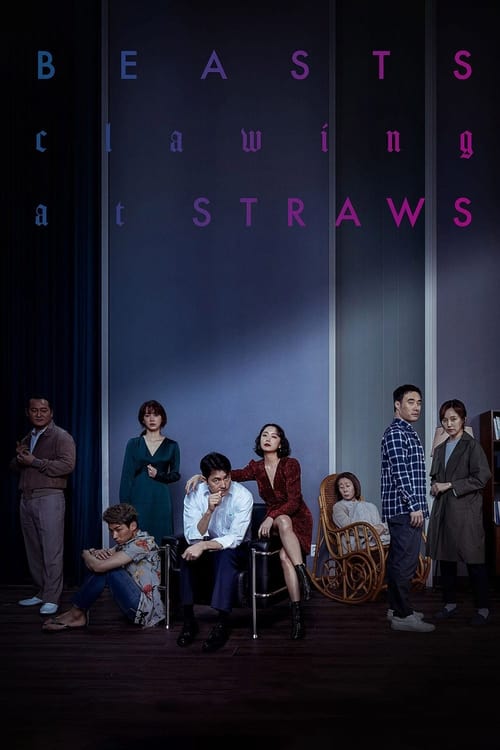
Beasts Clawing at Straws
2020 · Kim Yong-hoon
For when you want a twisty, nasty crime puzzle to lean into — the kind of night where you'd rather outsmart a movie than be comforted by one. Challenge over comfort, but the payoff is real.
What it's about
A bag of cash turns up in a sauna locker, and everyone who touches it is already drowning. A restaurant worker caring for his ailing mother, a customs officer whose girlfriend vanished with money he owed a loan shark, and a handful of other cornered people orbit the same fortune across interlocking storylines, each convinced this is their one way out.
The experience
Coiled and mean in the best way — it moves like a trap slowly closing, with jolts of pitch-black comedy that make you laugh right before you wince. The chapter structure keeps you guessing how the pieces connect, and the tension ratchets steadily as desperation curdles into something worse.
Performances
Jeon Do-yeon is magnetic as the story's coolest and most dangerous player, all silk over steel — she walks off with the film without ever raising her voice.
The craft
A debut made with the confidence of a veteran: precise compositions, a timeline that shuffles its chapters so revelations land like punches, and editing that snaps the ensemble's fates together with satisfying clicks. It's a film built on structure, and the structure sings.
Why it matters
Arriving in the wake of Korean cinema's global breakout moment, it announced Kim Yong-hoon as a new voice and showed the Korean crime thriller running at full strength beyond its established masters.
Snapshot
Kim Yong-hoon's debut feature is a tightly wound ensemble noir in which a single bag of cash changes hands across interlocking storylines, each character more desperate than the last. Adapted from Sone Keisuke's 2012 Japanese crime novel Wara ni mo sugaru kemono-tachi, the film resets the source material squarely in the economic fault lines of contemporary South Korea — precarious employment, crushing private debt, and the corrosive pressure of family obligation. Its chapter structure, dark humor, and willingness to follow moral failure all the way to its furthest conclusions mark it as a confident entry in the post-Parasite moment of Korean genre cinema, while its compositional intelligence announces a new directorial voice working in full command of the medium.
Industry & production
The film was produced by Lewis Pictures and Megabox Plus M, the latter serving as both domestic distributor and co-producer — a structure increasingly common in mid-budget Korean genre fare during the late 2010s, as multiplex conglomerates vertically integrated into production. Kim Yong-hoon, previously known as a screenwriter, wrote the adaptation himself, transposing Sone's Japanese coastal setting and social milieu into Korean equivalents without losing the source's mordant fatalism. Casting assembled some of the most acclaimed performers working in Korean cinema: Jung Woo-sung, Jeon Do-yeon, Bae Sung-woo, Youn Yuh-jung, and Jung Man-sik. The presence of Jeon Do-yeon, one of the most decorated actors in the Korean industry following her Cannes Prize for Secret Sunshine (2007), and Youn Yuh-jung, a screen veteran since the 1970s, gave the project immediate institutional credibility. The film world-premiered at the Busan International Film Festival in 2019 before its theatrical release in February 2020, positioning it within BIFF's ongoing role as the primary launchpad for prestige Korean commercial cinema.
Technology
Beasts Clawing at Straws was shot on digital, consistent with the near-universal practice of Korean studio-adjacent productions of the period. Cinematographer Kim Tae-soo worked in a widescreen aspect ratio that makes full use of frame depth to stage the film's many scenes of spatial entrapment — the cramped sauna backrooms, the dim apartment interiors, the rain-soaked streets that feel both familiar and hostile. The film's palette sits in the cool-to-neutral range favored by contemporary Korean noir, with bursts of warm artificial light (neon, tungsten) that recall the chiaroscuro logic of classic noir photography without literalizing the reference. Technically, no unusual or experimental formats have been documented in production materials; the film's craft achievements are primarily in the application of established digital cinematography to a specific expressive agenda rather than in technological novelty.
Technique
Cinematography
Kim Tae-soo's work favors composed, controlled framing over handheld urgency — a choice that creates an almost clinical distance from the characters' increasingly frantic situations, heightening the dark comedy latent in their desperation. The camera frequently holds characters slightly off-center or at mid-shot distance, giving the audience enough room to observe behavior analytically rather than simply experiencing it viscerally. Depth staging in interiors allows two or more characters to occupy different psychological zones of the frame simultaneously. Low-key lighting, particularly in the sequences set in the sauna, collapses background detail and forces attention onto face and gesture. The overall visual register is controlled, elegant, and faintly menacing — a tonal coherence achieved largely through restraint.
Editing
The chapter-based structure is the film's most visible editorial strategy. Each chapter centers on a single character, and the editing within chapters is fairly conventional — clean coverage, functionally timed cuts that emphasize performance. The structural audacity arrives in the transitions between chapters, which reframe events already witnessed from a new character's perspective, generating delayed comprehension and retrospective irony. This technique, indebted to both Kurosawa's Rashomon (1950) and the more recent tradition of ensemble crime films such as Go (Isao Yukisada, 2001) in Japanese cinema and Tarantino's non-linear constructions, is used here not purely for puzzle-box cleverness but to underline how completely each character is trapped inside their own subjectivity, unable to see the larger web they are caught in. The film's final convergence sequence rewards the patience demanded by the earlier episodic rhythm.
Mise-en-scène / staging
Kim stages actors in a manner that consistently emphasizes spatial constraint — bodies wedged into corners, conversations held across narrow corridors, confrontations in rooms with too much furniture. This is the mise-en-scène of people who have run out of room, figuratively and literally. The sauna, the film's moral and spatial hub, functions as a liminal zone where class identities are temporarily stripped away and replaced by something rawer. The staging of violence is notably restrained; rather than elaborating mayhem for genre pleasure, Kim tends to cut away or reduce physical conflict to its essential beats, keeping attention on the human cost rather than the kinetic spectacle. The femme fatale figure of Yeonhee (Jeon Do-yeon) is staged with a consistent visual composure that codes her power — she is almost always still while the men around her scramble.
Sound
The sound design and score function as a consistent source of tonal irony. The film's tendency to score moments of moral degradation with music that is slightly too composed, too measured, reinforces the gap between how the characters understand their own situations and how the film presents those situations to the audience. The soundtrack makes no attempt at the kind of genre maximalism (swelling tension, percussive shock cuts) common in mainstream Korean thrillers; instead it maintains a low, pressurized register that keeps the film feeling closer to literary noir than action-entertainment. Specific composer attribution and production details of the sound design are not widely documented in English-language critical literature, and I have not verified them to a level of certainty sufficient to state them here.
Performance
The ensemble work is the film's most praised element and arguably its central artistic achievement. Jeon Do-yeon plays Yeonhee with a predatory calm that makes her the film's most unsettling presence — a character operating entirely outside the moral frameworks that constrain the others, yet never reduced to genre villainy. Youn Yuh-jung's performance as the debt-crushed mother Mi-ran is a more contained kind of devastation: exhausted, practical, refusing self-pity, and all the more heartbreaking for it. (Youn would win the Academy Award for Supporting Actress the following year for Minari, bringing retrospective international attention to her Beasts work.) Bae Sung-woo's Joongman, the hapless sauna worker whose accidental discovery of the bag sets events in motion, anchors the film's darkest comedy — he is the most ordinary man in an extraordinary situation, and Bae plays his incremental moral compromises with a specificity that never descends into caricature. Jung Woo-sung brings a rugged conventionality to Taeyoung that the screenplay systematically dismantles. Together, these performances operate in a register of desperate naturalism that keeps the film's more schematic structural elements grounded in recognizable human behavior.
Narrative & dramatic mode
The film's governing dramatic logic is that of cascading catastrophe: every decision made by every character to escape their trap tightens it. The bag of cash is a MacGuffin in the strict Hitchcockian sense — its contents are less important than the desires it activates — but it also functions as a social diagnostic. The desperation each character brings to the bag reveals the specific economic wound they are carrying: Joongman's dead-end employment and ailing mother, Taeyoung's debt bondage to a loan shark, Mi-ran's struggle against a predatory private debt system, Yeonhee's determination to extract herself from circumstances that have already cost her everything decent. The film's structure — parallel storylines converging on a single object — is classical, but Kim's execution avoids the smugness of pure mechanism. The characters are not chess pieces; they suffer. The narrative mode is closest to literary noir, with the dark comedy of Fargo and the ensemble precision of late Chabrol somewhere in the genealogy.
Genre & cycle
Beasts Clawing at Straws sits at the intersection of several overlapping currents in Korean genre cinema. It participates in the "bag of money" thriller subgenre — a loose international form encompassing Blood Simple (1984), No Country for Old Men (2007), and the Japanese crime fiction from which it directly descends. It belongs to the Korean "dark social comedy" strain that had developed through the 2010s alongside a more serious tradition of issue-driven drama, a strain that Parasite (2019) had just brought to global prominence. It also inherits from the Korean crime film cycle of the 2000s and 2010s — films like A Bittersweet Life (2005) and The Wailing (2016) — a willingness to treat genre as a serious artistic container rather than a disposable commercial mode. Within that context, Beasts is notable for its ensemble structure, its relative lack of action set-pieces, and its emphasis on the institutional and economic rather than purely the criminal.
Authorship & method
Kim Yong-hoon came to the feature with a background in screenwriting, and the literary precision of the adaptation reflects that formation. His handling of Sone's source material demonstrates a clear-eyed translation instinct: the specificity of Japanese social anxiety (the working conditions, the debt culture, the dynamics of urban loneliness) is transposed into South Korean equivalents without either explaining the translation or pretending the two contexts are identical. As a first-time director, Kim shows no visible anxiety about visual competence; the film is immaculately composed from first to last. His key collaborator in achieving this visual consistency was cinematographer Kim Tae-soo. The ensemble casting model required the director to calibrate wildly different acting styles into a coherent tonal register — a challenge Kim handles largely by trusting his performers and keeping his own directorial interventions invisible. The absence of auteurist self-announcement is itself a kind of statement: this is a film confident enough in its material not to need signature flourishes.
Movement / national cinema
The film arrives at a particular moment in South Korean cinema — immediately following the international breakthrough of Parasite (2019) and amid a broader global recognition that Korean genre filmmaking had developed a distinctive set of concerns and competencies. Korean cinema's engagement with class, economic precarity, and the violence of social aspiration had been building for over a decade by 2020, and Beasts Clawing at Straws draws on that accumulated vocabulary while deploying it with a specific ensemble architecture relatively rare in Korean productions. The film also reflects Korean cinema's productive relationship with Japanese source material — a cultural exchange that runs through literature, manga, and genre fiction and has produced numerous significant adaptations. More broadly, the film belongs to a moment when Korean commercial cinema was operating at a level of craft and thematic ambition that made the art/genre distinction increasingly difficult to sustain.
Era / period
Released in February 2020, Beasts Clawing at Straws landed at a moment of significant rupture: its theatrical run was curtailed by the onset of the COVID-19 pandemic, which collapsed theatrical attendance in South Korea within weeks of release. This meant that a film positioned as a prestige commercial release — with major stars, festival pedigree, and strong critical notices — reached a fraction of the audience its theatrical booking suggested. The irony is not purely commercial: the film's themes of economic desperation, institutional fragility, and the precarity of plans built on borrowed time acquired an unintended resonance with the social conditions of the pandemic year. The film sits, then, at a cultural threshold: the last normal moment of a theatrical release pattern that the pandemic would permanently alter, and the crest of the Korean genre wave that Parasite had made globally visible.
Themes
Debt — private, institutional, and moral — is the film's organizing theme. Every character is in debt to someone: financially, emotionally, or in terms of obligations they cannot meet. The bag of cash represents not freedom but the fantasy of freedom, and the film's darkest insight is that the characters' inability to use it wisely is inseparable from the conditions that made them desperate in the first place. Related to this is a sustained examination of how economic pressure distorts moral reasoning: each character's ethical capitulation is presented not as villainy but as incremental necessity, a series of individually comprehensible steps toward a collectively catastrophic outcome. The film also engages with gender and class in ways specific to contemporary Korea: Yeonhee's predatory agency is coded as a response to structural vulnerability, and the elderly women in the film bear a disproportionate share of the suffering generated by male failures. Beneath the noir mechanics, Beasts Clawing at Straws is a film about what societies do to their most precarious members.
Reception, canon & influence
Critical reception. The film received strong reviews from Korean critics and solid notices in the international press that covered its BIFF premiere. The consensus identified the ensemble performances — particularly Jeon Do-yeon and Youn Yuh-jung — as the film's primary achievement, with secondary praise for the structural craft of the adaptation and Kim Tae-soo's cinematography. The COVID-affected theatrical run limited the cultural footprint the film might otherwise have achieved, and it has not yet received the sustained retrospective critical attention that would confirm a canonical position in assessments of Korean cinema.
Influences on the film (backward). The most cited formal precedent is the Coen Brothers, specifically Blood Simple (1984), Fargo (1996), and No Country for Old Men (2007) — films that share the "bag of money as social X-ray" structure and the dark comedy of human catastrophe. Tarantino's non-linear ensemble architecture (Pulp Fiction, 1994) is a less direct but legible inheritance. Within Japanese crime fiction, Sone Keisuke's source novel participates in a tradition of small-scale, sociologically precise noir associated with the Honkaku revival and the domestic crime fiction of writers like Kirino Natsuo. Within Korean cinema, the film inherits the dark social comedy of Bong Joon-ho's earlier work and the formal seriousness of Korean crime films from the previous decade.
Legacy and forward influence. As of the writing of this dossier, Beasts Clawing at Straws is most significant for two things beyond its own merits: it is the film that introduced Kim Yong-hoon as a major directorial presence in Korean genre cinema, and it is the film in which, in retrospect, Youn Yuh-jung's late-career international ascent becomes clearly visible. The film has circulated internationally on streaming platforms and has built a secondary reputation in genre-cinema communities as a carefully crafted example of ensemble noir. Whether it will ultimately register as a landmark of the Korean crime cycle — or as a distinguished entry in its second tier — remains an open question that the critical record of the 2020s has not yet fully answered.
A Deleuzian reading
Start with the bag.
The full Deleuzian reading of Beasts Clawing at Straws →
Reception
It opened in Korean cinemas in February 2020 — right as COVID emptied theaters — so it barely got a chance at home, then quietly found its real audience abroad on streaming during the post-Parasite hunger for Korean thrillers.
How Beasts Clawing at Straws was received, from release to now →
Influences: the films it descends from and the films it influenced
- Blood Simple (1984) — Originates the 'bag of money as moral X-ray' MacGuffin architecture: multiple characters pursue the same object in mutual ignorance of each other's knowledge states, so the object itself — not any individual villain — becomes the mechanism of cascading catastrophe.
- Fargo (1996) — The dark social comedy technique of aligning criminal desperation with mundane economic inadequacy — small debts and minor humiliations scaling into murder — delivered through tonal deadpan that refuses to break for catharsis or moral condemnation.
- No Country for Old Men (2007) — Chapter-based multi-perspective withholding in which cash functions as moral litmus test across separate character threads; low-key depth staging in constrained interiors under near-available-light conditions, where composed stillness amplifies off-screen threat.
- Pulp Fiction (1994) — Non-linear chapter architecture that begins each storyline mid-action and withholds inter-thread connections, so that the formal reordering of scenes generates retroactive dramatic irony unavailable in sequential viewing.
- Rashomon (1950) — Multi-perspective reframing in which the same criminal event is returned to from successive vantage points that add new information rather than simply contradict — the structure of accumulating revelation rather than competing testimony.
- A Simple Plan (1998) — Cascading catastrophe logic in which ordinary people discover found money and generate compounding bad decisions, each cover-up requiring a worse crime; depth staging in snow-muted constrained interiors amplifies the claustrophobia of irreversible moral entrapment.
- Memories of Murder (2003) — Established Korean crime cinema's tonal grammar — procedural rigor coexisting with dark comedy, crime embedded in specific social textures of Korean institutional life — with ensemble staging in which supporting characters carry equal dramatic weight to the nominal protagonists.
- A Bittersweet Life (2005) — Set the compositional standard for Korean genre cinema — off-center framing, deep focus, disciplined low-key lighting in interior spaces — establishing that formal rigor rather than kinetic spectacle could be the primary register of Korean crime filmmaking.
- Confessions (2010) — Chapter-based ensemble structure adapted from Japanese domestic crime fiction in which each chapter restages prior events from a new perspective, systematically dismantling viewer sympathy; tonal irony generated by lyrical cinematography applied to acts of moral catastrophe.
- Deliver Us from Evil (2020) — Extends the low-key depth staging and multi-thread ensemble structure of the domestic Korean crime cycle into a transnational spatial corridor (Thailand–Korea), applying compositional rigor developed in confined interior staging to location-based genre filmmaking.
- Hunt (2022) — Extends the multi-perspective chapter architecture into the Korean political thriller: two parallel investigator threads pursue the same MacGuffin (a mole's identity) in mutual ignorance, with dramatic irony generated by the viewer's asymmetric information advantage over each character's knowledge state.
- Exhuma (2024) — Extends ensemble naturalism and liminal spatial staging into the horror-crime hybrid: a single discovered object generates cascading institutional and supernatural consequences across character threads, replicating the MacGuffin-as-moral-test structure in a genre where the object's power is literally rather than metaphorically corrupting.
- Parasite (2019) — Immediate sibling in the Korean dark social comedy cycle: both films stage economic precarity through architectural liminal spaces and use ensemble naturalism to distribute moral culpability across class positions, refusing the genre convention of a clean criminal-victim divide.
- Burning (2018) — Contemporaneous Korean art-crime sibling using liminal spaces (greenhouses, rooftop apartments, border zones) as moral geography, and making material poverty legible through behavioral performance — the way characters move through space — rather than expository declaration.
- The Wailing (2016) — Shares the technique of multiplying incompatible explanatory frames around a single criminal event so that ensemble perspectives generate irresolution rather than resolution; spatial constraint in rural Korean interiors under low-key available lighting to produce dread through compositional compression.
- The Gangster, the Cop, the Devil (2019) — Direct sibling in the Korean ensemble crime cycle: institutional spaces function as liminal zones where social hierarchies collapse, and the MacGuffin function is distributed across character types — each pursues the same target with incompatible motivations — rather than localized in an object.
Similar films
- Deliver Us from Evil (2020) — influence & lineage
- Parasite (2019) — influence & lineage
- Memories of Murder (2003) — influence & lineage
- Burning (2018) — influence & lineage
- A Bittersweet Life (2005) — influence & lineage
- Night in Paradise (2020) — shared sensibility
- Oldboy (2003) — shared sensibility
- The Yellow Sea (2010) — shared sensibility