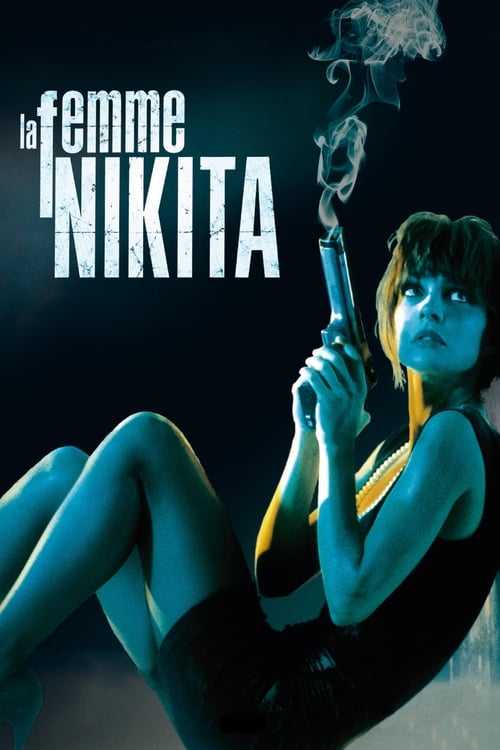
Nikita
1990 · Luc Besson
For when you want a slick, stylish thriller with more feeling than the genre usually allows — date-night action that also stings. Reach for it when pure spectacle isn't quite enough.
What it's about
A feral young drug addict is condemned for killing a policeman, then offered a way out no one should have to take: the state fakes her death and rebuilds her, over years of brutal training, into a government assassin. Released into a new identity, she tries to build an ordinary life — a boyfriend, an apartment, a future — while the phone can ring at any moment with a job she can't refuse.
The experience
Sleek, propulsive, and surprisingly emotional — the action hits hard, but the film keeps cutting to the ache of a woman living a lie. It's stylish pulp with a bruised heart, and the tension of her double life never lets up.
Performances
Anne Parillaud is ferocious and heartbreaking in the title role, carrying the character from snarling animal violence to brittle, learned poise — a performance that won her the César for Best Actress.
The craft
Luc Besson directs with glossy, high-style surfaces — neon, gunmetal, and immaculate compositions — and stages action sequences with a clean, kinetic punch. The look and Éric Serra's synth-driven score make it a defining piece of late-80s/early-90s French style; it plays beautifully loud and big.
Why it matters
It became a template: an American remake, a long-running TV series, and a whole lineage of trained-female-assassin stories trace straight back to it, and it cemented Besson as France's most commercially potent stylist.
Snapshot
Nikita — released internationally as La Femme Nikita and in the United States simply as Nikita — is Luc Besson's fourth feature and the film that consolidated his reputation as the most commercially potent of France's "cinéma du look" directors. It takes a lurid premise (a feral young drug addict, condemned for killing a policeman, is faked-dead by the state and remade into a government assassin) and treats it as a fable of coerced transformation. Anne Parillaud's central performance, which carries the film from animal violence to brittle composure, anchored its critical standing; she won the César for Best Actress. The film married the glossy, advertising-inflected surfaces of the 1980s French look to the propulsion of the American action thriller, and in doing so it became a template. Its bloodline runs forward through Besson's own Léon (1994), an immediate American remake (Point of No Return, 1993), a Hong Kong variant, and two long-running television series — making Nikita one of the most widely reproduced French films of its era and a foundational text for the modern female-assassin cycle.
Industry & production
Nikita was produced through Gaumont, the studio that had backed Besson's earlier rise and with which he was closely identified during this period; it was mounted as a French production (commonly cited as a French–Italian co-production, with Italian financing attached, though the precise contractual structure is the kind of detail the popular record reports only loosely). By 1990 Besson was a bankable name domestically on the strength of Le Grand Bleu (The Big Blue, 1988), which had been a vast popular success in France even as it divided critics. That commercial leverage is the essential industrial fact behind Nikita: it allowed Besson to make a stylish, violent, mid-budget genre picture with the production values of a studio film and the auteur signature of a personal one.
The casting reflects a deliberate blend of new and established faces. Parillaud, then not a major star, was given a role that demanded sustained physical and emotional exposure. Around her Besson assembled a notably strong supporting cast: Tchéky Karyo as Bob, the handler who trains and half-loves her; Jean-Hugues Anglade as Marco, the gentle supermarket cashier who becomes her civilian life; Jeanne Moreau, in a pointed piece of casting, as Amande, the older woman who instructs Nikita in femininity and poise; and Jean Reno as Victor, "the cleaner," a fixer brought in to dispose of bodies. Moreau's presence imports the authority of the French New Wave into a film that is, in many respects, a repudiation of that tradition's aesthetics — a generational handshake and provocation at once. The film was a substantial commercial success in France and traveled widely abroad, which is precisely why it generated remakes so quickly; specific admission and box-office figures vary across sources and are best treated with caution.
Technology
Nikita is a film of conventional late-1980s/early-1990s production technology — shot photochemically on 35mm, cut on film, scored with the synthesizer-heavy palette then standard for Besson's collaborator Éric Serra. There is no special-effects innovation to claim here; its "technology" is essentially that of high-end commercial and music-video production repurposed for narrative cinema. Within the story, however, technology is a motif: Nikita's training includes computers and electronic surveillance, and the apparatus of the secret service — wires, transmitters, telescopic rifles, the cold instruments of remote killing — is rendered as the gleaming hardware of a state that watches and reaches everywhere. The film's fascination with sleek tools mirrors its director's; the gadgetry of espionage is photographed with the same loving attention Besson's films give to design objects generally.
Technique
Cinematography
Nikita marks the beginning of the long, defining partnership between Besson and cinematographer Thierry Arbogast, who would shoot most of the director's subsequent major films (Léon, The Fifth Element, and beyond). Arbogast's work here is glossy and controlled, favoring a cool, often blue-shadowed palette punctuated by warmer, sodium-lit interiors. The look is consonant with the cinéma du look ethos — surfaces are seductive, compositions are clean and graphic, and the image frequently has the saturated, backlit sheen of advertising. Yet the film is not merely decorative: the camera shifts register with Nikita herself, jagged and disorienting in the opening pharmacy raid, then progressively more composed and elegant as she is "civilized." The visual style enacts the narrative of domestication.
Editing
The cutting (credited to Olivier Mauffroy) is brisk and genre-literate, building the action setpieces — the opening robbery, the restaurant graduation test, the climactic embassy mission — with momentum and clarity. Besson's editing instinct throughout this period is closer to the rhythmic, kinetic logic of music video and the American action film than to the longer takes of art cinema; the film moves. Tonally, the editing is also responsible for the abrupt swings between tenderness and violence that define the picture, cutting from domestic intimacy to lethal assignment with deliberate whiplash.
Mise-en-scène / staging
The film is organized around a series of charged, enclosed spaces: the clinical training facility ("Center 23" in the story's mythology), the restaurant where Nikita's final exam turns into a trap, the apartment she shares with Marco, the embassy bathroom of the disastrous last mission. Besson stages these as discrete worlds, each with its own design language, and the recurring visual idea is confinement — Nikita is always inside someone else's architecture, someone else's plan. The most celebrated staging set-piece is the graduation test: ordered to kill in a crowded restaurant and then escape through a bathroom window, she finds the window bricked up — the state's lesson that there is no exit it has not already foreseen. It is a near-perfect compression of the film's theme into a single piece of physical staging.
Sound
Éric Serra, Besson's regular composer, supplies a synthesizer-driven score whose textures — moody, electronic, with a melancholic recurring theme — are inseparable from the film's atmosphere. Serra's music tends to underscore Nikita's interiority rather than the action's adrenaline, lending even the violent sequences a tone of detachment and sadness. The sound design contributes to the film's oscillation between hushed intimacy and sudden eruptions of gunfire. (Specific licensed songs are sometimes cited in connection with particular scenes; because attributions vary across sources, they are not asserted here.)
Performance
The film belongs to Anne Parillaud, whose arc is its real subject. She begins as something barely human — twitching, hostile, animalistic — and is gradually drawn into recognizable womanhood, never quite shedding the wildness underneath. The performance's achievement is that the "civilized" Nikita never feels fully safe; the violence remains coiled inside the poise. Karyo gives Bob a complicated mixture of paternal control and suppressed desire, and Anglade makes Marco's ordinary kindness genuinely moving, so that the life Nikita stands to lose has weight. Moreau, in a few scenes, lends the transformation gravity and irony. Reno's brief, chilling turn as the cleaner is the film's most famous supporting note, and its consequences would be considerable.
Narrative & dramatic mode
Structurally the film is a transformation narrative — a dark, gender-inverted Pygmalion or My Fair Lady, with the state as Henry Higgins and Moreau's Amande as its instrument of refinement. The drama proceeds in clearly marked stages: the crime and the faked death (a symbolic execution and rebirth); the training and the graduation trap; the release into a double life under a new identity; the missions that intrude on that life; and the final, failed assignment that drives Nikita to vanish from the apparatus altogether. The mode is melodrama crossed with thriller: emotionally heightened, organized around impossible choices between love and obedience, freedom and survival. Besson is less interested in espionage plausibility than in the pathos of a person who is never permitted to author her own life — the action exists to dramatize a condition of total control.
Genre & cycle
Nikita sits at the intersection of the action thriller and the melodrama of female suffering, and it effectively inaugurated a modern cycle: the trained female assassin torn between her lethal function and a longed-for ordinary life. It draws on the espionage thriller and the gangster film but reroutes them through a woman's subjectivity, making the genre's usual machinery — the handler, the mission, the cover identity — into instruments of personal tragedy. Within Besson's own filmography it belongs to a recurring type: the marginal or "wild" protagonist (the mute survivor of Le Dernier Combat, the underground misfits of Subway, the diver of The Big Blue) who exists outside ordinary society. Nikita is that figure weaponized.
Authorship & method
Nikita is the work of Besson as both writer and director, and it crystallizes his method: high-concept premises executed with the surface gloss of advertising and the drive of American genre cinema, organized around a vulnerable outsider. It is also a film defined by its key collaborators, several of whom became Besson's recurring team. Thierry Arbogast's cinematography and Éric Serra's score are the two most consequential signatures here, both establishing partnerships that would shape Besson's subsequent films. The casting of Jean Reno as the cleaner is the most famous instance of Besson's method as a self-citation engine: the character is a clear conceptual ancestor of the title role in Léon (1994), which Besson would build around Reno, expanding the cleaner into a full protagonist. In this sense Nikita is not only a finished film but a workshop for the work that followed.
Movement / national cinema
The film is the most commercially successful flowering of the cinéma du look, the loose tendency in 1980s French cinema associated with Besson, Jean-Jacques Beineix (Diva, 37°2 le matin), and Leos Carax (Mauvais Sang). Critics — the term is often traced to Raphaël Bassan — used "le look" to describe films that privileged style, surface, youth, pop iconography, and spectacle over the social realism and literary seriousness associated with earlier French traditions. These films were frequently accused of being all surface, of substituting advertising aesthetics for substance; Nikita, with its glossy violence and its marginal heroine, is in many ways the movement's emblem and its lightning rod. It marks a French cinema consciously competing with Hollywood on Hollywood's terms while retaining a distinctly French texture of melancholy and design.
Era / period
Nikita is a product of late-Mitterrand France and the broader 1980s culture of the music video, the glossy magazine, and the television commercial — Besson and his peers came out of and spoke that visual language. It belongs to a moment when European cinema was anxiously measuring itself against the resurgent American blockbuster, and when "style" had become both a commercial strategy and a critical battleground. The film's vision of an all-seeing, body-disposing secret state also resonates with the surveillance anxieties of the period's geopolitics, even as it keeps politics abstract: the "government" that owns Nikita is deliberately faceless, a structure rather than a regime.
Themes
The film's governing theme is coerced transformation and the question of whether a self made by others can ever be free. Nikita is killed and reborn at the state's convenience, named and renamed, taught how to walk, smile, dress, kill — a body shaped entirely by external will. Around this turn several others: the domestication of violence (the wild woman made elegant, but still deadly); gender and the made woman, with Moreau's charm school making explicit that "femininity" itself is a trained performance; surveillance and control, the bricked window standing for a system that permits no unforeseen escape; and the conflict between love and function, as the ordinary life Nikita builds with Marco becomes the thing the apparatus cannot allow her to keep. The ending — her disappearance — reads as the only available freedom: not victory over the system but vanishing from its sightline.
Reception, canon & influence
Critically, Nikita was received as the arrival of Besson as a major commercial force and as a showcase for Parillaud, whose performance won her the César for Best Actress (the film figured in the César nominations more broadly that year). Reactions split along the same fault line that ran through all cinéma du look criticism: admirers praised its style, energy, and emotional charge, while detractors saw a beautifully shot but morally and intellectually shallow exercise in surface. That debate has never fully resolved, and Nikita remains a reference point in discussions of style-versus-substance in modern French cinema.
Looking backward, the film draws on the American action and espionage thriller, the gangster picture, and the Pygmalion transformation story, filtered through the advertising-derived aesthetics of its moment and Besson's own prior gallery of outsider protagonists. Looking forward, its influence is unusually direct and traceable. Besson himself spun Jean Reno's cleaner into Léon (The Professional, 1994). Hollywood produced a near-shot-for-shot American remake, Point of No Return (The Assassin, 1993), directed by John Badham with Bridget Fonda. A Hong Kong reworking, Black Cat (1991), followed quickly. And the property generated two television series — the Canadian-produced La Femme Nikita (1997–2001), with Peta Wilson, and the CW's Nikita (2010–2013), with Maggie Q — an unusually long afterlife for a French art-action film. Beyond these direct descendants, Nikita is widely regarded as a foundational text for the contemporary female-assassin genre, its DNA visible in later films built around lethal, conflicted women. Few French films of its generation have been copied so literally or echoed so persistently; that reproducibility is, in the end, the clearest measure of its place in film history.
A Deleuzian reading
Remember the window.
The full Deleuzian reading of Nikita →
Reception
A stylish hit in France that some critics initially wrote off as glossy 'cinéma du look' excess, it's now recognized as the ur-text of the female-assassin movie — the template every Atomic Blonde, Red Sparrow and Anna is still working from.
How Nikita was received, from release to now →
Influences: the films it descends from and the films it influenced
- Le Samouraï (1967) — Melville's pared-down iconography of the contract killer — impassive face, monastic bare apartment, procedural calm — is the direct template for Besson's silent 'cleaner' Victor and for Nikita's affectless professional poise.
- Le Cercle Rouge (1970) — Supplies the cold blue-gray nocturnal palette and the wordless heist-procedural rigor that Arbogast and Besson restyle with advertising sheen.
- The Manchurian Candidate (1962) — Establishes the programmed-assassin engine: a human reconditioned by a covert state apparatus into a deniable weapon, the structural source of Nikita's coerced-transformation plot and surveillance-and-control theme.
- My Fair Lady (1964) — The make-over-as-domination structure — a woman remade in speech, dress and manners by controlling men — which Besson inverts into the lethal 'made woman,' a weaponized Pygmalion.
- Diva (1981) — Founding cinéma du look text whose lacquered advertising-image surfaces, saturated color and pop-operatic emotion establish the aesthetic grammar Nikita perfects.
- Subway (1985) — Besson's own prior outsider-in-confinement film, whose cobalt underground palette and Éric Serra synth score are the rough drafts of the signatures Nikita refines.
- Blade Runner (1982) — Scott's adman command of backlit smoke, neon and lacquered surface legitimized the advertising-gloss cinematography Arbogast brings to Besson's frames.
- Léon: The Professional (1994) — Besson's literal self-citation: Reno's silent cleaner is expanded from cameo to full protagonist, recycling the same mentor/innocent dyad and confinement architecture.
- Point of No Return (1993) — Near shot-for-shot Hollywood remake that transposes the female-assassin training arc, beats and structure intact onto Bridget Fonda.
- Black Cat (1991) — Hong Kong reworking that ports Nikita's coerced-killer-recruited-by-the-state plot into HK action grammar within a year of release.
- The Long Kiss Goodnight (1996) — Extends the lethal-woman-with-buried-identity premise — domestic femininity masking a state-trained killer — central to the made-woman conceit.
- Kill Bill: Vol. 1 (2003) — Codifies the female-assassin cycle Nikita seeded, staging the trained woman's revenge as a melodrama-thriller hybrid built on tonal whiplash.
- Hanna (2011) — A girl engineered into an assassin by a handler, foregrounding the made-killer transformation arc with an electronic score (Chemical Brothers) that voices interiority in Serra's manner.
- Colombiana (2011) — Besson-written and -produced female-assassin vehicle that directly extends the Nikita formula of an orphaned woman remade into a contract killer.
- Red Sparrow (2018) — Its 'sparrow school' is the inverted-Pygmalion made literal: a woman coerced and reconditioned by a state program into a seductive weapon.
- Anna (2019) — Besson reprising Nikita almost beat-for-beat — a model recruited and reconditioned by intelligence services into an assassin, recycling the inverted-Pygmalion made-woman.
- Atomic Blonde (2017) — Applies Nikita's neon-blue advertising-gloss palette and music-driven kinetic editing to a female-assassin thriller, carrying the cinéma du look DNA into a contemporary key.
- The Fifth Element (1997) — Besson's first full collaboration with Arbogast and Landra calibrates the cinematographic language — saturated interior lighting, denial of the gray-metal minimalism dominant in Hollywood sci-fi — and the editing rhythm of tonal intercutting that The Fifth Element inherits without modification.
- Chainsaw Man - The Movie: Reze Arc (2025) — The woman remade by handlers into a deployable assassin—her affection weaponized against her—is the direct precursor to Reze as a Soviet-run bomb-girl ordered to seduce.
- Mauvais Sang (1986) — Contemporaneous cinéma du look companion deploying music-video-kinetic color staging and pop-scored interiority — the same advertising-era visual energy as Nikita.
- The Villainess (2017) — Supplies the structural template Jung rebuilds beat for beat: state abduction of a violent woman, the assassin academy's etiquette-and-marksmanship curriculum, and the graduation test staged as a lethal ambush inside a civilian social ritual — the mechanism The Villainess converts into its wedding and bus set pieces.
Similar films
- Léon: The Professional (1994) — influence & lineage · same viewing thread
- Kill Bill: Vol. 1 (2003) — influence & lineage
- Le Samouraï (1967) — influence & lineage
- The Bourne Identity (2002) — same viewing thread
- The Bourne Supremacy (2004) — same viewing thread
- Ronin (1998) — same viewing thread
- The Villainess (2017) — shared sensibility
- Breathless (1960) — shared sensibility
All the films related to Nikita →
Watch it with: curated runs of related films
- The Silent Professional — A run of lethal loners who move through the world with monkish economy — watch them back to back for pure, terse competence under pressure and men who just want to disappear.