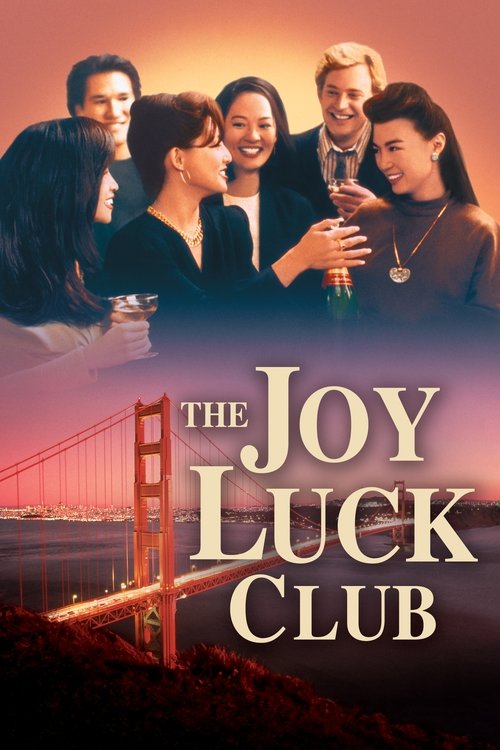
The Joy Luck Club
1993 · Wayne Wang
For a night when you want a good, cleansing cry — especially if you've ever loved a parent you struggled to understand. Comfort viewing in the deepest sense: it hurts, then it heals.
What it's about
Four Chinese immigrant mothers and their American-born daughters trade stories across a single San Francisco afternoon — a farewell party for June, who is about to travel to China to meet the half-sisters her late mother was forced to leave behind in wartime. From that gathering the film keeps slipping into memory: the mothers' harrowing girlhoods in feudal China, the daughters' bruising attempts to grow up American under mothers they can't quite read. Eight lives, one long conversation about sacrifice, expectation, and what gets lost in translation between generations.
The experience
It moves like a wave of stories, each one pulling you deeper, and it will absolutely make you cry — sometimes from grief, sometimes from recognition. Tender and wrenching by turns, it earns its emotion honestly rather than jerking tears.
Performances
Ming-Na Wen anchors the film as June, but this is a true ensemble piece — eight actresses playing mothers and daughters, each getting a story of her own, and the mothers in particular carry decades of pain in small gestures and unfinished sentences.
The craft
The interlocking flashback structure is the marvel here: stories nested inside stories, past and present answering each other, all held together by one afternoon's party. Wayne Wang keeps the sprawling novel legible and gives each woman's memory its own texture, from candlelit rural China to sunlit California kitchens.
Why it matters
One of the first studio-financed American features built around a majority Asian American cast, it stood almost alone for decades and became a touchstone that later generations of Asian American filmmakers pointed back to.
Snapshot
The Joy Luck Club is Wayne Wang's adaptation of Amy Tan's 1989 bestselling novel, a mosaic of four Chinese immigrant mothers and their American-born daughters, structured as a lattice of interlocking flashbacks. Its narrative armature is a single afternoon: a farewell party in San Francisco for Jing-mei "June" Woo (Ming-Na Wen), about to travel to China to meet the twin half-sisters her late mother Suyuan was forced to abandon during wartime flight from Guilin. From that present-tense gathering the film descends repeatedly into memory — the mothers' harrowing pasts in pre-revolutionary China, the daughters' bruising coming-of-age in America — before returning to a cathartic reunion. It occupies a notable place in American film history as one of the first studio-financed features built around a majority Asian American cast and told from Asian American women's points of view, and it did so a full generation before Crazy Rich Asians (2018) reopened that door commercially. Its enduring reputation rests less on formal daring than on the density and emotional force of its ensemble storytelling.
Industry & production
The film emerged from a confluence of literary success and unusually committed producing. Amy Tan's novel was a publishing phenomenon, and its adaptation was shepherded by producer Janet Yang together with Oliver Stone's Ixtlan company; Tan herself and screenwriter Ronald Bass served as producers alongside Patrick Markey. That producing configuration mattered: it meant the source author retained substantial creative authority, unusual for a Hollywood adaptation, and helped protect the story's cultural specificity. The picture was financed and released through Hollywood Pictures, the Disney/Buena Vista label, which gave a story with no white leads a mainstream studio berth and distribution — itself a small landmark for the period.
Casting was a deliberate, wide-net effort to assemble Asian and Asian American performers across generations and national backgrounds — a genuine logistical challenge in an industry that offered few standing roles for such actors, meaning the production drew on stage veterans, expatriate talent, and relative newcomers alike. The result gathered performers such as Kieu Chinh, Tsai Chin, France Nuyen, and Lisa Lu as the mothers and Ming-Na Wen, Tamlyn Tomita, Lauren Tom, and Rosalind Chao as the daughters. The film was received as a commercial success relative to its modest scale and became a touchstone of representation; I am not going to cite precise box-office figures here, as I cannot verify exact numbers, but the record is consistent that it performed respectably and well beyond expectations for a film of its subject and casting.
Technology
The Joy Luck Club is a conventionally produced early-1990s studio drama shot photochemically on 35mm film and finished for standard theatrical release; it predates the digital-intermediate era and involves no significant technological innovation at the level of capture, effects, or post-production. Its ambitions are dramaturgical rather than technical. What is worth noting technologically is period recreation: the mainland-China flashbacks required the production to render pre-1949 China — costume, décor, and setting — convincingly, work carried out through traditional art-department and location craft rather than digital augmentation. The film's "technology," in other words, is the classical apparatus of continuity cinema deployed in service of an intricate temporal structure.
Technique
Cinematography
Amir Mokri photographed the film. The cinematography's central task is to keep a many-layered chronology legible and emotionally distinct: the present-day San Francisco frame, the daughters' American pasts, and the mothers' Chinese pasts each need their own atmosphere without fracturing the whole. The film leans on warm, burnished interiors for the party framing device and on more saturated, painterly compositions for the Chinese sequences, using light and palette to signal era and place as the story slides between them. Mokri favors close, faces-first framing appropriate to a film that is fundamentally about looking at women as they remember — the camera privileges reaction, the listening face, the held gaze between mother and daughter. It is handsome, legible studio photography in service of the ensemble rather than a self-announcing visual signature.
Editing
Editing is arguably the film's most consequential craft contribution, and Maysie Hoy cut it. The screenplay by Tan and Bass braids at least eight major life-stories, and the film's coherence depends entirely on transitions — the graceful hand-offs from a face at the party to that same character's or her mother's past, and back. Hoy's cutting choreographs these descents and returns so the viewer rarely loses the thread despite the constant movement across decades and continents. The rhythm is built around emotional arrival: the film repeatedly withholds the full meaning of a memory until a later cut delivers it, so that the editing itself performs the theme of belated understanding between generations. This is the structural intelligence that turns a potentially confusing anthology into a single sweeping experience.
Mise-en-scène / staging
The staging works along a deliberate contrast axis. The framing device is domestic, contemporary, and crowded — a house full of relatives, a mahjong table, food, chatter — an American present of assimilated comfort. Against it, the Chinese flashbacks are staged with a heightened, sometimes near-operatic formality: the rituals of concubinage, arranged marriage, and family hierarchy are blocked to emphasize constraint, threshold, and enclosure, women framed within courtyards, doorways, and the geometry of houses that are also traps. Objects carry weight across the cuts — a swan feather, jade, a pawned ring — as talismans that survive the passage from old world to new. The production design's job is to make feudal China and immigrant San Francisco feel like the same emotional continuum viewed at two ends.
Sound
Rachel Portman composed the score, and her music is a defining element of the film's texture: lyrical, string-forward, and unabashedly emotive, it functions as connective tissue across the temporal jumps, giving the anthology a continuous emotional through-line where the images are discontinuous. The score underlines the melodrama openly, which is consistent with the film's mode. Beyond music, the sound design does quiet cultural work — the layering of Chinese and English, of accented and unaccented speech, dramatizes the generational language gap that the film treats as one of its central wounds. Voice-over narration, carried over from the novel's first-person chapters, is a load-bearing device: the mothers and daughters narrate their own memories, and the human voice is the film's principal instrument of intimacy.
Performance
Performance is where the film's reputation ultimately lives. Built as a true ensemble, it distributes its weight across eight principal women and asks each to carry a self-contained arc within the larger design. The mother performances — Kieu Chinh's Suyuan, Tsai Chin's Lindo, France Nuyen's Ying-Ying, Lisa Lu's An-Mei — anchor the film's gravity, playing across decades and often in Mandarin, and they lend the flashbacks a lived severity. The daughters — Ming-Na Wen, Tamlyn Tomita, Lauren Tom, Rosalind Chao — register the subtler contemporary registers of resentment, inadequacy, and longing. The acting style is frankly emotional, calibrated to a film that seeks and earns tears; its craft lies in the precision with which each pairing dramatizes a specific misunderstanding between love and expectation.
Narrative & dramatic mode
The film's mode is domestic melodrama in the fullest, non-pejorative sense — the "woman's film" tradition of maternal sacrifice, buried secrets, and belated reconciliation, updated to an Asian American immigrant frame. Structurally it is an anthology bound by a frame narrative: June's departure supplies the present-tense container, and within it the film runs four parallel mother-daughter dyads, each further split into the mother's Chinese past and the daughter's American past. This produces a nesting of flashbacks-within-flashbacks that is unusually ambitious for a mainstream melodrama. The engine of every strand is the same: a secret or trauma in the mother's history that has silently shaped, and often warped, her relationship with her daughter, disclosed only at the moment of reconciliation. The film's dramatic logic is therefore one of accumulation and release — a series of confessions building to a collective catharsis, culminating in June's reunion with her half-sisters, which retroactively redeems every preceding strand.
Genre & cycle
Within genre terms the film sits at the intersection of the literary prestige adaptation, the multigenerational family saga, and the maternal melodrama. It belongs to the early-1990s cycle of adaptations of contemporary women's bestselling fiction — the studio appetite for emotionally expansive, female-centered novels that could reach the audience that had made the books hits. More specifically, it is a landmark of Asian American cinema and of the small body of Hollywood films willing to center immigrant, non-white women's experience. In the longer view it reads as an isolated peak: it did not immediately spawn a sustained cycle of studio-backed Asian American ensemble films, which is precisely why its role as antecedent to the later Crazy Rich Asians moment is so often invoked.
Authorship & method
The authorship here is genuinely shared rather than singular. Wayne Wang directs, and the film is legible as an extension of his career-long project: from Chan Is Missing (1982) and Dim Sum: A Little Bit of Heart (1985) through Eat a Bowl of Tea (1989), Wang had been mapping Chinese American life — the frictions of assimilation, the gap between generations, the texture of immigrant community — in independent registers before scaling that concern up to a studio ensemble here. His method throughout has been one of cultural fidelity and actor-centered restraint; in The Joy Luck Club he subordinates directorial flourish to the ensemble and the structure.
Amy Tan and Ronald Bass wrote the screenplay together, a collaboration that paired the source author's authority over the material with Bass's Hollywood structural craft; Tan's direct involvement as writer and producer is central to why the adaptation preserves the novel's interiority and cultural specificity. Cinematographer Amir Mokri supplies the film's warm, era-differentiated look; editor Maysie Hoy engineers the temporal architecture that makes the anthology cohere; and composer Rachel Portman provides the unifying emotional score. The "method," collectively, is one of faithful, emotionally maximal adaptation — the team's shared goal being to translate a beloved literary structure to screen without diluting either its cultural particulars or its melodramatic force.
Movement / national cinema
The film is best understood within Asian American cinema — a movement rooted in independent and community filmmaking of the 1970s and 1980s, of which Wang is one of the signal figures. The Joy Luck Club represents the moment that sensibility crossed into the Hollywood mainstream. It is a diasporic, hyphenated work: its subject is precisely the condition of living between two national cinemas' worth of experience — feudal and modern China on one side, immigrant America on the other — and its form, splitting each character between an Old World and a New World past, embodies that doubleness. It is an American film about the persistence of China within American lives, and it belongs as much to the history of American immigrant narrative as to any single national cinema.
Era / period
Released in 1993, the film is a product of the early-1990s studio interest in prestige literary adaptation and in stories of identity and multiculturalism, a moment when the mainstream was briefly more receptive to non-white-centered drama than it would consistently remain. It sits at the tail of the pre-digital, photochemical era of studio filmmaking. Its diegetic span, however, is vast: the "period" it depicts reaches back to pre-1949 mainland China — the world of arranged marriages, concubinage, and wartime upheaval — and forward through mid-century immigration to a contemporary San Francisco. That reach across a half-century of Chinese and Chinese American history is central to its ambition.
Themes
The film's governing theme is the inheritance between mothers and daughters — how a mother's unspoken trauma is transmitted, mistranslated, and finally understood across a generational and cultural divide. From it radiate the film's other concerns: the immigrant condition and the costs of assimilation; the gap between a mother's love and its expression, which the daughters experience as impossible expectation; the silencing and eventual reclaiming of women's voices within patriarchal structures, dramatized most starkly in the Chinese flashbacks of concubinage and forced marriage. Language and translation recur as both literal and metaphorical wounds — what cannot be said across generations, what is lost between Mandarin and English. Above all the film is about the redemptive power of finally telling one's story: nearly every strand resolves when a secret is spoken and a history is at last shared, and the closing reunion universalizes that movement from silence to disclosure to reconciliation.
Reception, canon & influence
Critically, the film was widely and warmly received on release, praised for its emotional power, its ensemble performances, and — pointedly — for the rarity and importance of its representation; it was embraced as a milestone even by critics who found its melodrama unrelenting. That tension has defined its critical afterlife: admirers hold up its structural ambition and cultural significance, while some later reassessments engage its frank sentimentality and its handling of gender and cultural stereotype. I would flag that the fine grain of individual contemporary reviews is not something I can reconstruct here without risking invented quotation.
Looking backward, the film's influences are literary and personal above all: Amy Tan's novel, itself drawing on her own family history, is the primary source, and behind it stands the broader tradition of immigrant and multigenerational women's fiction. Formally it inherits the classical Hollywood maternal melodrama and the woman's-film tradition, and it extends the independent Chinese American cinema Wang had been building since Chan Is Missing.
Looking forward, its legacy is chiefly one of representation and precedent. For a quarter-century it stood as the most prominent studio film centered on an Asian American ensemble, and it is repeatedly cited as the crucial antecedent to the 2018 breakthrough of Crazy Rich Asians — the film that reopened, after a long gap, the possibility it had first demonstrated. Its cast and creators became reference points for a generation of Asian American performers and filmmakers, and its mother-daughter, memory-braided structure has become a template invoked whenever the diasporic family saga is discussed. Its influence, in short, is measured less in imitators than in the long shadow it cast as proof that such a film could exist — and in the frustration, often voiced, that Hollywood took so long to build on what it had shown was possible.
Reception
A solid hit in 1993 — warm reviews, strong box office for a modest budget — it's now remembered with a bittersweet edge: hailed as a breakthrough for Asian American representation, then invoked for decades as proof Hollywood didn't follow through, since no major studio film with a contemporary Asian American ensemble arrived until Crazy Rich Asians 25 years later. Its 2020 National Film Registry induction sealed the reappraisal from 'weepie adaptation' to landmark.
How The Joy Luck Club was received, from release to now →
Influences: the films it descends from and the films it influenced
- The Farewell (2019) — Descendant refining the diasporic family-saga template of intergenerational women and the untranslatable cultural gap, again pairing an author-adjacent personal source with restrained, actor-centered staging.
- Saving Face (2004) — Set the template for intergenerational Chinese-American mother-daughter storytelling built on parallel buried secrets, and for casting a marquee Chinese dramatic actress as the wounded immigrant mother (here Joan Chen).
- Chan Is Missing (1982) — Wang's own inaugural template of episodic, community-mosaic storytelling about Chinese American identity — the actor-centered, culturally specific restraint he later scales up to a studio ensemble here.
- Dim Sum: A Little Bit of Heart (1985) — Wang's direct precursor in mother-daughter framing and enclosure-blocking within domestic interiors, treating the generational gap as a matter of gesture and silence rather than exposition.
- Eat a Bowl of Tea (1989) — Wang's immediate step toward period-set Chinese American melodrama with era-differentiated palette, rehearsing the warm nostalgic look Amir Mokri gives the flashback strata here.
- Stella Dallas (1937) — Foundational maternal-melodrama and woman's-film grammar of self-sacrificing mother love filmed in emotionally maximal faces-first close-up — the classical-Hollywood register the film consciously inherits.
- Imitation of Life (1959) — The mother-daughter melodrama of assimilation and inherited shame, weaponizing lush score and heightened sentiment as structure — the Sirkian maternal-weepie DNA underlying the film's braided grief.
- Terms of Endearment (1983) — The 1980s prestige mother-daughter tearjerker built on female-ensemble performance and orchestral emotional cueing, the studio melodrama model the film updates for a diasporic cast.
- Raise the Red Lantern (1991) — Sibling in enclosure-blocking of women within courtyard/household architecture and a saturated era-differentiated palette dramatizing female confinement, the contemporaneous Chinese-language women's cinema alongside which Wang worked.
- How to Make an American Quilt (1995) — Descendant carrying the exact anthology-braiding device — a present-day frame that unspools into interwoven women's flashback vignettes, each a self-contained memory, stitched by a female ensemble.
- Eve's Bayou (1997) — Descendant extending voice-over-narrated, memory-braided family melodrama centered on women's generational inheritance, using match-transitions between present recollection and dramatized past.
- The Namesake (2006) — Descendant applying the same immigrant-generational adaptation method — literary source, era-differentiated flashback strata, faces-first framing of the assimilation gap between parent and American-born child.
- Crazy Rich Asians (2018) — The explicitly cited descendant that reopened the studio Asian-American ensemble film, inheriting the mother-daughter/matriarch conflict axis and female-ensemble prestige melodrama the film first proved viable.
- Everything Everywhere All at Once (2022) — Descendant that inverts the mother-daughter generational-inheritance melodrama into genre spectacle while keeping its emotional core — the immigrant mother reconciling with a daughter across a memory-fractured structure.
Similar films
- The Farewell (2019) — influence & lineage
- Raise the Red Lantern (1991) — influence & lineage
- Saving Face (2004) — often watched together
- Farewell My Concubine (1993) — often watched together
- The Wedding Banquet (1993) — shared sensibility
- Eat Drink Man Woman (1994) — shared sensibility
- So Long, My Son (2019) — shared sensibility
- Yi Yi (2000) — shared sensibility