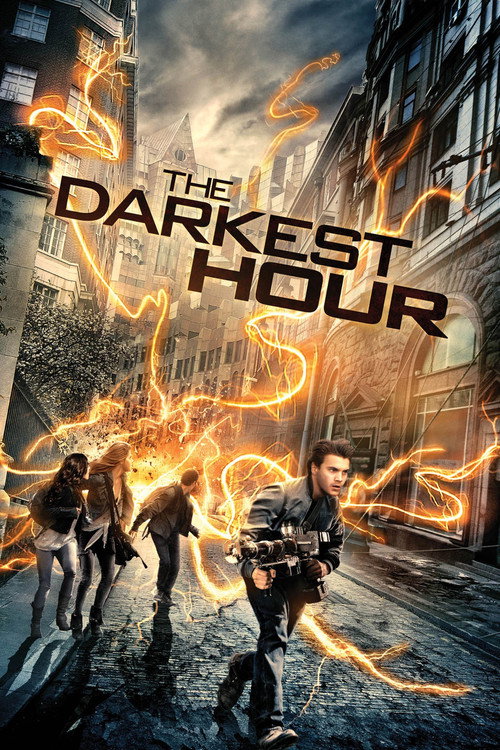
The Darkest Hour
2011 · Chris Gorak
For a low-stakes popcorn night when you want aliens, running, and a novel backdrop without having to think — comfort-food genre viewing, not a challenge.
What it's about
Five young travelers are partying in Moscow when the lights start falling from the sky — an alien invasion that arrives through the power grid itself. The invaders are invisible, pure energy, and lethal on contact, so the survivors navigate an emptied-out city where the only warning you get is a flickering light bulb. It's a scramble for survival through dead streets and dead electronics.
The experience
A quick, disposable ride — more eerie in its empty-Moscow imagery than actually scary, with tension that comes from watching for flickers rather than facing monsters. Undemanding and over fast.
The craft
The hook is the invisible enemy: instead of spaceships filling the sky, the film builds dread from absence — vacant boulevards, dead grids, bodies turned to drifting ash. Shooting on location in Moscow gives it a look most Hollywood invasion movies don't have, even when the effects and script stay strictly functional.
Why it matters
A modest footnote in the alien-invasion cycle, more interesting as a rare Hollywood production shot in Russia — under producer Timur Bekmambetov — during the post-conversion 3D boom than for anything it changed.
Snapshot
The Darkest Hour is a lean, modestly budgeted alien-invasion picture distinguished less by what it achieves than by the peculiar conditions of its making: a Hollywood-financed, English-language science-fiction film shot almost entirely on location in Moscow under the producing hand of Russian genre impresario Timur Bekmambetov, and released theatrically in post-converted 3D in December 2011. Its premise inverts the usual spectacle economy of the invasion film. The aliens here are invisible — beings of pure energy that arrive sheathed in shimmering distortion, drawn to electrical power, and capable of reducing a human body to drifting ash on contact. The result is a film built around absence: empty boulevards, dead grids, and an enemy you locate by watching light bulbs flicker rather than by seeing a craft fill the sky. That conceit is the film's most genuine idea, and the gap between the idea's elegance and the execution's thinness is, in many ways, the film's defining tension. It belongs to a dense early-2010s cluster of alien-invasion releases and is most useful to a study of influence as a case study in low-cost genre production, runaway shooting abroad, and the post-Avatar 3D conversion economy.
Industry & production
The film's central industrial fact is its geography. The Darkest Hour was produced through Timur Bekmambetov's Bazelevs operation and shot on location in Moscow, making it one of the more visible attempts of the period to mount an American studio genre film using Russian locations and crews. Bekmambetov — director of Night Watch (2004), Day Watch (2006), and the Hollywood action film Wanted (2008) — functioned as producer and creative engine, lending the project both his command of the local production environment and his taste for kinetic, effects-forward genre cinema. The director's chair went to Chris Gorak, an American whose background was in art departments and production design rather than studio tentpole filmmaking. Distribution in North America was handled by Summit Entertainment, with New Regency (Regency Enterprises) among the financing partners; the picture was conceived from the outset as a relatively economical entry rather than a major event release.
The Moscow setting was not incidental color but the production's organizing logic: real squares, metro stations, ministry buildings, and apartment blocks gave the film a depopulated grandeur that a backlot could not, and the choice let the production trade on lower local costs while delivering a genuinely unfamiliar urban texture to Western audiences. The film opened in the United States in late December 2011 to weak commercial returns and poor reviews; it is accurate to describe it as an underperformer, but specific box-office figures and budget numbers should be treated cautiously, and I will not assert exact totals here. What is clear is that the film made no lasting commercial mark and did not generate a franchise, despite the obvious sequel-readiness of its world.
Technology
Two technological frames matter. The first is the 3D release format. The Darkest Hour arrived during the post-Avatar (2009) stereoscopic boom, when studios routinely converted films to 3D in post-production to capture premium ticket pricing. This picture was a conversion rather than a native-3D shoot, and like many conversions of its moment it drew criticism for adding little dimensional value — a recurring complaint of the era, when audiences had been trained by the Clash of the Titans (2010) backlash to distrust hasty conversions.
The second, and more interesting, is the way the film makes technology its subject. The invisible aliens are defined entirely through their electromagnetic signature: they manifest as rippling heat-haze distortions, they swarm toward power and electronics, and their proximity is signaled by lights and devices guttering to life or burning out. The survivors' counter-strategy is likewise technological and pleasingly low-tech — exploiting the principle of the Faraday cage (the aliens cannot detect what is shielded from electrical fields, so glass and grounded enclosures become hiding places), and eventually a jury-rigged microwave-based weapon. This grants the film a faint hard-SF flavor, the sense of ordinary people reverse-engineering a survival physics, even if the screenplay rarely develops the idea past its first statement.
Technique
Cinematography
The photography, credited to Scott Kevan, does the heavy lifting of the film's atmosphere. Its strongest passages are the early post-attack sequences, in which a recognizable, crowded Moscow is emptied to an eerie stillness — abandoned cars, scattered ash, the silence of a metropolis with its power cut. The camera favors the depopulated cityscape as its principal effect, and the invisible-enemy premise pushes the cinematography toward a logic of looking: shots are organized around what cannot be seen, with the audience scanning the frame for the tell-tale shimmer or the flicker of a bulb. This is a sound instinct that the film only intermittently honors before falling back on conventional chase coverage.
Editing
The cutting follows the standard contemporary action-horror grammar: a quiet, dread-building opening movement giving way to staccato pursuit sequences as the survivors move across the city. The disintegration set-pieces — bodies flashing to ash — are timed for shock punctuation. The film runs short, and the editing's chief weakness is structural rather than rhythmic: the narrative thins as it proceeds, and the cutting cannot disguise an undernourished middle. Specific editorial credits for the film are not something I can attribute with full confidence, and I will not guess at them.
Mise-en-scène / staging
Here the director's own formation tells. Gorak came up through the art department, and the film's strongest authorial signature is environmental: the staging of space, the dressing of abandoned interiors, the choreography of small groups of people through large emptied locations. The mise-en-scène consistently emphasizes vulnerability of scale — a handful of figures dwarfed by monumental Soviet-era and contemporary Moscow architecture. The invisible aliens force a particular staging discipline, since menace must be conveyed through environmental cues (moving objects, electrical disturbance, the reactions of characters) rather than a visible creature, and the film is at its best when it trusts that constraint.
Sound
Sound design is, by necessity, central to a film whose monster cannot be seen. The aliens are characterized aurally as much as visually — by electrical crackle, hum, and the distortion of ambient noise — and the contrast between the dead silence of the powerless city and the sudden electromagnetic "voice" of an approaching swarm is the film's most effective horror device. The score is credited to Tyler Bates, a composer associated with genre and action cinema; his work supports the film's tension-and-release structure without imposing a strong thematic identity of its own.
Performance
The ensemble is young and was cast to read as a transnational group of stranded twenty-somethings: Emile Hirsch and Max Minghella as American entrepreneurs in Moscow on a soured business trip, with Olivia Thirlby and Rachael Taylor as the women they fall in with, and Joel Kinnaman among the supporting cast. The performances are functional within the survival-thriller mode — fear, grief, improvised resolve — but the screenplay gives the actors thin interiors to work with, and none of the roles offers the kind of definition that would let a performance transcend the material. Hirsch, the most established dramatic actor of the group at the time, anchors the film without being given much to deepen.
Narrative & dramatic mode
The dramatic mode is survival horror grafted onto disaster cinema: a small group of strangers thrown together by catastrophe, moving from shelter to shelter across a hostile city, picking up and losing companions as they go. The narrative arc is the familiar contraction-and-quest shape — initial disorientation, discovery of the enemy's rules, formation of a plan, push toward a possible escape or counterstrike. Its distinctive wrinkle is epistemological: because the threat is invisible, much of the drama is about knowledge — learning how the aliens hunt, how to detect them, how to hide. When the film leans into this (the characters as amateur scientists deducing the physics of their predicament), it finds a genuine register. More often it defaults to chase-and-evade beats, and the back half loses dramatic pressure as the rules, once established, cease to generate new complications.
Genre & cycle
The Darkest Hour sits squarely inside the early-2010s alien-invasion cycle, a remarkably dense run that includes Skyline (2010), Battle: Los Angeles (2011), Cowboys & Aliens (2011), Super 8 (2011), and, soon after, Battleship (2012) — itself part of a longer post-Independence Day (1996) and post-War of the Worlds (2005) lineage of city-leveling invasion spectacle. Against that field, the film's positioning is deliberately contrarian on budget: where most of its cohort competed on visible spectacle and destruction, The Darkest Hour economized by making its aliens invisible, converting a financial constraint into a conceptual premise. It also draws on the young-people-in-a-collapsing-city strain of contemporary genre film exemplified by Cloverfield (2008), and its invisible, optically distorted predator has an obvious ancestor in the active-camouflage hunter of Predator (1987). The energy-being conceit places it within a smaller tradition of incorporeal or non-anthropomorphic alien threats, a road less traveled than the rubber-suit or CGI-creature norm.
Authorship & method
The film is best understood as a producer's project and a designer's film. Bekmambetov supplies the production apparatus, the Moscow access, and the genre sensibility; Gorak supplies a craftsman's eye for space and atmosphere. Gorak's authorship is legible chiefly in the handling of environment and in a sensibility carried over from his debut, the contained Los Angeles bio-terror drama Right at Your Door (2006), which likewise concerned ordinary people trapped by an invisible, airborne catastrophe — a thematic rhyme worth noting between the two films. The screenplay is credited to Jon Spaihts, a detail of real interest given that Spaihts went on to substantial science-fiction credits including Prometheus (2012), Passengers (2016), Doctor Strange (2016), and Dune (2021); The Darkest Hour is among his earliest produced screen work, and its invisible-enemy survival premise reads in hindsight as an early sketch of his interest in hard-edged SF scenarios. (The story credit involves additional writers; I'd treat the precise attribution as something to verify rather than assert.) Among key collaborators, Scott Kevan's cinematography and Tyler Bates's score are the most identifiable technical signatures.
Movement / national cinema
The film occupies an unusual dual citizenship. It is, on paper, an American studio genre release, but its production reality is that of a Russian-facilitated international co-venture, and it is most legible as part of Bekmambetov's broader project of moving between Russian and Hollywood genre filmmaking. In that sense it belongs to the early-2010s wave of "runaway" Hollywood production seeking lower costs and fresh locations abroad, and specifically to a moment when the Russian film industry — buoyed by Bekmambetov's international success — was positioning Moscow as a viable production base for Western-facing genre work. It is not part of any Russian art-cinema tradition; rather, it uses Russian infrastructure and locations in service of an Anglophone commercial form.
Era / period
Released at the end of 2011, the film is a creature of its exact moment on several axes: the tail of the post-Avatar 3D gold rush and its conversion economy; the peak density of the alien-invasion cycle; and a period of accelerating Hollywood interest in international locations and co-financing. Thematically it also carries a faint charge of post-2008 anxiety — young Western entrepreneurs whose start-up ambitions collapse overnight, stranded in a foreign capital when the systems that sustain modern life simply switch off. The film does not develop this resonance with any rigor, but the period texture is unmistakable.
Themes
The film's controlling metaphor is power in its double sense — electrical and existential. The aliens feed on energy and travel the grid; humanity's vulnerability is precisely its dependence on the electrified, networked infrastructure of modern life, and the film's most suggestive gesture is to imagine an enemy that turns our own power supply into a hunting ground. Tied to this is a theme of invisibility and the unknowable threat: the horror lies in not being able to see the danger, only its effects, which lends the picture a low-grade paranoia about a world whose dangers are ambient and undetectable. A third strand is foreignness and dislocation — Americans abroad, illiterate in the language and geography of the city that is killing them, the familiar invasion-narrative anxiety relocated so that the human protagonists are themselves the strangers. Finally there is the recurrent disaster-film theme of improvised community among the abandoned. These themes are present more as premises than as developed arguments; the film states them clearly and explores them lightly.
Reception, canon & influence
Critical reception was poor. Reviewers broadly acknowledged the novelty of the invisible-alien premise and the atmospheric value of the emptied Moscow locations, but faulted the film for thin characterization, a slack second half, and a 3D presentation that added little — a verdict consistent with wider 2011 skepticism toward post-conversion stereoscopy. It found no significant critical defenders and has not undergone the kind of reappraisal that occasionally rescues maligned genre films; its standing today is that of a minor, largely forgotten entry in a crowded cycle.
On the question of influences on the film (backward): its lineage runs through the optically camouflaged predator of Predator (1987), the young-survivors-in-a-stricken-city template of Cloverfield (2008), the broad invasion grammar of Independence Day (1996) and War of the Worlds (2005), and the energy-/non-corporeal-alien tradition; its production model and sensibility derive directly from Bekmambetov's Russian-Hollywood genre work. Its director's own Right at Your Door (2006) supplies the invisible-catastrophe-traps-ordinary-people throughline.
Its legacy forward is slight and indirect. The film shaped no visible school of imitators and launched no franchise. Its most durable significance is contextual rather than aesthetic: as a marker of the Moscow-as-Hollywood-location experiment of the early 2010s, as a data point in the 3D-conversion debate of its years, and — most concretely for film history — as an early produced credit for screenwriter Jon Spaihts, whose subsequent career gives this otherwise minor picture a small retrospective interest. The honest summary is that The Darkest Hour is remembered, to the extent it is remembered at all, for a good idea it could not fully realize and for the unusual circumstances of its making rather than for anything it set in motion.
A Deleuzian reading
A bulb stutters in an empty underpass.
The full Deleuzian reading of The Darkest Hour →
Reception
Panned on its Christmas Day 2011 release (critics filed it under 'invisible aliens, invisible script'), it's since settled into a mild 'okay, the concept was actually kind of cool' shrug rather than a real reappraisal.
How The Darkest Hour was received, from release to now →
Influences: the films it descends from and the films it influenced
- Predator (1987) — Supplies the template for framing an optically camouflaged enemy through heat-shimmer distortion and environmental displacement rather than a visible body — the same invisible-enemy framing The Darkest Hour applies to its energy aliens.
- Cloverfield (2008) — Establishes the young-survivors-traverse-a-stricken-metropolis structure, told at ground level with civilians improvising movement through a city whose authorities have already collapsed.
- War of the Worlds (2005) — Models the civilian-POV invasion grammar in which characters flee energy weapons that disintegrate people, keeping the alien apparatus partial and overwhelming rather than legible.
- The War of the Worlds (1953) — Originates the energy-/force-field alien whose power is rendered as glowing electrical discharge — the non-corporeal, current-based menace The Darkest Hour rebuilds around electromagnetic design.
- Independence Day (1996) — Codifies the large-scale invasion-spectacle grammar — synchronized global strike, emptied and destroyed urban landmarks — that the film inherits but reduces to a single depopulated city.
- Right at Your Door (2006) — Gorak's own debut supplies the throughline: ordinary people sealed in by an invisible, airborne catastrophe, with dread generated through what cannot be seen entering the space.
- The Birds (1963) — Pioneers the unexplained-threat survival film that withholds any scientific account of the menace, forcing characters into epistemological guesswork about the rules of staying alive.
- 28 Days Later (2002) — Provides the depopulated-capital-city cinematography — a major metropolis shot empty and silent — that The Darkest Hour transposes to an evacuated Moscow.
- Hollow Man (2000) — Demonstrates how to stage an invisible adversary's presence through environmental disturbance — displaced objects, ripples, reactive surfaces — the same indexing the film uses for its unseen aliens.
- Pulse (Kairo) (2001) — Routes a non-corporeal threat through electricity and electromagnetic conduits, treating power infrastructure itself as the medium of menace — directly anticipating the film's electrical-power and EM sound design.
- Night Watch (2004) — Establishes Bekmambetov's Russian-Hollywood genre apparatus — Moscow access, hybrid production model, and pulp-SF sensibility — that produced and shaped The Darkest Hour.
- A Quiet Place (2018) — Extends the epistemological-survival design — survival governed by a strict sensory rule against a predator you must avoid being perceived by — into a fully realized horror grammar the earlier film only sketched.
- Bird Box (2018) — Carries forward the perceptual-prohibition survival premise, where staying alive depends on not perceiving an invisible threat, formalizing the unseen-enemy framing into the film's core constraint.
- Skyline (2010) — Same-cycle invasion built on light-/energy-based aliens that absorb humans, sharing the non-corporeal-menace and scale-vulnerability staging of trapped civilians dwarfed by the threat.
- Battle: Los Angeles (2011) — A 2011 cycle-mate enacting squad-level survival across an emptied, occupied city, sharing the editing rhythm of dread-to-pursuit through abandoned urban corridors.
- Monsters (2010) — Tells invasion through atmosphere, absence, and depopulated landscape rather than spectacle — the same low-budget strategy of making the unseen and the emptied environment carry the threat.
- Attack the Block (2011) — Pairs young protagonists defending a single urban enclave against aliens, sharing the youths-versus-invasion-in-a-confined-cityscape template of the same year.
- Vanishing on 7th Street (2010) — Builds survival horror on an invisible, electrically-keyed threat that makes people vanish amid a citywide power failure, mirroring the film's electrical-power-as-lifeline and depopulated-city grammar.
Similar films
- War of the Worlds (2005) — influence & lineage
- The War of the Worlds (1953) — influence & lineage
- Cloverfield (2008) — influence & lineage
- Pulse (2001) — shared sensibility
- Event Horizon (1997) — shared sensibility
- Mission: Impossible - Ghost Protocol (2011) — shared sensibility
- Dark City (1998) — shared sensibility
- Coherence (2014) — shared sensibility