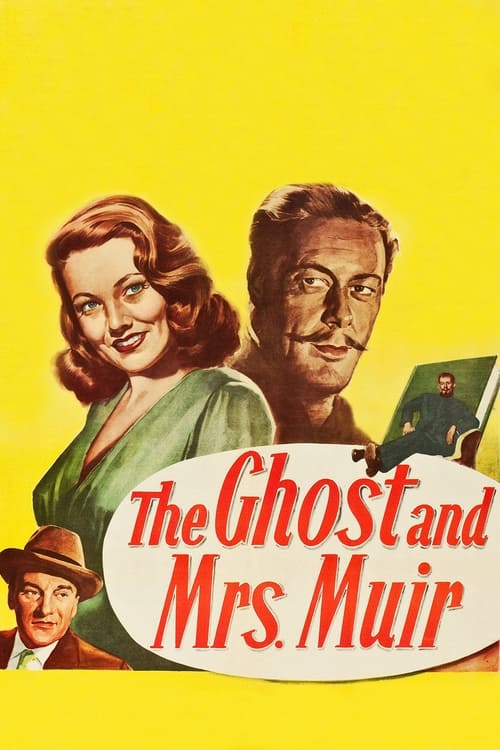
The Ghost and Mrs. Muir
1947 · Joseph L. Mankiewicz
For a rainy night when you want an old-fashioned romance with an otherworldly edge — comfort viewing that will still put a lump in your throat. Reach for it when you want to feel something tender rather than be scared.
What it's about
In 1900, a young widow defies her late husband's stifling family and rents a cottage on the English coast for herself, her daughter, and her maid — only to find it haunted by the ghost of its former owner, a gruff, salty sea captain. Instead of fleeing, she stays, and the living woman and the dead sailor strike up a partnership that deepens into something neither of them expected.
The experience
Wistful, witty, and quietly aching — the banter between the widow and her ghost is a pleasure, but the film keeps opening out into something more melancholy about solitude, time, and the loves we can't quite have. It leaves a lingering, bittersweet glow rather than a chill.
Performances
Gene Tierney gives Lucy Muir a lovely, stubborn independence, and Rex Harrison makes the captain both a bluster machine and a genuinely romantic presence; George Sanders is perfectly oily as a charming living suitor.
The craft
Bernard Herrmann's score — often cited as his own favorite — does much of the film's emotional work, all sea-swell and longing, while Charles Lang's silvery black-and-white photography makes the coast and the cottage feel half real, half remembered. Joseph L. Mankiewicz directs with a light touch that lets the fantasy stay grounded in character.
Why it matters
It has endured as one of Hollywood's most beloved supernatural romances, a touchstone for films about love that crosses the boundary between the living and the dead, and later inspired a television series.
Snapshot
The Ghost and Mrs. Muir is a supernatural romance produced and released by Twentieth Century-Fox in 1947, adapted from the 1945 novel by "R.A. Dick" — the pen name of the Irish author Josephine Leslie. It tells of Lucy Muir (Gene Tierney), a young Edwardian-era widow who defies her late husband's family to rent a seaside cottage, Gull Cottage, only to find it haunted by the shade of its former owner, a gruff sea captain named Daniel Gregg (Rex Harrison). What could have been a horror premise becomes instead a chaste, decades-spanning love story: the living woman and the dead sailor form a partnership, collaborate on a book, and — after Lucy's brush with an unworthy living suitor — remain bound to one another until her death reunites them. The film is notable today less as a box-office event than as an object of durable critical affection, prized above all for Bernard Herrmann's score, which the composer reportedly counted among his most personal works, and for the assured early direction of Joseph L. Mankiewicz, then only his second year behind the camera. It stands as one of the most elegant entries in Hollywood's brief postwar cycle of afterlife romances.
Industry & production
The picture belongs to the mature studio system at its peak, produced within Fox's house style under production chief Darryl F. Zanuck and shepherded by producer Fred Kohlmar. Its source was a recent and popular novel, exactly the kind of pre-sold literary property studios favored, and the adaptation was entrusted to Philip Dunne, a Fox contract writer of literate reputation (later credited on How Green Was My Valley among others). The casting reflects the studio's roster of the moment: Gene Tierney was one of Fox's most valuable and photogenic stars, coming off Laura (1944) and Leave Her to Heaven (1945); Rex Harrison was a British import Fox was actively building, having just paired him with Irene Dunne in Anna and the King of Siam (1946); and George Sanders, cast here as the caddish children's-author Miles Fairley, was a reliable Fox player of urbane villains. Edna Best plays the housekeeper Martha, Vanessa Brown the grown daughter Anna, and a very young Natalie Wood appears as Anna as a child. Production was studio-bound in the customary fashion — the "English" coast and Gull Cottage are constructed and controlled environments rather than location work — which suited a story reliant on fog, moonlight, and the sea as atmosphere. Precise budget and grosses for the film are not something I can state with confidence; the reliable record describes it as a respectable rather than a blockbuster performer, and I will not invent figures.
Technology
Technically the film is a conservative, high-craft product of its era rather than an innovator. It was photographed on black-and-white 35mm stock and presented in the standard Academy ratio, at a moment when Fox's most lavish productions were increasingly turning to Technicolor; the decision to shoot in monochrome was an aesthetic one, appropriate to a ghost story built on grays, silvers, and shadow. The supernatural effects are deliberately restrained and largely optical/photographic in the conventional sense — the Captain simply appears and vanishes within the frame, realized through lighting, staging, and cutting rather than through elaborate trick photography or the kind of double-exposure spectacle a more effects-driven ghost film might have pursued. The film predates magnetic recording and stereophonic sound in mainstream release; its sound is a single-channel optical track. In short, its distinction lies not in any new apparatus but in the exceptionally refined deployment of established studio tools.
Technique
Cinematography
The film's most conspicuous technical achievement is the black-and-white photography of Charles Lang (billed as Charles B. Lang, Jr.), which earned the picture its sole Academy Award nomination, for Best Cinematography (Black-and-White). Lang, one of Hollywood's most respected camera artists, gives the film a soft, luminous, slightly diffused surface — moonlit interiors, fog rolling off the sea, the glow of lamplight — that renders the boundary between the material and the spectral atmospheric rather than frightening. Lucy is frequently keyed with a gentle, romantic light; the Captain emerges from and recedes into pools of shadow. The imagery does much of the film's emotional work, translating a story about longing and the passage of time into a visual register of mist and half-light.
Editing
The film was cut by Dorothy Spencer, a major Fox editor whose credits include Stagecoach (1939) and, later, Cleopatra (1963). Her work here is unobtrusive and classical, prioritizing legibility and performance. The ghost's appearances and disappearances are handled with clean, matter-of-fact cutting that treats the supernatural as ordinary within the film's world. Most striking is the handling of time in the final act: the picture compresses years and then decades, moving Lucy from young widowhood to old age, and the editing manages these ellipses gracefully so that the passage of a whole life feels both swift and weighted.
Mise-en-scène / staging
Gull Cottage and its telescope, the sea beyond the windows, and the Captain's portrait function as recurring anchors of the mise-en-scène; the house is effectively a third principal character. Art direction by Richard Day and George W. Davis builds an Edwardian seaside world of controlled cosiness and openness to the elements. Mankiewicz stages much of the film as intimate two-handers between Lucy and the unseen-to-others Captain, blocking Harrison so that his physical presence dominates a room the other characters believe empty — a spatial joke and a romantic device at once.
Sound
Sound design is dominated by two elements: the ever-present sea, and the near-continuous musical score (discussed below under Authorship). Harrison's voice — plummy, commanding, salted with nautical bluster — is itself a sonic centerpiece; because the Captain is often defined by presence-as-voice, the film's sound track carries an unusual share of characterization. The interplay of the Captain's spoken dictation and Lucy's transcription in the writing scenes makes sound the medium of their collaboration.
Performance
Gene Tierney gives one of her most sympathetic performances as Lucy, modulating from timid new widow to a woman of quiet independence and, finally, to serene old age; the role asks for restraint and an inner life rather than showiness, and she supplies both. Rex Harrison's Captain Gregg is the film's engine — brusque, tender, comic, and melancholy by turns — a performance that trades on his verbal dexterity and would help define his screen persona in the years before My Fair Lady. George Sanders lends his practiced smooth insincerity to the philandering Miles Fairley, and Edna Best provides warm ballast as Martha. The child Natalie Wood registers even in a small part.
Narrative & dramatic mode
Dramatically the film is a chamber romance structured around a paradox: its central love affair can never be physically consummated, because one partner is dead. This impossibility is the source of both its wit and its pathos. The narrative proceeds in movements — Lucy's assertion of independence in taking the haunted cottage; the truce and then partnership with the Captain, sealed by their co-authoring his salty memoir "Blood and Swash" (which she "ghostwrites," a pun the film enjoys) to solve her money troubles; the intrusion of the living suitor Fairley and his exposure as a married cad; and a long coda in which the Captain withdraws so that Lucy may live a full mortal life, returning only at her death. The dramatic mode blends drawing-room comedy of manners with elegiac romance, and the tonal control — keeping the supernatural gentle, the comedy affectionate, and the sadness earned — is the screenplay's principal accomplishment.
Genre & cycle
The film sits squarely within a short but distinctive Hollywood cycle of the 1940s: the romantic fantasy of the afterlife and the benign ghost. Its nearest cousins include Here Comes Mr. Jordan (1941), A Guy Named Joe (1943), The Enchanted Cottage (1945), the British Blithe Spirit (1945) and A Matter of Life and Death (1946), and, released the following year, Portrait of Jennie (1948). These pictures repeatedly stage love across the boundary of death or unreality, and it is difficult not to read the cycle against the backdrop of a nation freshly bereaved by the Second World War — films that imagined the dead as present, benevolent, and reconcilable with the living. Within that cycle The Ghost and Mrs. Muir is unusual for the near-total chastity and permanence of its central bond and for making a woman's autonomy, rather than a soldier's return, its emotional stakes.
Authorship & method
The dossier's central authorship question is the balance between a rising director and a group of exceptional collaborators. Joseph L. Mankiewicz, celebrated as a writer-director of urbane, dialogue-forward cinema, is here directing someone else's script — Philip Dunne's — which makes the film a slightly atypical entry in a body of work usually defined by Mankiewicz's own writing. It was only his second directorial credit, following Dragonwyck (1946), and it shows the emerging Mankiewicz signature of literate, performance-centered filmmaking two and three years before the triumphs of A Letter to Three Wives (1949) and All About Eve (1950). Philip Dunne, the screenwriter, deserves substantial credit for the film's tone and its balance of comedy and feeling. Charles Lang's Oscar-nominated cinematography and Dorothy Spencer's editing have been noted above.
The collaborator most often singled out is the composer Bernard Herrmann, then early in his film career after Citizen Kane (1941) and The Magnificent Ambersons (1942) and his other Fox work of the mid-1940s. Herrmann's score for The Ghost and Mrs. Muir — surging sea music, tender and yearning romantic themes, an overall elegiac cast — is widely regarded as among his finest, and by his own account was a personal favorite. Nearly continuous and quasi-operatic, it carries the film's emotion so directly that many commentators treat it as co-author of the picture's power; it has had a substantial afterlife in concert suites and recordings independent of the film.
Movement / national cinema
The film is a product of classical Hollywood at the studio system's height and does not belong to any avant-garde or self-conscious "movement." Its interest is cultural rather than programmatic: although wholly American in production, it is thoroughly English in setting and sensibility, drawn from an Irish author's novel, set on an English coast, and populated by British performers (Harrison, Sanders, Best). It participates in Hollywood's longstanding fascination with a picturesque, literary England — the same impulse that produced Fox's other Anglophile prestige pictures of the decade — filtering that world through American studio craft.
Era / period
Made in 1947, the film is an early-postwar production, and it can be read as part of the moment's broader mood of mourning and reconciliation with loss, shared with the afterlife-romance cycle noted above. At the same time it is a period piece looking backward, set around the turn of the twentieth century, and its Edwardian frame lets it treat a woman's economic and personal independence — Lucy earns her own living by her writing and refuses both her in-laws' control and a false living suitor — at a safe historical remove. It arrives just before the industry's convulsions of the late 1940s and early 1950s (the antitrust divestiture, television, and the turn to widescreen color), making its intimate, monochrome classicism feel almost valedictory in retrospect.
Themes
The film's governing themes are female autonomy and self-determination — Lucy's insistence on shaping her own life; the collision of imagination and reality, embodied in a love that exists only in a realm the practical world cannot see; and mortality and the passage of time, dramatized in the long aging of Lucy while the dead Captain remains unchanged. The act of writing recurs as a motif of both independence and intimacy: the memoir Lucy transcribes is at once her livelihood and the vessel of her bond with Gregg. Beneath the comedy runs a persistent melancholy about renunciation — the Captain's decision to release Lucy so that she may live — and a final, consoling vision of love fulfilled beyond death, as the aged Lucy is restored to youth and led away by her sailor.
Reception, canon & influence
On release the film was received as a well-made, tasteful romance rather than a landmark; its single Academy Award nomination, for Charles Lang's cinematography, reflects the industry's regard for its surface craft. Its reputation has grown considerably over the decades, buoyed above all by the sustained critical and musical esteem for Herrmann's score and by later appreciation of Mankiewicz's direction and Tierney's and Harrison's performances; it is now commonly cited among the finest of Hollywood's ghost romances.
Looking backward, the film's influences are literary and generic: R.A. Dick's novel provides its plot and characters, and it draws on a long tradition of benign-ghost and afterlife fictions as well as the specific 1940s Hollywood cycle of fantasy romances within which it was conceived. Looking forward, its most concrete legacy is the popular American television series The Ghost & Mrs. Muir (which ran in the late 1960s, on NBC and then ABC, starring Hope Lange and Edward Mulhare), a clear index of the property's enduring appeal. More diffusely, the film became a touchstone for the subgenre of tender romances between the living and the dead or the temporally separated, and Herrmann's score in particular has enjoyed an independent concert and recording life. Beyond the television series, claims of direct, traceable influence on specific later films should be made cautiously; the film's real legacy is one of quiet canonization — a picture that grew in stature as a model of how gracefully Hollywood could make a ghost story into a meditation on love, independence, and time.
A Deleuzian reading
Rex Harrison stands in the middle of a parlour with his feet planted and his chest out, filling the room the way weather fills a harbour.
The full Deleuzian reading of The Ghost and Mrs. Muir →
Reception
A modest, politely-received studio picture in 1947, it has quietly climbed into the canon of great Hollywood supernatural romances — helped enormously by the posthumous cult around Bernard Herrmann's score, now ranked among his very best.
How The Ghost and Mrs. Muir was received, from release to now →
How to watch The Ghost and Mrs. Muir: what to notice on a first viewing
- Watch the Captain photographed as clearly as anyone living. Mankiewicz and cameraman Charles Lang refuse double exposure or shimmer; the ghost appears with the same visual density Gene Tierney gets throughout. The camera never marks him as less real than her, which is the whole point of watching him.
- Watch fog and lamplight soften every ghostly scene. Charles Lang lights the cottage in a diffused, silver register, moonlit interiors and sea fog, rather than the sharp shadow a horror film would use. The softness decides the genre for you, turning what could scare you into something tender instead.
- Watch the Captain's presence fill a room others call empty. Mankiewicz blocks Rex Harrison so his physical bearing dominates the space even while other characters act as if nothing is there. The staging lets you hold two different versions of the same room at once.
- Listen for the score doing the work dialogue does not. Bernard Herrmann's nearly continuous music underlines mood and the passing of time throughout, especially across scenes with little or no talk. The music becomes a second narrator, telling you what the characters cannot say aloud.
- Watch Lucy's face for quiet resolve, not just sorrow. Gene Tierney plays her as a woman deciding things for herself, and the shift from timid widow to independence shows mostly in small changes of bearing. The character's growth reads through composure rather than through any dramatic outburst.
The whole guide to watching The Ghost and Mrs. Muir, with the keys for a rewatch →
Influences: the films it descends from and the films it influenced
- Citizen Kane (1941) — Herrmann's method here — near-continuous, leitmotif-driven scoring that binds elliptical time-jumps into a single emotional throughline — is the technique he carries directly into Mrs. Muir's quasi-operatic wall-to-wall accompaniment.
- The Magnificent Ambersons (1942) — Herrmann's elegiac writing for the passing of an era, plus the film's montage of years compressed into dissolves, prefigures Mrs. Muir's score-carried time-lapse of Lucy aging alone in the house.
- Rebecca (1940) — Establishes the female-gothic template Mankiewicz inherits: a house treated as a character animated by an absent male presence, rendered in low-key chiaroscuro that makes architecture feel occupied by the unseen.
- Dragonwyck (1946) — Mankiewicz's own directorial debut, again with Gene Tierney in a brooding house-as-character gothic, where he first develops the restrained, performance-centered blocking of intimate two-handers he refines in Mrs. Muir.
- The Uninvited (1944) — Its seaside cliff-house whose haunting is benign rather than malevolent, and its treatment of the ghost as a tender presence, is the immediate genre precedent for Mrs. Muir's non-threatening spectral romance.
- Here Comes Mr. Jordan (1941) — A keystone of the 1940s Hollywood afterlife-fantasy cycle within which Mrs. Muir was conceived, normalizing the light-comic treatment of death and negotiation with the dead.
- Peter Ibbetson (1935) — Pioneers the temporally/physically separated lovers who commune across an impassable divide, the narrative device Mrs. Muir converts into the living-widow-and-dead-captain arrangement.
- Vertigo (1958) — Herrmann's surging, unresolved 'love theme' for an impossible romance with a figure who is half-absent is a direct descendant of the yearning Mrs. Muir theme, using the same rising, never-consummated harmonic language.
- The Innocents (1961) — Extends the craft of the ghost-occupied house rendered through deep-focus low-key chiaroscuro, where lighting and empty rooms conjure a presence the camera never fully shows.
- Somewhere in Time (1980) — A conscious revival of the elegiac time-separated romance, with John Barry's near-continuous, Herrmann-modeled yearning score deployed as the film's primary emotional carrier exactly as in Mrs. Muir.
- Truly, Madly, Deeply (1990) — Reworks the tender living-and-dead two-hander in a single domestic space, sustaining the unconsummated-yet-intimate register and the ghost-as-benign-companion staging Mrs. Muir codified.
- The Age of Innocence (1993) — Carries forward the voice-over-framed comedy-of-manners elegy of a renounced, unconsummated love, using narration and restrained performance to mourn the passage of time in the same key as Mrs. Muir's coda.
- Blithe Spirit (1945) — Rex Harrison's clipped, mordant verbal persona is deployed in the same benign-ghost comedy-of-manners register, establishing the arch-but-wounded diction he brings to Captain Gregg two years later.
- A Matter of Life and Death (1946) — Contemporaneous entry in the same early-postwar cycle of love straddling the mortal boundary, sharing the impulse to render passage between life and death as a courtly, wistful romance rather than horror.
- Portrait of Jennie (1948) — Made a year later in the same elegiac vein, it extends the time-crossed romance between a living artist and a returning spirit, matching Mrs. Muir's yearning-across-mortality tone and its score-as-co-author approach.
- A Letter to Three Wives (1949) — Mankiewicz here perfects the disembodied narrating voice as an active dramatic presence structuring the film — the voice-as-presence device Herrmann and Captain Gregg's off-screen dictation rehearse in Mrs. Muir.
- All About Eve (1950) — The full flowering of Mankiewicz's literate, performance-forward two-handers and voice-over authorship that Mrs. Muir shows in embryo, built on privileging verbal persona over spectacle.
- Harvey (1950) — Sustains a supernatural companion perceived by one person through eyeline and intimate reaction rather than effects spectacle, the same suggestion-over-depiction discipline central to Harvey.
Similar films
- Rebecca (1940) — influence & lineage
- A Matter of Life and Death (1946) — influence & lineage
- Portrait of Jennie (1948) — influence & lineage
- All That Heaven Allows (1955) — shared sensibility
- Leave Her to Heaven (1945) — shared sensibility
- When Marnie Was There (2014) — shared sensibility
- Laura (1944) — shared sensibility
- Sunset Boulevard (1950) — shared sensibility