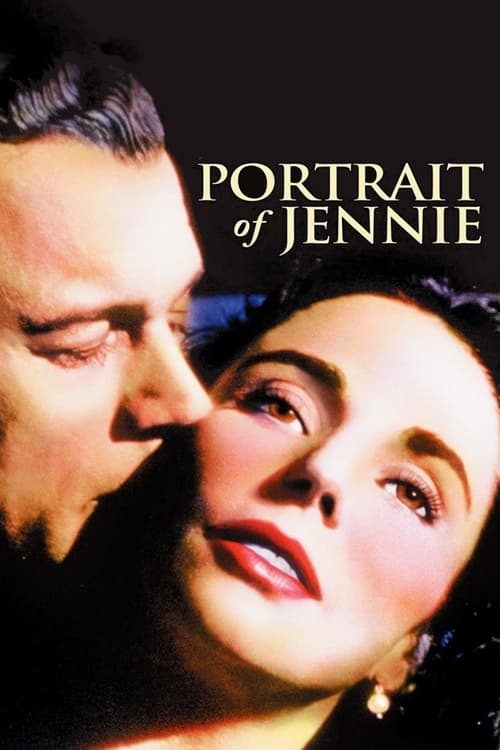
Portrait of Jennie
1948 · William Dieterle
For a late night when you want to be haunted rather than scared — a swooning, melancholy romance for viewers who like their love stories touched with the uncanny. Comfort and strangeness in equal measure.
What it's about
A broke Depression-era painter in New York can't sell his work — dealers tell him it has no feeling in it. Then, in Central Park at dusk, he meets a strange, old-fashioned girl who talks about events decades out of date, and who seems years older each time she reappears, though only weeks pass between meetings. She becomes his subject and his obsession, and the mystery of who — or when — she is builds toward a storm off the New England coast.
The experience
Dreamlike and genuinely eerie — it moves like a reverie, each encounter deepening the spell, and the romantic ache and the ghost-story chill are the same feeling. The storm finale is a jolt of pure sensory intensity after all that hush.
Performances
Joseph Cotten grounds the mystery with a weary, wounded sincerity that keeps the fantasy from floating away, and Jennifer Jones manages the nearly impossible trick of playing one person at several ages — child, schoolgirl, woman — and making each feel continuous with the last.
The craft
Producer David O. Selznick threw every experimental device he had at this: textured, canvas-like imagery, a score woven from Debussy, and a storm climax that shifts into tinted stock for overwhelming effect. It's one of the strangest and most tactile-looking Hollywood films of its era, and it absolutely rewards a big screen and good sound.
Why it matters
A commercial disappointment that became a touchstone of Hollywood supernatural romance — filmmakers and critics have kept returning to it as proof that the studio system could produce something genuinely visionary and strange.
Snapshot
Portrait of Jennie is David O. Selznick's most avowedly experimental production and one of the strangest objects in late-1940s American cinema: a metaphysical love story in which a Depression-era painter, Eben Adams (Joseph Cotten), repeatedly encounters a girl in Central Park, Jennie Appleton (Jennifer Jones), who ages years between meetings that are only weeks apart, and who may be a ghost, a memory, a projection of artistic longing, or all three. Adapted from Robert Nathan's slim 1940 novella, the film is less a narrative than an accumulating mood — a sequence of encounters, each one deepening the mystery and raising the emotional stakes, until it resolves in a storm-lashed climax at the Land's End lighthouse off Cape Cod.
What makes the film unusual is not its plot, which is thin by design, but the density of technical means brought to bear on it. Selznick, in the years after Gone with the Wind (1939) and Rebecca (1940), had become a producer who mounted comparatively few pictures and invested obsessively in each; Jennie was made under his direct and famously interventionist supervision as a vehicle for Jones, then his romantic partner and later his wife. The result is a picture that treats the surface of the image itself as an expressive instrument — canvas textures overlaid on the photography, a color-tinted storm sequence, a final shot in Technicolor, a musical score adapted from Debussy — in service of a story about whether art can hold a person outside of time.
The film was a notorious commercial disappointment, and its reputation has been unstable ever since: dismissed by many contemporaries as overwrought, embraced by later critics — especially in France — as one of the few genuine American approaches to a poetic, oneiric cinema. It sits at the intersection of the woman's picture, the supernatural romance, and the noir-adjacent psychological drama, and it belongs to a small cluster of postwar American ghost films that treat the afterlife as an aesthetic rather than theological problem.
Industry & production
Portrait of Jennie was produced by the Selznick Studio and released through Selznick Releasing Organization, the distribution arm Selznick had established after breaking with United Artists. It arrived at the tail end of Selznick's active career as a producer of original productions; after this film and a small number of other projects, he largely withdrew from independent production, and the picture is often characterized as the point at which his method of endless refinement became commercially unsustainable.
The production is a textbook case of Selznick's working practice: extended shooting, extensive retakes, multiple writers, and a post-production period that stretched the film well past its intended release. Principal photography was undertaken in 1947, with location work in New York — Central Park, the Metropolitan Museum of Art, the reservoir — and additional material shot in New England for the Cape Cod sequences, along with studio work on the interiors. The screenplay is credited to Paul Osborn and Peter Berneis, with adaptation credit to Leonardo Bercovici; as with many Selznick productions, the producer himself worked extensively on the script and continuity, and the finished film reflects his hand in structure and emphasis as much as any single writer's.
The film's release history is itself part of its story. It premiered at the end of 1948 in a limited engagement to qualify for Academy consideration, then went into general release in 1949. It underperformed badly relative to its cost — a cost inflated by the protracted schedule and by the elaborate optical and special-effects work of the finale. Precise budget and loss figures vary between accounts and I will not assert a specific number; what is uncontested is that the picture lost money substantially and was regarded within the industry as a costly folly. Selznick subsequently oversaw a shortened version for reissue, and the film circulated for decades in prints of varying length and quality, which complicated critical assessment. Its restoration in later years — recovering the tinted storm sequence and the Technicolor final shot as intended — materially changed how the film reads.
Institutionally, the picture belongs to a moment of stress in Hollywood: the 1948 Paramount consent decrees were dismantling the studios' theatrical holdings, television was beginning its encroachment, and postwar foreign markets were constricted. An expensive, uncategorizable art film about a ghost was precisely the sort of gamble the system was becoming less able to absorb.
Technology
Portrait of Jennie is significant less for inventing technology than for the ingenuity with which it recombines existing tools toward an unusual expressive end.
The most discussed device is the imposition of a visible texture over the photographic image. In several passages the frame carries a canvas- or gauze-like grain, so the black-and-white photography acquires the woven surface of a painting. This was achieved photographically and optically rather than digitally — a matter of filters, screens, and printing — and its purpose is thematic: the film's subject is a portrait, and the film periodically insists that we are watching something that is itself being turned into an image.
The climactic hurricane sequence departs from black-and-white altogether, presented in a green tint that rises with the storm. Tinting was an old technology by 1948 — standard in the silent era, largely abandoned after the coming of sound — and its deployment here is deliberately archaic, a reach backward for an effect the modern monochrome palette could not supply. The film then closes with a shot of the finished portrait rendered in Technicolor, so that the film's final image is the only one presented in full color: the painting outlives the story, and it alone gets the fuller register.
The storm itself required extensive miniature, matte, and process work, staged against the lighthouse set with large-scale water effects. The picture's technical achievement was recognized by the Academy: it won the Oscar for Best Special Effects for the 1948 awards, and Joseph H. August received a posthumous nomination for Best Cinematography (Black-and-White). August died before the film's release, and Jennie stands as his final work.
Sound-technologically, the film also experimented: some presentations of the storm sequence employed an augmented multi-channel or amplified sound presentation in selected theaters, part of the late-1940s appetite for making the theatrical experience irreproducible at home. Details of these engagements are sparsely documented, and I would not want to overstate their extent.
Technique
Cinematography
Joseph H. August's photography is the film's central artistic achievement. August had shot for John Ford across the silent and sound eras — The Informer (1935) among the best known of their collaborations — and brought to Jennie a command of atmospheric, low-key, high-contrast monochrome that had by then become the visual language of both the horror film and film noir.
The New York exteriors are shot with a diffusion and haze that renders the city as a半-remembered space: Central Park in winter, snow and bare branches, the skating rink, the museum's stone interiors. Rather than the documentary sharpness that postwar location shooting often produced — the location realism of The Naked City (1948), for instance — August pushes the real locations toward the condition of memory. The camera favors soft edges, veiling atmospherics, and light sources that bloom.
Jennie's appearances are consistently staged with a light discipline that separates her from her surroundings: she is often the brightest thing in the frame, or emerges from an indeterminate depth of field. The photography does not use crude ghost effects — no transparency, no double exposure to signal spectrality. Her unreality is produced by light, framing, and the way the world around her is rendered indistinct.
Editing
The film's structure is elliptical: it proceeds by encounters separated by unmeasured gaps. The editing (credited to William Morgan, working under Selznick's characteristically hands-on supervision) has to make the intervals between Eben and Jennie's meetings feel simultaneously short and vast. Cutting between the encounters tends to be economical — the transitions themselves are frequently effected with dissolves and optical devices that stress passage and dissolution rather than crisp continuity.
Within scenes, the film is comparatively unhurried; the encounters play in longer takes that permit the performances room. The acceleration in the final act, where the film shifts to the storm and the lighthouse, is felt as a rupture in the film's rhythm as much as in its color.
Mise-en-scène / staging
The film's spaces are organized around thresholds: the park at dusk, the museum after hours, the artist's studio, the convent, the lighthouse at the edge of the sea. Each is a place where one condition gives onto another. The recurring emptiness of these settings — a park with almost no one in it, a museum with no visitors — is not naturalistic; it is the staging of a world that has been cleared to make room for one relationship.
The studio is a crucial space, cluttered with the apparatus of image-making, and the film repeatedly frames Eben looking at the canvas rather than at Jennie, or at Jennie through the geometry of an easel. The portrait is present as a physical object throughout, and its progressive completion is the film's real plot: as the painting nears finish, Jennie nears whatever end awaits her.
The lighthouse finale replaces the film's soft, interiorized world with hard verticals, spray, and mechanical scale — the only sequence in which the film's spaces are genuinely hostile.
Sound
The score, arranged and adapted by Dimitri Tiomkin, is built substantially from the music of Claude Debussy, drawing on the Impressionist repertoire and folding it into a Hollywood dramatic idiom. The choice is programmatic rather than merely decorative: Debussy's harmonic language — unresolved, chromatic, atmospheric — is the aural equivalent of the film's diffusion filters. The decision to build a Hollywood romance score around a canonical Impressionist composer rather than an original theme is itself an authorial statement about what kind of film this intends to be.
Jennie's song — the film's most-remembered aural motif, sung by Jones in an unaccompanied, childlike register about where she comes from and where she is going — functions as a riddle repeated across the film, its meaning shifting as we learn more. It is sound used as narrative device, not accompaniment.
The film also opens with a spoken prologue framing the story in philosophical terms, invoking questions of time and reality. The prologue's grandiosity has drawn a good deal of critical mockery, and it is fair to say it announces the film's ambitions less gracefully than the film itself realizes them.
Performance
Jennifer Jones's performance is the film's most demanding element: she must play a character who ages from adolescence to adulthood across a handful of scenes, without makeup transformation carrying the burden. She does it primarily through carriage, vocal placement, and rhythm of speech — a girl's rapidity and non-sequitur in the early scenes giving way to a woman's stillness. The performance is heightened and stylized, in keeping with the film's mode; readings that find it mannered are not wrong so much as measuring it against a naturalism the film never pursues.
Joseph Cotten plays Eben with the recessive, slightly abstracted quality he brought to much of his work in this period — a man to whom things happen. His function is to be the film's point of contact with ordinary reality, and his relative flatness is structural: he grounds a story that would otherwise float away.
The supporting cast provides the film's realist ballast. Ethel Barrymore, as the gallery owner Miss Spinney, gives the film its most fully inhabited performance and much of its warmth; Lillian Gish appears as a Mother Superior, a piece of casting that carries its own historical weight, given her centrality to the silent cinema whose visual idiom the film in places recalls. Cecil Kellaway rounds out the gallery world.
Narrative & dramatic mode
The film's dramatic mode is best described as lyric rather than dramatic. It does not build through conflict; it builds through repetition with variation. Each meeting between Eben and Jennie follows the same broad shape — she appears, they speak, she leaves — and each is differentiated by her age, the season, and what Eben has learned.
The mystery structure operates in a minor key. Eben conducts a nominal investigation: he learns that the Appletons were trapeze artists who died years earlier, that Jennie attended a convent school, that a young woman by that name drowned in a hurricane. But the film has no interest in a revelation that would settle the question. The information arrives, and the film's response is neither shock nor explanation — it simply proceeds toward the storm.
This is a narration organized around a persistent ambiguity that the film declines to resolve: is Jennie a ghost, or is she a temporal anomaly, or is she Eben's need made visible? The film supplies textual support for each and adjudicates none. The famous frame — that the story is offered as a meditation on time and eternity — is the film's request that the viewer accept irresolution as the point.
Formally, the film is also a portrait of artistic process: Eben cannot paint until he meets Jennie, and the film's true narrative arc is the passage from a blank canvas to a finished portrait. That the portrait ends up in a museum, and that this is presented as consolation rather than triumph, is the film's characteristic double edge.
Genre & cycle
Portrait of Jennie belongs to a distinct postwar cycle of American supernatural romances in which the dead and the living conduct relationships across an ontological gap: The Ghost and Mrs. Muir (1947), A Guy Named Joe (1943), the British A Matter of Life and Death (1946), and, at a slant, It's a Wonderful Life (1946). These films share a common historical pressure. They emerge from a society that had just absorbed mass wartime death, and they offer, in the guise of romance, a set of propositions about whether the dead remain accessible.
It also belongs to the woman's picture as Selznick practiced it — a producer's genre organized around a female star, a doomed love, and a high emotional register — and to the more diffuse category of the psychological or "prestige" fantasy, in which literary source material licenses formal ambition that a straightforward genre picture would not be permitted.
Its relation to film noir is oblique but real. The photography, the fatalism, the sense of a man drawn toward an unknowable woman who will destroy him, and the flashback-inflected structure all belong to noir's vocabulary. What separates it is the absence of criminality and the substitution of the metaphysical for the sordid. It is closer to Laura (1944) — another film in which a man falls in love with a portrait before he can love the woman — than to the crime cycle proper, and the comparison is one critics have drawn repeatedly.
Authorship & method
William Dieterle is a director whose reputation has been persistently underweighted, in part because his best-known work — the Warner Bros. biographical pictures, The Story of Louis Pasteur (1936), The Life of Emile Zola (1937) — is prestige filmmaking of a kind that critical fashion turned against. But Dieterle came out of the German cinema; he had acted for Murnau in Faust (1926) and directed in Germany before emigrating, and the expressionist inheritance is legible throughout his American career, most obviously in The Devil and Daniel Webster (1941) — itself a supernatural fable, and the clearest antecedent within his own filmography for Jennie's method. Dieterle's specialty was the collision of the fantastic with the sentimental, handled without irony.
That said, Portrait of Jennie is a divided authorship. David O. Selznick's involvement was constant and decisive: he shaped the script, drove the reshooting, ordered the special-effects finale, and controlled the post-production, including the tinting and color decisions. To call it a Dieterle film without qualification misrepresents how it was made; to call it purely a Selznick production undersells the visual intelligence and directorial control evident in the encounters, which are staged with a delicacy that is Dieterle's signature.
Joseph H. August's cinematography, discussed above, is the third authorial force and arguably the strongest. Dimitri Tiomkin's Debussy adaptation gives the film its aural identity. The screenwriting credits — Paul Osborn, Peter Berneis, with adaptation by Leonardo Bercovici — are, as often in Selznick productions, an imperfect record of who wrote what.
Movement / national cinema
The film is American in production and financing but strongly continental in aesthetic. Its two decisive imports are German expressionism, arriving via Dieterle's training and via the broader émigré presence in Hollywood, and French Impressionism, arriving via the Debussy score and via a visual strategy — diffusion, soft focus, atmospheric veiling — that has clear affinities with the pictorialism of 1920s French narrative avant-garde cinema.
This continental orientation helps explain the film's critical trajectory. It was more warmly received in France than in the United States, and it became a reference point for critics and filmmakers attentive to a cinema of reverie rather than action. Its championing by French critics is a well-documented aspect of its afterlife, though accounts of exactly who said what vary, and I'd rather record the general fact than attribute specific quotations I cannot verify.
Era / period
The film is doubly historical. Diegetically, it is set in the Depression — Eben's poverty, the empty gallery, the scarcity of buyers — and its portrait of a hungry artist in a city with no money is specific and unglamorous. Made in 1947–48, it looks back at the 1930s from the other side of a war.
Contextually, 1948 is a hinge year: the Paramount decision, the beginning of the studio system's structural dissolution, the height of postwar anxiety, and the early stirrings of the blacklist. The film's retreat into metaphysics can be read as of a piece with a broader postwar turn toward interiority in American cinema — the psychoanalytic cycle, the noir cycle, the ghost cycle — in which questions that could not be posed politically got posed existentially.
Themes
Time and its non-linearity. The film's governing conceit is that two people can be alive in the same place at different times, and that love might be strong enough to briefly reconcile them. It refuses to give this a mechanism.
Art as preservation and as insufficiency. Eben paints Jennie to keep her. The painting survives; she does not. The film's ending is not straightforwardly consoling: the portrait hangs in a museum, admired by strangers, and Eben is alone. Art holds the image and loses the person.
The muse and its cost. The film is candid that Eben's creative rebirth depends entirely on Jennie, and that this is a form of consumption. His art requires her, and her existence is bound to the painting's completion. The film does not moralize about this, but it does not hide it.
Mortality and the unresolved dead. Every character of consequence is either dead, dying, or in some way outside ordinary time. The film's environment of empty parks and after-hours museums is a world already half-vacated.
Faith and the inexplicable. The convent sequence, and Gish's presence in it, situate the film's mystery adjacent to religious mystery without ever making a theological claim.
Reception, canon & influence
Contemporary reception was divided and, on balance, unfavorable in the United States. The film's ambition was widely acknowledged; its solemnity, its prologue, and its perceived pretension were widely mocked. It failed commercially — sufficiently that it is routinely cited as a contributing factor in Selznick's withdrawal from independent production. Its Academy recognition came in technical categories: the Special Effects award, and August's posthumous cinematography nomination.
Influences on the film (backward) run in several directions. Robert Nathan's novella supplies the premise. The tradition of the fatal portrait — Wilde's The Picture of Dorian Gray, filmed in 1945; Laura (1944) — supplies the central object and its logic. German expressionist cinema, particularly Murnau, supplies the visual treatment of the uncanny as a property of light. The French Impressionist cinema of the 1920s and Debussy's music supply the film's textures. Within Dieterle's own work, The Devil and Daniel Webster is the direct precedent for handling the supernatural as a matter of atmosphere and Americana.
Forward influence is significant and often unacknowledged. The film is one of the essential precedents for the time-crossed romance as a durable subgenre — Somewhere in Time (1980) is its most direct descendant in American film, and the broader cycle of romances structured around temporal impossibility owes it a template. Its treatment of a woman who exists primarily as an image, and of a man's love as an act of representation, feeds directly into the tradition that runs through Vertigo (1958); the two films' shared preoccupation with a portrait, an unreachable woman, and the male fantasy of remaking her makes the comparison a critical commonplace, though I'd note that Hitchcock's direct engagement with Jennie is a matter of critical inference rather than documented statement.
Its most durable legacy may be formal. The idea that a film's material surface — grain, tint, texture — can itself carry meaning, rather than serving transparency, was radical in 1948 Hollywood and has become a standard resource of art cinema. Filmmakers working in a register of memory and dream have repeatedly returned to this territory.
Critically, the film's stock has risen steadily. It has been embraced by writers on the fantastic in cinema, on Selznick, and on the woman's picture, and its restoration has made a stronger case for it than the truncated prints ever could. It remains a minority taste — too slow for genre audiences, too sentimental for some critics of the avant-garde — but its position as one of the few genuinely poetic films produced inside the classical Hollywood system is now reasonably secure.
Reception
A famously expensive flop that helped sink David O. Selznick's producing empire on release in 1948, it has since been reclaimed as one of Hollywood's great supernatural romances — a delirious cult favorite rather than a footnote.
How Portrait of Jennie was received, from release to now →
How to watch Portrait of Jennie: what to notice on a first viewing
- Watch how much brighter Jennie looks than everything around her. August lights her to stand out from indistinct surroundings without any trick photography, no double exposure, just framing and light doing the separating. Her strangeness is built entirely from how she's lit, not from any visible special effect.
- Notice the soft, hazy edges on outdoor scenes. Central Park and the city streets are shot through diffusion that blurs sharp documentary detail into something closer to a remembered place. The city itself starts to look less like a location and more like a memory.
- Notice how empty the park and museum both are. The film clears its public spaces of ordinary crowds, so a park at dusk or a museum after hours feels made for one relationship only. The emptiness is staged, not realistic, and it keeps the whole world feeling privately arranged.
- Listen for Jennie's unaccompanied song about where she's from. She sings the same simple, childlike verse more than once across the film, and its meaning shifts each time you hear more of the story. The riddle repeats instead of resolving, so the song becomes a question rather than an answer.
- Watch Eben looking at the canvas instead of Jennie. The film keeps framing him through the geometry of an easel, watching the portrait progress as much as it watches the woman posing for it. The painting's slow completion is the story the film is actually tracking scene to scene.
The whole guide to watching Portrait of Jennie, with the keys for a rewatch →
Influences: the films it descends from and the films it influenced
- Faust (1926) — Dieterle acted in it, and its method of constructing the supernatural out of layered light — glass shots, painted skies, and miniature landscapes filled with smoke so the apparition is a property of the exposure rather than an actor's trick — is the direct source of Jennie's storm and sky mattes.
- Sunrise: A Song of Two Humans (1927) — Establishes the depopulated studio landscape — forced-perspective miniature city, fog-diffused marsh crossed by a moving camera through gate and doorway thresholds — as an emotional rather than geographic space, which is exactly how Dieterle stages Central Park and the Cloisters.
- Broken Blossoms (1919) — Hendrik Sartov's soft-focus portrait lenses on Lillian Gish invented the diffusion halo that Joseph H. August applies to Jennifer Jones, and Gish's presence in Jennie is a deliberate importation of that photographic tradition into 1948.
- The Fall of the House of Usher (1928) — The French Impressionist toolkit Jennie draws on — slow motion, superimposition, gauze and grain treated as expressive surface — deployed around the same premise of a woman absorbed into her own portrait as the painter completes it.
- Peter Ibbetson (1935) — Charles Lang's gauzed dream passages let lovers meet across a barrier of time rather than class, giving Hollywood its first sustained template for a romance whose obstacle is temporal and whose resolution is deliberately left unverifiable.
- Rebecca (1940) — The Selznick house device Jennie reuses wholesale: an incantatory spoken prologue dissolving into mist, and a beloved sustained entirely as an image the film refuses to show, controlled through Selznick's post-production rewriting and reshooting.
- The Devil and Daniel Webster (1941) — Shot by Joseph H. August, it is the direct rehearsal for Jennie's method — apparitions produced in camera with backlight, smoke, and optical printing, and Herrmann's score treated as an active supernatural agent rather than accompaniment.
- Laura (1944) — Organizes an entire mise-en-scène around a painted portrait and assigns the absent woman a single melodic theme returned to in variation — the structural pairing of fatal portrait plus recurring song motif that Jennie inherits.
- The Picture of Dorian Gray (1945) — Interrupts a black-and-white film with Technicolor inserts of the painting, the exact precedent for Selznick's decision to reserve full color for Jennie's final shot of the canvas.
- Night of the Hunter (1955) — Stanley Cortez's studio expressionism — painted skies, miniature riverbank, hard-edged low key — pursues Jennie's wager that the poetic can only be built on a soundstage, and it recasts Lillian Gish for the same iconographic weight Dieterle used her for.
- Vertigo (1958) — Takes over the portrait-as-obsession machinery and the man who loves a woman by remaking her as an image, including the green-filtered resurrection that answers Jennie's green-tinted storm sequence.
- Last Year at Marienbad (1961) — Pushes Jennie's elliptical construction to its limit — an incantatory spoken prologue, lyric repetition of shots and lines with small variations, and depopulated formal gardens where a woman's existence is never adjudicated.
- The Innocents (1961) — Freddie Francis's black-filter vignetting and diffused deep-focus CinemaScope staging place apparitions at the far edge of the frame so the haunting registers as a photographic condition of the image, Jennie's central technical premise.
- La Jetée (1962) — Reduces the time-crossed romance to its essential unit — the woman preserved only as a still image, the man's love an act of looking at a picture — with a spoken narration carrying all narrative weight over frozen frames.
- Solaris (1972) — The returning woman is an image generated by the man's longing rather than a person, and Tarkovsky marks her ontological register by switching between monochrome, tinted, and color stock exactly as Selznick used tint and a Technicolor coda.
- Somewhere in Time (1980) — The most literal American descendant: a portrait initiates the time crossing, the hero's research replaces plot mechanics, and a borrowed classical theme (Rachmaninoff) does the work Tiomkin's Debussy adaptation does for Jennie.
- Wings of Desire (1987) — Henri Alekan's silk-diffused monochrome breaks into color at the instant the immortal enters mortal time, reproducing Jennie's tint-to-Technicolor logic in which a change of film surface, not of plot, announces the crossing.
- The Ghost and Mrs. Muir (1947) — Charles Lang's sea-mist low-key photography plus a Herrmann leitmotif carry a love across an ontological threshold, and it closes with the same device of aging conveyed through lighting and carriage rather than makeup.
Similar films
- Laura (1944) — influence & lineage
- Faust (1926) — influence & lineage
- The Ghost and Mrs. Muir (1947) — influence & lineage
- Sunrise: A Song of Two Humans (1927) — influence & lineage
- Letter from an Unknown Woman (1948) — shared sensibility
- Leave Her to Heaven (1945) — shared sensibility
- The Passion of Joan of Arc (1928) — shared sensibility
- Portrait of a Lady on Fire (2019) — shared sensibility