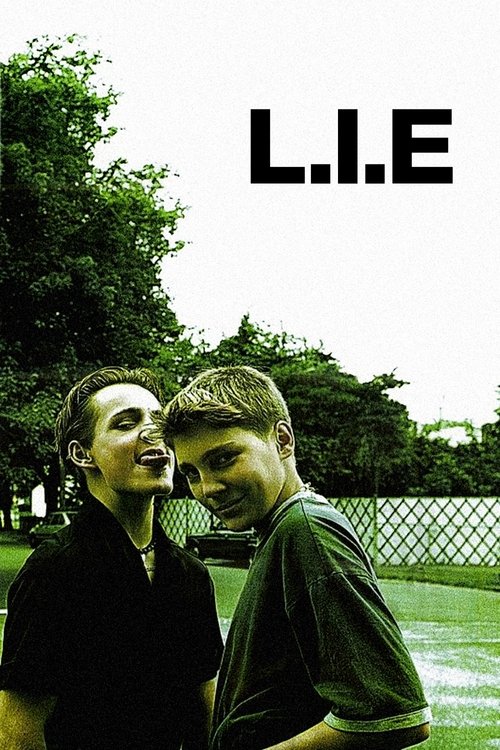
L.I.E.
2001 · Michael Cuesta
For when you want a challenging, conversation-starting independent film and can handle genuinely difficult subject matter — this is the opposite of comfort viewing, and it will stay with you for days.
What it's about
Howie is fifteen, adrift in a well-off Long Island suburb after his mother's death on the expressway that gives the film its name, with a father too busy and compromised to notice him. He and a friend drift into burglarizing neighbors' houses — until they rob the wrong one, belonging to Big John, a charismatic ex-Marine who preys on teenage boys. What forms between Howie and this dangerous man is unstable, unnerving, and nothing like what you'd expect.
The experience
Tense and deeply uncomfortable by design — it refuses easy judgments, sitting in moral gray zones most films won't go near. It's also tender in surprising places, which is precisely what makes it so unsettling.
Performances
Brian Cox is extraordinary as Big John — magnetic, funny, and monstrous all at once, one of the most disturbingly human portraits of a predator ever put on screen. And a very young Paul Dano, in his first major role, carries the film with a raw, watchful intelligence.
The craft
Michael Cuesta's low-budget debut turns the Long Island Expressway into the film's spine — a constant hum of danger and loss running past manicured lawns. The direction trusts silence and ambiguity, letting scenes breathe until you're not sure whether to feel sympathy or dread, often both.
Why it matters
Its unflinching subject matter earned it an NC-17 rating and real controversy, but it launched Paul Dano's career, announced Cuesta as a director, and became a touchstone for early-2000s American indie cinema's willingness to go where studios wouldn't.
Snapshot
L.I.E. is Michael Cuesta's feature directorial debut, a low-budget American independent drama set in the affluent but emotionally desolate suburbs of Long Island. Its title names the Long Island Expressway, the highway that bisects the film's world and functions throughout as a literal and figurative artery of danger and loss — the road on which the protagonist's mother died and along which adolescent boys court their own destruction. The film follows Howie Blitzer (Paul Dano, in his first major screen role), a fifteen-year-old adrift after his mother's death and his contractor father's neglect, who falls into petty burglary with a small circle of friends. When the boys rob the home of Big John Harrigan (Brian Cox), a charismatic ex-Marine and serial predator of teenage boys, Howie is drawn into an unstable relationship with the man — part menace, part mentorship, part the only sustained adult attention he receives. The film is best remembered for two things: Brian Cox's fearless, unsettlingly humane performance as a pedophile, and the MPAA's NC-17 rating, which made L.I.E. a flashpoint in the long-running American debate over film classification and adult subject matter. It remains a touchstone of early-2000s transgressive suburban realism.
Industry & production
L.I.E. belongs to the cohort of late-1990s/early-2000s American independent cinema produced well outside the studio system, financed modestly and aimed at the festival-to-arthouse pipeline. It premiered at the Sundance Film Festival in January 2001, where the unknown Dano's performance and Cox's central turn drew immediate attention and positioned the film as one of the festival's notable discoveries. Specific budget figures are not well documented in the public record; the production was clearly economical, shot on actual Long Island locations with a small ensemble and a naturalistic, location-driven aesthetic that reflects its means.
The film's industrial significance is inseparable from its ratings battle. The MPAA assigned L.I.E. an NC-17 — the rating that, since replacing the X in 1990, had become commercially toxic because many theater chains and newspapers refused to book or advertise NC-17 titles. The film contains no explicit sexual depiction; the rating reflected its subject matter rather than graphic content, and the filmmakers and distributor protested that the classification effectively censored a serious, non-exploitative treatment of predation. The picture was ultimately released theatrically without a rating through the small distributor Lot 47 Films. The episode became a frequently cited example in critiques of the ratings system and its uneven, content-versus-theme inconsistencies, and the film is among those invoked in later examinations of the MPAA's opacity (it figures in the broader conversation around Kirby Dick's 2006 documentary This Film Is Not Yet Rated).
Technology
L.I.E. was produced as a conventional independent film of its moment, before the wholesale shift to digital acquisition that would reshape low-budget production later in the decade. The image has the grain and available-light texture of a modestly resourced shoot, and the technological story here is one of restraint rather than innovation: the film does not foreground any novel apparatus, instead deploying standard production tools in service of an unvarnished realism. The precise film stock and camera package are not prominent in the documentary record, and it would be invention to specify them. What the film does exploit technologically is the expressive economy of practical locations — suburban interiors, the highway and its overpasses — captured without conspicuous artifice.
Technique
Cinematography
Romeo Tirone's photography is central to the film's tone, favoring muted, naturalistic light and a palette drained toward the gray-green of off-season suburbia. The expressway itself is the dominant visual motif: recurring shots of the L.I.E. — its overpasses, its rushing traffic, the railing on which Howie balances in the film's framing device — render the road as a presence rather than a backdrop, a channel of speed and mortality threading the narrative. The camera tends to stay close to Howie's eye level and psychological vantage, observing adults and spaces as he experiences them. Compositions favor the unglamorous geometry of tract houses, garages, and roadside America, and the film resists prettifying its world, letting the banality of the suburb register as its own kind of menace. Tirone's collaboration with Cuesta would continue into the director's subsequent television work.
Editing
The cutting is patient and observational, allowing scenes — particularly the charged two-handers between Howie and Big John — to breathe and accumulate tension through duration rather than fragmentation. The editing sustains ambiguity, refusing to telegraph where each encounter between boy and man will land, which is essential to the film's discomfiting effect. The framing device of Howie on the overpass railing brackets the narrative and lets the film return, structurally, to the highway as the locus of risk. The public record is thin on the specifics of the editorial team's biographies, and I will not attribute the cut to a named editor I cannot confirm; what is evident on screen is a preference for held, unforced rhythms over momentum.
Mise-en-scène / staging
Cuesta stages L.I.E. in the textures of lived-in suburban neglect: Howie's motherless house, his father's job sites, Big John's tidy and oddly cultured home. The contrast between Big John's ordered, almost paternal domestic space and the chaos of Howie's home life is a deliberate staging strategy — it makes the predator's appeal legible and therefore more disturbing. Big John's environment carries markers of taste and self-possession (his manner, his cultivation) that the film uses to complicate any simple monstrousness. The highway and its margins recur as transitional, liminal spaces where the boys are most exposed.
Sound
The sound design serves the realist register, grounding scenes in the ambient noise of traffic and suburban quiet. The musical score — credited to Pierre Földes — is used sparingly, supporting the film's emotional undercurrents without overstatement. The film also threads literary language into its soundtrack of voice: Howie's narration and his invocation of Walt Whitman (the poet a native son of Long Island) lend a plaintive, elegiac counterpoint to the squalor of the action, aligning the boy's inner life with a tradition of American lyric yearning.
Performance
Performance is the film's greatest achievement. Brian Cox's Big John is a study in calibrated contradiction — genial, commanding, wounded, and genuinely dangerous — and the role's refusal to flatten a predator into a monster is precisely what made the film controversial and what makes the performance enduring. Cox finds the manipulator's charm and the man's loneliness without ever asking the audience to excuse him. Opposite him, the teenaged Paul Dano delivers a remarkably unguarded, interior performance as Howie, conveying grief, curiosity, and self-endangerment with a stillness that announced a major talent; the role launched one of the more distinguished careers in American screen acting. Billy Kay as Gary, Howie's reckless friend and object of his inchoate desire, rounds out a trio of finely observed adolescent portraits.
Narrative & dramatic mode
L.I.E. operates in the mode of intimate psychological realism, structured as a coming-of-age narrative that deliberately corrupts the form's reassurances. Its drama is built less on plot mechanics than on the shifting power and tenderness between Howie and Big John, with the threat of exploitation held in constant, unresolved suspension. The film is bracketed by Howie's reflective voiceover and the recurring image of the expressway, giving it a confessional, retrospective frame. Cuesta refuses melodrama and tidy resolution; the narrative's turns — including its abrupt, harsh late developments — are delivered with an unsentimental flatness that heightens their impact. The dramatic mode is one of moral discomfort: the audience is denied a stable position from which to judge, made to sit inside relationships that are simultaneously protective and predatory.
Genre & cycle
The film sits at the intersection of the coming-of-age drama and the crime film (its burglary plot and milieu of delinquency), but it is most legible as part of an American independent cycle of suburban-malaise and transgressive-realist films around the turn of the millennium. This cycle — encompassing the work of Todd Solondz (Happiness, 1998), Larry Clark (Kids, Bully), and the broader vein of films diagnosing the rot beneath middle-class American comfort — used adolescence, sexuality, and violence to puncture suburban pieties. L.I.E. shares with these films a willingness to dramatize taboo subject matter (pedophilia, adolescent sexuality, parental abandonment) in a sober, non-exploitative register, and it shares their fate of friction with distribution and ratings gatekeepers.
Authorship & method
L.I.E. is a family-rooted authorial project: Michael Cuesta directed and co-wrote, working from a screenplay developed with Gerald Cuesta and Stephen M. Ryder. The film bears the marks of a debut feature made with conviction — close to its Long Island setting, committed to its difficult premise, and disciplined in its refusal of sensationalism. Cuesta's method here is observational and actor-centered, trusting performance and location over stylistic flourish. His key collaborator on the image was cinematographer Romeo Tirone, whose naturalistic lighting defines the film's look; the score is credited to Pierre Földes. (On the editorial credits the documentary record available to me is thin, and I decline to attribute the cut to a name I cannot verify.)
Cuesta's subsequent career strongly contextualizes L.I.E. as a calling card. He moved into prestige television, directing for Six Feet Under and helming the pilot of Dexter — work whose interest in damaged interiority and moral ambiguity echoes his debut — as well as later episodes and the pilot of Homeland. He returned to features with Twelve and Holding (2005), again exploring adolescence and grief in suburbia, and later directed the journalism drama Kill the Messenger (2014). The throughline of his authorship is an attraction to characters operating in moral gray zones, treated with empathy rather than judgment.
Movement / national cinema
The film is firmly within American independent cinema, specifically the post-Sundance generation of the late 1990s and early 2000s that built careers through festival exposure and specialty distribution. It is not affiliated with a formal movement or manifesto; rather, it exemplifies the era's independent realism, in which modest budgets, regional specificity, and provocative subject matter combined to differentiate small films from studio product. Its New York–area, Long Island setting roots it in a recognizable regional American milieu, and its production circumstances — small distributor, ratings struggle — are characteristic of the period's independent ecology.
Era / period
Released in 2001, L.I.E. is a document of turn-of-the-millennium suburban America, preoccupied with the anomie beneath material comfort. It arrived at a moment when independent film was both vibrant and increasingly squeezed by the commercial constraints of the ratings system and shrinking exhibition for adult-themed work. The film's frank treatment of its subject placed it in dialogue with contemporaneous anxieties about childhood, sexuality, and predation, and its ratings ordeal made it an artifact of the early-2000s contest over what serious American film was permitted to depict.
Themes
The film's governing themes are absence and abandonment: Howie is orphaned by death (his mother) and by neglect (his preoccupied, ethically compromised father), and his vulnerability to Big John is figured as the consequence of that vacancy. Adolescent masculinity and the confusions of emerging sexuality run throughout — Howie's feelings for Gary, the boys' bravado, the unsettling intimacy he finds with an adult who both endangers and attends to him. Predation and its disturbing proximity to care is the film's most provocative theme: by humanizing Big John, Cuesta forces a reckoning with how grooming exploits genuine emotional need. The expressway crystallizes the motif of mortality and transit — a road of departures and fatal accidents. Threaded through is a Whitmanesque strain of American longing, the poet's voice (and his Long Island origins) summoned as a counter-melody of tenderness and self-discovery against a landscape of loss.
Reception, canon & influence
Critically, L.I.E. was received as a serious, accomplished debut, with near-unanimous praise reserved for Brian Cox's performance and warm recognition of Dano's arrival; the film's bravery in handling its subject without exploitation was widely noted, even as some commentary inevitably centered on the ratings controversy rather than the work itself. Its festival debut at Sundance 2001 established its reputation among critics and independent-film audiences.
Looking backward, the film draws on the lineage of American suburban-disquiet and transgressive-realist cinema — the Solondz/Clark vein noted above — and on a broader tradition of coming-of-age stories that treat adolescence as a site of danger rather than nostalgia. Its literary borrowing from Walt Whitman situates it within an American Romantic inheritance of yearning and self-making.
Looking forward, the film's most concrete legacy is the career it launched: Paul Dano became one of his generation's most respected actors (There Will Be Blood, Little Miss Sunshine, Prisoners, and beyond), and L.I.E. is routinely cited as his breakthrough. Cuesta's own trajectory into ambitious, morally complex television (notably the Dexter and Homeland pilots) carried forward the debut's sensibility. More diffusely, L.I.E. remains a reference point in arguments about the MPAA and NC-17, a case study in how the ratings system handled difficult themes, and a durable example for filmmakers seeking to dramatize taboo material with empathy rather than sensationalism. Its influence is less a matter of stylistic imitation than of demonstrated possibility — proof that a small film could treat the unspeakable with gravity and earn lasting critical respect.
A Deleuzian reading
Start with the boy on the railing.
The full Deleuzian reading of L.I.E. →
Reception
Premiered at Sundance in 2001 to strong reviews but was hobbled by an NC-17 rating and its radioactive subject matter; today it's mostly remembered as the film that gave us Paul Dano — and as proof that Brian Cox was doing career-best work two decades before Succession made him a household name.
How L.I.E. was received, from release to now →
Influences: the films it descends from and the films it influenced
- Happiness (1998) — Established the template L.I.E. inherits directly: a suburban pedophile (Dylan Baker's Bill Maplewood) rendered in patient, unflinching close-third without exculpation or sensationalism — the exact register Cuesta and Brian Cox adopt for Big John.
- Welcome to the Dollhouse (1995) — Pioneered the deadpan-observational gaze on suburban adolescent cruelty and neglect, treating childhood as a site of menace rather than nostalgia — the coming-of-age-subverted frame L.I.E. builds on.
- Kids (1995) — Documentary-naturalistic, available-light handling of endangered teenagers and predatory adult appetite, filmed on real locations without moralizing — the transgressive-realist lineage the dossier names explicitly.
- Days of Heaven (1978) — Codified the pairing of naturalistic available-light cinematography with a literary child's-eye voiceover frame — the formal device L.I.E. echoes via Romeo Tirone's lighting and the Whitman narration.
- My Own Private Idaho (1991) — Lyrical treatment of drifting, hustling youth caught in a predatory adult economy, lending dignity to the endangered boy — a precedent for Howie's vulnerability to Big John.
- The 400 Blows (1959) — Founding model of the observational, location-rooted following of an abandoned, parentally-neglected boy, with the adult world as threat — the suburban-neglect/abandonment armature of L.I.E.
- The Woodsman (2004) — Directly inherits Big John: a sustained, empathetic-but-unflinching portrait of a pedophile (Kevin Bacon) built on a controlled lead performance and non-exploitative restraint, the possibility L.I.E. proved.
- Mysterious Skin (2004) — Carries forward the empathetic, formally restrained dramatization of child sexual abuse and subverted coming-of-age, trusting performance and tone over sensational depiction.
- Little Children (2006) — Extends the suburban-predation drama with a registered sex offender humanized through patient staging, framed by a literary omniscient voiceover — the same neglect-and-predation suburb seen through L.I.E.'s lens.
- Twelve and Holding (2005) — Cuesta's own continuation of the method: observational, actor-centered staging of suburban adolescence in peril and grief, location-rooted and empathetic toward characters in moral gray zones.
- Prisoners (2013) — Carries the Paul Dano breakout L.I.E. launched into another predation-and-abduction drama, casting his unsettling vulnerability as the suspected innocent — a direct line in the performance lineage the dossier names.
- There Will Be Blood (2007) — The fullest flowering of the Dano performance L.I.E. introduced, opposite another devouring older-man figure — the concrete career legacy the dossier identifies as the film's most durable influence.
- George Washington (2000) — Contemporaneous American-indie application of Malick-derived naturalistic light plus poetic voiceover over decaying landscapes and unsupervised children — the same image-and-narration synthesis Cuesta uses.
- Bully (2001) — Same-year transgressive-suburban realism shot on practical locations, dramatizing teen violence and sexuality with the same refusal of stylistic flourish in favor of raw observation.
- Gummo (1997) — Fragmentary, naturalistically-lit portrait of suburban/exurban decay and feral adolescence, sharing L.I.E.'s commitment to environment-as-character and unsentimental neglect.
- The Ice Storm (1997) — Adjacent suburban-disquiet study where adult dysfunction endangers adolescents, using restrained staging of domestic neglect rather than melodrama — a parallel reading of turn-of-millennium suburbia.
Similar films
- My Own Private Idaho (1991) — influence & lineage
- Leviticus (2026) — shared sensibility
- Donnie Darko (2001) — shared sensibility
- La Promesse (1996) — shared sensibility
- Five Easy Pieces (1970) — shared sensibility
- A History of Violence (2005) — shared sensibility
- The Outsiders (1983) — shared sensibility
- The Hand of God (2021) — shared sensibility