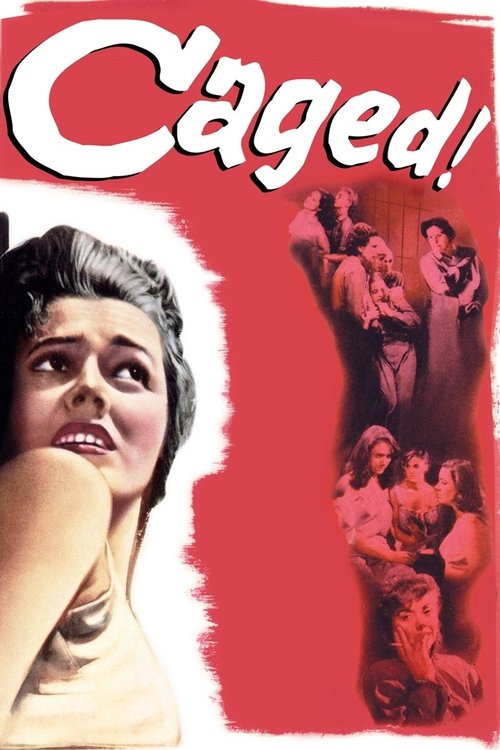
Caged
1950 · John Cromwell
For when you want something hard-edged and honest — a black-and-white drama that takes an unflinching look at how people get ground down, not a comfort watch. Reach for it when you're in the mood to be moved and outraged in equal measure.
What it's about
A nineteen-year-old widow, pregnant and guilty of little more than being in the wrong car, is sentenced to a women's state prison as an accessory to a botched robbery. Inside, she's caught between a reform-minded superintendent with no real power and a matron who runs her ward through humiliation and fear. What follows is the story of what an institution does to a person who arrived decent — and what she has to become to survive it.
The experience
Grim, claustrophobic, and quietly furious — a slow tightening rather than a thriller's rush. It builds through small cruelties and rare flickers of kindness, and it leaves a bruise; you come out angry at a system more than at any one villain.
Performances
Eleanor Parker is remarkable as Marie Allen, charting a visible transformation from frightened girl to hardened survivor almost entirely through posture and eyes. Hope Emerson is unforgettable as the sadistic matron Harper, and Agnes Moorehead brings weary conviction to the superintendent fighting a losing battle.
The craft
Shot in stark noir black-and-white that turns the prison into a world of bars, shadows, and hard institutional light, with a script that treats its women as people rather than types. Its most shocking moments are staged with restraint — a pair of shears, a locked door — which makes them land harder. The ensemble scenes in the ward have a documentary-like texture rare for a 1950 studio picture.
Why it matters
This is the film that established the women-in-prison picture — every later entry in the genre, exploitation or prestige, works from its blueprint — while remaining one of Hollywood's toughest social-problem dramas about incarceration.
Snapshot
Caged is the film that gave the women-in-prison picture its template and, arguably, its conscience. Adapted by Virginia Kellogg and Bernard C. Schoenfeld from Kellogg's story "Women Without Men," it follows Marie Allen (Eleanor Parker), a nineteen-year-old widow jailed as an accessory to a botched robbery in which her husband was killed. Pregnant on arrival and functionally innocent, Marie is processed through a state institution that alternates between the well-meaning but powerless reformism of superintendent Ruth Benton (Agnes Moorehead) and the casual sadism of matron Evelyn Harper (Hope Emerson). Over the course of the film Marie loses her child to adoption, loses her hair to Harper's punitive shears, and finally loses the fragile decency she entered with — walking out at the end recruited into the very underworld that put her inside. The picture belongs to the Warner Bros. social-problem tradition, but it is told with the shadow-language of film noir and the observational grain of a semi-documentary. Its lasting significance is double: it is a serious, unusually unsentimental study of institutional dehumanization, and it is the fountainhead of a durable and eventually disreputable genre.
Industry & production
Caged was a Warner Bros. production, made at the end of the 1940s when the studio's tradition of topical, socially conscious melodrama — the strain that had produced I Am a Fugitive from a Chain Gang — was being reinflected by the postwar vogue for realism and the darker palette of noir. The project's origin is one of the more frequently cited facts of its production history: co-writer Virginia Kellogg, who had recently supplied the story for White Heat, undertook first-hand research inside women's correctional institutions, an investigative approach that gave the screenplay its texture of procedural detail — intake, the strip search, the laundry and sewing details, the parole board, the informal economy of contraband and favors. That research grounds the film's most persuasive quality, its sense that it knows how such a place actually runs.
The film was directed by John Cromwell, a veteran with roots in the New York stage, at a point when his standing in Hollywood was becoming precarious; the anti-Communist pressures of the era would soon curtail his American studio career, and Caged stands as one of the last major studio pictures of his most productive period. Beyond that, the granular commercial record — budget, shooting schedule, box-office returns — is not something I can state with confidence, and I won't invent figures. What is securely documented is the film's prestige outcome: it drew three Academy Award nominations (Eleanor Parker for Best Actress, Hope Emerson for Best Supporting Actress, and Kellogg and Schoenfeld for their writing), and Parker took the Volpi Cup for Best Actress at the Venice Film Festival. For a modestly scaled genre melodrama, that is a notable concentration of recognition, and it signals that the industry received Caged as a serious picture rather than a programmer.
Technology
Technologically Caged is a conventional late-studio-era product, and its interest lies in how thoroughly it exploits mature tools rather than in any novelty. It was shot on black-and-white 35mm with the fast panchromatic stocks and coated lenses of the period, which by 1950 permitted the deep, high-contrast, low-key lighting the film depends on. The idiom is entirely soundstage-based: the prison is a built environment of tiers, bars, and corridors, and the film's power comes from the controlled artificiality of that space rather than from location authenticity. Sound is standard optical monaural recording. There is nothing here of the widescreen or color experimentation that the industry would embrace within a few years under television's pressure; Caged is instead a late, confident demonstration of the Academy-ratio black-and-white studio picture at the height of its expressive maturity.
Technique
Cinematography
Carl Guthrie's photography is the film's most obvious artistic asset and the clearest evidence of its noir kinship. The women's prison becomes a landscape of bars and their shadows: cell doors, window grilles, and railing patterns are thrown across faces and floors so that the geometry of confinement is inscribed on the bodies of the confined. Compositions favor the oppressive — high angles that flatten inmates into a mass, low angles that make Harper monumental, tight framings that crowd Marie against walls and bunks. The lighting is characteristically low-key, carving figures out of darkness, but it is deployed with dramatic discrimination: Benton's office and the reformist world are lit more evenly, while the cellblock and Harper's domain are pools of shadow. The result is a visual argument, not merely a mood.
Editing
Owen Marks — an experienced Warner cutter — edits for accumulation rather than propulsion. The film's rhythm is that of routine and duration: the deadening repetition of institutional days, punctuated by the shocks of childbirth, punishment, and death. Sequences such as the intake processing are built to convey procedure and its erosion of the individual. Where the picture accelerates — in a riot, in moments of violence — the cutting tightens, but the governing strategy is one of measured escalation, tracking Marie's psychological hardening across a series of degradations rather than staging a conventional plot of incident and reversal.
Mise-en-scène / staging
The staging is fundamentally theatrical in the best sense, drawing on Cromwell's stage background: the prison is a single dense social world, and the film choreographs a large ensemble of women within it, establishing hierarchies, alliances, and cruelties through blocking. The tiered cellblock functions almost as a stage set with multiple acting levels. Physical detail carries meaning — the sewing and laundry work, the shared cell, the contraband kitten whose fate becomes a pivot of the film's cruelty. The single most exploited element of staging is Hope Emerson's Harper, whose sheer physical scale is used compositionally: she dominates frames, looms over inmates, and embodies institutional power as bodily fact.
Sound
Sound is used with restraint appropriate to the film's realism. The aural texture of the institution — clanging gates, echoing corridors, the massed noise of women — does much of the work of characterizing the space as oppressive and inescapable. Dialogue carries the period's argot of prison and vice, part of what gives the script its documentary savor. Max Steiner's score (see below) is the principal non-diegetic layer, and it is applied more sparingly than in the studio's grander melodramas.
Performance
Performance is where Caged earns its reputation. Eleanor Parker executes one of the era's most fully mapped transformations, playing Marie across a wide arc from a frightened, soft-faced innocent to a hollowed-out, hardened woman; the film asks the audience to watch decency being extinguished by increments, and Parker makes the process legible without melodramatic underlining. Hope Emerson's Harper is a landmark of screen menace — corrupt, jovial, and casually brutal — a performance whose physical presence and moral rot became the model for every prison matron to follow. Agnes Moorehead lends Benton a weary, principled intelligence, embodying reform's real limits inside a broken system. The supporting bench — including Jan Sterling, Betty Garde, Ellen Corby, and Lee Patrick as a smooth vice recruiter — fills out the prison society with sharply individuated types.
Narrative & dramatic mode
The film's dramatic mode is tragic and deterministic rather than redemptive. Its structure is a descent: a naïve protagonist enters an institution nominally meant to rehabilitate and is instead schooled in criminality, so that the plot mechanism is not escape or vindication but corruption. This inverts the conventional prison-drama promise of endurance rewarded. The narration is close to Marie throughout, aligning our sympathy with her deterioration, and the film withholds catharsis: the ending, in which she is bailed into the underworld's service and Benton orders her file kept active against her certain return, is a closed loop of institutional failure. The mode is social tragedy — the individual crushed less by a villain than by a system, with Harper as that system's grinning face.
Genre & cycle
Caged is the keystone of the women-in-prison film. Isolated antecedents existed in the 1930s — pictures such as Ladies They Talk About and Condemned Women had already discovered the dramatic utility of the female penitentiary — but Caged consolidated the genre's iconography and raised its ambitions to those of the prestige social-problem film. It fixed a set of conventions that would recur for decades: the innocent newcomer, the sympathetic-but-hamstrung reformer administrator, the sadistic matron, the internal caste system, the predatory recruitment into vice, the institution as machine for producing criminals. Simultaneously it is a hybrid, folding the Warner social-conscience picture and the visual grammar of film noir into the prison melodrama. That fusion of respectability and lurid subject matter is precisely what made the template so exportable — and so susceptible to later coarsening.
Authorship & method
The dominant creative signature is arguably the screenplay's. Virginia Kellogg's research-driven method gives Caged its spine of authenticity, and her and Bernard C. Schoenfeld's script supplies both the procedural realism and the tragic architecture. John Cromwell's direction is the film's controlling intelligence in execution: a former stage actor and director, he was known less as a visual stylist than as a superb handler of actors and dense ensemble drama, and Caged plays to exactly those strengths, marshaling a large female cast into a coherent social world and drawing career-defining performances from Parker and Emerson. Cromwell's touch is unobtrusive, subordinating flourish to performance and situation.
Among collaborators, cinematographer Carl Guthrie translates the material into noir terms, making confinement visible. Editor Owen Marks — whose credits include Casablanca — shapes the film's accretive rhythm. Composer Max Steiner, Warner's foremost house musician, supplies the score; consistent with the film's restraint it functions to underline emotion at key junctures rather than to saturate the picture, a comparatively disciplined outing for a composer famous for wall-to-wall scoring. The whole is a strong example of studio authorship: not the vision of a single auteur but the productive convergence of a research-based script, an actor's director, and Warner's craft departments.
Movement / national cinema
The film sits at the intersection of two American currents. First, the Warner Bros. social-problem tradition, with its faith that popular melodrama could indict institutions — here the target is the failure of the penal system to rehabilitate, and its tendency to manufacture the recidivism it claims to prevent. Second, the postwar noir sensibility, both visually (low-key, bar-shadowed cinematography) and morally (determinism, corruption, the absence of clean resolution). Caged is a Hollywood studio product through and through, not the offspring of any avant-garde or foreign movement, but it shares the era's broader realist turn — the same impulse that produced the semi-documentary crime films of the late 1940s — redirected inward, onto a closed institution.
Era / period
Made in 1950, Caged is a film of the immediate postwar moment, when Hollywood's appetite for darker, more socially critical subject matter was near its peak and before the disruptions — television, widescreen, the collapse of the studio contract system — fully reshaped the industry. Its unsentimental view of a state institution is of a piece with the period's willingness to look at American failure. It also arrives on the eve of the blacklist era whose pressures would soon damage Cromwell's Hollywood standing, lending the film a valedictory quality within his career. Stylistically it represents the black-and-white studio melodrama at a moment of full technical and expressive command, just before the medium's postwar transformations.
Themes
The film's controlling theme is institutional dehumanization: the systematic reduction of a person to a number, a body, a file. Closely bound to it is the critique of a carceral system that punishes rather than reforms and, in doing so, breeds criminality — Marie's arc is the theme's proof. Corruption and the abuse of custodial power run through Harper, whose petty tyranny embodies how unchecked authority curdles. The film is pointedly attentive to gendered vulnerability: motherhood (Marie's pregnancy and the loss of her child) becomes a site of institutional cruelty, and the predatory recruitment of women into vice frames incarceration as a pipeline into further exploitation. Scholars have also read a coded queer subtext into the film's closed female society and its predatory recruiter, one of the ways a Production Code–era picture registered desires it could not name directly. Underlying all of this is a bleak determinism — the sense that the institution's gravity is inescapable, sealed by the closing insistence that Marie will be back.
Reception, canon & influence
Caged was received as a serious and accomplished picture, its standing confirmed by three Academy Award nominations and Eleanor Parker's Venice Best Actress award. Critically it has aged into a canonical status on two tracks: as a distinguished example of the noir-inflected social-problem film, admired for its performances and its unrelenting design, and as the acknowledged origin point of an entire genre.
Its backward influences are the earlier prison melodramas and the Warner social-conscience cycle that taught Hollywood how to dramatize institutions, together with the noir visual style then saturating the studio's output; the decisive new ingredient was Kellogg's investigative realism. Its forward legacy is unusually clear-cut. Caged established the women-in-prison template that later films worked and reworked — the 1962 House of Women is essentially a reconception of the same material — and, further down the line, the exploitation cycle of the late 1960s and 1970s built its lurid formula on the conventions Caged had dignified. The most direct salute is the title of Jonathan Demme's 1974 Caged Heat, which openly invokes the 1950 film even as it pushes the genre toward exploitation. That trajectory — from prestige social critique to drive-in staple — is itself part of Caged's historical meaning: it demonstrates how a serious film can seed a genre that then travels far from its maker's intentions. What keeps Caged itself alive is that it remains the version done straight and done well — the rare women-in-prison film whose interest is moral and whose craft is first-rate.
Reception
In 1950 it was a prestige social-problem picture — three Oscar nominations, including Best Actress for Eleanor Parker. Decades of sleazy women-in-prison exploitation flicks later, it's been reclaimed as the genre's serious, genuinely great original.
How Caged was received, from release to now →
Influences: the films it descends from and the films it influenced
- The Big House (1930) — Founded the cell-block ensemble drama and its institutional soundscape — clanging gates, mess-hall roar, lockstep routine — that Caged inherits wholesale as its 'institutional ambience.'
- I Am a Fugitive from a Chain Gang (1932) — Warner social-problem indictment whose tragic-descent arc and bleak closed-loop ending — the protagonist released more brutalized than when he entered — is the exact narrative template Caged transposes to a women's prison.
- 20,000 Years in Sing Sing (1932) — Modeled Warner's institution-as-drama method, welding procedural detail of incarceration to star melodrama the way Caged fuses Kellogg's research to Parker's arc.
- Ladies They Talk About (1933) — The proto women-in-prison picture: it lays out the cell-block sisterhood, tough-dame types, and reform-vs-corruption structure that Caged systematizes into a coherent genre.
- Condemned Women (1938) — RKO women's-reformatory melodrama that directly prefigures Caged's central plot engine — a naive ingénue corrupted by the institution meant to reform her.
- Of Human Bondage (1934) — Cromwell's own actors'-director method here — suppressing visual flourish to draw a career-defining transformation from Bette Davis — is precisely the craft he later applies to Eleanor Parker.
- Double Indemnity (1944) — Canonical source of the low-key, barred-shadow noir lighting grammar that cinematographer Carl Guthrie borrows to make confinement literally visible on the cell walls.
- Riot in Cell Block 11 (1954) — Extends Kellogg's research-driven, semi-documentary institutional realism into the docudrama prison-uprising film, prizing verified procedure over melodrama.
- Women's Prison (1955) — Directly reworks Caged's template with Ida Lupino inheriting the Hope Emerson menace — the sadistic-matron archetype as the institution's human face.
- House of Women (1962) — Essentially a Warner reconception of the same material, replaying Caged's ingénue-in-the-cellblock structure and closed, self-perpetuating institutional world.
- Scrubbers (1982) — Reclaims Caged's morally serious, research-based social realism for the women-in-prison film, deliberately countering the exploitation cycle the genre had drifted into.
- The Big Doll House (1971) — Codifies the exploitation WIP formula — sadistic matron, cell-block hierarchy, escape plot — as a lurid inversion of the conventions Caged had first played straight.
- 99 Women (1969) — Carries Caged's institutional-dehumanization premise and sadistic-warden dynamic into European softcore melodrama, the genre traveling far from its maker's intent.
- Caged Heat (1974) — Its very title openly salutes Caged even as it pushes the women-in-prison conventions Caged dignified toward drive-in exploitation.
- Brute Force (1947) — The definitive male noir prison film, whose oppressive low-angle institutional framing and sadistic authority figure (Cronyn's Capt. Munsey) are exactly rhymed by Caged's Emerson matron and Guthrie's angles.
- White Heat (1949) — Contemporaneous Warner noir routed through the same craft departments — including Max Steiner's disciplined, punctuating score — applying expressionist penal imagery to the institution.
Similar films
- I Am a Fugitive from a Chain Gang (1932) — influence & lineage
- Mildred Pierce (1945) — shared sensibility
- Monster (2003) — shared sensibility
- The Woman in the Window (1944) — shared sensibility
- Promising Young Woman (2020) — shared sensibility
- The Postman Always Rings Twice (1946) — shared sensibility
- The Girl with the Needle (2024) — shared sensibility
- All About Eve (1950) — shared sensibility