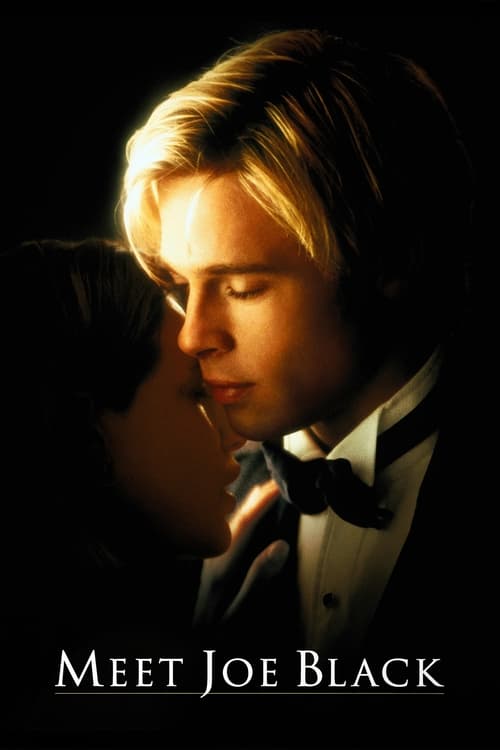
Meet Joe Black
1998 · Martin Brest
For a rainy Sunday when you want something romantic, wistful, and unhurried — when you'd rather sink into a mood than be gripped by a story. A good-cry movie for the patient.
What it's about
Bill Parrish, a self-made media magnate days from his sixty-fifth birthday, receives a visitor no one can refuse: Death himself, curious about life and wearing the body of a handsome young man. Calling himself Joe Black, he moves into Bill's home as houseguest and shadow, granting Bill extra time in exchange for a guided tour of being alive. The arrangement gets complicated when Joe falls for Bill's daughter — and Bill has to watch Death court his own child.
The experience
Slow, plush, and unashamedly sincere — nearly three hours that drift like a long summer dinner party, more interested in glances and conversations than plot. It's a film about savoring, and it asks you to savor it; if you surrender to the pace, the ending lands with real tenderness.
Performances
Anthony Hopkins does lovely, generous work as a man taking inventory of his life, and Brad Pitt takes a real swing playing an eternal being learning to be human — mannered, strange, oddly touching.
The craft
Everything is deliberately sumptuous: candlelit mansions, a fireworks-lit birthday gala, a swooning orchestral score, and a pace that treats every scene as worth lingering over. It's old-fashioned Hollywood craftsmanship applied at maximum lavishness.
Why it matters
A famous case of a big romantic gamble that divided critics on release — mocked for its length, defended for its sincerity — and it has aged into a genuine cult favorite for viewers who love a full-hearted studio romance.
Snapshot
Meet Joe Black is Martin Brest's lavish, deliberately unhurried fantasy-romance in which Death takes human form to learn what it means to be alive — and falls in love along the way. Anthony Hopkins plays Bill Parrish, a media magnate days from his sixty-fifth birthday; Brad Pitt plays the entity who borrows the body of a young man and, christened "Joe Black," becomes Bill's houseguest, confidant, and rival for the affection of his daughter Susan (Claire Forlani). The film is a loose, vastly expanded reworking of Death Takes a Holiday (1934), itself drawn from Alberto Casella's play. Running close to three hours, it is one of the longest mainstream Hollywood romances of its decade, and its critical and commercial reputation has always been bound up with that length — read by detractors as bloat and by defenders as a sustained, almost hypnotic mood piece. It sits at the intersection of star-vehicle prestige filmmaking and an older tradition of metaphysical comedy-drama, and it marks a high point of glossy late-1990s studio craftsmanship even as it tested audience patience.
Industry & production
The film was a major Universal Pictures release, produced under Brest's own banner with the director also serving as producer — a mark of the autonomy he had earned after the back-to-back successes of Midnight Run (1988) and Scent of a Woman (1992), the latter of which won Al Pacino his Academy Award for Best Actor. That track record bought Brest unusual latitude, and Meet Joe Black shows it: a long shoot, a long cut, and a reported budget in the high tens of millions of dollars (figures commonly cited in the $90 million range, though I'd treat any precise number cautiously). The production drew on Brad Pitt at or near the peak of his marquee value, pairing him with Hopkins, a recent Oscar winner himself for The Silence of the Lambs. The film's release also became a footnote in blockbuster history: prints carried the first theatrical trailer for Star Wars: Episode I — The Phantom Menace, and a portion of the audience reportedly bought tickets for the preview rather than the feature. Commercially the picture is generally regarded as having underperformed relative to its cost, recouping more strongly overseas than domestically; I won't assert exact grosses, but the consensus is that it fell short of expectations for a film of its budget and star wattage. For Brest the trajectory afterward was steep — his next and, to date, final feature was Gigli (2003), and Meet Joe Black now reads as the last of his expansive, confident studio productions.
Technology
Meet Joe Black is a fundamentally analog, photochemical production made at the end of the era before digital intermediates became standard, and its technological signature is conservative by design. It was shot on 35mm film with anamorphic-scaled widescreen framing and finished in a traditional optical/photochemical workflow. There is little reliance on digital effects; the film's "fantasy" is achieved almost entirely through performance, lighting, and editing rather than visual trickery — the supernatural is rendered as a quality of presence, not a spectacle. The one element that flirts with the uncanny — a flickering, blue-white luminescence and a sense of stilled time around Death's arrivals and departures — is handled in-camera and in the grade rather than through conspicuous compositing. The film's most discussed "effect," the abrupt traffic collision that ends the young man's life in the early coffee-shop sequence, is staged as practical stunt-and-edit work, and its jolting violence is amplified precisely because the surrounding film is so smooth and unhurried. In short, the technology here is the mature, late-1990s apparatus of glossy studio realism, deployed to keep the metaphysics grounded.
Technique
Cinematography
The cinematography is the film's most celebrated technical asset, the work of Emmanuel Lubezki — here in his studio-craftsman phase, years before his run of Oscars with Alfonso Cuarón and Terrence Malick. Lubezki gives the picture a warm, burnished, almost amber interiority: the Parrish mansion and offices are lit as spaces of privilege and dusk, with light that seems to pool around faces. He favors soft, motivated sources, generous shallow focus that isolates the actors against luxuriant backgrounds, and a camera that moves with patience rather than urgency. The visual scheme draws a quiet contrast between the golden world of the living and the cooler, bluer register that accompanies Joe — a chromatic logic for mortality. The film's long takes and held close-ups, particularly on Forlani and Pitt, are essential to its romantic spell; Lubezki lets the camera linger past the point of conventional coverage, which is part of why the film feels both ravishing and slow. It stands as an example of how much "prestige" a cinematographer of this caliber could lend to material that, in plainer hands, might have looked like a glossy soap.
Editing
The editing, credited to Michael Tronick and Joe Hutshing (the latter an Oscar winner for his work with Oliver Stone), is the film's most contested craft element — not because it is poorly executed but because it commits so fully to a slow rhythm. Scenes are allowed to breathe to and past their natural endpoints; conversations play in long beats with pauses given full weight; reaction shots are held. This is a deliberate aesthetic strategy that asks the audience to settle into the film's temporality, mirroring Death's own experience of slowing down to inhabit human time. Whether the choice succeeds is the central critical question about the movie: the same cutting that lends the romance its dreamy gravity is what stretches the picture toward three hours. The early collision is the film's one moment of percussive editing, a deliberate rupture, and its shock derives from contrast with everything around it.
Mise-en-scène / staging
The film's world is one of upper-tier American wealth rendered with production-design opulence: the Parrish estate, the penthouse boardrooms, and above all the climactic birthday party, staged as a vast nocturnal garden gala complete with fireworks. Brest stages dialogue with theatrical patience — two-handers between Hopkins and Pitt are blocked like chamber drama, the actors often seated, the framing stable, the emphasis entirely on faces and pauses. The recurring breakfast-table scenes, including the much-quoted moment of Joe discovering peanut butter, use domestic ritual to chart his growing humanity. The staging consistently privileges intimacy and stillness over movement, which suits a story about a creature learning to be present in a body and a life.
Sound
Sound design is restrained and atmospheric, reinforcing the film's hushed register. The dominant sonic element is Thomas Newman's score, one of the most distinctive of his late-1990s output: spare piano, sustained strings, and his characteristic shimmering, melancholy textures. The score's central theme became unusually well known in its own right and has been widely associated with the film's mood of yearning and mortality. (A note on accuracy: the lush "Whisper of a Thrill" cue is firmly tied to this film, though the broader pop-cultural afterlife of Newman's music makes attribution claims worth checking against the actual cue sheet.) Dialogue is recorded and mixed for clarity and intimacy, with silence used as an expressive tool — the film trusts quiet.
Performance
Performance is where the film lives or dies, and the work is strong even when the screenplay is thin. Anthony Hopkins anchors the picture with a warm, grave authority, playing Bill Parrish as a man of appetite and conscience reckoning with the end; his late monologues about love and a life well lived are delivered with unforced feeling. Brad Pitt makes a genuinely strange and committed choice as Joe: he plays Death as a being of flat affect and deliberate diction, watchful and childlike, learning emotion in real time — a performance that some found mesmerizing and others mannered. Claire Forlani's Susan supplies the romantic ache, and the early coffee-shop scene with Pitt's pre-Death young man — all halting, hopeful flirtation — is among the film's most fondly remembered. Marcia Gay Harden and Jake Weber fill out the family-and-business intrigue. The ensemble's collective patience is what allows the long running time to function as immersion rather than tedium for the film's admirers.
Narrative & dramatic mode
The film operates in the mode of metaphysical fable crossed with domestic melodrama. Its premise is a high-concept conceit — Death incarnate as a houseguest — but its dramatic engine is conventional: a family in crisis, a corporate-takeover subplot, a forbidden romance, and a patriarch's preparation for death. The structure is leisurely and accumulative rather than plotted for momentum; tension comes less from event than from the slow tightening of an emotional vise as Bill's borrowed time runs out and Joe's love for Susan threatens to upend the bargain. The film is essentially a chamber piece inflated to epic length, and its dramatic interest lies in the ethical and emotional negotiation between mortal and immortal — what one owes to life, what love costs, and whether Death can be taught to let go.
Genre & cycle
Meet Joe Black belongs to the long Hollywood lineage of "supernatural visitor" and "afterlife/personification" fantasies — a cycle that runs from Death Takes a Holiday (1934) and Here Comes Mr. Jordan (1941) through The Bishop's Wife, Heaven Can Wait (both the 1943 Lubitsch film and the 1978 Beatty remake), and into the 1990s vogue for romantic metaphysics exemplified by Ghost (1990) and City of Angels (1998), the latter released the same year and likewise concerning a deathless being who falls for a mortal. Within that cycle Brest's film is the prestige, long-form, star-driven variant, trading whimsy for solemnity. It also belongs to the late-1990s cycle of glossy adult dramas built around top-tier stars and high craft, a mode that the rise of the franchise blockbuster would soon marginalize.
Authorship & method
The film's authorship is genuinely collaborative and somewhat diffuse, as its multi-name screenplay credit signals: the script is attributed to Ron Osborn, Jeff Reno, Kevin Wade, and Bo Goldman, working from the earlier Death Takes a Holiday material. Goldman — a celebrated screenwriter (One Flew Over the Cuckoo's Nest, Melvin and Howard, and Scent of a Woman for Brest) — is the key authorial link to the director, and the film's interest in mortality, dignity, and the moral weight of a single life bears his fingerprint. Martin Brest is the dominant creative force: his method here is one of patience and trust in actors, an extension of the dialogue-driven, performance-first approach of Scent of a Woman, pushed to an extreme of duration. His key collaborators define the film's surface — Emmanuel Lubezki's photography supplies the visual luxury, Thomas Newman's score supplies the emotional undertow, and editors Michael Tronick and Joe Hutshing execute (and embody) the film's controversial slowness. The result is very much a director's film in tone and tempo, even as its writing passed through many hands.
Movement / national cinema
The film is a mainstream American studio production with no affiliation to a formal movement; it is Hollywood prestige filmmaking in its late-1990s incarnation. If it has a lineage, it is the classical-Hollywood tradition of literate, star-centered romantic fantasy — the world of Leisen, Lubitsch, and the "sophisticated" studio picture — refracted through the high-gloss production values of the 1990s. Its one transnational thread is creative rather than industrial: the involvement of Mexican cinematographer Emmanuel Lubezki, part of the wave of Mexican filmmakers (alongside Cuarón, Iñárritu, and del Toro) whose careers would soon reshape American cinema, here working in a purely studio-craftsman capacity.
Era / period
Meet Joe Black is a quintessential artifact of the late-1990s studio system — a moment when a major could still bankroll a three-hour, effects-light adult romance built entirely on stars and mood. Its release alongside the Phantom Menace trailer is almost too perfect a historical marker: the slow, analog, character-driven prestige film and the coming franchise spectacle sharing the same reel. The film's confidence in duration, in silence, and in the drawing power of two actors in conversation reflects an industry equilibrium that was already beginning to tip. Within a few years, the economics that allowed such a picture would be much harder to assemble, which lends the film a retrospective sense of being made at the close of an era.
Themes
At its center the film is a meditation on mortality and presence: Death must learn to inhabit a body, to taste and touch and love, before he can understand what he takes away. From this flow its major themes — the value of a life measured by love rather than achievement (Bill's wealth and power are explicitly set against the question of whether he has loved well); the idea that love and death are intimately linked, each giving the other meaning; the ethics of the bargain, as Bill trades guidance for time and Joe's desire threatens the terms; and the dignity of letting go. The recurring motif of "lightning" — the overwhelming, unbidden arrival of love — frames romance as a kind of grace, while the breakfast rituals and the birthday party stage life's pleasures as the very things that make mortality both unbearable and worthwhile. It is, finally, a film about appetite for living, voiced through a creature who has never lived.
Reception, canon & influence
Critical reception was sharply divided, and the dividing line was almost always the running time. Detractors found the film ponderous and self-indulgent — a slender fable stretched past three hours — and faulted Pitt's deliberately affectless performance as cold. Defenders praised its handsomeness, Hopkins's gravity, Lubezki's images, Newman's score, and the seductive patience of its romance, arguing that the length was the point. (I'd characterize the reviews as genuinely mixed rather than uniformly negative; specific star ratings vary by critic and are worth verifying individually before quoting.) Commercially it is generally regarded as a disappointment relative to its budget, stronger abroad than at home.
Its influences run backward to Death Takes a Holiday (1934, dir. Mitchell Leisen) and the Casella play beneath it, and more broadly to the classical Hollywood tradition of romantic fantasy about visitors from beyond. Forward, its legacy is real if diffuse: Thomas Newman's score endured well past the film, becoming a touchstone of late-1990s soundtrack romanticism; the early coffee-shop and traffic-collision sequence took on a long second life in internet film culture; and the picture is frequently cited in discussions of Lubezki's pre-Malick studio work and of the "prestige romance at extreme length" as a now-rare studio form. It did not spawn imitators, but it has aged into a cult object — admired by some as an underrated mood piece, invoked by others as a cautionary tale about indulgence — and it remains a fixture in debates about pacing, star performance, and the vanishing economics of the grown-up Hollywood romance.
A Deleuzian reading
A spoon of peanut butter, and a face going still.
The full Deleuzian reading of Meet Joe Black →
Reception
Critics in 1998 rolled their eyes at the three-hour runtime and it underperformed in the US, but it's since settled into warm reappraisal — a lush, sincere melodrama with a devoted rewatch crowd and a Thomas Newman score people openly adore.
How Meet Joe Black was received, from release to now →
Influences: the films it descends from and the films it influenced
- Death Takes a Holiday (1934) — The direct source: Death personified as a courtly visitor inhabiting a borrowed human body and lodging in a wealthy household, supplying the chamber-fable architecture of mortals hosting and humanizing Death over a fixed 'holiday' span.
- A Matter of Life and Death (1946) — Pioneers the emissary-from-beyond romance whose two realms are distinguished by palette, establishing the color-coding-of-mortality grammar (eternity vs. flesh rendered as distinct light) that Lubezki echoes in the film's amber/cool divisions.
- Heaven Can Wait (1978) — The late-studio prestige template for a soul in borrowed flesh falling for a mortal — gentle comic tempo, performance-driven scenes, and grown-up romantic-fantasy played straight rather than for spectacle.
- Like Water for Chocolate (1992) — Lubezki's breakthrough in amber, candle-and-hearth domestic interiors; the warm-interior palette and firelit shallow-focus he carries directly into Joe Black's mansion.
- A Little Princess (1995) — Lubezki's pre-Malick studio mode at its purest — golden candlelit interiors, color-coded enchantment, and shallow-focus glow that prefigure the seed's visual luxury.
- Scent of a Woman (1992) — Brest's own performance-first, dialogue-driven patience with Bo Goldman's screenplay — trust-the-actor long scenes about dignity and mortality, here pushed to an extreme of duration.
- Little Women (1994) — Establishes Thomas Newman's delicate chamber idiom of piano-and-strings scoring domestic ritual, the intimate emotional undertow he extends across Joe Black's parlors.
- The Shawshank Redemption (1994) — Newman's swelling humanist orchestral template — patient, redemptive long lines — that became the late-1990s touchstone the seed's score consciously inhabits.
- The Age of Innocence (1993) — Opulent amber interiors, chamber blocking of repressed upper-class romance, and domestic-ritual staging stretched to a slow, restrained tempo where manners and tableware carry the drama.
- Road to Perdition (2002) — Thomas Newman's amber, elegiac score laid over painterly, restrained studio prestige — the mortality-and-dignity scoring mode carried forward into another slow, handsome chamber tragedy.
- The New World (2005) — Lubezki's natural-light, contemplative long-take method matured — the slow, patient image-making Joe Black's studio slowness anticipates before Lubezki fully committed to it with Malick.
- The Tree of Life (2011) — Lubezki photographing a metaphysical fable about mortality as luminous, drifting image with slow rhythm and expressive silence — the apotheosis of the contemplative mode glimpsed in the seed.
- The Curious Case of Benjamin Button (2008) — Brad Pitt's becalmed, near-affectless performance again anchoring an extreme-length, amber-toned metaphysical fable about a life measured against death — the seed's star-performance gambit revisited.
- Great Expectations (1998) — Same Lubezki/Cuarón team the same year: signature color-coded palette and shallow-focus romantic close-ups, the laboratory where Lubezki's studio-romance look was being refined in parallel.
- City of Angels (1998) — Same-year supernatural-visitor romance — an immortal falls for a mortal and chooses corporeal experience — played as lush prestige melodrama, the seed's direct genre cohort.
- What Dreams May Come (1998) — Same-year painterly metaphysical death-fable that literalizes color-as-mortality, sharing the impulse to render the boundary between life and the beyond through saturated, designed light.
- American Beauty (1999) — Newman's defining percussive-minimalist score (marimba and mallet ostinatos under suburban domestic ritual) — the immediate next chapter of his late-90s sound that Joe Black helped popularize.
Similar films
- The Curious Case of Benjamin Button (2008) — influence & lineage
- A Matter of Life and Death (1946) — influence & lineage
- American Beauty (1999) — influence & lineage
- The Shawshank Redemption (1994) — influence & lineage · often watched together
- The Tree of Life (2011) — influence & lineage · often watched together
- Eternity (2025) — often watched together
- Barry Lyndon (1975) — often watched together
- We Live in Time (2024) — often watched together