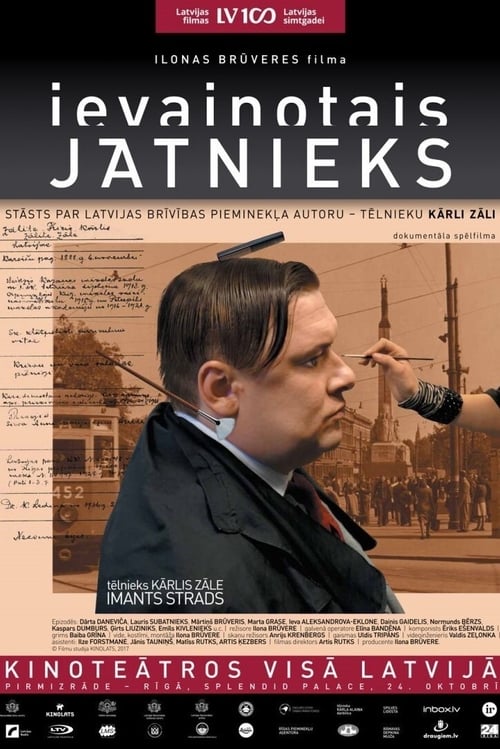
The Wounded Rider
2017 · Ilona Brūvere
For a thoughtful evening when you want history and art rather than plot — the kind of documentary you put on when a museum visit isn't available. A contemplative watch, not a gripping one.
What it's about
A documentary portrait of Kārlis Zāle, the sculptor behind Latvia's two defining monuments: Riga's Freedom Monument, with its copper Liberty holding three stars aloft, and the solemn Brothers' Cemetery for the nation's war dead. His life runs through the century's upheavals — revolutionary Petrograd, avant-garde Berlin, then the return home to carve a brand-new state's self-image in stone and bronze.
The experience
Measured and stately, mixing archive with staged dramatic passages — less a lecture than a slow walk around a monument, asking what it means. It rewards patience with a genuine sense of how art and nationhood get fused.
The craft
Ilona Brūvere, one of Latvian documentary's established figures, works in her favored docudrama mode, weaving archival material with reenacted scenes to animate a man whose art was public in the most literal sense. The monuments themselves — filmed in scale and detail — are the visual payoff.
Why it matters
Made as Latvia approached its centenary, it doubles as a national self-portrait — a meditation on how monuments carry a country's memory across occupation and independence.
Ilona Brūvere's documentary portrait of Kārlis Zāle, the sculptor who gave Latvia its two defining monuments: Riga's Freedom Monument, the copper figure of Liberty holding three stars aloft, and the solemn ensemble of the Brothers' Cemetery for the nation's war dead. Zāle's biography runs through the great upheavals of the early twentieth century — training amid revolutionary Petrograd, a formative spell in avant-garde Berlin, then the return home to build, in stone and bronze, the self-image of a state that had only just come into being. Brūvere, one of Latvian documentary's established figures, works in the docudrama mode she favors, weaving archival material with staged passages to animate a man whose art was public in the most literal sense. Made as Latvia approached its centenary, the film doubles as a meditation on how monuments outlive their makers and their regimes: the Freedom Monument stood through half a century of Soviet rule, officially disdained, quietly revered, and waiting — flowers laid at its base becoming, by the late 1980s, acts of defiance.
Reception
How The Wounded Rider was received, from release to now →
Influences: the films it descends from and the films it influenced
- October (Ten Days That Shook the World) (1928) — Its intellectual montage — famously dismantling the Tsar's statue shot-by-shot to make a monument into a political argument — is the direct template for reading a public sculpture as ideology through editing.
- The Fall of the Romanov Dynasty (1927) — Founded the archival-compilation film, recutting salvaged newsreel and found footage into historical argument — the exact archival-montage method the seed builds on.
- Man with a Movie Camera (1929) — Its constructivist kino-eye montage and self-reflexive avant-garde cutting model the formal montage vocabulary the film inherits from revolutionary-era cinema.
- Statues Also Die (1953) — Essay-film interrogation of what sculpture means once severed from living context — the monuments-and-memory essay method, camera reanimating static art into political discourse.
- Night and Fog (1955) — Its grammar of present-day tracking shots across a memorial site intercut with archival material — color-present versus archival-past — is the montage structure for filming a site of memory.
- Guernica (1950) — A whole film built around a single public artwork, with the camera moving through a static art object to generate political narrative — the biographical-portrait-of-an-artwork device.
- 235,000,000 (1967) — Founding work of the Riga poetic-documentary school, using orchestrated monumental montage that establishes the national Latvian documentary idiom the seed writes within.
- Culloden (1964) — Pioneered docudrama reenactment staged as if live reportage — the staged historical-reconstruction technique underlying the seed's docudrama passages.
- Berlin: Symphony of a Great City (1927) — Its rhythmic avant-garde city-symphony montage established the associative editing tradition the seed's archival-montage inherits.
- Ten Minutes Older (1978) — Exemplar of the Latvian poetic-documentary observational method — sustained, meaning-laden framing — shared as authorship/latvian-documentary lineage.
- Is It Easy to Be Young? (1986) — Late-Soviet Latvian documentary that confronts occupation and national identity head-on, extending the same politically charged Latvian nonfiction craft.
- The Missing Picture (2013) — Reconstructs national trauma where the archive fails, via staged figures fused with found footage — the same docudrama-plus-archive approach to memory the seed uses.
- Nostalgia for the Light (2010) — Essay-documentary binding landscape and monument to a nation's memory of state repression, extending the monuments-and-memory essay form.
- The Event (2015) — Reconstructs a pivotal political moment from pure archival footage without narration — a rigorous extension of the archival-montage reconstruction craft.
- The Maelstrom (1997) — Assembles private found film into a national-historical portrait through archival montage — the same found-footage-as-history technique applied to memory.
- Crossroad Street (1988) — Continues the Latvian documentary school's method of reading national identity through a specific place, sibling craft to the seed's monument-as-nation focus.
Similar films
- Man with a Movie Camera (1929) — influence & lineage
- The Rider (2018) — shared sensibility
- Our Land (2026) — shared sensibility
- De Gaulle: Liberté (2026) — shared sensibility
- A Taxi Driver (2017) — shared sensibility
- Vagabond (1985) — shared sensibility
- The Cycle of Love (2026) — shared sensibility
- Afternoons of Solitude (2025) — shared sensibility