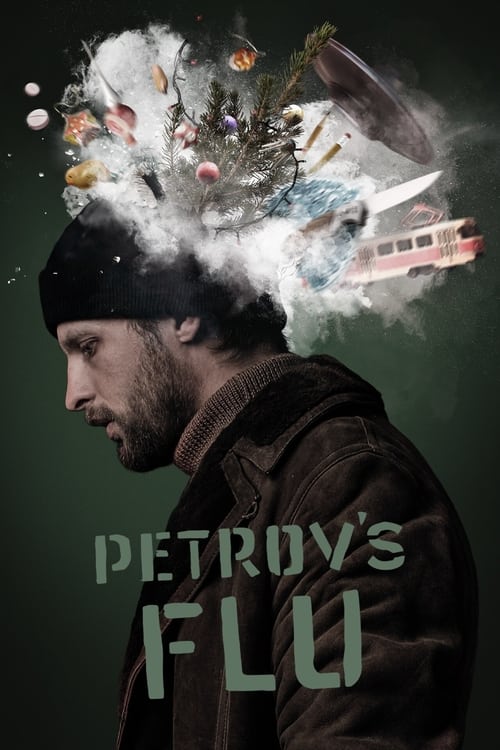
Petrov's Flu
2021 · Kirill Serebrennikov
For when you want to be swept up rather than told a story — a late-night plunge for adventurous viewers, not a tidy comfort watch.
What it's about
A garage mechanic who draws comic books on the side staggers through one flu-ridden winter night in provincial Russia, dragged from bus to party to hearse by his loose-cannon friend Igor. As his fever climbs, fantasy, memory and Soviet-era childhood bleed into the present — and his librarian wife and young son turn out to be running fevers, and secret lives, of their own. It's a family portrait dissolved in delirium.
The experience
Feverish is the literal word: long unbroken takes sweep you through crowds and decades without ever letting you get your footing. Rowdy, grimy, sometimes very funny and sometimes tender — disorienting by design, hypnotic if you surrender to it.
Performances
Chulpan Khamatova is quietly ferocious as Petrov's wife, a mild-mannered librarian with a violent imagination — the film's most startling running joke and its saddest thread.
The craft
Serebrennikov and cinematographer Vladislav Opelyants stage whole sequences as roaming single takes that slip between reality and hallucination mid-shot, shifting palette and period without a visible seam. The dense sound of coughing buses, parties and snow makes the fever tactile — this one rewards a big screen and good speakers.
Why it matters
It premiered in competition at Cannes in 2021 while its director was barred from leaving Russia, which made the film a statement about artistic freedom as much as a novel adaptation; it stands among the most formally ambitious Russian films of its era.
Snapshot
Petrov's Flu (Russian: Петровы в гриппе, more literally The Petrovs In and Around the Flu) is Kirill Serebrennikov's fevered adaptation of Alexey Salnikov's acclaimed 2016 novel, a hallucinatory descent through a single influenza-wracked night in provincial post-Soviet Russia. Petrov, a garage mechanic and amateur comic-book artist, drifts through Yekaterinburg in a delirium, ferried between buses, apartments, a hearse, and the recesses of memory by his mercurial friend Igor, while the membrane separating waking life from fantasy, present from Soviet past, and the living from the dead dissolves entirely. Premiering in competition for the Palme d'Or at Cannes in July 2021 — where its director, barred from leaving Russia, was conspicuously absent — the film stands as one of the most formally ambitious Russian features of its decade: a maximalist, virtuosic, deliberately disorienting object that treats illness as both literal affliction and a metaphor for a nation feverish with unprocessed nostalgia.
Industry & production
The film was produced by Ilya Stewart's Hype Film, the Moscow-based outfit behind Serebrennikov's The Student (2016) and Leto (2018), in an international co-production structure that drew in French, Swiss, and German partners — a financing model that had become essential for arthouse Russian cinema seeking festival distribution and reflected Serebrennikov's status as a director of greater standing abroad than at home with the authorities. Charades handled international sales.
The production cannot be separated from its director's legal situation. Serebrennikov, artistic director of Moscow's Gogol Center and one of Russia's most prominent stage and screen directors, had been ensnared since 2017 in the "Seventh Studio" embezzlement case, widely understood by observers as politically motivated retaliation against a dissident artist. By the time Petrov's Flu was shot, his house arrest had been lifted, but a travel ban remained in force. He therefore could not attend the Cannes premiere of his own competition film — addressing the audience remotely — a circumstance that lent the work's atmosphere of confinement, paranoia, and stifled circulation an unmistakable real-world resonance. The film opened in Russia in September 2021.
Technology
Petrov's Flu was shot digitally by Vladislav Opelyants, whose camerawork required the kind of flexible, mobile capture that digital acquisition and modern stabilization rigs afford — extended Steadicam and crane-assisted moves through cramped trams and apartment interiors. The film's most conspicuous technological gesture is its manipulation of the image's texture and shape: the contemporary scenes are rendered in a desaturated, sickly palette, while the central flashback to a 1977 New Year's children's party is given a distinct, boxier, period-coded look, the format itself shifting to evoke Soviet-era film stock and home-movie memory. This kind of in-camera-feeling temporal coding, achieved through aspect-ratio and color-grade strategy, is a digital-era affordance deployed for distinctly analog nostalgia. The technical achievement was recognized at Cannes with the Vulcain Prize (the CST Artist–Technician award) going to Opelyants.
Technique
Cinematography
Opelyants's photography is the film's signal achievement and the engine of its meaning. The defining technique is the elaborate long take: roving, unbroken shots that follow characters out of one space and into another, gliding from a crowded bus into a fantasy of mass shooting and back, threading through doorways, down stairwells, and across thresholds of reality without the editorial cut that would normally signal such a shift. By denying the audience the conventional grammatical marker of transition, the camera makes hallucination and reality continuous and indistinguishable — the spectator, like Petrov, loses the ability to locate where the real ends. The palette is jaundiced and overcast, all wet asphalt, fluorescent interiors, and the bruised gray of a Russian winter, against which the eruptions of fantasy (a sleek black hearse, the white-and-silver of the Snow Maiden) flare with heightened color.
Editing
Where the long takes hold, the film's larger architecture is a feat of construction that braids multiple time frames and points of view — Petrov's, his estranged wife Petrova's, their son's, and a long retrospective strand reaching back to the Soviet 1970s — into a single delirious continuum. The cutting strategy withholds orientation deliberately, allowing sequences to reveal only belatedly whether what we have watched was lived, imagined, or remembered. (The specific editor's credit is not something I can verify with confidence here, and I won't attribute it.) The governing logic is associative rather than causal: the film moves the way a fever moves, by drift, recurrence, and sudden lucid intervals.
Mise-en-scène / staging
Serebrennikov's background in theater is everywhere legible in the staging. Interiors are dense with the bric-a-brac of late- and post-Soviet domestic life; crowds are choreographed through space with the precision of a stage director blocking an ensemble. The set pieces — a politicized rant in a bus that tips into a firing-squad fantasy, the recurring motif of the New Year's yolka (fir-tree) party with its costumed Father Frost and Snow Maiden, the hearse interior — are conceived as discrete theatrical tableaux that the mobile camera stitches together. The contemporary world is rendered grimy and overstuffed; the remembered Soviet party is staged with an aching, idealized clarity.
Sound
The soundscape is layered and immersive, moving between the diegetic clamor of public transport and apartment life and the muffled, subjective acoustics of a sick man's perception. The score is credited in part to Aidar Salakhov, who also appears within the film as an accordion player — a characteristic Serebrennikov gesture folding a collaborator into the diegesis. The music and sound design support the film's oscillation between gritty realism and the heightened, dreamlike register of its fantasy sequences.
Performance
The ensemble sustains a difficult tonal register — earnest, deadpan, and surreal at once. Semyon Serzin anchors the film as the passive, perpetually unwell Petrov, a man more carried than acting. Chulpan Khamatova is its most striking presence as Petrova, the mild librarian whose interior life harbors lurid fantasies of bloody vengeance, a performance that pivots from drab realism to genre violence and back. Yuri Kolokolnikov plays Igor, the trickster-psychopomp who guides Petrov across the boundary of the living and the dead; Ivan Dorn appears as the writer Sergey; and Yulia Peresild embodies Marina, the Snow Maiden of the 1977 party whose famously cold hand becomes one of the film's most haunting motifs.
Narrative & dramatic mode
The film operates in a subjective, unreliable, stream-of-consciousness mode in which delirium is the organizing principle rather than an episode within an otherwise stable story. There is a loose armature — a flu sweeping through the Petrov family on the eve of the New Year — but the narrative repeatedly slips its moorings into fantasy, flashback, and embedded stories, including a substantial movement that decouples from Petrov to follow Petrova and then reaches decades back to the Soviet childhood party. The dramatic engine is not plot but the gradual revelation of how these strata connect, culminating in the recognition that threads we took for unrelated hallucination are in fact bound by memory and a chain of cold hands across time. It is a structure that rewards retrospective reassembly and resists the single linear reading.
Genre & cycle
Petrov's Flu is aggressively hybrid, braiding social-realist observation of provincial Russian life with science fiction, black comedy, horror, and magical realism. Its TMDB-level billing as "Drama, Science Fiction, Comedy" undersells the promiscuity of its mode-mixing: a revenge fantasy plays as giallo-tinged horror, the figure of Igor belongs to folkloric psychopomp myth, and a UFO/alien strand surfaces from the comic-book imagination of its protagonist. The film belongs to a contemporary art-cinema cycle of fever-dream, reality-bending features, and within Russian cinema to a lineage of the fantastical-grotesque applied to everyday post-Soviet malaise.
Authorship & method
The film is comprehensively a Serebrennikov work: he directed and wrote the adaptation himself, reshaping Salnikov's interiorized, digressive novel into an audiovisual delirium. His method here fuses his theatrical sensibility — ensemble choreography, tableau staging, performance pitched between naturalism and stylization — with a cinema of the bravura long take. The decisive collaboration is with cinematographer Vladislav Opelyants, his regular director of photography (The Student, Leto), whose unbroken mobile shots are the formal embodiment of the script's reality-dissolving ambitions and who was honored at Cannes for the work. Composer Aidar Salakhov contributed to the score and appears onscreen. Producer Ilya Stewart of Hype Film completes the core creative axis that has shaped Serebrennikov's recent international features. The editing and certain technical credits I am unable to attribute with confidence and have therefore left unstated rather than risk error.
Movement / national cinema
The film sits within contemporary Russian auteur cinema's festival wing — the strand, exportable to Cannes, Venice, and Berlin, that includes figures such as Andrey Zvyagintsev — and within Serebrennikov's particular position as an internationally celebrated dissident artist working under state pressure at home. Its co-production financing reflects the structural reality that this kind of ambitious, politically uncongenial Russian filmmaking increasingly depends on European partners. Aesthetically it draws on a deep Russian and Soviet tradition of the literary-fantastical and the grotesque, channeling a Gogolian and Bulgakovian impulse — the everyday made uncanny, the devil loose in the city — into a thoroughly contemporary idiom.
Era / period
Released in 2021, Petrov's Flu is doubly a product of its moment. Made and premiered during the COVID-19 pandemic, its central conceit of a contagious, consciousness-altering illness sweeping through a population acquired an unintended topicality, though the novel predates the pandemic and the film's flu is finally more metaphor than epidemiology. It is equally a film about the longue durée of the post-Soviet condition three decades on — the unhealed rupture of 1991, the persistence of Soviet structures of feeling in private memory, and the way an idealized socialist childhood (the 1977 party) continues to haunt a disenchanted present. The sickness is national and historical as much as bodily.
Themes
At its core the film treats illness as the master metaphor: the flu is the porous, lowered state in which the boundaries that ordinarily organize experience — sanity and delusion, life and death, now and then — give way. Memory and nostalgia form the second great theme, crystallized in the recurring New Year's yolka and the Snow Maiden, emblems of a Soviet childhood remembered as warmth even as its central touch is deathly cold. The film probes the persistence of violence beneath placid surfaces (Petrova's fantasies), the entrapment and stasis of provincial life, and art and imagination as both escape and symptom — Petrov's comics leak into the world around him. Underlying everything is a diagnosis of a society feverish with its own unresolved past.
Reception, canon & influence
Petrov's Flu divided critics in a way characteristic of maximalist, deliberately exhausting cinema: widely admired for the audacity and technical command of its long takes and its formal control of a near-unfilmable novel, it was also faulted by some for sensory overload and emotional opacity. Its Cannes competition slot confirmed Serebrennikov's standing among the festival's recurring auteurs, and the Vulcain Prize for Opelyants's cinematography gave the production its principal laurel; the premiere's narrative was inevitably shaped by the director's enforced absence, which framed the film's reception within the larger story of artistic freedom in Russia.
Looking backward, the film's influences are legible: the source novel by Alexey Salnikov; the Russian literary tradition of the fantastical-grotesque (Gogol, Bulgakov); Serebrennikov's own theatrical practice; and a broader art-cinema vocabulary of the virtuoso long take and the subjective fever-dream. Looking forward, its longer legacy is still settling — and it would be premature to over-claim a body of work demonstrably shaped by it. Its more immediate significance lies in consolidating Serebrennikov's international auteur profile ahead of his subsequent festival features and in standing as a benchmark for the ambition of which contemporary Russian art cinema remains capable, even — especially — under duress.
A Deleuzian reading
Start with the hand.
The full Deleuzian reading of Petrov's Flu →
Reception
It divided Cannes 2021 — hailed as exhilarating by some, exhausting by others — but its stock has quietly risen since, now often read as a prescient fever-portrait of Russian malaise from a director who left the country the following year.
How Petrov's Flu was received, from release to now →
Influences: the films it descends from and the films it influenced
- Mirror (1975) — Its associative editing dissolves memory, dream, newsreel and present into a single subjective fever-logic — the structural template for Petrov's nonlinear, unreliable interiority.
- Khrustalyov, My Car! (1998) — Delirious deep-focus long takes careen through overcrowded Soviet interiors, a grotesque tactile chaos that Opelyants's roving mobile camera directly inherits.
- Hard to Be a God (2013) — The camera is shoved through teeming, filth-caked bodies in unbroken takes, modeling the immersive grotesque mise-en-scène Serebrennikov pushes into delirium.
- Come and See (1985) — Steadicam subjectivity converts bodily/sensory derangement into a hallucinatory first-person assault — the precedent for filming illness from inside the fevered nervous system.
- 8½ (1963) — Fever-dream fusion of memory, fantasy and waking reality staged as theatrical procession, the grammar of magical-realist slippage Petrov's Flu runs on.
- Werckmeister Harmonies (2000) — Choreographed virtuoso long takes in desaturated monochrome treat the camera as a drifting consciousness moving through a town's collective unease.
- The Color of Pomegranates (1969) — Frontal, emblematic theatrical tableaux — figures arranged as living stage pictures — feed Serebrennikov's tableau staging drawn from his own theater practice.
- Red Psalm (1972) — Continuous choreographed mobile long takes orchestrate ensembles flowing in and out of frame, the precedent for Petrov's roving long-take crowd ballets.
- Leto (2018) — Same DP Vladislav Opelyants and the same method — mobile long takes that rupture into magical-realist fantasy interludes — directly precede and prefigure Petrov's Flu.
- Suspiria (1977) — Giallo-horror's irrational, supernaturally-charged set-pieces supply the genre grammar behind Petrov's eruptions of fevered horror logic.
- Russian Ark (2002) — A single unbroken Steadicam take collapsing historical time, the Russian-auteur benchmark for the long take as a temporal-dissolution device.
- Birdman (2014) — Builds the illusion of one continuous take fused to theatrical performance, sharing Petrov's bravura long-take-as-stagecraft ambition.
- Children of Men (2006) — Lubezki's immersive bravura long takes plunge the camera through chaotic action, the contemporary touchstone for the choreographed unbroken shot Opelyants extends.
- Enter the Void (2009) — A first-person floating camera renders a drug/death trip as continuous hallucinatory fever-dream, paralleling Petrov's subjective reality-dissolution.
- Holy Motors (2012) — An episodic urban fever-dream of shapeshifting performance and deadpan magical realism, structurally akin to Petrov's associative procession of registers.
- Songs from the Second Floor (2000) — Deadpan-surreal staging in static theatrical tableaux, the deadpan tableau pole of the same staging vocabulary Serebrennikov mobilizes.
- The Grand Budapest Hotel (2014) — Uses discrete aspect-ratio shifts to code distinct time periods, the same temporal-coding-by-format device that organizes Petrov's flu eras.
- Beanpole (2019) — Contemporary post-Soviet art cinema turning illness and trauma into expressive, color-coded mise-en-scène — the same scene Serebrennikov consolidates internationally.
Similar films
- Russian Ark (2002) — influence & lineage
- Beanpole (2019) — influence & lineage
- Come and See (1985) — influence & lineage
- Mirror (1975) — influence & lineage
- Shadows of Forgotten Ancestors (1965) — shared sensibility
- The Cranes Are Flying (1957) — shared sensibility
- Dry Leaf (2026) — shared sensibility
- Nostalgia (1983) — shared sensibility