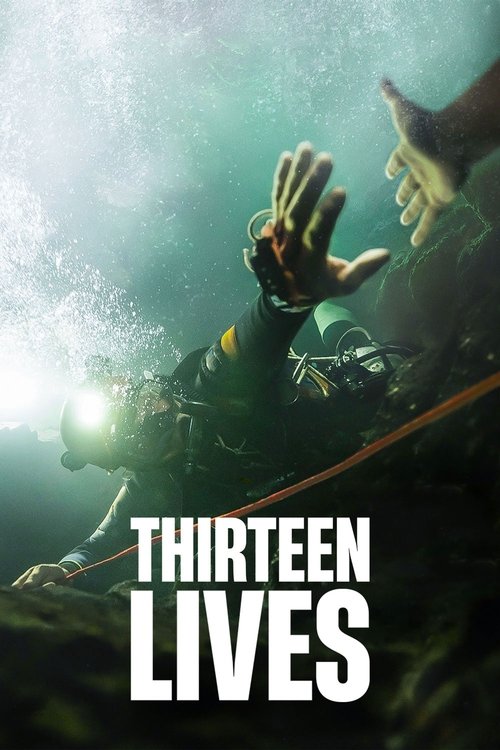
Thirteen Lives
2022 · Ron Howard
For when you want to be gripped without being manipulated — a true-story thriller that leaves you moved and a little awed by ordinary competence. Tense but ultimately warm; safe to watch with almost anyone.
What it's about
In 2018, twelve boys and their soccer coach walk into a Thai cave and a sudden monsoon seals them miles inside behind flooded tunnels. What follows is the true story of the rescue attempt: Thai Navy SEALs, thousands of volunteers, and a handful of middle-aged hobbyist cave divers from Britain who turn out to be the only people on earth capable of reaching them — and who must then confront a plan that sounds like madness.
The experience
Quietly, cumulatively nail-biting. Even knowing the outcome, the underwater passages are so claustrophobic and patiently filmed that you catch yourself holding your breath; the tension comes from process, not melodrama.
Performances
Viggo Mortensen and Colin Farrell underplay beautifully as the two British divers — prickly, practical men whose heroism is expressed entirely through craft and doubt rather than speeches.
The craft
Ron Howard shoots the dives in tight, murky, disorienting close quarters — the actors trained to do much of the diving themselves — and the sound of regulators, current, and scraping rock does most of the scaring. It's one of his most restrained films: a procedural that trusts the engineering and the geography to carry the drama, and it genuinely benefits from good speakers.
Why it matters
Among the several tellings of the Tham Luang rescue, it stands out for its rigor and for giving real weight to the Thai side of the operation, marking a late-career high point for Howard's craftsmanship.
Snapshot
A procedural survival drama reconstructing the 2018 Tham Luang cave rescue in northern Thailand, in which twelve boys and their football coach were trapped for eighteen days in a flooded limestone cave system, and ultimately extracted by a multinational team of volunteer cave divers using an unprecedented and ethically fraught method of unconscious underwater transport. Ron Howard's film prioritizes engineering process, collective expertise, and moral weight over conventional disaster-movie catharsis. Released directly to Amazon Prime Video in August 2022, it is among the most restrained and technically rigorous films of Howard's career — a procedural closer in spirit to Apollo 13 than to The Perfect Storm, and unusual among mainstream American productions for its genuine attention to the host nation's perspective, geography, and culture.
Industry & production
Thirteen Lives was produced by MGM and Amazon Studios, with Working Title Films and Imagine Entertainment (Howard's long-standing production company) as production entities. The script was developed by William Nicholson, a British dramatist whose filmography — Shadowlands (1993), Gladiator (2000), Everest (2015) — shows a recurring interest in endurance and moral reckoning under extreme physical duress. Amazon's involvement reflects the streaming era's appetite for prestige event films that would historically have sought theatrical distribution: the production budget was substantial (reported to be in the range of tens of millions of dollars, though precise figures are not confirmed in public studio reporting), and the casting — Viggo Mortensen, Colin Farrell, Joel Edgerton — is commensurate with theatrical A-list production.
Physically, the production split between Thailand and Queensland, Australia. Access to the actual Tham Luang Nang Non cave was limited, but the production team — with production designer Molly Hughes — constructed elaborate replica cave systems and flooded tank environments in Queensland, enabling the controlled underwater photography that is central to the film's texture. Some above-water sequences were shot on location in Chiang Rai Province. This hybrid approach, combining real topography with purpose-built practical sets, is typical of high-budget location drama that requires both authenticity and safety management.
The film arrived in the same cultural space as several prior treatments of the rescue: the Thai-produced drama The Cave (2019), the National Geographic documentary The Rescue (2021, directed by Elizabeth Chai Vasarhelyi and Jimmy Chin, which won the Academy Award for Best Documentary Feature), and various television news reconstructions. Howard's version was thus neither the first nor the definitive account; it occupied a distinct tonal register — more sober and procedural than the Thai drama, more conventionally narrative than the documentary.
Technology
The film's principal technological challenge was underwater photography in conditions simulating flooded cave passages: narrow, silted, near-zero visibility. Sayombhu Mukdeeprom, the cinematographer, worked with specialist underwater camera operators and lighting technicians to achieve footage that conveys claustrophobia and disorientation without entirely sacrificing spatial legibility for the audience. The camera systems used in the underwater sequences combined purpose-built housing rigs with available-light approaches augmented by very low wattage practical light sources — reproducing the experience of divers navigating by handheld torches and helmet-mounted lights.
The production largely avoided digital compositing for the cave interiors, preferring practical tank builds and genuine submersion. This restraint distinguishes the film from the VFX-heavy language of contemporary disaster cinema and is philosophically consistent with the story's emphasis on unglamorous, tactile expertise. Sound design and post-production mixing (discussed below) were equally central to the film's technical identity. The film was shot digitally; Mukdeeprom's work does not attempt a documentary grain or verité texture but pursues a muted, naturalistic palette.
Technique
Cinematography
Sayombhu Mukdeeprom brings to Thirteen Lives a sensibility formed far from Hollywood conventions. His primary body of work is with Thai director Apichatpong Weerasethakul — Syndromes and a Century (2006), Uncle Boonmee Who Can Recall His Past Lives (2010), Cemetery of Splendor (2015) — films known for their contemplative duration, ambient spatial awareness, and refusal of melodramatic emphasis. He also shot Luca Guadagnino's Call Me by Your Name (2017), bringing a comparable stillness and sensory attention to a very different register of drama. His work on Thirteen Lives is notably quieter than the visual language of most Howard productions: there is a preference for wider angles that embed characters in physical space, modest camera movement, and a refusal to aestheticize peril through slow motion or canted framing.
In the underwater sequences, Mukdeeprom works with the fundamental inhospitality of the environment — the silt-clouded water, the oppressive rock, the unreliable light — rather than against it. The effect is that the cave feels genuinely unknowable, and the viewer's spatial disorientation tracks the experience of the divers themselves. Above ground, the cinematography is similarly unflashy: the monsoon rains, the hillside operations, the tent cities of the rescue infrastructure are presented with the matter-of-fact precision of photojournalism rather than the saturated drama of disaster cinema.
Editing
The film's editing structure — credited to work that balances three narrative strands (the boys inside the cave, the British lead divers, and the broader rescue coordination) — manages temporal compression without the frantic cross-cutting that marks most survival thrillers. The editing rhythm is closer to Captain Phillips (2013) than to Dunkirk (2017): procedural, cumulative, and patient. Extended sequences are allowed to run long enough for procedural detail to register, communicating that the rescue operation was, above all, a problem of engineering, hydrology, and endurance rather than of heroic individual action.
Mise-en-scène / staging
Howard's staging choices consistently de-emphasise individual triumph. Scenes of technical planning — the divers rehearsing the unconscious-transport method with weighted mannequins, hydrologists measuring water flow, engineers building pump systems — are given the same narrative weight as scenes of emotional confrontation. The rescue camp above the cave is staged as a small city of expertise: bureaucratic negotiation, equipment logistics, monsoon management, Thai Army coordination, and the Buddhist prayer ceremonies maintained by the local community are all present and treated as equally real elements of the historical situation.
The film's most consequential staging decision concerns the ethical scene in which Dr. Richard Harris (Joel Edgerton) is asked to administer ketamine anesthetic to each child individually and then supervise as unconscious bodies are passed through flooded passages by divers — a procedure with no precedent and real mortality risk. Howard stages this without score, with close attention to procedural detail, and without resolving the ethical ambiguity through reassuring outcome announcement. The sequence is uncomfortable in the way that factual reconstruction should be uncomfortable.
Sound
The sound design is the film's most consistently distinguished technical achievement. In the underwater sequences, diegetic sound is radically stripped: breathing apparatus, the muffled percussion of water, the knock of rock against cylinder — these are foregrounded while ambient score recedes or disappears entirely. The effect is one of radical physical particularity: each underwater passage sounds different, and the listener understands subliminally that sound is information in cave diving. Above ground, the sound palette expands — rain becomes a constant, ominous presence; the acoustic contrast between the monsoon-saturated exterior and the dry, echoing cave interior registers as its own kind of dramaturgy.
The musical score — composed by Benjamin Wallfisch, whose prior work includes It (2017) and Blade Runner 2049 (2017, with Hans Zimmer) — is applied with unusual restraint for mainstream American drama. Wallfisch largely avoids the swelling orchestral passages that conventionally signal emotional release in the survival genre; where music enters, it tends to be spare and tonal, closer to ambient sound design than to traditional underscore.
Performance
The three central performances are notably pitched against the tendency of true-story films to turn their subjects into icons. Viggo Mortensen as Rick Stanton plays Britain's most experienced cave diver as introverted, technically obsessive, and socially awkward — a man whose gift for cave diving seems inseparable from a personality shaped by solitude. Colin Farrell's John Volanthen is warmer but equally characterized by practical focus rather than emotional display. Joel Edgerton's Richard Harris carries the film's most explicit moral burden — the possibility that a child he sedates will die underwater — and Edgerton plays it in the mode of professional dissociation, which is more psychologically accurate and more disturbing than conventional dramatic anguish.
The Thai cast — including Teeradon Supapunpinyo as a Navy SEAL and Weir Sukollawat as the Thai rescue coordinator — are given substantially more screen time and interiority than is typical for American productions set in foreign countries. This is consistent with the film's broader refusal of a purely Western heroic frame, though some critics noted that the boys themselves and their coach remain somewhat underdeveloped as individuals.
Narrative & dramatic mode
Thirteen Lives is structured as a procedural, not a melodrama. The classical disaster-film template — escalating crisis, individual protagonist, cathartic resolution — is present only in skeletal form. Howard and Nicholson's central gamble is that process itself can be dramatic: that watching experts identify a problem, construct hypotheses, test approaches, fail, revise, and try again is more compelling than conventional character arc. The film succeeds unevenly at this. The procedural sequences — particularly those involving water-pump engineering and the ketamine protocol — are genuinely gripping. The more conventionally dramatic scenes, including some material involving the boys' families, occasionally slide toward the emotional shorthand the rest of the film resists.
The film's narrative mode is also shaped by a fundamental ethical tension that goes mostly unspoken: the rescue was not inevitable. The method devised — unconscious children, passed hand-to-hand through flooded tunnels by divers — had a non-trivial probability of killing some or all of the children. The film is aware of this, and its refusal to present the successful outcome as the inevitable validation of the method's correctness is one of its more mature structural choices.
Genre & cycle
Thirteen Lives belongs to the procedural disaster film, a subgenre that experienced a significant revival in the 2010s: Captain Phillips (2013), The Martian (2015), Sully (2016), Dunkirk (2017), Deepwater Horizon (2016), Everest (2015). These films share a preference for technical authenticity, ensemble or collaborative heroism, and the dramatic grammar of competence under pressure. They are descendants of the 1970s disaster cycle (The Poseidon Adventure, The Towering Inferno) but have largely abandoned that cycle's melodramatic irony and star-studded social cross-sections in favour of procedural realism.
Howard's film also participates in a smaller cycle of films specifically about collective institutional heroism rather than individual action — a strain that includes Apollo 13 and, at the art-film end, Hirokazu Kore-eda's social ensemble work. The film's emphasis on the Thai state's coordination effort, the volunteer international expert community, and the Buddhist community's spiritual sustenance of the rescue distinguishes it from films that locate heroism in a single figure.
Authorship & method
Ron Howard occupies a distinctive position in American cinema: a director of consistent technical professionalism and humanist storytelling who has largely been excluded from auteurist canons precisely because his sensibility is absorptive and facilitative rather than assertive. His career — from Splash (1984) and Cocoon (1985) through Apollo 13 (1995), A Beautiful Mind (2001), Cinderella Man (2005), Frost/Nixon (2008), and Rush (2013) — shows a strong and persistent attraction to true stories of extraordinary competence and collective human effort, usually told in classical continuity style with unusually careful research and technical grounding. Thirteen Lives fits this pattern precisely: it is the film a director with Howard's values and methods was perhaps most well suited to make.
The collaboration with Sayombhu Mukdeeprom is the most significant single departure from Howard's usual working relationships and the most visible aesthetic surprise of the production. Mukdeeprom's background in slow cinema and his established relationship with Thai space and light bring a textural quality that Howard's previous cinematographic partnerships — with Salvatore Totino on several recent films — would not have generated. This is a case of a director making a choice that productively challenges his own defaults.
William Nicholson's screenplay is functional and well-researched. His tendency toward clean exposition and moral directness serves the procedural structure well, though the script occasionally reverts to expository dialogue where a more elliptical approach might have trusted the audience further.
Movement / national cinema
Thirteen Lives is an American-produced film about a Thai event, helmed by an American director, with British and Australian protagonists — a configuration that makes any straightforward national cinema categorization impossible. It is most accurately understood as a product of globalized Hollywood production, which increasingly finances films that are simultaneously American in their commercial structure and transnational in their subject matter and location.
The choice of Sayombhu Mukdeeprom as cinematographer is an act of meaningful cultural specificity: a Thai artist photographing a Thai landscape, even in service of a story whose foreground protagonists are largely European. His presence arguably inflects the film's relationship to the Thai natural world — the cave system, the monsoon, the agricultural landscape of Chiang Rai — with a sensory attentiveness that a cinematographer without his particular formation might not have achieved. Whether this constitutes a form of cultural collaboration or a form of aesthetic appropriation is a question the film raises without fully resolving.
Era / period
The film was made and released in the early 2020s, a period defined by the consolidation of streaming as the dominant distribution model for prestige drama. Amazon's decision to release Thirteen Lives without a wide theatrical run — unusual for a film of its budget and cast — reflects the streaming economy's willingness to absorb productions that might previously have sought and received theatrical distribution. The film arrived in a post-pandemic exhibition environment in which the theatrical proposition for non-franchise drama had been significantly weakened.
The film also participates in the early-2020s moment's interest in collective competence and institutional response — themes with obvious resonance against the backdrop of the COVID-19 pandemic, climate crisis, and a broader cultural reckoning with the limits of individual agency. Whether this context shaped the production or merely shaped its reception is difficult to establish, since the project was developed from 2018 onward; but the film's implicit argument that expertise, coordination, and willingness to cede individual authority are what save lives found a particular resonance in its historical moment.
Themes
The film's governing theme is the nature of expertise: what it means, how it is accumulated, and what it demands socially and personally of those who possess it. Stanton and Volanthen are introduced as men whose gift is also their isolation — they can do what no one else can precisely because they have spent their lives in a kind of monastic devotion to cave diving, which is not a pursuit that accommodates ordinary sociability. The film treats this not as tragedy but as a form of vocation, and it finds in the rescue the moment where a life of apparently solitary obscure practice suddenly intersects with a desperate public need.
A second theme is collective action against bureaucratic and political resistance. The rescue required the Thai government's willingness to authorize an unprecedented procedure, to accept international help without national embarrassment, and to cede operational control to a group of foreign volunteers without official credentials. The film presents this as genuinely difficult and genuinely achieved — a diplomatic and political accomplishment as real as the diving feat.
The film is also, obliquely, about the ethics of risk on behalf of others. The ketamine protocol was not the divers' risk to take; it was imposed on children who could not consent. The film holds this discomfort open rather than resolving it through outcome, which is one of its most honest moves.
Reception, canon & influence
Critical reception was broadly positive, with particular attention to the film's procedural restraint, the underwater cinematography, and the performances of Mortensen, Farrell, and Edgerton. Several critics noted the film's unusual willingness to distribute heroism across nationalities and institutions rather than concentrating it in a single protagonist. Some criticism addressed the relatively thin characterization of the Thai figures and the boys themselves, a structural constraint that reflects both the screenplay's Anglo-Australian focus and the more general difficulty of representing an event whose human center — the children — was by definition inaccessible to the rescue team during most of its duration.
The film's streaming release complicated its canonical positioning: without theatrical rollout or awards-season campaign positioning, it received less concentrated critical attention than its production values and ambition might otherwise have generated. It was not a significant awards presence, which is common for streaming-first releases of this period regardless of quality.
Influences on the film (backward): Howard's own Apollo 13 is the most direct precursor — the ensemble procedural about a crisis managed by collective technical intelligence, with an emphasis on the operations room as much as the vehicle. Das Boot (1981) and its tradition of claustrophobic underwater duration establish a precedent for taking confined aquatic space seriously as a site of psychological and physical drama. The Wages of Fear (1953) provides a model for the ethical weight of dangerous missions undertaken by ordinary professionals. The documentary The Rescue (2021) preceded the fiction film and established some of the archival imagery and interview testimony that shaped the production's understanding of events.
Legacy and influence (forward): It is too early, as of this writing, to assess the film's long-term influence with confidence. It has not demonstrably generated a wave of imitation or significantly altered the conventions of the procedural survival genre. Its most durable contribution may be the demonstration — alongside The Rescue — that the Tham Luang story is sufficiently rich in procedural and ethical complexity to sustain multiple serious treatments. The casting of a Thai cinematographer of international standing on an American production about a Thai event may also, modestly, contribute to ongoing conversations about multicultural production practice in globalized Hollywood. Whether Thirteen Lives eventually enters the canon of significant procedural drama, alongside Apollo 13 and Captain Phillips, will likely depend on critical reassessment rather than initial reception — a common pattern for competent, unshowy work that resists easy celebration.
A Deleuzian reading
A torch beam pushes into silt-clouded water and finds nothing — not a wall, not a boy, not the next ten feet of passage.
The full Deleuzian reading of Thirteen Lives →
Reception
Quietly rerouted from a planned theatrical release to Prime Video by Amazon in 2022, it earned respectful reviews but little noise; since then it's steadily picked up a reputation as underrated late-period Ron Howard — the 'this was way better than I expected' streaming discovery.
How Thirteen Lives was received, from release to now →
Influences: the films it descends from and the films it influenced
- Apollo 13 (1995) — Howard's own template for the operations-room ensemble procedural: crisis managed by distributed technical expertise across simultaneous vessel and ground strands, with collective competence — not individual heroism — as the dramatic subject and procedural accuracy as the source of tension.
- Das Boot (1981) — Establishes the confined-aquatic-passage grammar — low ceilings, water sounds, bodies in extreme physical proximity — as a site of sustained psychological duration, a formal argument for practical set construction that Thirteen Lives's flooded-tunnel sequences inherit directly.
- The Wages of Fear (1953) — Provides the model for procedural sequences whose entire drama is technical — dangerous work executed by ordinary professionals — with score withheld at moments of maximum tension, forcing the audience into the action's own terms rather than an emotional commentary on them.
- Uncle Boonmee Who Can Recall His Past Lives (2010) — Sayombhu Mukdeeprom's foundational collaboration with Apichatpong established his wide-angle deep-focus staging of Thai forest and interior light — the naturalist ambient palette and spatial grammar he imported wholesale into Thirteen Lives's cave and jungle location photography.
- Cemetery of Splendor (2015) — Mukdeeprom's tropical color work here — muted, humid, desaturated by available light rather than corrected toward saturation — is the direct precursor of his palette for Thirteen Lives's exterior Thai locations and the environmental sound design both films share.
- The Abyss (1989) — First large-scale practical underwater production built in purpose-flooded tanks, developing the breathing-apparatus choreography, water-column lighting rigs, and actor-in-mask performance techniques that Thirteen Lives's production team studied and extended for its narrow-passage sequences.
- United 93 (2006) — Real-time procedural crisis drama in which ensemble performance and documentary-inflected naturalism — actors as technicians executing roles rather than emoting — displace conventional dramatic scoring and single-protagonist heroism as the organizing principles.
- Captain Phillips (2013) — Multi-strand procedural intercutting a crisis with its institutional rescue response, deploying Tom Hanks's professional dissociation to defer psychological release until a single score-free ethical sequence — the template Thirteen Lives consciously echoes in its anesthesia-administration climax.
- Zero Dark Thirty (2012) — Procedural multi-strand structure organized around a specific operation with de-heroicized performance throughout and an ambient low-register score that treats dramatic intensity as a function of accumulating information rather than orchestrated sentiment.
- Contagion (2011) — Ensemble procedural distributing crisis response across multiple institutions, nations, and professional types in parallel-cut structure, making collective competence itself — not any individual — the dramatic subject, which Thirteen Lives extends to a bi-national rescue.
- Heat (1995) — Establishes professional dissociation as a viable dramatic register — expert operators characterized primarily through their competence rather than their psychology — providing the performance template that Mortensen, Farrell, and Edgerton adapt for figures whose interiority is inaccessible precisely because their expertise is total.
- Dunkirk (2017) — Multi-strand rescue-operation structure that replaces conventional dramatic music with ambient sound design (Zimmer's ticking) and distributes heroism across an ensemble with no commanding protagonist, arguing formally that logistics — the process of evacuation itself — is sufficient dramatic content.
- The Rescue (2021) — Documentary treatment of the same Tham Luang event that established the cave-diving procedural framework and interview-testimony structure Howard dramatized, sharing its narrow-passage immersive photography and its structural focus on the divers' specific method — wet-suit-and-anesthetic — as the narrative hinge.
- Sicario (2015) — Parallel procedural operation film deploying wide-angle environmental cinematography that aestheticizes the operational landscape without sentimentalizing it, and sustaining tension through Jóhann Jóhannsson's drone-ambient score — formal strategies Thirteen Lives shares as a sibling development within the procedural genre.
Similar films
- Apollo 13 (1995) — influence & lineage
- Dunkirk (2017) — influence & lineage
- Captain Phillips (2013) — influence & lineage
- Society of the Snow (2023) — same viewing thread
- The Lost Bus (2025) — same viewing thread
- Beyond Utopia (2023) — same viewing thread
- Lone Survivor (2013) — shared sensibility
- 13 Hours: The Secret Soldiers of Benghazi (2016) — shared sensibility
All the films related to Thirteen Lives →
Watch it with: curated runs of related films
- Ordinary People, Impossible Odds — A run of true-life ordeals where staying alive comes down to sheer endurance and the people who refuse to leave anyone behind — watch them together when you want to be reminded what human beings actually do at the edge.