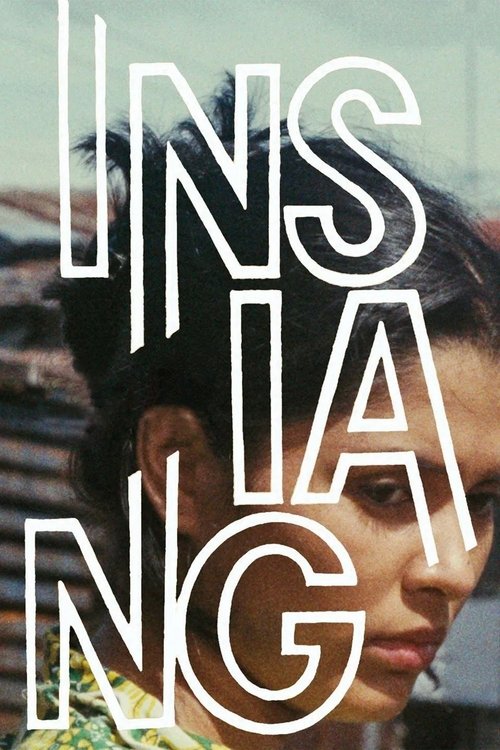
Insiang
1976 · Lino Brocka
When you want a film to chew on for days and can handle something harrowing — this is challenge viewing, the kind that rewards you with one of world cinema's great slow-burn character transformations.
What it's about
In the Tondo slums of Manila, a young laundress named Insiang lives with her embittered mother — and home becomes a trap when the mother takes in a young lover. What starts as a portrait of daily survival in the shantytowns tightens, degree by degree, into a chamber drama about betrayal, desire, and what a person pushed past endurance might do.
The experience
Intense and airless in the best sense — melodrama stripped of all consolation, shot with documentary rawness, building a slow dread that tightens like a fist. It's gripping, upsetting, and impossible to look away from.
Performances
Hilda Koronel is extraordinary in the lead, shifting from meekness to something far more unsettling by almost imperceptible degrees, while Mona Lisa delivers one of cinema's great monstrous-parent portrayals as the mother.
The craft
Lino Brocka shot it in the real Tondo slums in a matter of days, and the crowded shanties, communal water pumps, and airless bedrooms are photographed with documentary candor that makes the melodrama land like fact. The compression — one household, few locations, escalating pressure — gives it the force of a stage tragedy caught on the street.
Why it matters
In 1978 it became the first Filipino film ever screened at Cannes, announcing Philippine cinema to the world and cementing Brocka — the fearless conscience of his national cinema under the Marcos dictatorship — as a major international figure.
Shot in the Tondo slums of Manila in a matter of days, on the run from both budget and censors, Lino Brocka's chamber tragedy follows a young laundress whose home becomes a trap when her embittered mother takes a young lover. Brocka — the openly gay, politically fearless conscience of Philippine cinema under the Marcos dictatorship — works in the register of melodrama but strips it of consolation: the crowded shanties, communal water pumps and airless bedrooms are photographed with documentary candor, while Hilda Koronel's extraordinary lead performance moves from meekness to something far more unsettling by almost imperceptible degrees. Mona Lisa, as the mother, matches her scene for scene in one of the great monstrous-parent portrayals. In 1978 it became the first Filipino film ever screened at Cannes, announcing a national cinema the wider world had ignored. Decades later, Martin Scorsese's World Cinema Project restored it, and its influence is audible in the Filipino realists who followed, from Lav Diaz to Brillante Mendoza. It opens at a slaughterhouse — an image the rest of the film quietly refuses to let you forget.
A Deleuzian reading
Before you meet anybody, you're in a slaughterhouse.
The full Deleuzian reading of Insiang →
Reception
Knocked out fast as a commercial melodrama and treated as just that at home, it then became the first Filipino film ever shown at Cannes (Directors' Fortnight, 1978) — and the 2015 Scorsese-backed restoration sealed its status as a crown jewel of Philippine cinema.
How Insiang was received, from release to now →
Influences: the films it descends from and the films it influenced
- Bicycle Thieves (1948) — Established the neorealist method Brocka adopts wholesale—shooting on real streets with the impoverished city as co-protagonist rather than a painted backdrop, so the Tondo slum in Insiang carries documentary weight.
- Los Olvidados (1950) — Its unsentimental slum melodrama—tenement cruelty rendered without pity, driving toward a betrayal and death—is the direct template for how Insiang refuses to redeem its poor rather than ennoble them.
- Le Sang des bêtes (1949) — Franju's abattoir documentary made the slaughterhouse a montage of social violence; Insiang's graphic slaughterhouse opening deploys the same device, letting butchered carcasses pre-figure the human predation to come.
- Imitation of Life (1959) — The Sirkian maternal melodrama—mother and daughter locked in emotional rivalry within a claustrophobic domestic frame, feelings pitched to excess—supplies the genre grammar Insiang grounds in a one-room shanty.
- Mildred Pierce (1945) — Its mother-daughter melodrama built on sexual rivalry over the same man prefigures the Insiang-Tonya-Dado triangle, where a mother's lover becomes the axis of maternal betrayal.
- Mother India (1957) — Codified the monumental suffering-mother melodrama of the postcolonial global South; Insiang inverts it into the 'monstrous parent,' answering Mother India's sacrificial saint with Tonya's devouring cruelty.
- Pather Panchali (1955) — Ray's humanist poverty realism—patient observation of daily deprivation with nonprofessional-feeling performance—models the Third World neorealist register Brocka works in from within melodrama.
- Pixote (1981) — Extends the slum-realist melodrama with nonprofessional street youth and unflinching tenement brutality, carrying Insiang's method into 1980s Latin American cinema.
- Salaam Bombay! (1988) — Shoots real slum life with nonprofessional performers and documentary candor to frame a vulnerable protagonist's entrapment—Insiang's neorealist-melodrama fusion transposed to Bombay.
- City of God (2002) — Opens on a kinetic set-piece of favela violence exactly as Insiang front-loads the slaughterhouse, and treats the slum as a total lived environment shot on location with locals.
- Rosetta (1999) — Handheld documentary candor pinned to a young woman's domestic entrapment and grinding poverty—the Dardennes distill Insiang's realist gaze on a trapped daughter into pure vérité.
- Serbis (2008) — The leading heir among the Filipino realists Brocka seeded: continuous location shooting in a decaying, sweat-soaked interior, a family's moral squalor observed with the same unblinking candor.
- Kinatay (2009) — Pushes Insiang's slaughterhouse-as-metaphor to its limit, rendering human butchery in real time with documentary-grade grime as the ultimate extension of Brocka's abattoir opening.
- Barber's Tales (2013) — Establishes the confined domestic single-location as a pressure chamber for a woman's constrained agency, the staging logic Lana compresses into the barbershop.
- Moral (1982) — Its unsentimental melodrama of a woman boxed in by economic and sexual constraint sets the template for Moral's clinical study of how limited women's real choices are.
- Batang West Side (2001) — Establishes the blocking logic Diaz uses for the diasporic apartment: entire dramatic crises staged in a one-room interior where bodies must physically negotiate past each other and no one can exit the frame, so conflict has nowhere to discharge.
- Kisapmata (1981) — Establishes the Filipino household-as-trap: sexual predation and economic dependency staged entirely inside one cramped home; de Leon inherits the premise and cools it, swapping Brocka's roving handheld heat and overlapping shouting for a fixed camera and withheld reaction shots.
- Manila in the Claws of Light (1975) — Brocka's own preceding feature runs the same craft engine—slum location shooting, documentary candor, a provincial innocent devoured by an indifferent Manila under Marcos—of which Insiang is the tighter chamber-piece companion.
- Himala (1982) — The other pillar of Philippine New Cinema, built like Insiang around a Nora Aunor–era lead's slow transformation and a searing social critique smuggled through melodrama past Marcos censors.
- Perfumed Nightmare (1977) — Contemporary Philippine New Cinema work that likewise weaponizes location shooting and a candid, near-documentary texture to indict neocolonial poverty, sharing Insiang's movement and moment.
Similar films
- Manila in the Claws of Light (1975) — influence & lineage
- The Young and the Damned (1950) — influence & lineage
- Bicycle Thieves (1948) — influence & lineage
- Kisapmata (1981) — shared sensibility
- Rocco and His Brothers (1960) — shared sensibility
- Canoa: A Shameful Memory (1976) — shared sensibility
- Norte, the End of History (2014) — shared sensibility
- Obsession (1943) — shared sensibility
All the films related to Insiang →