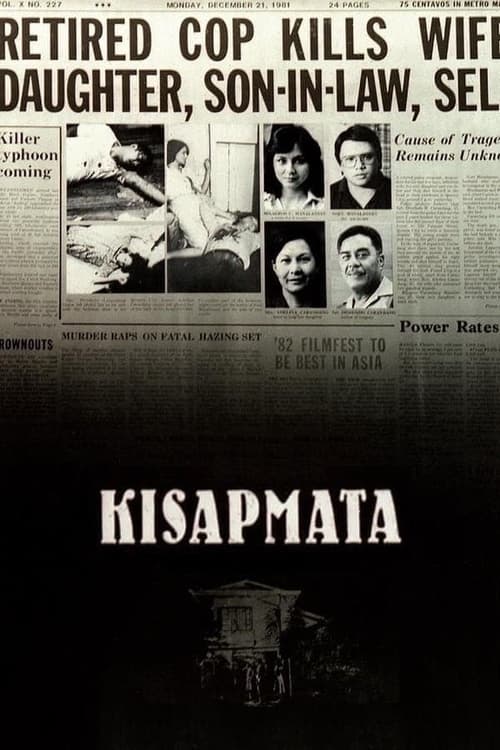
Kisapmata
1981 · Mike de Leon
For when you want a slow-burn psychological thriller that leaves you rattled — a film to watch gripping the armrest and argue about afterward. Definitely a challenge, not a comfort; save it for a night you can handle a heavy one.
What it's about
A retired Manila policeman gives his daughter permission to marry — then refuses to let her leave. The newlyweds are installed in his house, the gate stays padlocked, and the marriage begins to suffocate under what he insists is fatherly love. Drawn from Nick Joaquin's true-crime reportage about a notorious real case, it plays as a domestic thriller where the monster sits at the dinner table.
The experience
It's horror conducted entirely in the register of the ordinary — polite meals, house rules, small permissions granted and revoked — and the dread tightens almost unbearably as you wait for the ordinary to crack. Quiet, controlled, and genuinely frightening in a way jump scares never are.
Performances
Vic Silayan's patriarch is one of the great screen monsters precisely because he never raises his voice: all soft-spoken courtesy over absolute menace, a performance that makes control itself terrifying.
The craft
Mike de Leon directs with surgical restraint, turning a single house into a trap — doorways, gates, and dinner tables framed so the geography of confinement becomes the suspense. The film wrings its terror from staging and silence rather than spectacle, and it plays beautifully in a dark, quiet room.
Why it matters
Released as the Marcos regime nominally lifted martial law, it was read by Filipino audiences as an allegory of authoritarian control in the shape of a father, and it stands as a peak of Philippine cinema's golden age.
Snapshot
Kisapmata — "in the blink of an eye" — is a domestic horror film that never once leaves the register of the ordinary. A retired policeman, Dadong Carandang, permits his daughter Mila to marry, then declines to let her leave: the newlyweds are installed in his house, the gate is padlocked, and the marriage is slowly asphyxiated under the guise of paternal love. Adapted from Nick Joaquin's 1961 crime reportage "The House on Zapote Street," written under his journalistic pen name Quijano de Manila, the film converts a notorious Manila murder-suicide into a chamber tragedy about ownership — of a daughter, a household, a country. It arrived in December 1981, at the end of the year Ferdinand Marcos nominally lifted martial law while retaining the power to rule by decree, and Filipino audiences read the patriarch accordingly. Vic Silayan's Dadong, soft-voiced and reasonable and implacable, is one of the great performances in Philippine cinema. The film is widely held to be Mike de Leon's masterpiece and, in the durable consensus of Filipino critics, among the finest films the country has produced.
Industry & production
De Leon occupied an unusual position in the Philippine industry: he was the grandson of Narcisa "Doña Sisang" de Leon, founder of LVN Pictures, the studio that had defined the first Golden Age of Filipino cinema in the 1940s and 1950s. By the 1970s LVN had ceased producing features and survived as a facilities house in Quezon City — equipment, sound stages, post-production. That inheritance gave de Leon something almost no other director of his generation had: independence from the producer class, access to technical resources, and the temperament of someone who had grown up inside a studio rather than clawing his way into one. He had already produced and photographed Lino Brocka's Maynila: Sa mga Kuko ng Liwanag (1975) before directing Itim (1976).
Kisapmata was made for Bancom Audiovision, the film arm of a Manila financial house — one of the era's short-lived attempts to fund ambitious local cinema from outside the traditional star-driven studios. That patronage matters: the film has no marketable stars in the commercial sense, no songs, no comic relief, and a structure that promises catastrophe from its first reel. Detailed production records for Philippine films of this period are poorly preserved, and figures for Kisapmata's budget and box-office performance are not reliably documented; claims to the contrary should be treated with suspicion.
It premiered in competition at the 1981 Metro Manila Film Festival, the state-sanctioned December showcase, and took multiple awards there; the following year it swept the Gawad Urian, the critics' prize given by the Manunuri ng Pelikulang Pilipino, including Best Picture, Best Director and Best Actor for Silayan. In 1982 it traveled to the Directors' Fortnight at Cannes, where de Leon was represented alongside Batch '81 — an unusual double for a Southeast Asian director at the time.
Technology
The film was shot on 35mm color negative and finished in mono optical sound, the standard Philippine specification of the period. Two technical conditions shape what Kisapmata looks and sounds like. First, the industry's near-universal reliance on post-synchronized dialogue: location sound recording was rare, and performances were dubbed in a studio afterward. This ordinarily produced a slightly detached, declamatory soundtrack; de Leon, unusually attentive to audio, turned the convention toward a clinical, close-miked intimacy in which whispers and breathing sit uncomfortably forward in the mix.
Second, the film's near-total interiority. Shooting almost entirely inside a single house on limited stock and with lighting units of modest power pushed cinematographer Rody Lacap toward low-key, practical-anchored illumination — table lamps, doorway spill, the sodium wash of a street beyond a grille. The grain and density of the original prints were part of the atmosphere.
The film was restored in 4K in the early 2020s and re-entered international circulation through boutique distribution — Kani Releasing in North America among them — after decades in which de Leon's own protectiveness over his work kept it difficult to see outside the Philippines. The restoration is the reason a global audience encountered the film at all, and it substantially changed its critical standing abroad.
Technique
Cinematography
Lacap photographs the Carandang house as a system of apertures. The recurring compositional unit is the frame-within-a-frame: doorways, window grilles, stair balusters, the ironwork of the front gate. Characters are repeatedly seen through something. The camera is predominantly static or moves in slow, unemphatic reframings; there are no flourishes, no expressionist tilts, almost nothing that announces a director. The horror is produced by patience and by placement — by holding a shot long enough that the viewer begins to check the edges of the frame for the father.
The palette is dim and jaundiced: browns, ochres, the green of painted concrete, faces lit from one side and falling into shadow on the other. Exteriors, when they occur, are flatter and brighter, and the contrast is the point — the world outside the gate is banal, functional, indifferent, and offers no help. Lacap and de Leon frequently place Dadong in the middle ground of a composition, neither foreground threat nor background presence, simply there, a fixture of the architecture.
Editing
The cutting is measured to the point of austerity. Scenes are permitted to run past the moment a conventional thriller would clip them; the discomfort accumulates in the dead time after a line has landed. There is little parallel montage and almost no suspense cross-cutting of the Hitchcockian kind — de Leon withholds the reassurance that comes from knowing where everyone is. The rhythm is that of domestic routine: meals, arrivals, the closing of doors. This makes the violence, when it finally comes, feel less like a climax than a rupture in the film's own metabolism — sudden, graceless, over almost before it registers. The title is a description of the ending.
Mise-en-scène / staging
Cesar Hernando's production design is the film's second screenplay. The house is a petty-bourgeois Manila interior of a specific vintage: religious images and santos, framed family photographs, doilies, a police service pistol, the accumulated proofs of respectability. Nothing is stylized; everything is legible as evidence. The geography of the house — gate, sala, stairs, the daughter's room, the parents' room — is established early and then exploited, so that by the second half the audience knows exactly how far it is from one door to another, and how little that distance protects anyone.
Staging is built on thresholds. Characters negotiate at gates, hover in doorways, speak across rooms. Dadong is almost always the one who controls passage: he holds the keys, he decides who enters, he appears at the top of stairs. The blocking encodes the argument that the film never states outright — that this is a house organized entirely around one man's right of access.
Sound
Kisapmata is a quiet film that uses quiet as pressure. Ambient sound is precisely selected and sparse: locks, hinges, the metallic complaint of the gate, footsteps on stairs, the low hum of a household at night. Lorrie Ilustre's score is minimal and dissonant, deployed in short applications rather than as continuous underscoring, and much of the film runs without music at all. Because the dialogue was post-synchronized, voices carry an eerie proximity regardless of camera distance — Dadong's reasonable murmur reaches the viewer as though spoken directly into the ear, which is precisely the intimacy the character claims and the audience wants to escape.
Performance
Vic Silayan, a veteran of radio and stage, plays Dadong without a single conventional signal of villainy. He is courteous, avuncular, occasionally jovial; his cruelty is expressed through favors, loans, concern for his daughter's health, appeals to gratitude. The performance is built on tempo — he is never hurried, and the household's terror is partly a function of having to wait for him to finish speaking. Charo Santos, in the role that made her (and who would later run ABS-CBN before returning to acting in Lav Diaz's Ang Babaeng Humayo), plays Mila as a study in withheld affect: obedience that has calcified into something closer to catatonia, with panic visible only at the edges. Charito Solis, one of the great stars of the preceding generation, makes the mother Dely the film's most painful figure — a woman whose complicity is indistinguishable from her own captivity. Jay Ilagan's Noel is the modern, reasonable, utterly insufficient man, whose every appeal to normalcy is absorbed without resistance and without effect.
Narrative & dramatic mode
The film is not a mystery. It is a chamber tragedy with a fixed vector: from the first scene, in which Dadong extracts money and deference from his prospective son-in-law, the question is not what will happen but how long. De Leon adapts Joaquin's reportage by discarding the journalistic apparatus — no voiceover, no investigator, no framing inquest — and staging the case as lived experience. What remains of reportage is the tone: an unsentimental attention to detail, and a refusal to editorialize.
Structurally it inverts the marriage plot. The wedding, which in melodrama resolves, here initiates the trap; the honeymoon is deferred and then canceled; the couple's new home is the father's house. Each act tightens by a single notch, and each escalation is disguised as an ordinary domestic negotiation. Crucially, de Leon keeps the worst material — the intimation of incest, the source of Mila's pregnancy, the exact nature of the hold — largely implicit, communicated through glances, evasions and the mother's silences. The film's horror is what it declines to show.
Genre & cycle
Kisapmata sits at an intersection: true-crime adaptation, domestic gothic, psychological thriller, and Filipino family melodrama turned inside out. Its nearest international relatives are the American domestic thrillers of the Hitchcock line — Shadow of a Doubt above all, with its beloved relative as household predator — and the European chamber film of the 1960s and 1970s, where a fixed set and a small cast are used to anatomize a power relation. It also belongs to the international "old dark house" tradition, but stripped of the supernatural: the haunting is a living man with a service revolver and a legal claim.
Within Philippine cinema it is best understood against the family melodrama, the industry's most reliable commercial form. De Leon uses that genre's furniture — the wedding, the in-laws, the debt, the pregnancy, the maternal sacrifice — and withholds every consolation the form normally provides. There is no reconciliation scene, no redemptive suffering, no restoration of the family unit. The family unit is the disease.
Authorship & method
De Leon's authorship is one of control and refusal. Educated partly in Europe, where he studied art history, he brought to Philippine cinema a formal rigor and a distrust of sentiment that set him apart from his great contemporaries. Where Brocka worked in heat and moral urgency and Ishmael Bernal in urban ensemble sprawl, de Leon worked cold, in closed forms, with an almost architectural sense of composition. He was also famously exacting and famously withdrawing: his filmography is small (Itim, Kung Mangarap Ka't Magising, Kakabakaba Ka Ba?, Kisapmata, Batch '81, Sister Stella L., Bayaning 3rd World, Citizen Jake) and punctuated by long silences and public quarrels with the industry.
The screenplay was written by de Leon with Clodualdo del Mundo Jr. — a scholar and screenwriter whose critical formation is visible in the film's structural economy — and Raquel Villavicencio, a frequent de Leon collaborator across writing and design. Rody Lacap photographed this and other key de Leon films of the period, including Batch '81; Cesar Hernando designed; Lorrie Ilustre composed. Editing is credited to Jess Navarro, a recurring presence in de Leon's post-production. This was a stable, repeatedly reconvened unit, and the consistency of the results across Kisapmata and Batch '81 — made back to back, sharing a palette, a rhythm, and a thesis about how authority reproduces itself — argues for reading them as a single project in two parts.
Movement / national cinema
Kisapmata is a central text of the Second Golden Age of Philippine cinema, the extraordinary decade-and-a-half running from the early 1970s through the mid-1980s in which Brocka, Bernal, de Leon, Celso Ad. Castillo, Marilou Diaz-Abaya and Peque Gallaga produced a body of work of world stature under an authoritarian government. The paradox of that period is well documented: the Marcos regime's cultural apparatus simultaneously courted international prestige — the Manila International Film Festival, the Experimental Cinema of the Philippines, the Cultural Center complex — and censored domestic production through the Board of Review for Motion Pictures and Television. Directors learned to work in allegory.
De Leon's contribution to that movement was to demonstrate that political critique did not require the street. Brocka's Manila is a city of slums and hustlers; de Leon's is a middle-class house with the gate locked from the inside. The film argues that authoritarianism is not principally an affair of the state but a habit of the family, reproduced in every household that treats obedience as love.
Era / period
The specific timing is important. Martial law had been formally lifted in January 1981; the regime's grip had not loosened. That November, the Manila Film Center under construction for the following January's international festival partially collapsed, killing workers — an event that became the era's grim emblem of prestige built over bodies. Kisapmata opened the following month. A Filipino audience in December 1981 did not need to be told what a genial old man with police credentials, an insistence on gratitude, and a locked gate was meant to evoke. The film's political charge was legible precisely because it never made a political statement; nothing in it could be cut by a censor.
The historical source adds a second temporal layer. Joaquin's reportage described a 1961 case, in a house on Zapote Street, in which a retired officer killed members of his family and then himself. By restaging a pre-martial-law crime in a martial-law present, de Leon suggests that the pathology is not the regime's invention but its precondition.
Themes
The governing theme is possession, and its local name is utang na loob — the Filipino ethic of internal debt, of gratitude owed and never fully discharged. Dadong does not command; he reminds. He gave life, food, education, a home, and the accounting is never closed. The film's most disturbing insight is that this claim is culturally legitimate: Dadong is not violating the family's values, he is enforcing them to their logical end.
Around this cluster the incest theme, kept almost entirely in negative space, functions as the ultimate expression of the same logic — ownership extended to the body. Complicity is the second great subject, embodied in Dely, who knows, has always known, and whose silence is both survival strategy and collaboration. Third is institutional failure: the police are Dadong's old colleagues, the church offers ritual without protection, neighbors and friends see the padlocked gate and say nothing. The couple's every appeal to an outside authority dissolves on contact. And beneath it all runs the allegory of nation-as-family: the father who cannot be deposed, only survived, and who takes the household with him when he goes.
Reception, canon & influence
Domestic critical reception was immediate and emphatic. The Manunuri's near-sweep at the Gawad Urian marked it as the film of its year, and Silayan's Dadong entered the culture as a permanent reference point for Filipino paternal menace. Internationally the picture was more complicated: the Directors' Fortnight selection in 1982 gave it a European showing, but Philippine cinema of the period reached the West unevenly, and de Leon's own guardedness about his work meant that for decades Kisapmata was a title one read about rather than saw. The 4K restoration and boutique reissue of the 2020s reversed that, and the film's second reception — as a rediscovery, praised by critics with no stake in Philippine cultural politics — has been strikingly consistent with the first.
Looking backward, the film's clearest debts are to Nick Joaquin, whose reportage supplied not only the case but the register of unhysterical attention; to the Hitchcock of Shadow of a Doubt and Psycho, for the proposition that the family is where horror lives; to the European chamber film's confidence that a single house and four actors are sufficient; and to the Filipino melodrama tradition it dismantles. De Leon's LVN formation is present too, in the classical staging and the refusal of improvisation.
Looking forward, its influence runs along two lines. Within Philippine cinema it legitimized the domestic interior as a site of political argument, and its DNA is visible in subsequent Filipino films that locate national violence inside the household rather than on the street. More broadly, it stands as one of the strongest available arguments that Southeast Asian cinema of the martial-law decades belongs in the international canon of the political thriller — a claim that critics outside the region were slow to test and have, since the restoration, largely conceded. It is now routinely placed at or near the top of best-of lists compiled by Filipino critics and institutions, and it is the film most often cited when the case is made for Mike de Leon as his country's most formally accomplished director.
A Deleuzian reading
A shot holds.
The full Deleuzian reading of Kisapmata →
Reception
It swept the 1981 Metro Manila Film Festival and screened in Cannes' Directors' Fortnight, then spent decades hard to see; its restoration and de Leon's rediscovery abroad have since pushed it from national treasure to international 'greatest Filipino film ever' contender.
How Kisapmata was received, from release to now →
How to watch Kisapmata: what to notice on a first viewing
- Watch characters photographed through doorways, grilles, or bars. Lacap keeps finding apertures, windows, stair balusters, the front gate's ironwork, so people are almost always seen through something rather than in open space. You start checking the edges of the frame instead of just the center.
- Notice who holds the keys and decides who enters. Characters negotiate at gates and hover in doorways throughout, and one man is almost always the one who controls who passes and who waits. The house is organized entirely around a single person's right of access.
- Listen for how close his voice sounds no matter the distance. The dialogue was post-synchronized, so his reasonable murmur reaches your ear at the same closeness whether he is near the camera or across the room. The intimacy he claims over the household is imposed on you acoustically too.
- Watch him stay courteous and unhurried in every scene. Silayan gives Dadong no conventional signal of villainy: he is avuncular and patient, and the household's fear is partly the fear of waiting for him to finish speaking. Cruelty here arrives disguised as ordinary care, never as a raised voice.
- Notice a scene continue after the conversation is over. De Leon lets shots run past the point a conventional thriller would cut away, letting the discomfort accumulate in the silence after a line has landed. The dread builds in what the film refuses to cut away from.
The whole guide to watching Kisapmata, with the keys for a rewatch →
Influences: the films it descends from and the films it influenced
- Anak Dalita (1956) — The LVN studio grammar de Leon was raised inside — proscenium-width staging with actors composed in depth and held through a scene in one setup rather than covered — survives intact in Kisapmata's static camera, stripped of Avellana's swelling score cues and consoling reaction close-ups.
- Shadow of a Doubt (1943) — Hitchcock's device of seating the monster at the family dinner table and letting him deliver his creed in a benign conversational key, uninterrupted, is exactly how Dadong's table monologues work: the household's habituated deference becomes the blocking that traps everyone in frame with him.
- Les Diaboliques (1955) — The template for withheld crosscutting in a crime film — the audience is locked to one household's routine and denied any parallel outside investigation, so the eruption detonates in rooms already made familiar; de Leon's suppression of police and church exteriors follows the same containment logic.
- Psycho (1960) — The house as psychological architecture — stairs, thresholds, an upper floor the camera is rationed — plus the mid-film genre rupture that converts a domestic/marriage plot into slaughter without changing shooting style; Ilustre's sparse dissonant strings answer Herrmann's.
- Through a Glass Darkly (1961) — The chamber-film proof that four actors and one house suffice: sustained held two-shots with no relieving cutaway, in which a father's clinical, unblinking observation of his daughter is itself staged as the film's central violence.
- The Servant (1963) — Mirrors, banisters, stair-rails and doorways deployed as frames-within-the-frame that continuously diagram who owns the house; Kisapmata's threshold blocking — Dadong filling doorways, the couple caged behind jalousies and window grillework — is the identical power-mapping device.
- In Cold Blood (1967) — The reportage-to-screen register de Leon takes from Nick Joaquin: a refusal to psychologize the killer or supply motive, paired with Conrad Hall's practical-source low-key lighting where lamps and windows inside the murder house are the only illumination.
- The Honeymoon Killers (1969) — True-crime staged in unglamorous long takes from a locked-off camera, with flat, post-synchronized-sounding line readings and no score cueing the horror — the deadpan procedural surface Kisapmata adopts for its own newspaper case.
- Insiang (1976) — Establishes the Filipino household-as-trap: sexual predation and economic dependency staged entirely inside one cramped home; de Leon inherits the premise and cools it, swapping Brocka's roving handheld heat and overlapping shouting for a fixed camera and withheld reaction shots.
- Itim (1976) — De Leon's own laboratory for the method — he shot it himself: an ancestral house rendered in low-key practical light, the patriarch's secret buried in its rooms, and the frame-within-a-frame vocabulary plus refusal of conventional coverage that Kisapmata systematizes.
- Dekada '70 (2002) — Takes Kisapmata's proposition that martial law is best filmed from inside a family home, keeping the political argument almost wholly within domestic interiors and using the father's rule over the dinner table and the front door as the state's working proxy.
- Dogtooth (2009) — A father confining adult children to a walled family compound, shot in locked-off frontal setups that crop heads and hold on empty doorways, performances flattened to affectlessness — Kisapmata's confinement-by-framing grammar pushed to absurdist extremity.
- Citizen Jake (2018) — De Leon's own late return to the patriarch-as-state, where the father's power is again established through blocking — the son summoned into, held at the edge of, and dismissed from his father's rooms — rather than through dialogue or exposition.
- Autobiography (2022) — Southeast Asian post-authoritarian chamber film in which a retired general's household stands in for the entire political order: low-key practical-lit interiors, static long takes, and threshold blocking that strands the young servant perpetually in the doorways of a house he serves.
- The Housemaid (1960) — Parallel invention of the single-house terror machine: the staircase as the axis of domination, an intruder absorbed into the family structure, and a resolution by mutual annihilation — the Asian chamber-domestic thriller Kisapmata belongs beside even absent any line of transmission.
- Batch '81 (1982) — Made back to back with the same unit — Rody Lacap's camera, Cesar Hernando's design, Lorrie Ilustre's score — and transplants the identical thesis, that authority reproduces itself by extracting consent from its victims, from the family house to a fraternity using the same geometric wides and rationed close-ups.
- The Seventh Continent (1989) — A family murder-suicide built from static, fragmented compositions of household objects and routine, with all explanatory interiority withheld — the European continuation of Kisapmata's decision to film the domestic mechanism rather than the psychology driving it.
- La Cérémonie (1995) — Maintains an unhurried, placid house-film surface straight through the rifle massacre, the camera refusing to escalate its style at the moment of violence — precisely Kisapmata's tactic of shooting the killings in the same unhysterical register as the breakfasts.
Similar films
- Insiang (1976) — influence & lineage
- From What Is Before (2014) — shared sensibility
- Evolution of a Filipino Family (2004) — shared sensibility
- Manila in the Claws of Light (1975) — shared sensibility
- Castle of Purity (1973) — shared sensibility
- Kishkindha Kaandam (2024) — shared sensibility
- The Godfather (1972) — shared sensibility
- Batang West Side (2001) — shared sensibility