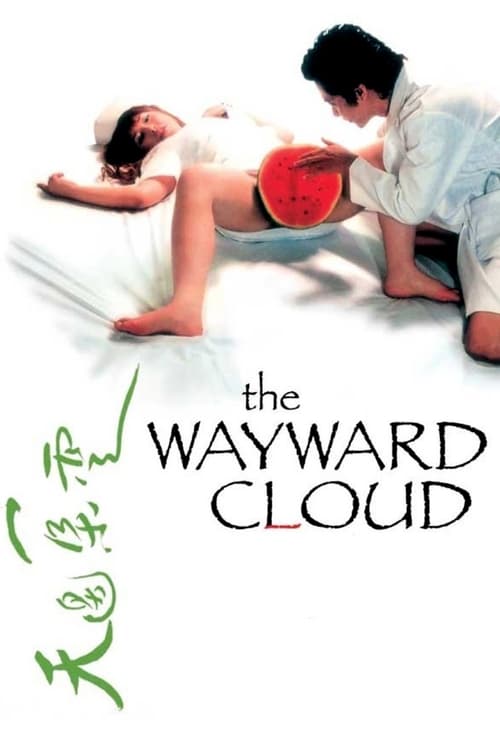
The Wayward Cloud
2005 · Tsai Ming-liang
For when you want to be challenged and unsettled, not soothed — a film to argue about and chew on for days. Definitely not a casual watch: it asks patience and a strong stomach for provocation, and rewards viewers who like cinema at its most extreme and deliberate.
What it's about
Taipei is in the grip of a drought: water is rationed, and watermelons have become the cheap substitute for everything liquid. A young man now scraping a living as an actor in cheaply made adult films crosses paths again with a woman he once knew, who hoards bottled water in her apartment and has no idea what he does for work. Around their halting near-romance, the film keeps erupting into full-blown lip-synced musical numbers.
The experience
Slow, strange, and deliberately uncomfortable — long, nearly wordless stretches of loneliness suddenly split open by gaudy, funny, dreamlike song-and-dance fantasies. It's droll and melancholy in equal measure, and its frankness about sex and the body builds to something genuinely confrontational.
Performances
Lee Kang-sheng and Chen Shiang-chyi, Tsai Ming-liang's longtime collaborators, do remarkable work almost entirely without dialogue, carrying whole histories of longing in posture and glance.
The craft
Tsai composes in long, fixed takes of ruthless precision, then detonates them with candy-colored musical fantasies staged in stairwells and public restrooms — the collision of the two registers is the film's whole argument. The imagery of water, skin, and watermelon-red is unforgettable, and the widescreen framing rewards a big screen.
Why it matters
A scandal at its Berlin festival premiere and a flashpoint in debates about sex and explicitness in art cinema, it stands as the most extreme statement of one of the era's most distinctive auteurs.
Snapshot
The Wayward Cloud is the film in which Tsai Ming-liang's cinema of thirst became literal. It is the third and final movement of the cycle that began with What Time Is It There? (2001) and continued through the short The Skywalk Is Gone (2002), returning Lee Kang-sheng's Hsiao-kang and Chen Shiang-chyi's Shiang-chyi to a Taipei that has run dry. Water is rationed; watermelons have become the state-sanctioned substitute for drinking water; and Hsiao-kang, whose last appearance ended with him auditioning for a pornographic film, now works in the adult industry, performing sex on cheap sets with a watermelon wedged between his co-star's legs. Shiang-chyi, who hoards plastic bottles in her apartment, recognizes him and does not learn what he does.
Around this thin armature Tsai builds two incompatible films at once. One is the most austere he had yet made: near-wordless, held in long static takes, punishingly patient. The other is a candy-colored musical, six or so lip-synched production numbers drawn from the Mandarin popular song repertoire of the 1950s and 1960s — the same seam Tsai had mined in The Hole (1998), much of it associated with the Hong Kong star Grace Chang (Ge Lan). The film alternates between them without transition or explanation, and ends with a sexual act so brutal and so protracted that it has determined the film's reputation ever since.
It premiered in competition at the 2005 Berlinale, where it took a Silver Bear for outstanding artistic contribution, the Alfred Bauer Prize, and the FIPRESCI award, and where it also produced walkouts. In Taiwan it became something Tsai's films had never been: a genuine commercial event, marketed on watermelons and scandal. Two decades on it remains the most divisive work by one of the defining figures of contemporary slow cinema — regarded by some as a nihilistic dead end and by others as the harshest and most honest thing he ever filmed.
Industry & production
By 2005 Tsai occupied a position typical of the internationally festival-funded Asian auteur and precarious for exactly that reason. Taiwan's domestic film industry had effectively collapsed over the preceding decade: after the liberalization of distribution and the removal of import restrictions, Hollywood took a share of the local box office so overwhelming that domestic production fell to a trickle of subsidized art films, most of them dependent on the Government Information Office's輔導金 grant scheme and on foreign co-production money. Tsai's previous feature, Goodbye, Dragon Inn (2003) — a film about the last night of a dying Taipei movie palace, released the year SARS emptied the region's cinemas — was a nearly perfect emblem of the situation it described.
The Wayward Cloud was produced through Homegreen Films, the company Tsai had established to control his own work, with French co-production support continuing the arrangement that had underwritten What Time Is It There? French money had by then become structural for Tsai, as it had for Hou Hsiao-hsien and for much of the Asian festival circuit: European producers and television pre-sales financed films that could not recoup domestically, in exchange for premieres at Cannes, Berlin, or Venice.
What distinguishes this production is its domestic marketing. Where Tsai's earlier films had been sold, insofar as they were sold at all, as difficult art cinema, The Wayward Cloud was released in Taiwan as an event: a saturated campaign built around watermelon imagery and the promise of transgression, with Tsai himself conducting the publicity in a mode closer to showmanship than to the reticence expected of him. It was released under the restricted rating and, unusually for a film of this explicitness in that market, without the cuts many expected. The result was a level of public argument — in newspapers, on television, among legislators and censorship advocates — that no Tsai film had generated before, and box-office returns that were exceptional by the standards of Taiwanese art cinema in the years before Cape No. 7 (2008) briefly revived the domestic market. Precise figures circulate inconsistently and are not reliable enough to state here; what is well documented is that the film outperformed every previous Tsai release at home, and that the scandal was the reason.
Technology
Three technological contexts press on the film. The first is photochemical: The Wayward Cloud was shot on 35mm, at the tail end of the period when a director of Tsai's scale could still assume film as a default. Tsai's long-take method — takes running minutes, framing fixed, no coverage — is in part a photochemical discipline, built around the magazine and around the knowledge that a shot which fails cannot be cheaply repeated. He would not move to digital capture until Stray Dogs (2013), after which the duration of his takes expanded again, freed of the reel.
The second is the technology the film depicts: the low-budget adult video industry. The pornography being shot inside the film is video work — fast, cheap, minimally lit, made for VCD and DVD distribution in a regional market saturated by Japanese AV and by piracy. Tsai films these shoots in his own idiom, from a fixed distance, which produces the film's central formal joke: pornography's aesthetic is all proximity and cut, and Tsai simply refuses both, revealing the labor, the boredom, the crew standing around, the bodies working.
The third is infrastructural. The drought is not invention. Northern Taiwan experienced serious water shortages in the early 2000s, with rationing schedules imposed on Taipei households — a lived civic memory for the film's first audience, and the reason its absurdist premise reads locally as satire rather than fantasy. The film's mediascape belongs to the same moment: public-service broadcasts on watermelon consumption, karaoke and KTV as the ambient form of Taiwanese social life, the lip-synched number as a technology of feeling available to anyone with a microphone and a screen.
Technique
Cinematography
Liao Pen-jung, who had photographed Tsai's features since Rebels of the Neon God (1992), shoots the two halves of the film as if they were made by different people, which is the point. The narrative material is composed in long static wide shots, frequently frontal, with the camera set at a distance that denies psychological access and holds it long past the point of comfort. Interiors are lit for their sources — fluorescent tubes, stairwell bulbs, the flat overhead light of apartment corridors — and rendered in the sickly greens and dead grays that have been Tsai's Taipei since the beginning. Space is stubbornly deep: characters enter and exit frames that remain after them, and the architecture outlasts everyone.
The musical numbers reverse every parameter. They are lit theatrically, in hard saturated color, with mobile framing, costume, and choreographic geometry — several of them staged as aquatic tableaux that reach back through Grace Chang to Busby Berkeley and the Esther Williams swim spectacle, one built around an outsized phallic prop with a bluntness that is both funny and hostile. Water, absent everywhere else, floods the fantasy.
Editing
The cutting, credited to Chen Sheng-chang, works almost entirely at the level of the block rather than the shot. Within scenes there is often no cut at all; between them, the film juxtaposes without joining. The musical numbers are not introduced by dissolves, sound bridges, or any of the conventional markers of interiority, and Tsai declines to specify whose fantasy they are. They simply happen, and then the drought resumes. The effect is closer to a suite than a narrative — a structure Tsai had rehearsed in The Hole, where song was likewise an eruption rather than an expression. Duration is the film's principal editorial instrument, and its final sequence is the extreme case: a single situation held so far past its dramatic function that the holding becomes the subject.
Mise-en-scène / staging
Tsai stages the film around a single substitution. The watermelon replaces water; it also replaces the body. It is drunk, carried, cradled, slept beside, cut open, penetrated, and finally worn — a prop that migrates from public-health object to erotic prosthesis to gore substitute without ever changing its nature. The red flesh, the black seeds, and the running juice do the work that Tsai's cinema usually assigns to fluids of other kinds; in a film about dehydration, everything wet is displaced onto fruit.
The spaces are Tsai's standing repertoire: the apartment block, the rooftop water tank, the stairwell, the pedestrian underpass, the public toilet, the elevator. He continues to treat Taipei as a body with plumbing, and the drought simply drains it. Shiang-chyi's hoarded bottles, arranged in her rooms like a congregation, are the film's most economical image of a solitude that has organized itself into a system.
Sound
There is no score. The narrative passages carry only room tone, traffic, water, machinery, and the effortful grunting of sex being manufactured — a soundtrack of labor. Dialogue is nearly absent; the two leads barely speak to one another across the entire film, and their courtship is conducted through objects. Against this, the songs arrive at full recorded fidelity, glossy and orchestrated, from another era and another Chinese-language cinema entirely. Nobody sings. Every voice in the film's musical numbers belongs to someone else, mimed — which is precisely the film's thesis about intimacy under pornography. The sound work is consistent with the standard of Taiwanese post-production of the period, where Tu Duu-chih's studio set the terms for Hou, Yang, and Tsai alike.
Performance
Lee Kang-sheng had by 2005 been Tsai's sole protagonist for thirteen years, since Tsai cast him out of a Taipei arcade for television work in the early 1990s. The performance here is the culmination of that method: opaque, affectless, physically available, refusing to signal interiority. Hsiao-kang performs sex professionally while giving nothing, and Lee's long-cultivated blankness makes the distinction between the job and the man impossible to locate — which is the film's cruelty and its argument.
Chen Shiang-chyi supplies what warmth the film has. Her Shiang-chyi is watchful, slightly comic, absurdly tender toward objects, and her performance is built almost entirely from handling: the way she carries a watermelon, tests a bottle, waits. Sumomo Yozakura, a Japanese adult performer, plays the actress opposite Hsiao-kang, and her presence raises the question the film will not let go of — the difference between an actress performing sex and a performer being used — with a physical endurance in the final scene that is inseparable from the scene's ethical difficulty. Lu Yi-ching and Yang Kuei-mei, both long-standing members of Tsai's company, appear within the musical apparatus, Yang carrying forward the lip-synch role she had originated in The Hole.
Narrative & dramatic mode
The film has almost no plot in the ordinary sense. Two people who met in an earlier film meet again; they circle one another; one of them has a job the other does not know about; she discovers it; the film ends. What replaces plot is a system of rhymes and substitutions, and a mode that oscillates between deadpan comedy, ethnographic observation, and something closer to allegory.
Tsai's dramatic method here is deliberately anti-psychological. Motive is never stated, backstory never supplied, and the film assumes an audience that has seen What Time Is It There? without depending on it. Characters are defined by what they do with things. The comedy is real — the watermelon business is genuinely funny, in a register close to silent slapstick — and the film's structure sets that comedy up in order to detonate it. The final sequence, in which Shiang-chyi at last sees Hsiao-kang at work and participates in it through a grille, converts every earlier gag into an accusation retroactively. Whether this constitutes a devastating critique of pornographic looking or an act of the same order committed by the film itself is the question on which every serious reading of The Wayward Cloud divides, and the film supplies no resolution.
Genre & cycle
The Wayward Cloud sits at the intersection of three cycles. It belongs, first, to Tsai's own serial project — a body of films that reuse one actor, one character name, one city, and a repertoire of motifs across two decades, and that constitute one of the most sustained acts of cinematic continuity outside of commercial franchise filmmaking. Within that project it completes the arc of What Time Is It There? and The Skywalk Is Gone.
Second, it belongs to Tsai's private genre of the anti-musical, established in The Hole, in which catastrophe — plague and endless rain there, drought here — is punctuated by lip-synched Mandarin pop. The inversion is systematic: The Hole drowned Taipei, The Wayward Cloud desiccates it, and both use the same songbook as the register of everything the characters cannot say.
Third, it arrived inside the mid-2000s art-cinema turn toward unsimulated or near-unsimulated sex — the moment of Catherine Breillat's Romance (1999), Patrice Chéreau's Intimacy (2001), Gaspar Noé's Irréversible (2002), Vincent Gallo's The Brown Bunny (2003), and Michael Winterbottom's 9 Songs (2004), the tendency critics were then labeling the New Extremism. Tsai's contribution is distinguished by refusing the register of intensity those films share: his explicitness is bored, procedural, and shot in wide.
Authorship & method
Tsai Ming-liang was born in Kuching, Sarawak, in 1957, and came to Taiwan as a student of drama and film — a Malaysian-Chinese outsider whose relation to Taipei has always been that of a resident foreigner. He worked in theater and television before Rebels of the Neon God, and the stage discipline persists in the fixed frame, the treatment of the shot as a lit box in which action is blocked in full.
His method by 2005 was fully consolidated and famously restrictive: minimal script, minimal dialogue, no score, no coverage, sequence-shot construction, and an ensemble he did not vary. The continuity of collaborators is central to the work. Liao Pen-jung photographed nearly every feature from the first to Face (2009); Lee Kang-sheng is not merely a lead actor but the material of the project, his body, his ailments, and his aging supplying subject matter across films; Chen Shiang-chyi, Lu Yi-ching, and Yang Kuei-mei form a stock company. Chen Sheng-chang cut this film and the ones around it. Tsai writes his own screenplays, works closely on production design, and functions as producer through Homegreen. There is no composer, because there is no score — the "music department" of a Tsai film is a curatorial act, the selection of pre-existing recordings whose emotional idiom is deliberately older than the images they accompany.
Movement / national cinema
Tsai belongs to the second wave of Taiwanese art cinema — the generation that followed the Taiwan New Cinema of Hou Hsiao-hsien, Edward Yang, and Wan Jen, and that emerged in the early 1990s alongside Ang Lee, Chen Kuo-fu, and Lin Cheng-sheng. Where the first wave had turned toward rural memory, national history, and the long duration of collective experience, Tsai's Taipei is urban, contemporary, atomized, and largely without history. His characters live in apartment buildings that are always leaking or drying out, and they have no families that function and no past that is narrated.
The Wayward Cloud is also a film about Chinese-language cinema's own memory. Its songs come from the Hong Kong Mandarin musical of the MP&GI/Cathay era — the world of Mambo Girl (1957) and The Wild, Wild Rose (1960) — a cosmopolitan, optimistic popular cinema that Taiwan consumed and that has since vanished. Tsai's use of that repertoire is neither camp nor straightforward nostalgia; it is the sound of a shared regional culture that has been replaced, in the film's present, by pornography and public-health announcements. Read alongside Goodbye, Dragon Inn, which mourned the exhibition side of the same lost cinema, The Wayward Cloud completes an argument about what Taiwanese screen culture became.
Era / period
The film is precisely dated to Taiwan in the mid-2000s: the Chen Shui-bian years, a period of cross-strait tension and intense domestic political division; a post-WTO media market open to imports and hollowed out for local producers; a theatrical sector in retreat before VCD, DVD, and piracy; and, in the immediate background, both the 2003 SARS epidemic and the drought that supplies the plot. Its explicitness also arrives at a specific moment in Taiwanese public life, when questions of censorship, ratings, and sexual speech were being actively contested in a young democracy still working out the limits of its liberalization — which is why the film's release functioned as a civic argument and not merely a critical one.
Globally, 2005 sits at the height of the festival-auteur system that made Tsai's career possible and at the beginning of the digital transition that would remake it. The critical vocabulary of "slow cinema," which would crystallize around the end of the decade, was already forming around exactly this body of work.
Themes
Thirst is the organizing figure, and Tsai works it exhaustively. The film equates water, sexual fluid, and juice, and arranges its characters around the scarcity of all three. Bodies that cannot produce moisture perform desire mechanically; a city that cannot supply water substitutes fruit; a couple that cannot speak substitutes objects.
From this follows the film's central subject, the commodification of intimacy. Pornography here is not depicted as vice but as work — repetitive, badly paid, physically taxing, conducted under fluorescent light by tired people. Tsai's refusal of pornographic grammar is the ethical instrument: by holding the wide shot, he makes visible everything the form is designed to crop out.
Beneath that sits the theme that has run through Tsai's cinema since Vive L'Amour (1994): the near-total failure of communication, and the way desire persists anyway, misrouted into surfaces, plumbing, and things. The film is also, obliquely, about looking — about the difference between watching and participating, and about what a spectator is complicit in. Its final image implicates the audience by construction. And there is the persistent Tsai theme of the body as a leaking, ailing, unglamorous apparatus, here in its most extreme statement: a body that has become a machine for producing images of pleasure, and that no longer registers pleasure at all.
Reception, canon & influence
The immediate reception was violently split, and has never fully settled. The Berlin jury's three awards ratified the film at the highest institutional level while sections of the same audience walked out; the charge most often brought against it — that its ending is misogynistic, that it stages the degradation it purports to critique, and that the woman's body is finally the object on which the film's argument is written — is a serious one and has been pressed by serious critics. The defense, equally serious, holds that the sequence is unbearable by design, that its length and stasis are what convert titillation into horror, and that a film about pornography that permitted its audience a comfortable exit would be dishonest. Tsai has consistently declined to adjudicate.
In Taiwan the reception was inseparable from the marketing and the ratings debate; internationally the film was received as the point at which Tsai either broke through or broke down. Academic writing has been more even-handed than daily criticism was. The film features substantially in the scholarship that consolidated Tsai's reputation over the following decade — Song Hwee Lim's Tsai Ming-liang and a Cinema of Slowness (2014) and Jean Ma's Melancholy Drift (2010) are the standard English-language reference points — where it tends to be read through duration, queer temporality, and the historiography of the Chinese musical rather than through scandal.
The influences running into the film are legible. Behind it stand the Hong Kong Mandarin musical and its stars; the European modernism of alienation, particularly Antonioni, whose emptied architecture and unexplained affect Tsai's framing continually recalls; the French New Wave attachment that Tsai had made explicit by casting Jean-Pierre Léaud in What Time Is It There?; and Tsai's own earlier work, above all The Hole, of which this film is a systematic negative, and The River (1997), which had already established his willingness to film sexual taboo without commentary.
Forward, the film's influence is real but indirect. It did not spawn imitators — its combination of parts is not reproducible — but it hardened Tsai's position as a central reference for the international slow-cinema tendency that runs through Apichatpong Weerasethakul, Lav Diaz, Albert Serra, Pedro Costa, and Carlos Reygadas, and it remains one of the most cited cases in the ongoing argument about whether extended duration is an ethical instrument or an aesthetic mannerism. Within Tsai's own career it marks a boundary: the last film of the Hsiao-kang-and-Shiang-chyi romance, and the last time he courted a mass audience. What followed — I Don't Want to Sleep Alone (2006), Face (2009), Stray Dogs (2013), the gallery-bound Walker series, Days (2020) — moved steadily away from narrative, from theatrical exhibition, and from provocation, toward the museum and toward pure duration. The Wayward Cloud is the film that exhausted the other path.
A Deleuzian reading
A woman keeps bottles.
The full Deleuzian reading of The Wayward Cloud →
Reception
It detonated at Berlin 2005 — prizes from the jury and walkouts from the audience in the same week, with headlines fixated on the explicit content. Two decades on it's been claimed as one of Tsai's boldest works, the scandal reframed as one of the era's great provocations rather than a stunt.
How The Wayward Cloud was received, from release to now →
How to watch The Wayward Cloud: what to notice on a first viewing
- Watch what the watermelon gets used for across the film. It's drunk, carried, cradled, cut open, treated as everything water and bodies once were, without ever stopping being just a watermelon. The film never explains the substitution. It just keeps happening until you can't unsee it.
- Watch how far back and how long the camera holds each shot. Liao shoots the narrative scenes in static, frontal wide shots held well past the point where a conventional film would cut. The distance keeps you from getting close to these people, which is exactly what the film wants.
- Listen for the total absence of music in the drought scenes. The narrative passages carry only ambient room tone, traffic, and machinery, with almost no dialogue between the two leads at all. The silence between them says more about their non-relationship than any conversation could.
- Watch a musical number start with no warning or transition. Tsai never signals whose fantasy a song belongs to. It simply happens in full saturated color, and then the drought resumes. The film refuses to explain the jump, so you're left to feel the gap yourself.
- Watch how Shiang-chyi carries and tests ordinary objects. Her performance is built almost entirely from handling things, a watermelon, a bottle, rather than from dialogue or expressive line readings. You learn who she is by watching what she does with her hands, not by anything she says.
The whole guide to watching The Wayward Cloud, with the keys for a rewatch →
Influences: the films it descends from and the films it influenced
- The Hole (1998) — Established the exact device The Wayward Cloud inverts — lip-synched Grace Chang numbers cut in as unmarked blocks against a scoreless, room-tone apartment drama, with plumbing (endless rain, a hole in the floor) as the connective architecture that here becomes drought and a water-pipe corridor.
- The River (1997) — Proved Tsai could stage sexual taboo in a fixed, source-lit wide with no reaction shot and no commentary — the bathhouse construction is the structural precedent for the final sequence's refusal to cut away or supply a judging angle.
- Vive L'Amour (1994) — Its terminal six-minute static take of Yang Kuei-mei weeping in an unfinished park set the rule that duration itself carries the film's argument, and its vacant Taipei real estate is the same lit-box staging space Liao Pen-jung reuses here.
- What Time Is It There? (2001) — Initiated the Hsiao-kang/Shiang-chyi serial continuity that The Wayward Cloud closes out, carrying the same actors' unexplained prior relation across films as narrative information the individual film declines to restate.
- Mambo Girl (1957) — The Hong Kong Mandarin musical's playback-sung, narratively detachable number — star mouthing a pre-recorded vocal in a decorated set — is the exact form Tsai excavates, strips of joy, and reattaches to a body that never sings.
- Singin' in the Rain (1952) — Built its plot on the scandal of dubbing — one woman's voice issuing from another's mouth — and Tsai literalizes that gag as the film's whole method, casting non-singers who only ever move their lips to someone else's recorded voice.
- L'Eclisse (1962) — Its closing montage of emptied architecture with the protagonists withdrawn is the model for Tsai's dedramatized framing — affect withheld, the built environment held long enough to become the subject in the actors' absence.
- The 400 Blows (1959) — Léaud-as-Doinel across a decades-long cycle is the template for Lee Kang-sheng as material rather than character — the same body filmed as it ages, an inheritance Tsai made explicit by casting Léaud himself in What Time Is It There?
- Jeanne Dielman, 23 quai du Commerce, 1080 Bruxelles (1975) — Frontal fixed wides holding domestic labor in near-real time until accumulated duration detonates in a terminal act of sex and violence — the same structural bet that the ending is only bearable, or unbearable, because of the hours of stasis preceding it.
- In the Realm of the Senses (1976) — Staged unsimulated sex inside a composed, theatrically blocked tableau rather than in pornographic coverage, forcing the art-film frame to hold explicit material without alibi — the formal problem Tsai's final shot restages with the camera immobilized.
- I Don't Want to Sleep Alone (2006) — Carries forward the immobile body and caretaker-as-object-handler staging into Kuala Lumpur, keeping Lee Kang-sheng's blankness and Liao Pen-jung's fluorescent source light while dropping the musical apparatus entirely.
- Stray Dogs (2013) — Pushes duration-as-subject to its limit with a fourteen-minute near-static two-shot before a mural, and repeats the watermelon-substitution logic in the cabbage Lee devours — an inedible surrogate destroyed on camera in one unbroken take.
- Days (2020) — The endpoint of the path this film opened and closed: unsubtitled by design, no score, transactional physical contact filmed in fixed wides, with Lee's actual chronic neck ailment supplying the only narrative causality.
- Goodbye, Dragon Inn (2003) — The immediately preceding film and its formal twin: near-wordless, scoreless room tone in a decaying single-purpose building, with a vintage Chinese-language film's soundtrack bleeding into the frame the way pop playback bleeds into this one.
- Battle in Heaven (2005) — Released the same year into the same festival argument, it likewise opens and closes on unsimulated sex held in slow, unerotic camera movement over non-professional bodies, testing whether formal rigor converts explicitness into ethics or alibi.
- Syndromes and a Century (2006) — Builds from two unmarked, tonally mismatched blocks joined without transitional signposting and scored only by ambient room and exterior sound — the same juxtaposition-without-explanation editing grammar Tsai uses between drama and musical number.
- Colossal Youth (2006) — Fixed, long-held frames lit by available fluorescent and doorway light, with the same non-professional performers recurring across films as a continuing body of work rather than as characters — Tsai's ensemble principle transposed to Fontainhas.
- Norte, the End of History (2013) — Runs the same wager at greater scale — static wides sustained past the point of narrative usefulness so that endurance becomes the viewer's moral position — making Diaz and Tsai the two poles of the ongoing duration-as-instrument-or-mannerism argument.
Similar films
- What Time Is It There? (2001) — influence & lineage · often watched together
- Goodbye, Dragon Inn (2003) — influence & lineage · often watched together
- Syndromes and a Century (2006) — influence & lineage
- Happy Together (1997) — same viewing thread · often watched together
- In the Mood for Love (2000) — same viewing thread
- Eat Drink Man Woman (1994) — same viewing thread
- Days of Being Wild (1990) — same viewing thread
- The Hole (1998) — influence & lineage · often watched together
All the films related to The Wayward Cloud →
Watch it with: curated runs of related films
- Love Against the Grain — A run of films where desire refuses the shape its world demands — opera stages, drought-struck Taipei, an honor-bound Lahore household, drenched Buenos Aires — and burns brighter, and more dangerously, for the refusal.