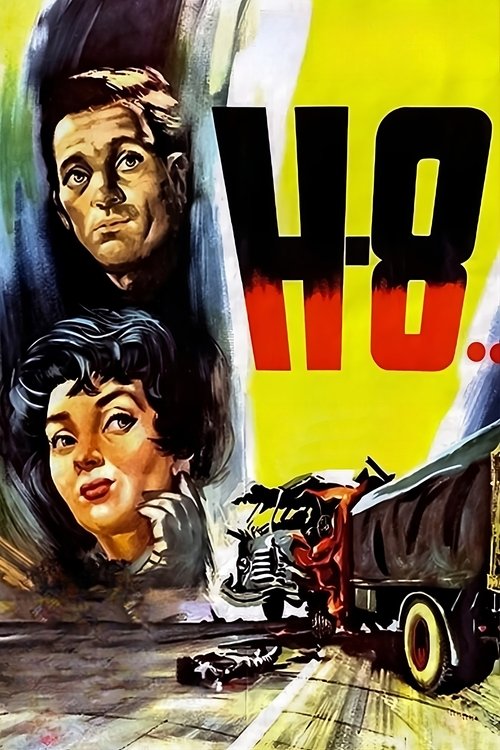
H-8...
1958 · Nikola Tanhofer
When you want suspense with a soul — a film to watch closely and sit with afterward, thinking about chance and how casually fate picks its victims. More gripping than grim, but it will leave you shaken.
What it's about
On a rainy night on the Zagreb–Belgrade highway, a reckless driver — his plate glimpsed only as the fragment 'H-8' — forces a bus and a truck into a head-on collision and vanishes. The film rewinds to the hours before impact, riding along with the passengers: their quarrels, flirtations, worries and small hopes. A narrator tells us up front that some of these people will not survive, but not which ones.
The experience
Quietly excruciating in the best way — every ordinary conversation on that bus is shadowed by what you know is coming. It plays like a countdown wrapped in a warm ensemble drama, and the dread builds without a single cheap trick.
The craft
The masterstroke is structural: telling you the ending in the first minutes and turning the whole film into an act of attention, so you study every passenger wondering who will be spared. Crisp black-and-white photography, rain-slicked night roads, and tight cross-cutting between bus and truck give it the momentum of a thriller and the texture of documentary fact.
Why it matters
Drawn from a real highway catastrophe, it became one of the most celebrated Yugoslav films of its era and a landmark of Croatian cinema, regularly cited among the region's best ever made.
Snapshot
H-8... is a Yugoslav (Croatian) black-and-white drama produced by Jadran Film in Zagreb, directed by Nikola Tanhofer, and drawn from a real traffic catastrophe on the Zagreb–Belgrade highway. Its premise is deceptively simple: on a rainy night, an unidentified passenger car — its number plate glimpsed only as far as the fragment "H-8..." — forces a bus and an oncoming truck into a head-on collision, then vanishes into the dark, its driver never caught. Around that anonymous act of recklessness the film assembles an ensemble portrait of the bus and truck passengers, cutting between their small journeys, quarrels, hopes and secrets in the hours before impact. What lifts it above a procedural or a message film is its narrational gambit: a voice-over addresses the audience at the outset and tells us, coolly, that some of these travelers will not survive the night — without telling us which. Everything that follows is watched through that scrim of foreknowledge. The film is today widely regarded as one of the summits of Croatian cinema, and in retrospective critics' polling it has repeatedly been named the greatest Croatian film ever made.
Industry & production
The film was a product of Jadran Film, the Zagreb studio that anchored Croatian feature production within the decentralized, republic-based structure of Yugoslav cinema in the 1950s. This was the era of relatively well-resourced state studio filmmaking, after the rigid ideological prescriptions of the immediate postwar years had loosened but before the oppositional energies of the 1960s "novi film" (new film). Within that system, H-8... is a studio picture in the best sense: professionally crewed, technically ambitious, and built on the infrastructure of a national studio capable of mounting a logistically demanding shoot that combined location work on an open highway with controlled interior staging.
The subject matter — a fatal road accident on the Bratstvo i jedinstvo ("Brotherhood and Unity") highway linking Belgrade and Zagreb — was topical. Motorization and the new arterial road were emblems of modernizing socialist Yugoslavia, and a mass-casualty crash carried an immediate documentary charge for contemporary audiences. The production translated a news event into a fiction while preserving the unresolved, unsettling fact at its core: the guilty driver was never identified. The precise budgetary and scheduling record for the production is thin in English-language sources, and this dossier does not assert figures it cannot substantiate.
Technology
H-8... was made on 35mm black-and-white film in the standard Academy frame typical of Yugoslav features of the period. Its technological interest lies less in novel equipment than in the demands its scenario placed on conventional 1950s tools. The story unfolds largely at night, in rain, and substantially inside and around moving vehicles — among the harder assignments in monochrome cinematography, since night, wet surfaces, and confined interiors all fight the film stock's appetite for light. The production accordingly leaned on the studio's capacity to build and light controlled mock-ups of vehicle interiors and to stage artificial rain and the collision itself, intercut with material shot on the actual road. The result reads as a marriage of location authenticity and studio control. Where specific camera and lighting hardware is concerned, the detailed technical record is not reliably documented in accessible sources, and it is described here only in the general terms the finished film makes evident.
Technique
Cinematography
The photography — the credited cinematographer is Slavko Zalar — is the film's most celebrated technical achievement and the engine of its atmosphere. Working in high-contrast monochrome, the film exploits the rainy night as a graphic resource: headlamp beams cutting through downpour, reflections sliding across wet asphalt and windscreens, faces isolated in pockects of interior light against surrounding blackness. The idiom borders on film noir in its chiaroscuro, but it is bent toward fatalism rather than menace. The confined bus and truck cabins are photographed to keep the ensemble legible while preserving the claustrophobia of shared, enclosed space, and the approach to the collision is built cinematographically as much as through cutting — a marshalling of light, motion, and darkness toward a catastrophe the audience has been told is inevitable.
Editing
Structurally the film is an editing achievement. It braids multiple passenger storylines across two vehicles and a shared timeline, moving between simultaneous actions and, crucially, between narrated foreknowledge and dramatized present. The cutting must sustain suspense that is not "what will happen" — we know a crash is coming — but "to whom," and it must keep an unusually large cast individuated. The march toward impact is paced as a tightening of the montage. The specific editor of record is not consistently documented in the English-language literature; rather than attribute the work to a name I cannot verify, I note that the film's construction is inseparable from Tanhofer's overall command of its temporal architecture.
Mise-en-scène / staging
The staging problem is that of the ensemble confined to moving boxes. Tanhofer arranges his travelers so that seating becomes dramaturgy: proximities, glances across an aisle, and the enforced intimacy of strangers generate the film's small conflicts and tendernesses. The two vehicles function as parallel social microcosms hurtling toward each other. The physical world — rain on glass, the swaying of the coach, the narrow corridor of the road — is used to compress a cross-section of society into a space none of them can leave.
Sound
Sound is integral to the film's dread. The ambient wash of rain, engine drone, and tire hiss forms a continuous bed against which the crucial voice-over narration is laid — the disembodied commentary that tells us death is among the passengers. This layering of an omniscient narrating voice over naturalistic vehicular sound is central to the film's effect. Details of the music score are not securely attested in the sources available to me, and I decline to attach a composer's name or characterization of the music that I cannot confirm.
Performance
The film asks for ensemble acting of a particular kind: a large cast, each given only fragments of screen time, must nonetheless register as a whole person quickly enough that their possible death carries weight. The performances are pitched to naturalism, avoiding star-vehicle grandstanding in favor of a democratic distribution of attention across the travelers. Among the players associated with the production is Antun Vrdoljak, later a prominent Croatian director and public figure; a fuller, verified cast enumeration is beyond what the accessible record lets me state with confidence, and I will not manufacture one.
Narrative & dramatic mode
The dramatic mode is fatalistic ensemble tragedy, organized around dramatic irony rather than mystery. By announcing at the start that some passengers are doomed, the narration converts every subsequent scene into an object of dread and pathos: an ordinary flirtation, a petty argument, a private worry all acquire the terrible possibility of being a last act. This is the structural logic of the fated-community story — the audience holds knowledge the characters lack. The film's genius is to withhold the specific assignment of death, so that suspense migrates from event to identity. The collision is thus not a twist but a horizon; the drama is the human material gathered before it. The unresolved guilt of the vanished "H-8..." driver adds a second, moral irony: the catastrophe has no visible author to punish, only anonymous carelessness and chance.
Genre & cycle
H-8... sits at the crossing of the disaster/accident film, the ensemble "cross-section" drama, and the crime film (the hit-and-run at its center is, formally, an unpunished crime). It belongs to the durable lineage of the multi-strand portmanteau narrative in which a diverse group is bound by a common vehicle or fate. Its tonal palette borrows from noir — nocturnal, rain-slicked, fatalistic — while its social scope aligns it with humanist realism. Within Yugoslav cinema it is a distinctive one-off rather than the product of a settled local cycle, which is part of why it has been received as singular.
Authorship & method
The controlling authorship is Nikola Tanhofer's. Tanhofer (1926–1998) came out of the Croatian film industry with a strong technical grounding, and H-8... remains the film on which his reputation principally rests; his method here is one of rigorous formal control marshalled toward emotional and moral effect, integrating narration, cutting, and photography into a single fatalistic design. The screenplay is credited to Zvonimir Berković and Tomislav Butorac; Berković would go on to his own directorial career, most notably with Rondo (1966), and the literate, structurally sophisticated conception of H-8... is consonant with that trajectory. The cinematography of Slavko Zalar is the decisive collaborative contribution, giving the film its visual signature. For the composer and editor, the reliable record accessible to me is thin, and I have deliberately left those attributions open rather than fill them with guesses; a scholar with access to the full Jadran Film credits should complete them.
Movement / national cinema
The film is a landmark of Croatian cinema and, more broadly, of the classical phase of Yugoslav filmmaking in the 1950s. It predates and in some respects anticipates the Yugoslav "novi film" / "crni val" (new film / black wave) of the 1960s, whose directors would push toward modernist form and social critique. H-8... is not a black-wave film — it works within the studio system and a broadly humanist address — but its self-conscious narration and mosaic structure show a formal ambition that looks forward to that later modernism. As a national-cinema monument it functions for Croatian film culture the way certain single canonical titles do elsewhere: a reference point against which later achievement is measured.
Era / period
Produced in 1958, the film is a document of high-1950s socialist Yugoslavia: a society modernizing rapidly, building highways, motorizing, and negotiating between collective ideology and individual lives. The Belgrade–Zagreb road is itself a period emblem — the "Brotherhood and Unity" artery linking the federation's two largest cities — and the film's cross-section of passengers can be read as a compressed image of that federal society in motion. The picture belongs to the moment after Yugoslav cinema had shed the crudest didacticism of the late 1940s and gained the craft and confidence to make ambitious studio drama.
Themes
The governing theme is fate and contingency — the arbitrariness with which death selects from an ordinary crowd. Around it cluster several others: anonymous guilt and the absence of accountability (the driver who is never found); mortality made vivid precisely because it is foretold; and the social panorama, the way a chance-assembled group of strangers stands in for a whole community. There is a persistent tension between the individual and the collective — each passenger a discrete life, all of them bound to a shared, unchosen outcome. The film also meditates, quietly, on how foreknowledge changes the meaning of ordinary moments, an almost philosophical inquiry conducted through popular narrative form.
Reception, canon & influence
Critically, H-8... has ascended to the status of Croatian cinema's benchmark work. In retrospective canon-forming exercises — critics' and professionals' polls conducted in the decades after its release — it has repeatedly been ranked the finest Croatian film ever made, and it is routinely singled out for the brilliance of its black-and-white photography and the audacity of its foretelling narration. Contemporary 1958 reception is less fully documented in accessible English-language sources, and I do not attribute specific period reviews or figures I cannot verify.
Its influences backward are best understood as belonging to two lineages. The first is the fated-community tale in which death is announced in advance and the narrative then anatomizes the lives it will claim — a structure with deep roots in literature and a strong kinship to Thornton Wilder's The Bridge of San Luis Rey, whether or not a direct debt can be proven. The second is the ensemble "vehicle" or cross-section drama descending from studio precedents such as Grand Hotel, transposed from hotel to highway. Its nocturnal, rain-lit visual manner shares the grammar of contemporaneous film noir.
Its legacy forward is primarily its enduring canonical authority within Croatian and post-Yugoslav film culture, where it stands as a proof of what the national cinema achieved at its 1950s height and as a touchstone for later filmmakers. Its architecture — multiple strands bound by a single catastrophe, framed by omniscient narration — also anticipates the network or "hyperlink" narratives that would become prominent in world cinema much later. Any claim that specific later films drew directly on H-8... should be made cautiously; the securer statement is that the film prefigured formal strategies that world cinema would rediscover, and that it has been kept alive through restoration and reappraisal as a classic rather than a curiosity.
Reception
A hit at home from day one — it took the top prize at the 1958 Pula Film Festival — and in 1999 Croatian film critics voted it the best Croatian film ever made; abroad it stayed almost invisible until Letterboxd-era cinephiles started passing it around as a jaw-dropping discovery.
How H-8... was received, from release to now →
Influences: the films it descends from and the films it influenced
- Grand Hotel (1932) — Establishes the cross-section 'vehicle' ensemble H-8... transposes from hotel to highway — strangers of unequal class braided into one narrative by sharing a single confined locus.
- Stagecoach (1939) — Confines a moral cross-section of society inside one vehicle in transit, using the shared journey to force disparate strangers' fates into a single suspense structure.
- The Bridge of San Luis Rey (1944) — Supplies the fated-community architecture — announce the catastrophe first, then reconstruct the separate lives converging on it — the Wilder template the dossier names as kin.
- Sunset Boulevard (1950) — Models the foretelling narration: a voice that discloses the ending in advance and then anatomizes how the doomed arrived there, the exact rhetorical gambit of H-8...'s omniscient voiceover.
- The Naked City (1948) — Threads multiple anonymous lives with an authoritative omniscient narrator over documentary-real locations, the 'many stories, one frame' voiceover grammar H-8... adopts.
- Odd Man Out (1947) — Robert Krasker's rain-slicked nocturnal chiaroscuro trailing a doomed man through a wet city is the noir night-photography idiom Slavko Zalar extends to the highway.
- The Wages of Fear (1953) — Builds sustained fatalistic dread around vehicles and cargo grinding down a hazardous road toward a foreknown catastrophe — road-as-death-machine suspense.
- Intolerance (1916) — Pioneers the parallel montage that cross-cuts independent story strands bound only by a shared thematic engine, the editing backbone of H-8...'s multi-strand design.
- The High and the Mighty (1954) — Contemporaneous sibling that loads a single imperiled vehicle (an airliner) with a passenger cross-section, the disaster-accident ensemble grammar H-8... runs in parallel.
- Rondo (1966) — The H-8... co-writer's own directorial feature extends its literate, rigorously architected Croatian chamber drama — the same structural sophistication credited to Berković's pen.
- The Sweet Hereafter (1997) — A single road accident kills a community's children and the film anatomizes the town it claims through interwoven strands — the fated-community-by-vehicle structure descended intact.
- Short Cuts (1993) — Weaves a large web of strangers whose lives brush and collide under a shared urban fate, the mature hyperlink-ensemble form H-8... prefigured.
Similar films
- The Wages of Fear (1953) — influence & lineage
- The Vanishing (1988) — shared sensibility
- A Taxi Driver (2017) — shared sensibility
- The Lost Bus (2025) — shared sensibility
- Passenger (1963) — shared sensibility
- Train to Busan (2016) — shared sensibility
- Landscape in the Mist (1988) — shared sensibility
- Crash (1996) — shared sensibility