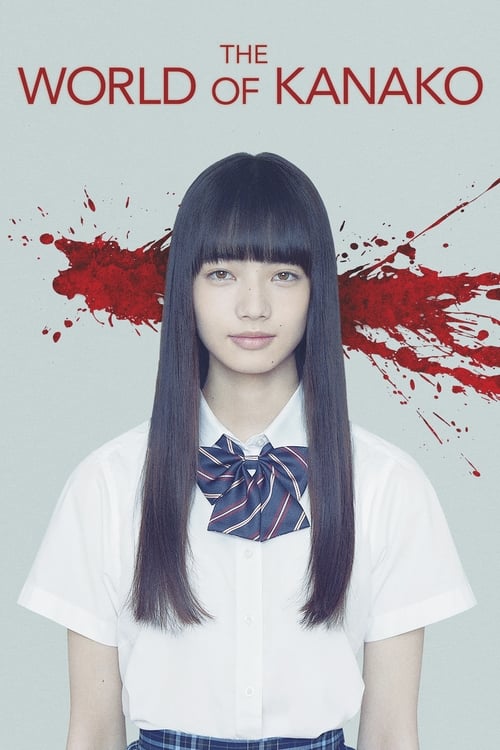
The World of Kanako
2014 · Tetsuya Nakashima
For when you want cinema turned up to eleven and can stomach real nastiness — a dare of a movie for adventurous nights, absolutely not a comfort watch. Know your tolerance going in.
What it's about
When straight-A student Kanako disappears, her mother turns to the worst possible man to find her: her ex-husband, a violent, alcoholic ex-cop with nothing left to lose. As he tears through Tokyo's underside — dealers, yakuza, terrified classmates — the picture of his angelic daughter curdles into something he can't recognize, and his search becomes as much rampage as rescue. A missing-girl mystery where nobody, least of all the searcher, is innocent.
The experience
An assault, honestly — hyper-caffeinated editing, lurid color, whiplash swings between pop-art playfulness and genuinely ugly violence. It's exhilarating and repellent at once, and it means to be; you come out wrung out.
Performances
Kōji Yakusho, one of Japan's greatest actors, goes ferociously against type as the father — a snarling, pitiful wreck of a man he somehow keeps magnetic for two hours. Nana Komatsu makes Kanako an unforgettable enigma out of only fragments and glances.
The craft
Tetsuya Nakashima directs like a man possessed: split timelines, animation bursts, retro title cards, and needle-drops slammed against brutality, all cut at a velocity few films attempt. The maximalist style isn't decoration — it's the father's fracturing mind made visible. Big screen, loud sound, seatbelt on.
Why it matters
A cult landmark of extreme Japanese cinema that pushed the missing-person thriller to its breaking point, and a jolting change of register for a director previously known for candy-colored melodrama.
Snapshot
The World of Kanako (Japanese title 渇き。, Kawaki, literally "Thirst") is Tetsuya Nakashima's blistering, deliberately repellent neo-noir, adapted from Akio Fukamachi's hardboiled novel Hateshinaki kawaki ("The Boundless Thirst"). It follows Akikazu Fujishima (Kōji Yakusho), a disgraced, alcoholic ex-detective enlisted to find his missing teenage daughter Kanako (Nana Komatsu) — only to discover that the angelic schoolgirl of his memory is a manipulative cipher at the center of a web of drugs, prostitution, and predation. The film weaponizes the missing-girl mystery, a genre built on sympathy and recovery, against itself: the deeper the father digs, the more monstrous everyone becomes, including him. Formally it is Nakashima at his most aggressive — a kaleidoscopic assault of split timelines, saturated color, hurtling cameras, pop-music irony, and graphic violence. Tonally it sits worlds away from the candy-colored whimsy of his earlier work, weaponizing that same maximalism toward nihilism. It remains one of the most divisive Japanese films of its decade: admired for its formal audacity, condemned for its near-total moral vacancy.
Industry & production
The film was produced and distributed in Japan within the established mainstream studio-distribution apparatus rather than the indie margins, a notable fact given its extreme content — it carried Japan's restrictive R18+ rating (Eirin's adults-only classification), unusual for a film built around a recognizable star like Yakusho and a literary property. Nakashima arrived at the project off the substantial commercial and critical success of Confessions (2010), which had been Japan's submission for the Academy Award for Best Foreign Language Film and a domestic hit; that standing afforded him the latitude to mount an uncompromising follow-up. The source novel by Akio Fukamachi was a well-regarded entry in Japan's prolific honkaku-adjacent crime fiction market, lending the production a recognizable IP foundation of the kind Japanese studios favor. Precise budget and box-office figures are not something I can confirm reliably; the film is generally understood to have been a modest commercial performer relative to Confessions, its severity limiting its reach. The production sustained a four-year gap after Confessions, consistent with Nakashima's deliberate, infrequent output.
Technology
The World of Kanako belongs to the fully digital era of Japanese commercial filmmaking, and its aesthetic is inconceivable without digital capture, intermediate grading, and the elastic post-production it enables. The film's hallucinatory color — bruised purples, neon reds, sickly greens — is the product of an aggressive digital color grade rather than photochemical process, and its dense compositing of on-screen text, animated flourishes, and superimposition extends the digital-collage approach Nakashima had refined since Memories of Matsuko (2006). The editing's extreme density — hundreds of cuts, intra-scene time-jumps, and rhythmic intercutting synchronized to music — likewise depends on nonlinear digital workflow. I should note plainly that I cannot confirm the specific camera systems or lab pipeline used; what is evident on screen is a film engineered in post as much as on set, treating the captured image as raw material for layered manipulation.
Technique
Cinematography
The camera in Kanako is restless to the point of aggression: whip-pans, handheld lunges, canted angles, and abrupt zooms that refuse the viewer any stable vantage. Nakashima and his cinematographer(s) compose in extremes — clinical wide tableaux that suddenly collapse into smeared, strobing close-ups. Light is rendered expressionistically, with hard neon sources, blown highlights, and pools of saturated color standing in for psychological states rather than naturalistic space. The visual scheme deliberately confuses beauty and disgust: a snowfall, a school corridor, a girl's face are lit with the same seductive gloss as scenes of brutality, implicating the camera's gaze in the film's predation. I'm not able to confirm the individual cinematographer credit with certainty — Nakashima has historically worked with more than one director of photography across a single film — so I'll refrain from attributing the work to a specific name.
Editing
Editing is the film's central instrument and its most contentious feature. The narrative is fractured across at least two timelines — the father's present-tense search and the events of months earlier seen partly through a classmate's vantage — and Nakashima cross-cuts them without conventional signposting, trusting (or daring) the viewer to assemble chronology from fragments. Within scenes, the cutting is percussive, often jumping forward or backward by seconds for disorienting effect, and frequently locked to the beat of incongruously upbeat pop and lounge music. Chapter cards, freeze-frames, and on-screen typography interrupt the flow. The effect is a sustained sensory overload that mirrors the protagonist's disintegration while withholding the catharsis of clear revelation. Detractors read this density as adolescent flash; admirers read it as a rigorously controlled assault in which form enacts the story's moral disorientation.
Mise-en-scène / staging
Nakashima's frames are crammed with designed detail — garish interiors, branded clutter, deliberately artificial production design that signals a world curdled into surface. Staging frequently undercuts gravity with grotesque comedy: violence choreographed as slapstick, sentiment punctured by sudden cruelty. The contrast between the spotless, idealized image of Kanako and the squalid spaces of the investigation is built into the décor. Costuming and color-coding carry meaning — Kanako's schoolgirl uniform becomes a charged emblem manipulated across the film. The overall environment is heightened, theatrical, anti-realist: a constructed hell rather than an observed Japan.
Sound
The soundtrack is a defining provocation. Nakashima scores extreme violence and degradation to buoyant, ironic music — easy-listening, pop, classical fragments — generating a queasy dissonance that has become a signature of his style since Matsuko. The juxtaposition refuses the audience an unmediated emotional response, holding suffering at an aestheticized, almost mocking distance. Sound design elsewhere is abrasive and percussive, matched to the cutting. I cannot confirm the composer or music-supervision credit reliably, so I won't attribute it.
Performance
Kōji Yakusho — one of Japan's most distinguished actors, far better known for restrained, humane roles — delivers a deliberately ugly, unhinged performance as Fujishima, a man whose paternal grief curdles into rage, paranoia, and sexual violence. The casting is itself a provocation: Yakusho's gravitas is conscripted to make a genuinely loathsome protagonist watchable. Nana Komatsu, then near the start of her career, plays Kanako largely as an absence and a projection — a surface onto which every other character's desire and fear is cast, which is precisely the role's design. Strong supporting turns (including by Satoshi Tsumabuki, Fumi Nikaidō, and Jun Kunimura) populate the surrounding grotesquerie. The performance register throughout is pitched, heightened, and unafraid of repulsiveness.
Narrative & dramatic mode
The film operates as an anti-detective story. It borrows the armature of the procedural — a search, clues, interrogations, a widening conspiracy — but systematically denies the genre's promises of recovery, justice, and moral clarity. The structure is fragmented and unreliable: chronology is scrambled, point of view shifts, and the titular girl is never granted a stable, knowable interiority. The dramatic mode is closer to a descent than an arc; rather than the detective restoring order, his investigation reveals that he is part of the rot, and the "solution" offers no redemption. This is mystery as nihilist provocation, in which the act of looking is shown to be corrupt and the object of the search is finally unrepresentable.
Genre & cycle
Kanako sits at the intersection of neo-noir, the Japanese hardboiled crime film, and the cycle of stylized extremity associated with post-2000 Japanese genre cinema (the lineage of transgressive directors like Sion Sono and Takashi Miike). Its missing-daughter premise places it in dialogue with international thrillers that interrogate paternal obsession, while its formal excess and moral vacancy align it with a strain of provocation cinema. Within Nakashima's own filmography it forms a tonal companion-and-inversion to Confessions: both are revenge structures built on the corruption of youth and adults alike, but Kanako strips away even the cold satisfaction Confessions offered. It can be read as a deliberate detonation of the redemptive missing-person drama.
Authorship & method
Tetsuya Nakashima is among the most stylistically identifiable Japanese filmmakers of his generation, a background in commercials and music-adjacent visual culture informing his maximalist, montage-driven approach. His career traces a striking tonal evolution: the pop exuberance of Kamikaze Girls (2004) and Memories of Matsuko (2006), the fairy-tale melancholy of Paco and the Magical Picture Book (2008), the icy cruelty of Confessions (2010), and the outright nihilism of Kanako. The throughline is method, not mood — the same toolkit of saturated color, ironic scoring, fractured chronology, and dense on-screen graphics is bent to radically different ends across the films. Nakashima is also a screenwriter and characteristically adapts existing literary material (here Fukamachi's novel) while refracting it through his own sensibility; he is frequently credited on the screenplay of his films. On the question of his key technical collaborators on Kanako specifically — cinematographer, editor, composer — I want to be candid that I cannot confirm the individual credits with the precision this section ideally demands, and I won't fabricate names; what can be said with confidence is that the film bears the unmistakable imprint of his post-production-intensive, collage-based authorship.
Movement / national cinema
The film belongs to a distinctly twenty-first-century Japanese commercial-genre tradition that fuses literary adaptation, star casting, and aggressively stylized direction — a current that runs parallel to, and sometimes overlaps with, the country's prolific output of transgressive and "extreme" cinema that gained international festival and cult attention in the 2000s. Unlike the social-realist or contemplative modes that often represent Japan abroad (the lineage of Kore-eda, for instance), Nakashima's work foregrounds artifice, velocity, and surface. Kanako can be situated within a broader anxiety running through Japanese genre film of the period about youth, the family, and the gap between idealized social image and private degradation — concerns it pushes to a deliberately scandalous extreme.
Era / period
Made and released in 2014, Kanako is a product of the fully digital, post-Confessions moment in Japanese commercial cinema, when a proven auteur could leverage success into an uncompromising hard-R provocation. Its preoccupation with the corrosion beneath a polished social façade — the model student who is secretly a predator, the protective father who is a violent abuser — resonates with a period sensibility skeptical of institutional and familial surfaces. The film's confrontational treatment of adolescent sexuality and its gleeful violence place it firmly outside any reassurance, marking it as a work that uses its era's technical and commercial freedoms to test the limits of audience tolerance.
Themes
The film's governing theme is the unknowability and corruption of the idealized other: Kanako exists almost entirely as a projection, and the men around her — her father above all — see in her what they desire or fear rather than who she is. From this flows a sustained interrogation of the predatory gaze, including the film's own, which lavishes seductive style on degradation and so implicates the viewer. Paternity is rendered as delusion and violence rather than protection; the search for a lost child becomes a mirror in which the searcher's own monstrousness is revealed. Beneath these runs a bleak vision of a society rotten at every level — school, family, police, commerce — with innocence exposed as either a lie or a vulnerability to be exploited. The Japanese title's single word, "Thirst," names the engine: an insatiable, finally unslakable craving that drives every character toward ruin.
Reception, canon & influence
Critically, The World of Kanako was sharply polarizing. Its detractors found it gratuitously violent, misogynistic, and formally exhausting — style deployed in the absence of moral or emotional purpose. Its defenders argued the opposite: that the assaultive form is precisely the point, an aesthetic strategy that refuses comfort and forces the viewer to confront complicity in the act of looking. This split — virtuosity versus vacancy — has largely defined its critical afterlife. I should note that I can't responsibly quote specific reviews, ratings, or box-office figures from memory without risking error, so I'll characterize the reception in general terms rather than cite numbers.
Looking backward, the film's influences are legible: the international neo-noir tradition of the corrupted investigator; the hardboiled register of its source novel; and most directly Nakashima's own prior cinema, especially Confessions, whose fragmented structure and ironic scoring it intensifies. Its stylistic kinship with the transgressive strain of contemporary Japanese genre filmmaking (the provocation cinema associated with figures like Sion Sono and Takashi Miike) is also clear, though such resemblances reflect a shared milieu more than direct lineage.
Looking forward, Kanako functions less as a film that founded a school than as a high-water mark of a certain maximalist, provocative auteurism — a touchstone in discussions of how far stylization can be pushed against repellent material before form and content fracture. For Nana Komatsu it was an early, attention-getting role ahead of a substantial career. Within Nakashima's body of work it stands as the most extreme statement of his method, frequently invoked when critics map the trajectory from his pop beginnings to his darkest extremes. Its canonical position is that of a divisive cult object rather than a consensus classic: a film whose influence is measured in argument — about taste, complicity, and the ethics of style — as much as in imitation.
A Deleuzian reading
Start with the snow.
The full Deleuzian reading of The World of Kanako →
Reception
Landed in 2014 as a shock to the system — festival write-ups were split between 'audacious' and 'repellent', with plenty of critics calling it nihilistic overkill. A decade on it's settled into cult-favorite status among extreme-cinema fans, though it never got the near-universal love of Nakashima's Confessions.
How The World of Kanako was received, from release to now →
Influences: the films it descends from and the films it influenced
- Confessions (2010) — The immediate parent: its braided multi-narrator chronology, slow-motion set to incongruously serene pop, and frost-blue digital grade are the exact toolkit Kanako inherits and pushes from icy cruelty into outright nihilism.
- Memories of Matsuko (2006) — Establishes Nakashima's commercial-trained, post-production-intensive collage method — musical-number montage, hyper-saturated color, and dense on-screen graphics — later inverted from candy-bright melodrama to predatory grime in Kanako.
- Natural Born Killers (1994) — The template for percussive multi-format cutting, ironic needle-drops over atrocity, and stock/film/video intercutting that implicates the viewer's appetite for violence — the assaultive editing grammar Kanako adopts wholesale.
- Chinatown (1974) — The corrupted-paternity engine — incest and a father's predation hidden beneath a detective plot — that Kanako recasts, so that the investigator's search for a missing girl exposes his own monstrousness rather than a villain's.
- The Long Goodbye (1973) — Anti-detective neo-noir that hollows out the hardboiled investigator into a deluded, complicit figure — the deconstruction of the seeker-of-truth that Kanako weaponizes by making its 'detective' an abuser.
- Memento (2000) — Models the fractured, withheld-information chronology as a detective's epistemological trap, where scrambled time conceals the investigator's own guilt — the structural device Kanako uses to delay our recognition of the father's nature.
- Oldboy (2003) — East Asian stylized-revenge neo-noir whose kinetic camera, lacquered expressionist color, and incest reveal demonstrate how operatic form can be bent against repellent material — a direct stylistic forebear.
- Sin City (2005) — Pioneers the fully digital-composited, graphic-novel color grade — selective desaturation and blown-out artifice — that licenses Kanako's anti-realist, post-produced palette over a hardboiled noir frame.
- Trainspotting (1996) — The commercial-director's kinetic vocabulary — freeze-frame title cards, ironic pop scoring over degradation, restless handheld — that Nakashima's generation absorbed and Kanako escalates.
- Run Lola Run (1998) — Music-video propulsion applied to narrative: relentless rhythmic cutting, on-screen graphics, and animation inserts that turn editing tempo itself into the film's argument — a percussive-cutting precursor.
- Ichi the Killer (2001) — Same Japanese-extreme milieu: cartoonishly excessive gore staged with anti-realist artifice and tonal whiplash, sharing Kanako's strategy of stylizing brutality past the threshold of comfort.
- Cold Fish (2010) — Contemporary Japanese provocation cinema mapping a 'normal' man's descent into atrocity with escalating, gleeful violence — the shared register of nihilistic genre maximalism Kanako belongs to.
- Love Exposure (2008) — Maximalist four-hour collision of perversion, faith, and pop energy whose restless camera and ironic scoring over transgression exemplify the same provocateur-auteur sensibility.
- Enter the Void (2009) — Subjective, neon-drenched first-person gaze and disorienting time structure that force the viewer inside a degraded consciousness — kin to Kanako's implicating, predatory point-of-view aesthetics.
- Only God Forgives (2013) — Pushes neon expressionist color and tableau staging against corrupted-family violence to the brink of vacancy — the same 'style versus emptiness' debate, over similar material, in the same moment.
- Spring Breakers (2012) — Deploys against-type casting (wholesome stars debased), looping fractured chronology, and seductive candy-color over moral rot to indict the viewer's pleasure — the predatory-gaze critique Kanako runs in parallel.
Similar films
- Confessions (2010) — influence & lineage
- Ichi the Killer (2001) — influence & lineage
- Memories of Matsuko (2006) — influence & lineage
- Perfect Blue (1998) — shared sensibility
- Mind Game (2004) — shared sensibility
- Kotoko (2011) — shared sensibility
- Nobody Knows (2004) — shared sensibility
- Gozu (2003) — shared sensibility