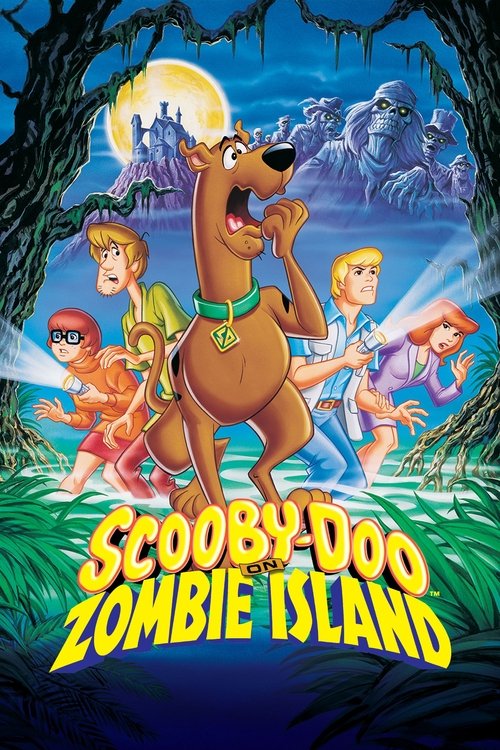
Scooby-Doo on Zombie Island
1998 · Jim Stenstrum
For a Halloween-adjacent family night, or when you want a nostalgic scare that actually delivers — comfort viewing with an edge, perfect for introducing a kid (or your inner kid) to horror.
What it's about
Years after going their separate ways, Scooby, Shaggy, Velma, Daphne, and Fred reunite to chase one more ghost — a pirate said to haunt a Louisiana bayou island. But this time the rubber-mask routine doesn't apply: the zombies rising from the swamp appear to be terrifyingly real, and the gang's tricks may not be enough.
The experience
Genuinely spooky for a Scooby movie — moss-hung swamp gothic and unnerving creature scares — while keeping the chase-scene slapstick and snack jokes intact. It's cozy and creepy at once, with real stakes the franchise had never dared.
The craft
Lush direct-to-video animation from Japan's Mook Animation gives the bayou real atmosphere — fog, torchlight, and creature designs that lean into horror rather than away from it. The writing takes the gamble of breaking the franchise's founding rule and plays the consequences straight.
Why it matters
The movie that resurrected a moribund franchise, launching the long run of Scooby features that followed and setting the darker, more sincere tone the series still draws on — a generation's first horror movie.
The direct-to-video feature that resurrected a moribund franchise by breaking its founding rule: this time the monsters are real. Mystery Inc. reunites, adult and slightly disillusioned, on a Louisiana bayou island where the ghost of a pirate proves to be the least of their problems. Produced under Warner Bros. animation veterans Glenn Leopold and Davis Doi with lush work from Japan's Mook Animation, it takes its swamp gothic seriously — moss-hung atmospherics, genuinely unnerving creature designs, a body count of terrified livestock — while keeping the Rube Goldberg chase comedy intact. The gamble paid off commercially and creatively, launching the long run of Scooby movies that followed and setting a darker, more sincere tone the franchise still draws on. A generation raised on it treats Zombie Island as their first horror film, and not without reason: its zombie reveals carry real melancholy, and its villains are played disturbingly straight. Few children's cartoons have ever committed so fully to their own dread.
Reception
A direct-to-video hit in 1998 that revived the whole Scooby franchise, it's since been canonized by millennials as the definitive Scooby-Doo movie — the rare kids' DTV title that gets sincere critical reappraisal as a legitimately good horror-comedy.
How Scooby-Doo on Zombie Island was received, from release to now →
Influences: the films it descends from and the films it influenced
- Scooby-Doo, Where Are You! (1969) — Supplies the exact 'meddling kids unmask a rubber-suited hoaxer' episode structure that Zombie Island inverts, keeping the beat-for-beat investigation rhythm but paying it off with a monster that is genuinely, non-negotiably supernatural.
- I Walked with a Zombie (1943) — Val Lewton's shadow-and-suggestion bayou voodoo atmosphere — mist, cane fields, dread built from what you don't see — is the template for Moonscar Island's plantation gothic staging and moonlit cinematography.
- White Zombie (1932) — Establishes the voodoo master who reanimates the dead as bound plantation labor; Lena and Simone's harvesting of victims to sustain themselves descends directly from its master-and-thrall zombie economy.
- Cat People (1942) — The predatory were-feline villainess who transforms and stalks in shadow is the direct creature-design and staging ancestor of Simone Lenoir's werecat reveal.
- Abbott and Costello Meet Frankenstein (1948) — Pioneers the comedy-horror balance Zombie Island relies on: the clowns mug and flee for laughs while the monsters are performed and shot completely straight, never winking, so the scares still land.
- Night of the Living Dead (1968) — Legitimizes the zombie as a literal rotting siege threat rather than a costume gag, giving Zombie Island license to stage decaying revenants that genuinely menace the leads inside a kids' property.
- Batman: The Animated Series (1992) — Warner's 'dark deco' house style — cinematic key-lighting, deep shadow, painted-on-black backgrounds and anime-studio subcontracting — is the production-design lineage the DTV Scooby unit borrows for its atmospheric-gothic look.
- Scooby-Doo and the Witch's Ghost (1999) — Stenstrum's immediate follow-up continues the same DTV model of a real, un-unmaskable supernatural antagonist and feature-length atmospheric build, cementing the format Zombie Island launched.
- Scooby-Doo and the Alien Invaders (2000) — Extends the launched DTV line's move toward genuine emotion and stakes — here a wistful romance subplot — carrying forward Zombie Island's tonal shift away from pure gag-mystery.
- Scooby-Doo (2002) — The live-action franchise revival inherits Zombie Island's core reinvention: the monsters are actually real, and the film trades on nostalgia for the formula while breaking its cardinal 'it was a man in a mask' rule.
- ParaNorman (2012) — Aims kids' comedy-horror at genuinely melancholic, sympathetic zombies who are wronged victims rather than villains — the same pathos-for-the-undead move Zombie Island makes with its cursed cat-cult harvest.
- Gravity Falls (2012) — Builds a mystery-of-the-week engine where the paranormal is authentically real beneath the comedy; Hirsch has cited Zombie Island as a touchstone for pairing genuine dread with a kid-detective format.
- Over the Garden Wall (2014) — Pitches autumnal Americana gothic and a pervasive melancholy directly at children, trusting young viewers with real unease and mortality the way Zombie Island's disillusioned, grown-up tone does.
- Monster House (2006) — Puts kid investigators against a haunting that turns out to be an actual malevolent supernatural entity with a tragic backstory, mirroring Zombie Island's 'the threat is real and it has a sad history' reveal.
- Courage the Cowardly Dog (1999) — Delivers rural-gothic horror-for-children in which the menace is staged straight and genuinely frightening against a comedic protagonist, sharing Zombie Island's swamp-country dread aesthetic.
- Coraline (2009) — Commits to real, un-defanged horror and creeping melancholy in a children's frame, extending the same premise Zombie Island proved — that a young audience can be trusted with authentic fear rather than a safe fake-out.
Similar films
- Night of the Living Dead (1968) — influence & lineage
- Five Nights at Freddy's (2023) — shared sensibility
- Scream (1996) — shared sensibility
- Fear Street: 1978 (2021) — shared sensibility
- Dawn of the Dead (1978) — shared sensibility
- The Lost Boys (1987) — shared sensibility
- Beetlejuice (1988) — shared sensibility
- Teenage Mutant Ninja Turtles: Mutant Mayhem (2023) — shared sensibility