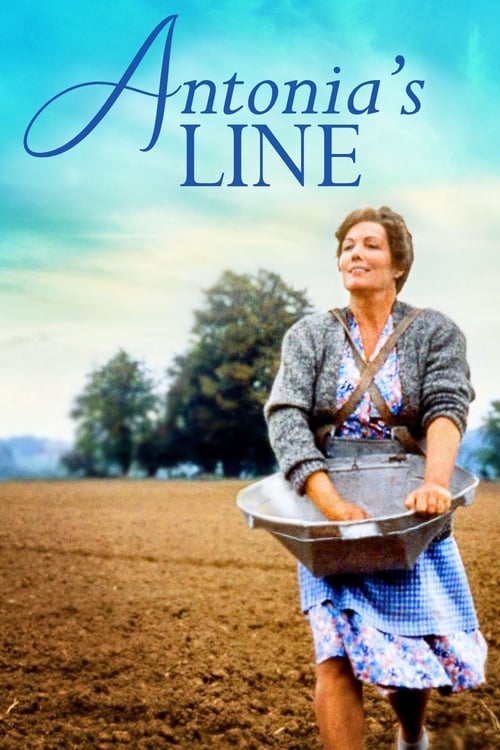
Antonia's Line
1995 · Marleen Gorris
For when you want a big-hearted saga about living on your own terms — something affirming that doesn't lie to you about loss. Good for a reflective night when you need to feel that a life can be built well.
What it's about
After the Second World War, the widow Antonia returns with her daughter to the rural Dutch village of her birth to take over the family farm. Over the following decades she gathers around her a chosen family of women, eccentrics, and outsiders — a philosopher who never leaves his room, a patient suitor, daughters and granddaughters — building a small matriarchal world that answers to no church and no husband. The film unfolds as Antonia, on the morning she knows will be her last, looks back across it all.
The experience
Warm, earthy, and surprisingly tough — a fable rhythm of seasons, births, and deaths that folds real darkness into its generosity without losing its stride. It's funny and sensual, then suddenly grave, and it leaves you with a full-hearted, life-goes-on glow.
Performances
Willeke van Ammelrooy anchors the whole chronicle as Antonia with a calm, amused authority — a woman who never raises her voice because she never has to.
The craft
Marleen Gorris structures decades of village life as a deathbed recollection, braiding agrarian realism with light strokes of magic realism, so the film moves like a told tale rather than a plot. The painterly farm landscapes and communal table scenes give it the texture of a folk memory.
Why it matters
It won the Academy Award for Best Foreign Language Film — the first winner in that category directed by a woman — and became a touchstone for feminist storytelling that chooses celebration over grievance.
Snapshot
Antonia's Line (Dutch: Antonia) is a multi-generational village chronicle that follows a widow who returns to her rural Dutch hometown after the Second World War and, over the ensuing decades, gathers around her a self-made community of women, eccentrics, and outsiders. Structured as a deathbed recollection — Antonia wakes on the morning she knows will be her last, and the film moves back through the years — it braids agrarian realism with strokes of magic realism into a warm, unsentimental fable about matriarchy, mortality, and life lived outside patriarchal and clerical authority. It remains best known as the film that won the Academy Award for Best Foreign Language Film, the first winner in that category to have been directed by a woman, and as the most widely seen work by Marleen Gorris, whose earlier films had established her as one of European cinema's most explicitly feminist directors.
Industry & production
The film was an international co-production drawing on Dutch, Belgian, and British financing and talent — a common structure for mid-1990s European art cinema seeking budgets and markets larger than any single national industry could supply. Its casting reflects this arrangement, pairing the Dutch star Willeke van Ammelrooy with the Belgian actors Els Dottermans, Jan Decleir, and Mil Seghers. Public-service and film-fund support of the kind that underpinned Dutch and Flemish production in this period was characteristic of how such a project would have been assembled, though the precise financing breakdown is not something I can detail from the reliable record without risking invention.
Commercially, Antonia's Line followed the classic path of a subtitled art film elevated by awards prestige: a modest but genuine international theatrical life, particularly on the specialty circuit in the United States and United Kingdom, greatly amplified once it took the Oscar. I will not cite specific box-office figures, as I cannot verify them precisely. What is well documented is the trajectory — a Netherlands submission that moved from festival exposure into the Academy race and emerged, somewhat unexpectedly, as the winner over more heavily favored competitors.
Technology
Antonia's Line is a photochemical film of its era, shot and finished on 35mm using conventional late-analog production tools; it belongs to a filmmaking culture that predates digital intermediate grading and digital capture. There is nothing technologically experimental about the production — no reliance on emergent digital effects, and no obvious optical trickery even in its magic-realist passages, which are achieved through staging, performance, and editing rather than visual-effects technology. The film's ambition lies entirely in dramaturgy and tone, not in technical apparatus, and the honest assessment is that its "technology" is unremarkable in the best sense: an invisible, serviceable classical toolkit deployed in support of story.
Technique
Cinematography
The photography, by Willy Stassen, favors a lucid, unhurried classicism suited to a decades-spanning chronicle. The visual register leans on natural landscape and seasonal change — fields, farm, village square, and the changing agrarian light — to mark the passage of time that the narrative compresses. Rather than a restless or showy camera, the film generally adopts composed, legible framings that let ensemble action and the tableau of the growing "line" of women register clearly. Where the film touches the fantastical, the camera treats the marvelous with the same matter-of-fact steadiness it gives the ordinary, a choice that is central to the magic-realist effect: the extraordinary is neither underlined nor stylized but simply observed.
Editing
The editing carries the film's most distinctive structural burden. Built as a retrospective told from the day of Antonia's death, the film must move fluidly across many years and an expanding cast of characters spanning four generations. The cutting compresses whole life-spans — births, deaths, courtships, departures — into an accumulating rhythm, using the deathbed frame and voice-over narration as the connective tissue that holds elliptical time together. This montage-of-a-lifetime approach lets the film register mortality as ordinary recurrence rather than melodramatic event: characters arrive, age, and pass with a cyclical evenness that the editing naturalizes.
Mise-en-scène / staging
The staging is organized around the farm and village as a self-contained social world. Gorris and her collaborators build the "line" of the title visually through recurring communal gatherings — above all the long refectory table where the expanding found-family eats together, a motif that concretizes the film's argument that kinship is chosen and assembled rather than merely inherited. The village is populated with a gallery of deliberately heightened figures — the reclusive philosopher Crooked Finger, the moon-howling "Mad Madonna," and other outsiders — staged so that the eccentric and the marginal sit at the center of the frame rather than its edges. This inversion, keeping the socially excluded at the compositional heart of communal scenes, is itself a thematic statement executed through blocking.
Sound
The score, composed by Ilona Sekacz, supports the film's blend of the earthy and the fabular, coloring its passages of communal warmth and its recurrent encounters with death. The soundworld is otherwise grounded in the rural and the domestic. Most structurally important is the voice-over narration, which frames the entire film as an act of storytelling handed down the female line and gives the chronicle its intimate, oral-history texture. Detailed technical accounts of the film's sound design are thin, and I won't manufacture specifics; what is clear is that music and narration together do much of the work of binding the film's wide temporal span into a single reflective voice.
Performance
Willeke van Ammelrooy anchors the film as Antonia with a performance of grounded authority — a matriarch who is warm without being soft, decisive without cruelty, and entirely unbothered by the disapproval of church and convention. The role asks her to age across decades and to serve as the still center around whom an ensemble revolves, and the film's coherence depends on her steadiness. Around her, the performances lean into the material's fable logic: Els Dottermans as the artist-daughter Danielle, Mil Seghers as the melancholy intellectual Crooked Finger, and Jan Decleir as the patient suitor Bas each play characters pitched slightly larger than naturalism yet kept emotionally credible. The ensemble style — heightened but sincere — is what allows the film's eccentrics to read as beloved community members rather than caricatures.
Narrative & dramatic mode
The film's dramatic mode is the multi-generational chronicle told as retrospective, framed by Antonia's foreknowledge of her own death on the day the film's "present" unfolds. This gives the sprawling story a firm elegiac spine: everything is recollected, already complete, and colored by the awareness of endings. Within that frame the film proceeds episodically, following the four-generation "line" — Antonia, her daughter Danielle, granddaughter Thérèse, and great-granddaughter Sarah — as it accumulates members by birth, adoption, and elective affinity. The narration, positioned as the family's inherited act of storytelling, foregrounds the theme that a lineage is also a narrative passed down. Tonally the film is a tragicomedy: it moves without friction between broad comic warmth, frank sexuality, sudden violence, and death, treating all four as facets of the same continuous life-cycle. This refusal to segregate comedy from mortality is the film's defining dramaturgical signature.
Genre & cycle
Antonia's Line sits at the intersection of the family saga, the village comedy-drama, and the feminist fable, inflected throughout by magic realism. Its lineage of eccentric-village portraiture and its cyclical, generational structure place it in dialogue with the European literary tradition of magic realism more than with any single film cycle. Within 1990s art cinema it belongs to a visible strand of woman-centered, matrilineal storytelling — films preoccupied with female community, reproduction on women's own terms, and the transmission of knowledge and property down a female line. It is not a genre film in the industrial sense; rather, it hybridizes recognizable modes (pastoral, saga, comedy of communal life) in service of an explicitly feminist worldview.
Authorship & method
Marleen Gorris is the film's decisive author, and Antonia's Line is best understood within her body of work. Her earlier features — A Question of Silence (1982) and Broken Mirrors (1984) — were confrontational, formally severe feminist films that indicted patriarchal violence directly. Antonia's Line marks a notable shift in register: it advances a comparably radical vision of female autonomy — women who reject marriage, church, and male authority while choosing motherhood, sexuality, and community on their own terms — but does so through warmth, comedy, and fable rather than through anger. This tonal evolution, from polemic to affirmative myth, is the through-line of Gorris's authorship, and it is what made Antonia's Line her breakthrough with international audiences. She would follow it by moving into English-language literary adaptation with Mrs Dalloway (1997).
Her key collaborators on the film include cinematographer Willy Stassen, whose lucid pastoral photography grounds the fable; composer Ilona Sekacz, whose score threads the film's comic and elegiac tones; and lead Willeke van Ammelrooy, whose central performance carries the chronicle. Gorris herself wrote the screenplay, making the film unusually unified as a single-authored vision of writer-director. Detailed accounts of the editorial collaboration are comparatively thin in the accessible record, and I won't overstate what can be confidently attributed; the editing's achievement, however, is inseparable from the script's own elliptical, decades-spanning design.
Movement / national cinema
The film is a landmark of Dutch cinema and, given its Flemish cast and Belgian involvement, of Low Countries filmmaking more broadly. Dutch feature production in this era was a small national industry heavily dependent on public funding and co-production, and its most visible international successes tended to be either the muscular genre work of a Paul Verhoeven or precisely the kind of festival-and-awards art film that Antonia's Line exemplifies. Gorris's win gave Dutch cinema one of its highest-profile international honors and reinforced the Netherlands' reputation, in this period, as a source of serious, socially engaged auteur cinema disproportionate to the size of its industry.
Era / period
Antonia's Line is a mid-1990s film that is, in its subject, a film about the second half of the twentieth century. Its diegesis opens in the immediate aftermath of the Second World War and runs forward across the postwar decades, using one rural community to register the era's slow social transformations — the loosening grip of the church, changing sexual mores, shifting ideas of family. As a production, it belongs to the moment just before digital tools reshaped both filmmaking and distribution, and to a European art-cinema economy in which festival prestige and the foreign-language Oscar remained the primary engines for lifting a subtitled film into wider visibility.
Themes
The film's central theme is matriarchy as a chosen order: a lineage of women who build a self-sufficient community founded on solidarity, land, and mutual care rather than on marriage or patriarchal inheritance. Flowing from this are its treatments of female sexuality and reproduction as matters of women's own choice — Danielle's decision to bear a child without a husband, and the frank, unpunished depiction of desire, including a lesbian relationship, across the generations. The film is pointedly anti-clerical and anti-authoritarian, setting its humane village community against the judgments of the church and the cruelties of patriarchal men, some of whom it depicts as sexually violent. Above all it is a meditation on the life-cycle: birth, sex, aging, and death are presented as one continuous, recurring rhythm, and the film's magic-realist touches — the dead who linger, the eccentrics who see differently — serve this vision of mortality as ordinary and cyclical rather than tragic. The transmission of knowledge (embodied in the philosopher Crooked Finger and the prodigy Thérèse) and of story (the inherited narration) rounds out its portrait of a lineage that passes down not property but wisdom and memory.
Reception, canon & influence
Critically, Antonia's Line was received as a warm, intelligent, and distinctly feminist crowd-pleaser — praised for its humane sweep, its ensemble, and van Ammelrooy's central performance, and for the deftness with which Gorris balanced comedy, sexuality, and death. Some critics found its fable-like generosity and its schematic gallery of virtuous women and villainous men less bracing than the harder edges of Gorris's earlier work, but the dominant response was affectionate. Its decisive canonical event was winning the Academy Award for Best Foreign Language Film — a result that surprised many observers and that carries a durable historical significance as the first win in the category for a female-directed film. That milestone is the anchor of the film's place in cinema history and the primary reason it remains cited and studied.
Looking backward, the film's influences are more literary and cultural than narrowly cinematic: the tradition of magic realism, the European village-chronicle, and the feminist thought that had shaped Gorris's whole career. Looking forward, its most concrete legacies are Gorris's own subsequent access to larger English-language projects, beginning with Mrs Dalloway, and its standing as a reference point in feminist film studies and in histories of the foreign-language Oscar. It is frequently invoked in discussions of matrilineal and woman-centered storytelling on screen. Beyond these, tracing a direct line of stylistic imitation is genuinely difficult, and I won't claim specific descendant films that the record does not support; the film's influence lives more in its symbolic status — as proof, at a particular moment, that a openly feminist fable directed by a woman could reach the summit of international recognition — than in a school of formal followers.
Reception
An arthouse crowd-pleaser in its day — it took the Toronto audience award and then the Oscar — yet it quietly slipped out of mainstream memory, becoming one of the least-watched Foreign Language winners; feminist cinephiles have been steadily reclaiming it as essential ever since.
How Antonia's Line was received, from release to now →
How to watch Antonia's Line: what to notice on a first viewing
- Notice how quickly the film jumps between different years. The story moves through decades in a handful of scenes, one generation giving way to the next without pausing to explain the gap in between. You're always a little unsure how much time has passed, which makes the chronicle feel like memory rather than a fixed history.
- Count the people seated around the long table at each gathering. Gorris keeps returning to the same long refectory table as the household's found family grows, adding a new face, another outsider, another generation with each visit. The table is where the film shows you a family being built by choice rather than by blood.
- Watch for the light and season changing between scenes on the farm. Willy Stassen's photography leans on natural agrarian light and visible seasonal change, sun, snow, harvest, to mark years passing that the film's editing otherwise compresses. The land itself is the clock. You feel time move through weather rather than through calendar dates.
- Listen for the narrator explaining who is telling the story. Voice-over narration frames the whole film as a story handed down the female line, giving the chronicle the intimate texture of a family telling its own history aloud. The film presents itself as an inheritance, passed by voice rather than by paper.
- Watch how Antonia's manner stays the same as everyone around her ages. Willeke van Ammelrooy plays her with a grounded, unhurried authority that barely shifts across decades, while children are born, grow, and start families of their own around her. Her steadiness gives the sprawling story a fixed point to keep returning to.
The whole guide to watching Antonia's Line, with the keys for a rewatch →
Influences: the films it descends from and the films it influenced
- Wild Strawberries (1957) — Establishes the dying-elder retrospective in which an old protagonist's final day dissolves into decades of remembered life, the exact frame-and-flashback armature Antonia's deathbed narration reuses.
- Amarcord (1973) — Models the village chronicle organized as a cyclical seasonal calendar of communal rituals populated by a gallery of grotesque local types, the structural template for Antonia's town of eccentrics.
- The Spirit of the Beehive (1973) — Pioneers the lucid pastoral-classical register in which rural realism quietly admits the marvelous, partly filtered through a child's gaze, the tonal permission Gorris takes for her fable's magic realism.
- Cría Cuervos (1976) — Builds a house-of-women across generations using elliptical intercutting of timeframes and a female voice reconstructing the past, prefiguring Antonia's matrilineal, time-collapsing narration.
- The Tree of Wooden Clogs (1978) — Photographs peasant labor across the turning seasons with non-actor communal ensembles and elliptical time, the pastoral-classicism and rural-chronicle grammar Willy Stassen's lensing echoes.
- Days of Heaven (1978) — Marries golden pastoral cinematography to a plainspoken female voice-over that narrates a rural chronicle elliptically, the oral-history-over-landscape device Antonia's Line adopts wholesale.
- Fanny and Alexander (1982) — Stages a multi-generational family saga around the recurring communal feast table while letting the supernatural intrude on bourgeois realism, twin devices central to Antonia's staging and register.
- A Question of Silence (1982) — Gorris's own severe indictment of patriarchal authority and male violence is the polemical root that Antonia's Line converts from confrontation into affirmative feminist fable — same authorship, inverted tone.
- Babette's Feast (1987) — Makes the communal table the film's moral and emotional climax within an anti-clerical current where sensual pleasure redeems a pious community, directly informing Antonia's table-motif and anti-church stance.
- Chocolat (2000) — Extends the anti-clerical fable of a free, unmarried woman revitalizing a repressed village against church authority, wrapping radical female autonomy in magic-realist warmth exactly as Gorris did.
- Volver (2006) — Continues the matriarchal chronicle in which a dead mother returns as a benign ghost inside a female-only community, braiding comedy with death — Antonia's tonal balance of fable, mortality, and chosen matriarchy.
- Fried Green Tomatoes (1991) — Uses an aging woman narrating a decades-spanning women's-community chronicle as spoken oral history inside a frame-and-flashback structure, the same retrospective-matriarch delivery mechanism.
- Like Water for Chocolate (1992) — Anchors a matrilineal magic-realist chronicle in the women's kitchen and table where food carries literal supernatural charge, narrated across generations — parallel fusion of feminist fable and magic realism.
- The Joy Luck Club (1993) — Braids multiple generations of mothers and daughters through interlocking voice-over recollections, the multi-generational matrilineal oral-history architecture Antonia's Line runs on a single family line.
- The House of the Spirits (1993) — Adapts Allende into a multi-generational matriarchal magic-realist saga where premonitions and spirits are woven matter-of-factly into a family line of women, the literary magic-realism tradition Gorris draws from cinematically.
- How to Make an American Quilt (1995) — Frames interlocking generational women's stories around a communal craft-gathering told as oral history, a contemporaneous cousin to Antonia's communal-women's-circle-as-chronicle-frame.
- Barber's Tales (2013) — Builds female emancipation as a matriarchal succession within a small rural community, women inheriting and remaking a domestic-economic space across a hostile social order.
Similar films
- Volver (2006) — influence & lineage
- Amarcord (1973) — influence & lineage
- Babette's Feast (1987) — influence & lineage
- Two Women (1960) — shared sensibility
- All About My Mother (1999) — shared sensibility
- Ida (2013) — shared sensibility
- Romería (2025) — shared sensibility
- Sound of Falling (2025) — shared sensibility