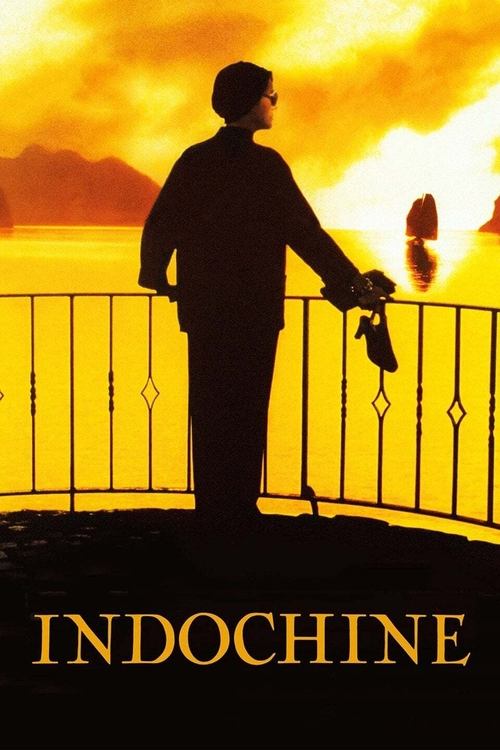
Indochine
1992 · Régis Wargnier
For when you're in the mood to be swept away — a long, gorgeous, tear-streaked epic for an evening when you want romance with real historical weight, not a quick watch.
What it's about
In 1930s colonial Vietnam, Éliane Devries runs a rubber plantation and raises Camille, an orphaned Vietnamese princess, as her own daughter. When a young French naval officer becomes entangled first with Éliane and then with Camille, the private love triangle is swallowed by history — Camille is pulled toward the anti-colonial struggle, and mother and daughter end up on opposite sides of an empire coming apart.
The experience
Sweeping and unhurried, an old-fashioned epic that trades in longing, lush landscapes, and heartbreak on a historical scale. It builds slowly and leaves a melancholy that lingers.
Performances
Catherine Deneuve anchors the whole film as Éliane, imperious and wounded at once — a performance that earned her an Oscar nomination and ranks among her defining roles.
The craft
A 160-minute production mounted on a grand scale, from plantation interiors to limestone bays, shot with a painterly eye for both colonial luxury and the landscape that dwarfs it. It's exactly the kind of film that rewards a big screen and a free evening.
Why it matters
It won the Academy Award for Best Foreign Language Film and became the most internationally celebrated French production of its moment, part of a wave of films reckoning with France's colonial past.
Snapshot
Indochine is a 160-minute French historical epic that folds a maternal melodrama into the long decline of French colonial rule in Vietnam. Catherine Deneuve plays Éliane Devries, the French-born owner of a rubber plantation in 1930s Indochina, who has raised an orphaned Vietnamese princess, Camille (Linh Dan Pham), as her own daughter. When the naval officer Jean-Baptiste Le Guen (Vincent Pérez) becomes the lover first of Éliane and then of Camille, the private triangle is overtaken by history: Camille is radicalized, flees into the anti-colonial underground, and emerges as a revolutionary, while Éliane is left to raise Camille's son. The film became the most internationally decorated French production of its moment, winning the Academy Award for Best Foreign Language Film and earning Deneuve an Oscar nomination for Best Actress. It is at once a lavish star vehicle for Deneuve and an explicit allegory in which the relationship of French "mother" and Vietnamese "daughter" stands for the colony's separation from the metropole.
Industry & production
Indochine belongs to the high-end, internationally financed French prestige cinema of the early 1990s, the same commercial register as the cinéma de patrimoine (heritage cinema) then in vogue. It was produced by Paradis Films and associated companies with the participation of major French distribution and television interests, and mounted on a scale unusual for French production — extended location work, large crowd scenes, period reconstruction of colonial Saigon, plantations, and the imperial court. The film shot on location in Vietnam (including the celebrated karst seascape of Ha Long Bay) and in Malaysia, with the Vietnamese locations carrying much of the film's spectacle value. I do not have a reliable budget figure to cite and will not invent one, but the production was clearly positioned as a flagship, awards-oriented release rather than a modest auteur project.
Strategically, the film arrived in a remarkable cluster of French films looking back at Indochina: Jean-Jacques Annaud's The Lover (L'Amant) and Pierre Schoendoerffer's Diên Biên Phu were released in the same general window. This concentration — three substantial French films revisiting colonial Vietnam within roughly a year — is itself the production story: the colonial past had become bankable subject matter, and Indochine was the entry that most successfully translated that material into global awards-circuit success.
Technology
Indochine was shot photochemically on 35mm color stock for theatrical exhibition, in the conventional professional production technology of its era; there is no notable technical innovation associated with the film, and its ambitions are scenographic rather than technological. Its "technology," in effect, is the logistics of large-scale location shooting — moving a French crew and equipment to Southeast Asian locations and staging period-dressed crowds, junks, and processions in real landscapes rather than on sets or via optical effects. The film's visual richness comes from natural locations, art direction, and anamorphic-style widescreen composition rather than from any new tool or process. I have no documented evidence of unusual camera or post-production technology and will not manufacture any.
Technique
Cinematography
The cinematography, by François Catonné, is the film's most consistently praised craft element and was recognized at the César Awards. Catonné works in a lush, painterly register: deep, saturated greens of the rubber plantations; the hazy water-and-limestone vistas of Ha Long Bay; warm, lamp-lit interiors of colonial households; and cooler, harder light as the story moves toward repression and revolt. The camera favors expansive long shots that place small human figures against immense landscape — a compositional strategy that doubles as theme, dwarfing the colonists' private dramas within a country whose scale and history exceed them. Catonné also handles Deneuve in the manner of classical star portraiture, lighting her with a flattering, sculptural attention that reinforces her function as the film's fixed center of gravity.
Editing
The editing, by Geneviève Winding, manages a sprawling chronology that spans from the 1930s to the 1954 Geneva Conference, organized as Éliane's retrospective narration to Camille's grown son. The cutting is classical and unhurried, prioritizing legibility and emotional continuity across a long running time and a wide geographic canvas. The film's principal structural device is the frame narrative: the present-tense act of telling brackets the historical flashback, and the editing returns periodically to that framing register to mark the passage from intimate memory to public history. The challenge the cut negotiates throughout is tonal — braiding the domestic melodrama of the love triangle with the larger movement toward anti-colonial uprising without letting either thread collapse into the other.
Mise-en-scène / staging
Wargnier stages Indochine as period spectacle in the grand manner. Production and costume design reconstruct the stratified world of late colonial Indochina — the planters' verandas and ballrooms, the bustle of Saigon, the formality of the Vietnamese imperial court, and at the other extreme the squalor of the coolie market and the prison island of Poulo Condore. The staging consistently visualizes hierarchy: French bodies elevated, served, and centered; Vietnamese bodies arranged as labor, retinue, or crowd. As the narrative turns, the same scenographic vocabulary is inverted, with mass political action filling spaces that earlier framed colonial leisure. The mise-en-scène thus carries the film's argument as much as its dialogue does.
Sound
The sound design supports the film's epic-melodramatic mode, layering the ambient textures of plantation, port, and crowd beneath a prominent orchestral score. Patrick Doyle's music is a central expressive instrument, swelling at the emotional crests of the love story and the political tragedy. The film was recognized for its sound work at the César Awards. The original-language soundtrack moves between French and Vietnamese, and the bilingual texture is itself meaningful, marking the boundary between colonizer and colonized that the plot keeps trying to cross.
Performance
Performance is organized around Deneuve, whose Éliane is a study in controlled surfaces — proprietary, maternal, erotically wounded, and finally elegiac. The role leans on and complicates Deneuve's established screen iconography of cool composure; the Academy Award nomination for Best Actress reflected how thoroughly the film is built as her vehicle. Opposite her, Linh Dan Pham, in an early screen role, carries Camille's arc from sheltered ward to hardened revolutionary, and Vincent Pérez supplies the romantic fulcrum as Jean-Baptiste. The supporting ensemble — including Jean Yanne as the cynical colonial police chief and Dominique Blanc, who was honored at the Césars for her supporting performance — fleshes out the colonial milieu. The performances are pitched to the film's heightened melodramatic key rather than to naturalism.
Narrative & dramatic mode
The dramatic mode is historical melodrama in the epic register: large emotions, fated love, maternal sacrifice, and personal destinies bent by political upheaval. The structure is a framed flashback — Éliane narrating the past to Étienne, Camille's son, so that the entire film is colored as memory, confession, and inheritance. This retrospective framing converts private history into testimony and gives the melodrama an elegiac cast from the first frame: we know we are watching a vanished world recalled by its survivor. The narrative braids two registers that comment on each other — the intimate triangle (Éliane / Jean-Baptiste / Camille) and the macro-history of an empire losing its grip — and its central dramatic engine is the substitution of one love for another and one allegiance for another, until the daughter chooses the nation over the mother.
Genre & cycle
Indochine sits at the intersection of the romantic epic, the colonial film, and 1990s French heritage cinema. Its most immediate cycle is the early-1990s wave of French films returning to Indochina — alongside The Lover and Diên Biên Phu — a moment when French popular cinema collectively revisited the colonial past. More broadly it belongs to the lineage of the international historical romance set against imperial decline, where a doomed love affair becomes the lens for a society's transformation. Critics have frequently situated it within the contested category of "nostalgic" colonial cinema, films that render the colonial world with such visual seduction that the question of complicity becomes part of their reception.
Authorship & method
Régis Wargnier directed and shares screenplay credit, and Indochine is the film that established his international profile. The screenplay was a collaborative effort: Wargnier worked with co-writers including Erik Orsenna, Louis Gardel, and Catherine Cohen, combining literary and dramatic sensibilities to shape the sweep of the story and the device of Éliane's narration. (Orsenna is a noted French novelist, which is consistent with the film's literary, retrospective architecture.) The key craft collaborators define the film's texture: cinematographer François Catonné, whose landscape-and-portrait imagery is the film's signature; composer Patrick Doyle — best known in this period for his scores for Kenneth Branagh's Shakespeare adaptations — whose romantic orchestral writing drives the emotional dynamics; and editor Geneviève Winding, who holds the long, time-spanning structure together. Wargnier's method here is that of the classical metteur en scène of prestige cinema: marshaling star, landscape, score, and period craft into a unified, large-scale emotional machine, with Deneuve's presence as the organizing principle.
Movement / national cinema
The film is a touchstone of mainstream French national cinema of its era — specifically the well-financed, export-oriented heritage and prestige production that flourished in France in the late 1980s and early 1990s. It is not an avant-garde or new-wave-descended work; its lineage runs through the tradition of high-production-value French literary and historical cinema. Its national significance is doubled by subject: as a French film about French Indochina, it is also a national reckoning — or, in the view of its critics, a national consolation — concerning the lost empire. The film became, by virtue of its Oscar, a prominent international ambassador for French cinema in that period.
Era / period
Indochine depicts French Indochina principally across the 1930s, extending its arc to the 1954 Geneva Conference that followed the French defeat at Dien Bien Phu and partitioned Vietnam — the moment at which the colonial relationship the film dramatizes is formally dissolved. The story thus runs from high colonial confidence through rising anti-colonial agitation to the threshold of decolonization. As a film of its own era, it is a product of early-1990s France: made roughly four decades after the events it depicts and within living memory of the colonial period, at a cultural moment when France was again willing — commercially and emotionally — to look back at Indochina on the big screen.
Themes
The film's governing theme is the allegory of colonialism as a familial bond and its rupture: Éliane is explicitly figured as a mother to the Vietnamese Camille, and the daughter's departure into revolution enacts the colony's separation from the metropole. Around this central conceit cluster maternity and inheritance (made literal in Camille's child, whom Éliane raises and who becomes the listener of the whole tale); love as both personal desire and political allegiance, where to choose a lover is to choose a side; and the seduction and violence of empire, the plantation economy's beauty inseparable from its coerced labor and its prisons. The framing device foregrounds memory, nostalgia, and the politics of who narrates history — the entire account reaches us through the colonizer's voice, which is precisely what later critics have interrogated.
Reception, canon & influence
Critically and on the awards circuit, Indochine was a major success. It won the Academy Award for Best Foreign Language Film and brought Deneuve an Oscar nomination for Best Actress — a rare double recognition for a French-language film — and it was honored at the César Awards, where its strengths in performance and craft (Deneuve's lead, supporting acting, cinematography, and sound among them) were recognized. (I am confident of the Oscar win and Deneuve's nominations and of multiple César recognitions; I am avoiding citing an exact César tally I cannot verify.) Its broad critical reception praised the visual splendor, the scale, and Deneuve's performance, while a significant strand of criticism — particularly in postcolonial film scholarship — has read the film as a beautiful but politically softened, even nostalgic, account of empire, one that centers French experience and aestheticizes the colonial world even as it narrates its loss. That tension between spectacle and critique is now central to how the film is discussed.
Looking backward, the film draws on the long tradition of the international historical romance and on France's literary culture of colonial memory (carried in part by its novelist co-writer), filtered through the high-gloss conventions of heritage cinema. Looking forward, its primary legacy is as the defining popular text of the early-1990s French "return to Indochina" and as a recurring case study — for its allegorical structure and its star-centered, scenographically opulent treatment of colonial history — in scholarship and teaching on colonial and postcolonial cinema. It also consolidated Régis Wargnier's standing as a director of large-scale historical drama and reaffirmed Deneuve's stature as an emblem of French cinema on the world stage. Claims of direct, traceable influence on specific later filmmakers are not something I can substantiate from the established record, and I will not overstate them; its enduring presence is as canonical reference point and object of debate rather than as a documented stylistic template for successors.
A Deleuzian reading
Start with the size of things.
The full Deleuzian reading of Indochine →
Reception
A prestige juggernaut on release — it won the Best Foreign Language Film Oscar and made Catherine Deneuve an Academy Award nominee — but it's since been reframed by postcolonial critics as the epitome of glossy French 'heritage cinema' nostalgia for empire, admired and side-eyed in equal measure.
How Indochine was received, from release to now →
Influences: the films it descends from and the films it influenced
- Gone with the Wind (1939) — Supplies the template of a plantation-mistress's romantic fortunes staged as allegory for a doomed social order, the personal-loss-mirrors-civilizational-collapse melodrama Éliane's arc inherits.
- Lawrence of Arabia (1962) — Originates the landscape long-shot that dwarfs the human figure and treats geography as the true subject — Catonné's wide Indochina vistas descend directly from Lean and Freddie Young's monumental framing.
- A Passage to India (1984) — Sets the heritage-cinema mode of the colonial encounter: imperial spectacle in which the colony is aestheticized into beauty even as colonial authority visibly frays.
- The Last Emperor (1987) — Models the individual-life-mapped-onto-national-rupture structure via framed flashback, with location shooting in authentic Asian sites and sumptuous Storaro-style color that Indochine reproduces.
- Out of Africa (1985) — Near-template: retrospective female voice-over framing a colonial romance, sweeping orchestral score over landscape, and a European star (Streep) deployed as the organizing presence of an empire's elegy.
- India Song (1975) — Establishes the languid, mournful aestheticization of French-Indochina torpor — the nostalgic beautifying of empire's decay that Indochine adopts wholesale as mood.
- Belle de Jour (1967) — Constructs the cool, opaque, glamorous Deneuve screen icon that Indochine relies on as its star portraiture and organizing principle.
- The Last Metro (1980) — Precedent for Deneuve as emblem of French national cinema anchoring a period drama — the star-as-organizing-principle of a historical narrative.
- Jean de Florette (1986) — Codifies the French heritage-cinema package — literary source, regional landscape, prestige period craft, large budget, international export — that Indochine scales up.
- East-West (1999) — Wargnier's own follow-on: a time-spanning historical melodrama of exile built as a star vehicle where personal romance carries the weight of geopolitical history.
- The Horseman on the Roof (1995) — Post-Indochine French heritage epic that extends the same large-scale fusion of landscape cinematography, period spectacle, and romance.
- Atonement (2007) — Extends the time-spanning heritage melodrama: framed retrospective narration in which a personal romance frames historical catastrophe, paired with lush cinematography and a romantic score.
- Days of Glory (2006) — Inherits the French-colonial-history epic form while contesting it — turning Indochine's metropolitan-centered, nostalgic gaze back toward the colonized subjects it had aestheticized.
- The Lover (1992) — Twin pillar of the early-'90s 'return to Indochina': same-year colonial nostalgia from a Duras source, eroticized retrospective narration, and lush tropical cinematography.
- Diên Biên Phu (1992) — The military counterpart of the same 1992 Indochina-memory wave — location-shot French-colonial-war spectacle addressing the same historical loss from the battlefield.
- Cyrano de Bergerac (1990) — Contemporaneous French heritage blockbuster marshaling opulent period mise-en-scène and a marquee star as prestige export in the same commercial mold.
- Henry V (1989) — Linked through composer Patrick Doyle, whose surging romantic orchestral writing here defines the same emotion-driving scoring method he brings to Indochine.
Similar films
- Jean de Florette (1986) — influence & lineage
- Cyrano de Bergerac (1990) — influence & lineage
- Out of Africa (1985) — influence & lineage
- Gone with the Wind (1939) — influence & lineage
- Chocolat (1988) — shared sensibility
- Black Girl (1966) — shared sensibility
- The Umbrellas of Cherbourg (1964) — shared sensibility
- Emitaï (1973) — shared sensibility