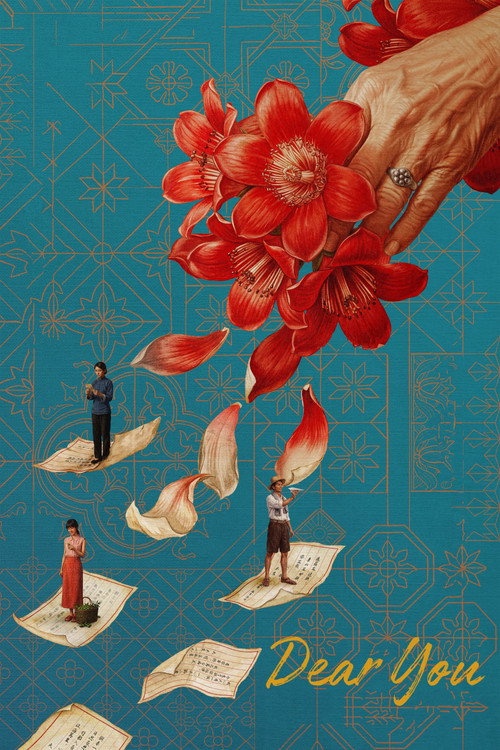
Dear You
2026 · Lan Hongchun
For a family-movie night with real feeling underneath the laughs — when you want to be entertained and then quietly ambushed by emotion. Comfort viewing with a lump in the throat.
What it's about
When his 'billionaire grandfather' in Thailand goes silent amid debt troubles, young Xiaowei flies south to track him down and secure the family fortune. What he finds instead is a mystery folded into his grandmother's past: the man who has been writing to her for years is not her husband. A treasure hunt turns into an untangling of family secrets stretched across the Chinese diaspora in Thailand.
The experience
It starts as a breezy quest comedy and deepens, letter by letter, into something wistful and moving — a film about the distances families cross and the things they leave unsaid. Light on its feet, warm at its core.
The craft
The film draws its emotional weight from real history: the century-old tradition of letters and remittances that connected Chaoshan (Teochew) families in China to relatives in Siam. Structuring a comedy around that correspondence — the quest plot giving way to an epistolary elegy — is the writing's smartest move.
Why it matters
A regional Chinese production working outside the star-and-studio system, and part of a growing body of films giving the Southeast Asian Chinese diaspora its stories on screen.
Snapshot
A grandson flies to Thailand to collect a fortune and comes home with a correspondence. That inversion — quest comedy turning into epistolary elegy — is the whole architecture of Dear You, and it places the film squarely inside a body of history that is unusually well documented even where the film's own paper trail is not: the Chaoshan (Teochew) migration to Siam, and the letters and remittances that migration ran on for a century and a half.
A caution belongs at the top. This is a very recent regional release by a director who works outside the star-and-studio system, and the verifiable public record on it — credits below the line, budget, shooting schedule, festival itinerary, critical response — is thin at the time of writing. Everything asserted here about the film's context is grounded; where a claim concerns the film's specific execution, it is marked as inference from the director's prior work and from the production norms of its cycle, not as established fact.
Industry & production
Lan Hongchun belongs to one of the more interesting anomalies in the contemporary Chinese industry: the hyper-local dialect feature financed substantially from within the region it depicts, aimed first at that region's audience and its diaspora, and only secondarily at the national market. His 2018 debut Dad, I'll Make It (《爸,我一定行的》) was made in Teochew with Chaoshan locations and Chaoshan performers drawn largely from short-video platforms rather than from the professional casting pool — reportedly including Zheng Runqi, a Chaoshan online performer, in the lead. Its 2023 follow-up, released internationally under a title in the Dear Mother family, kept the same language and the same territory.
The economics of this model are worth stating plainly because they explain the film's form. A Teochew-language feature cannot open wide against a New Year tentpole and cannot rely on stars to sell trailers. It is capitalized modestly, often with regional and clan-adjacent money; it plays disproportionately in Guangdong and in the Southeast Asian Teochew markets; and it recoups by converting a linguistic community into a ticket-buying constituency. That is closer to the exhibition logic of the 1950s–60s Amoy-dialect (Hokkien) films made in Hong Kong for Taiwan and Nanyang audiences than to anything in the mainland mainstream. Dear You's move into Thailand is not tourism — it is the film following its own distribution map to the largest Teochew population on earth.
Chinese productions shooting in Thailand have a well-established infrastructure to draw on: Thai service crews, incentive rebates, and a decade of precedent running from Lost in Thailand (2012) through Lost in the Stars and No More Bets (both 2023). What is not publicly documented is whether Dear You was structured as a genuine co-production or as a mainland production with Thai service support; the distinction matters for quota treatment and for revenue in Thailand, and it should not be guessed at.
Technology
No equipment or post credits for this film are reliably in the public record, so what follows is the available baseline rather than a description of choices made. A production of this scale in 2026 shoots large-format digital — an Alexa 35 or Venice-class body is the default rental in both Guangzhou and Bangkok — finishes through an ACES-managed pipeline, and delivers DCP plus near-simultaneous streaming masters for the domestic platforms. Drone and gimbal coverage of the Chaoshan courtyard-house vernacular and of Bangkok's Yaowarat is now so cheap that its absence would be the stylistic statement.
Two technologies bear more directly on the film's substance. The first is the short-video platform. Lan's casting pipeline, his audience-acquisition, and the dialect-comedy idiom his performers arrive already fluent in are all Douyin-and-Kuaishou phenomena; the marketing of a film like this is conducted in vertical clips and want-to-see counts on Maoyan and Taopiaopiao long before a poster exists. The second is archival: the qiaopi letters the film's plot turns on have themselves been digitized at scale in Shantou and were inscribed on UNESCO's Memory of the World Register in 2013. A film built on found correspondence in 2026 is working with a subject that is more accessible, and more photographable, than it was a generation ago.
Technique
Cinematography
On the evidence of the earlier Chaoshan films, the house grammar is unshowy: medium and medium-wide framings that keep whole family groups in one shot, available and practical light in interiors, and a willingness to let a scene run rather than cut into it. The Thailand material almost certainly breaks that register — a heat-saturated palette, denser and more mobile street coverage — and the film's expressive burden is likely carried by that contrast between the ordered grey-and-terracotta of the ancestral compound and the chromatic overload of Bangkok. This is inference, not report.
Editing
The synopsis implies a two-clock structure: the present-tense search, and the decades of correspondence surfacing behind it. Films in this mode almost always resolve into cross-cutting between a journey and a reading, with the letters supplying voice-over that runs against the images rather than describing them. The dramaturgical problem such a film has to solve in the cutting room is when the audience learns what the protagonist learns — simultaneously (suspense withheld, recognition shared) or earlier (dramatic irony, the audience watching him not-know). Which solution Dear You takes is the single most consequential formal question about it, and it is not one this dossier can answer.
Mise-en-scène / staging
The Chaoshan half of the film has an exceptionally dense iconography available to it, and Lan's earlier work has used it: the si diam kim and ê suaⁿ hó courtyard house types, the ancestral hall, gongfu tea served continuously as the medium through which every difficult conversation is conducted, bai lao ye deity offerings, the funerary and New Year calendars that organize a Chaoshan year. The Thai half has an equally specific vocabulary — the Sino-Thai shophouse, the Teochew shrines and clan charities of Bangkok's Chinatown, the gold shops on Yaowarat Road. The film's staging, if it works, works by rhyming the two: the same altar, the same tea tray, six hundred miles and four generations apart.
Sound
This is where the film is least replaceable. Teochew is a Southern Min language, not a Mandarin dialect in any linguistic sense and not intelligible to Mandarin speakers; mainland prints require subtitles. Choosing it is a choice to make most of one's national audience read. The tradition it opens onto — Teochew opera (chaoju), the string-ensemble xianshi music, the gong-and-drum repertoire — is also a living tradition in Bangkok, where troupes have played for the Teochew community for over a century. A score that moves between those idioms and a conventional orchestral underscore would be doing the film's thematic work sonically. Equally, the trilingual reality of the Thai scenes (Teochew, Thai, Mandarin, with the grandfather's generation speaking a Teochew that has drifted from the homeland's) is available as texture; whether the film exploits it is unknown.
Performance
Lan's method has been non-professional and semi-professional casting, which buys authenticity of accent and body at the cost of range. The mode this film is in — broad comedy that turns, late, into grief — is brutally demanding on exactly the register amateurs find hardest. The pivot scene, whatever it is, either lands or the film collapses.
Narrative & dramatic mode
The structure is classical recognition-and-reversal in a comic wrapper. A young man pursues an object (the billionaire grandfather, the inheritance, the rescue from debt) and discovers that the object never existed as he understood it: the letters that constituted his grandfather's presence were written by someone else. That is peripeteia in its textbook form — the pursuit produces knowledge that dissolves the pursuit's premise.
Two older literary machines are running underneath. One is Cyrano: the proxy letter-writer whose words are received as another man's, love arriving in the right envelope with the wrong return address. The other is the benevolent lie — the family conspiracy to protect an elder from a truth, the structure that organizes The Farewell (2019) and, differently, Good Bye, Lenin! (2003). The moral question both machines generate is the same one and it is genuinely hard: was the deception a theft of the grandmother's life, or the thing that made it livable? A film in the family-comedy mode is under commercial pressure to answer the latter, warmly and quickly. Whether Dear You earns that answer or merely asserts it is the central critical question anyone writing on it will have to settle.
The journey armature — a young person travelling to find a vanished relation and finding a different history instead — has a distinguished lineage, from Central Station (1998), where a letter-writer for the illiterate escorts a boy toward an absent father, to Lion (2016). What distinguishes the Chaoshan version is directionality: the grandson retraces his great-grandfather's emigration route in reverse, and does it as a consumer with a passport rather than as a labourer in a steerage berth.
Genre & cycle
Dear You sits at the intersection of four live cycles.
The Chinese family-reunion comedy (hejiahuan) that has anchored Spring Festival and summer slates for a decade, and its more specific subspecies, the tearjerker comedy — comedy for two acts, catharsis in the third — whose modern template is Hi, Mom (2021).
The Chinese-film-in-Thailand cycle, which since Lost in Thailand has treated the country as a comic elsewhere, and which since No More Bets has treated Southeast Asia as a site of menace. Dear You arrives after both and is, on its premise, a deliberate corrective to the second.
The regional-dialect feature, which runs from Crazy Stone (2006) through Jia Zhangke's Shanxi films and Bi Gan's Guizhou to the Chaoshan pictures — but where those directors use dialect for realist texture inside Mandarin-language films, Lan's films are dialect all the way down.
And the pan-Asian grandmother film, decisively reactivated by Pat Boonnitipat's How to Make Millions Before Grandma Dies (2024) — a Thai film about a Teochew-Thai family, inheritance, and a grandson's calculating love that turns real. That film travelled across Southeast Asia and into China. Dear You is working the same seam from the opposite shore, and the comparison is unavoidable.
Authorship & method
Lan Hongchun's authorship is best described not as a style but as a position: he is the filmmaker who has made Chaoshan legible to itself on screen, working with local performers, local money, local language, and a subject matter that the national cinema had left to documentary and to the Shantou archives.
The below-the-line credits for Dear You — cinematographer, editor, composer, screenwriter — are not reliably documented in accessible sources, and this dossier will not supply names it cannot verify. What can be said about the method is structural. Films in this model are typically written in the room with dialect consultants and performers, since the comedy is idiomatic and cannot survive translation from a Mandarin draft; the director functions as much as a cultural broker — securing locations in clan compounds, negotiating with lineage associations, recruiting from a local performance scene — as a stylist. That is a real authorial practice, and a rarer one in China than the auteur model it is usually measured against.
Movement / national cinema
The most useful frame is the Sinophone, in Shu-mei Shih's sense: the cultural production of Chinese-speaking communities at and beyond the edges of the Chinese state, in languages that are not Mandarin, with histories that do not resolve into a single national narrative. Dear You is Sinophone by construction — a Teochew film about the Teochew of Thailand, a population whose Chineseness has been Thai for four generations.
It also connects to a buried commercial history: the Nanyang exhibition circuits on which the Shaw and Cathay empires were built, the Teochew opera troupes that toured Siam, and the mid-century Amoy-dialect production boom that served diaspora audiences the Mandarin and Cantonese industries did not. Chaoshan dialect cinema is a small, late, digital-era recurrence of that older arrangement, in which a film's natural market is a language community rather than a country.
Era / period
Three contemporaneous conditions shape how the film reads in 2026.
The Chinese box office has become extraordinarily concentrated — the 2025 phenomenon of Ne Zha 2 demonstrated how much of a year's revenue a single title can absorb — and the mid-budget, non-IP, adult-audience film is squeezed hard. A dialect family comedy survives in that market by being unsubstitutable to its core audience rather than broadly appealing.
China–Thailand relations were strained through 2025 by the scam-compound abductions publicized after the Wang Xing case in January of that year, which was widely reported to have depressed Chinese tourist bookings to Thailand. A warm, familial, Thailand-set Chinese film in 2026 is not politically neutral; it is a repair gesture, whether or not it was conceived as one.
And the qiaopi have entered their heritage phase — museumized in Shantou, UNESCO-inscribed, taught. Filming them now is filming a thing that has already been designated as memory, which brings both institutional support and the risk of piety.
Themes
Money as the grammar of love. The qiaopi were letter and remittance in one object; affection and cash arrived in the same envelope and could not be separated. The film's premise — a grandfather defined by wealth, then by debt, then by absence — sits directly on that fusion. In the Mao era, dependents of overseas Chinese held a distinct social category and could exchange remittance certificates for goods otherwise unobtainable; being loved from abroad was, materially, a form of status.
落叶归根 / 落地生根 — fallen leaves return to the root, versus taking root where you land. The two idioms name the central unresolved question of the Chinese diaspora, and the film's discovery that the correspondent is not the husband is a way of asking it: the man who stayed in touch is not the man who was supposed to come back.
The woman who waits. The grandmother is the film's real subject, and the tradition she stands in — decades of household maintenance funded by a man who is a handwriting sample — is one of the most consequential and least filmed structures of Chinese social history.
Inheritance as fantasy. The rich overseas relative is a genuine fixture of Chaoshan imagination, not an invention; the best-known Thai-Chinese business dynasties, the Chearavanont family of CP Group among them, do trace to Chaoshan villages. The film seems to weaponize that fantasy in order to dismantle it.
Reception, canon & influence
Reception. There is no substantial critical literature on Dear You at the time of writing, and no reliable aggregate audience score, box-office figure, or festival record to report. Stating otherwise would be fabrication. What can be said is what the precedent predicts: dialect films of this kind are received domestically along a fault line, praised for authenticity and warmth by critics attentive to regional cinema, and faulted by others for sentimentality and for a comic register calibrated to an in-group. The specific critical exposure here is the reveal — whether it is treated as an earned reversal or as a twist deployed for effect.
Backward. The film's debts are legible: the Cyrano proxy-letter device; the benevolent-deception family film of The Farewell; the quest-for-an-absent-father road picture of Central Station; the tearjerker-comedy architecture of Hi, Mom; the Thailand-as-comic-elsewhere template of Lost in Thailand; the Teochew-Thai intergenerational melodrama of How to Make Millions Before Grandma Dies; and, structurally, the epistolary cinema that runs through Iwai Shunji's Love Letter (1995), in which correspondence with a person who is not who the sender believes is precisely the mechanism.
Forward. Too early to assess, and worth saying so directly. The measurable questions are identifiable, though: whether the film widens the commercial ceiling for non-Mandarin Sinophone features in China; whether it pulls Chinese production toward diaspora subject matter in Southeast Asia and away from the crime-thriller framing of 2023; and whether it consolidates Lan Hongchun's three features into something the industry treats as a Chaoshan cycle rather than three local successes. The first of those will be visible in a year of greenlights. The last is already half-true in the English-language titling, where Dear Mother and Dear You have been made to rhyme.
A Deleuzian reading
A man sits still while his own sentences are read aloud in another man's name.
The full Deleuzian reading of Dear You →
Reception
Opened as a small regional Teochew-dialect release in Shantou in April 2026, then word of mouth turned it into the sleeper story of the year — five straight weeks atop the Chinese box office and nearly ¥2 billion, landing third on the 2026 annual chart.
How Dear You was received, from release to now →
Influences: the films it descends from and the films it influenced
- Dad, I Can Do It (2018) — Established Lan's production method that *Dear You* reuses wholesale — casting from the Chaoshan stage and short-video performance scene rather than the Mandarin star system, and writing the gag structure directly in Teochew so the puns survive, since the comedy is untranslatable from a Mandarin draft.
- Take You to See My Mom (Dear Mother) (2023) — Fixed the staging grammar *Dear You* inherits: the gongfu tea tray as the scene's blocking anchor, where the pouring and re-pouring of three cups sets the rhythm of an argument and gives actors business that keeps dialect dialogue from becoming static two-shot talk.
- Su Liu Niang (1957) — The canonical Chaoju opera film supplies the specific sonic vocabulary — erxian and yehu strings, the xianshi ensemble's sliding pitch — that *Dear You* quotes non-diegetically to signal the ancestral register, a recognizably regional sound cue rather than a generic orchestral swell.
- The Love Eterne (1963) — Proved that a regional operatic idiom could be engineered into mainstream Sinophone commercial cinema for overseas diaspora markets — the exact commercial gambit *Dear You* runs with Teochew, including the reliance on a musical idiom the target audience already knows by ear.
- The Shop Around the Corner (1940) — The foundational architecture of correspondence between people who misidentify each other, built so the audience holds the knowledge the characters lack — every scene between them plays double, which is precisely how *Dear You* sustains comedy across an epistolary deception.
- Cyrano de Bergerac (1990) — The proxy-letter device in its purest form: eloquence composed by one body and credited to another, staged so the camera holds on the ghostwriter's face while the letter is read aloud by or to someone else — the shot *Dear You* repeats at its hinge.
- Love Letter (1995) — The two-clock cross-cut between correspondents who never share a frame, with the reveal delivered through a physical archival object (handwriting, a library card) rather than through dialogue — the structural template behind *Dear You*'s epistolary frame and its peripeteia.
- Central Station (1998) — The professional letter-writer for illiterate clients who edits, withholds and never posts what she is paid to transcribe, turning a transactional act of writing into a moral debt — and then the road quest for an absent father that the unposted letters force.
- The Farewell (2019) — The benevolent-lie family conspiracy staged as logistics: symmetrical frontal ensemble framing at the banquet table where relatives coordinate the deception in the presence of its subject, with the generational language gap doing the comic work.
- How to Make Millions Before Grandma Dies (2024) — Demonstrated commercially that Teochew can carry a film's most intimate register inside a Thai production — the grandmother's language marking what the younger generation has lost — and built structure out of Chinese-Thai ritual labor (tomb-sweeping, the ancestral altar, elder care).
- Hi, Mom (2021) — The tearjerker-comedy contract: two acts of broad sketch playing, then a reversal that retroactively recodes every earlier gag as the other person's concealed sacrifice, so the laugh and the cry are drawn from the same material rather than alternated.
- Lost in Thailand (2012) — Codified Thailand as the mainland comedy's usable elsewhere — tuk-tuks, temples, the Chiang Mai tourist circuit as a set-piece generator — and the co-production logistics that make shooting a Chinese film there routine.
- Ilo Ilo (2013) — Records a Sinophone Southeast Asian household where Hokkien, Mandarin, English and Tagalog are chosen line by line according to who is being addressed or excluded, treating code-switching as performance direction rather than as local color.
- Detective Chinatown (2015) — The other mainland route into the Thai-Chinese Teochew diaspora — Bangkok's Yaowarat shot as a Chinese-language space with local clan geography intact — but framed as crime-thriller spectacle, the genre choice *Dear You* declines in favor of melodrama.
- Successor (2024) — Sustains an engineered fiction around a single unwitting person for a film's full length, with the comedy generated by the labor of maintaining it and the reversal arriving when the apparatus is exposed — the same benevolent-deception machine, pointed at parenting instead of letters.
- Kaili Blues (2015) — The same authorial position rather than the same style: a director working in his home dialect with non-professional local performers and negotiated hometown locations, making a place legible to itself on screen instead of importing a national-cinema crew.
Similar films
- How to Make Millions Before Grandma Dies (2024) — influence & lineage
- The Farewell (2019) — influence & lineage
- Main Vaapas Aaunga (2026) — shared sensibility
- Dear Ex (2018) — shared sensibility
- Yi Yi (2000) — shared sensibility
- Big World (2024) — shared sensibility
- Her Story (2024) — shared sensibility
- So Long, My Son (2019) — shared sensibility