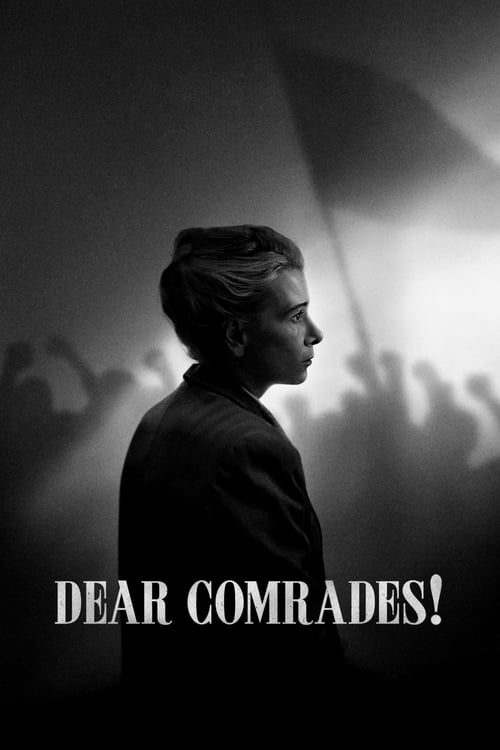
Dear Comrades!
2020 · Andrei Konchalovsky
For a night when you want serious, adult filmmaking that confronts history head-on — a challenge, not a comfort, but one that repays your full attention. Reach for it when you want to be moved and angered in equal measure.
What it's about
Novocherkassk, 1962: the Soviet government hikes food prices, workers at the local factory walk out, and the state answers the strike with bullets. Lyudmila, a regional Party official who believes in the system down to her bones, watches the crackdown unfold — and then has to search for her own daughter in the chaos that follows, in a town where the atrocity is being erased even as the blood is hosed off the square.
The experience
Grave, controlled, and quietly devastating — it builds like a vise, with the horror coming less from violence than from watching officials calmly organize a cover-up. You leave shaken and thinking about what belief costs.
Performances
Yulia Vysotskaya is remarkable as Lyudmila — a true believer whose certainty fractures in real time, playing party-line steel and maternal panic in the same breath without ever softening the character for sympathy.
The craft
Shot in stark black and white in the boxy old Academy ratio, it looks like a Soviet film of the very era it depicts — a period reconstruction so precise it feels like recovered footage. Konchalovsky stages the crackdown and its aftermath with chilling procedural detail, and the austere images reward a big, dark screen.
Why it matters
It won the Special Jury Prize at Venice and was Russia's Oscar submission — a startling late-career reckoning from a director in his eighties, dragging one of the USSR's most suppressed atrocities into the light.
Snapshot
A black-and-white historical drama shot in Academy ratio, Dear Comrades! reconstructs the June 1962 Novocherkassk massacre — one of the most systematically suppressed atrocities of the Khrushchev era — through the eyes of Lyudmila, a regional Communist Party secretary whose granite ideological faith is cracked open by personal catastrophe. The film won the Special Jury Prize at the Venice Film Festival in 2020 and was Russia's submission for the Academy Award for Best International Feature Film. Grave, formally austere, and morally unsparing, it stands as the culmination of Andrei Konchalovsky's late-career return to Russian history and the question of what it costs a person to believe in a system that murders its own.
Industry & production
The film was produced in Russia through the studio Andrei Konchalovsky Productions. Financing was domestic, though the film's provocative subject matter — a Soviet massacre that the state had classified for decades — made its relationship to official Russian culture institutions characteristically fraught. Konchalovsky had navigated similar terrain with Paradise (2016), which dealt with the Holocaust and French collaboration under Nazi occupation. The Novocherkassk massacre was classified until the glasnost era under Gorbachev, and survivors and families were denied even acknowledgment of the deaths for nearly thirty years. For Konchalovsky, the choice of subject carries a polemical charge: this is a crime committed not by Stalinist terror but under Khrushchev, the supposed reformer, revealing that state violence against ordinary Soviet citizens was systemic rather than the aberration of one era.
The screenplay was written by Konchalovsky himself, drawing on declassified KGB and party documents released in the post-Soviet period, as well as survivor testimony. The historical record is substantially documented: official Soviet investigation files, the memoirs of military commanders present that day, and oral history projects undertaken by Russian NGOs in the 1990s and 2000s all inform the film's granular reconstruction of those three days in June. The decision to keep production largely within Russia gave the film an authenticity of location and archival feeling that a co-production might have softened.
Technology
Dear Comrades! was shot in black and white at the Academy ratio (approximately 1.33:1), choices that immediately position the film within the visual language of early 1960s Soviet documentary and newsreel photography. The square frame contracts the image, reducing peripheral space and heightening the claustrophobic pressure of Lyudmila's world. The cinematography was executed digitally — as is standard for contemporary productions of this scale — but the lighting, grain simulation, and tonal palette are scrupulously calibrated to evoke the photographic texture of the Khrushchev period.
This is an increasingly deliberate aesthetic strategy in films of historical reckoning: by approximating the image technology of the period depicted, the film claims a quasi-documentary authority while simultaneously reminding the viewer that this is an act of reconstruction. Comparable moves appear in Joshua Oppenheimer's The Act of Killing, Pawel Pawlikowski's Ida (2013) and Cold War (2018), and Konchalovsky's own Paradise — all films that use period-appropriate monochrome as a form of moral seriousness rather than stylistic nostalgia.
Technique
Cinematography
The cinematographer was Andrei Naydenov, who had worked with Konchalovsky on previous productions. The visual strategy is rooted in depth staging and available-light-styled illumination: faces emerge from shadow, institutional spaces press down on characters, and the Soviet town — its apartment blocks, factory yards, and party meeting rooms — is rendered with a flat, exhausted bureaucratic gray that is itself a political statement. The camera is frequently still or nearly still; when it moves, it does so with deliberate, unhurried tracking or slow zooms that recall the observational mode of Soviet documentary cinema rather than Western dramatic convention. There is none of the handheld agitation that contemporary films often use to signal historical authenticity; instead, the stillness becomes suffocating, the frame a trap.
The massacre sequences, shot in a documentarian register with the camera retreating behind distance and obstruction, are among the most formally disciplined representations of state violence in recent European cinema. Rather than rendering the killings as spectacle, Konchalovsky and Naydenov consistently refuse the privileged position of witness: we hear, we see fragmentary motion, we sense the scale through aftermath rather than direct confrontation. This strategy belongs to a tradition of films — Elem Klimov's Come and See (1985), Claude Lanzmann's Shoah (1985), Gillo Pontecorvo's The Battle of Algiers (1966) — that treat the representation of atrocity as itself an ethical problem.
Editing
The editing maintains the film's meditative, Bressonian tempo. Cuts are rarely motivated by conventional dramatic momentum; instead, sequences are allowed to breathe past the point where mainstream filmmaking would have moved on, generating an accumulative weight. The structure tracks Lyudmila's search for her daughter across the three days with procedural patience, following her through the bureaucratic machinery of a system that both employs her and threatens her. The edit does not build toward catharsis so much as toward a sustained recognition that is harder to dismiss than a single climactic scene.
Mise-en-scène / staging
Konchalovsky stages the film in dense, populated spaces — crowded offices, cramped apartments, streets — with characters often blocked against institutional furniture and architecture. The production design is precise in its period reconstruction, and the costumes carry the drabness of Soviet middle management without caricature. What is striking is the staging of the party meetings and KGB debriefings: these scenes are shot with the same naturalistic attention as the domestic sequences, resisting the temptation to treat the bureaucratic apparatus as obviously sinister or absurd. The horror is precisely that these processes look and sound so mundane.
Sound
The sound design emphasizes ambient industrial noise — the factory, the crowds, the administrative machinery of the Soviet state — over scored dramatic music. The film makes restrained use of period Soviet songs and official broadcasts, using the sonic texture of Khrushchev-era public culture as both historical evocation and ironic counterpoint to what the audience knows is happening just beyond the edge of the frame. The relative absence of a conventional underscore is itself a statement: there is no musical cue to tell the audience how to feel, no emotional permission to experience the events as safely aestheticized history.
Performance
Yuliya Vysotskaya — Konchalovsky's wife and a consistent presence in his late-career work — plays Lyudmila with extraordinary interior discipline. The performance is built on the architecture of a woman who has organized her entire self around the party, who has made real sacrifices in the name of an idea, and who experiences the massacre not as an obvious moral violation but as a catastrophic cognitive dissonance. Vysotskaya resists all temptation to make Lyudmila sympathetic in easy ways or to signal the audience her eventual moral trajectory. She remains, for most of the film, both perpetrator and victim of the same system — a double positioning that gives the performance its unsettling moral complexity. The film's emotional impact depends entirely on the audience's willingness to inhabit a consciousness they would otherwise dismiss as complicit.
Narrative & dramatic mode
The film belongs to what might be called the intimate historical mode: a catastrophic public event refracted through the close, almost novelistic perspective of a single flawed consciousness. This is a classic strategy for making the unrepresentable representable — the same structural logic governs Spielberg's Schindler's List, but also Tarkovsky's Mirror and Klimov's Come and See. By choosing as its point-of-view character not an innocent bystander but a true believer and party functionary, Konchalovsky refuses the consolation of moral distance. Lyudmila is complicit in the system whose violence she witnesses.
The dramatic spine is ostensibly a search narrative — a mother looking for her missing daughter across a locked-down city — but this thriller framework is consistently subverted. The film is not interested in suspense; it is interested in what a person who has given their life to an ideology does when that ideology reveals itself as murderous. The ending, which offers no clean resolution and no ideological conversion, insists that the psychological damage is structural and ongoing.
Genre & cycle
Dear Comrades! belongs to the post-Soviet historical reckoning cycle that accelerated in Russian cinema after the archival openings of glasnost and continued through the 2000s and 2010s: films like Aleksandr Sokurov's Taurus (2001), Nikolai Dostal's Cloud Paradise (various works), and Yuri Bykov's films engaging Soviet-era institutional violence. Internationally, it connects to a broader cycle of monochrome historical dramas — including Pawlikowski's work and László Nemes's Son of Saul (2015) — that deploy formal austerity as an index of moral seriousness. It is also part of Konchalovsky's own late-career triptych of history films (The Postman's White Nights, Paradise, Dear Comrades!), each of which examines ideological catastrophe through a female protagonist.
Authorship & method
Andrei Konchalovsky (born 1937) is the elder brother of Nikita Mikhalkov and one of the central figures of Soviet and post-Soviet cinema. His biography is one of the most peripatetic in world cinema: he co-wrote the screenplay for Tarkovsky's Andrei Rublev (1966); directed the Soviet epic Siberiade (1979); spent a decade in Hollywood directing genre films including Runaway Train (1985), which earned Oscar nominations for Jon Voight and Eric Roberts; returned to Russia; then in his late seventies embarked on the chamber-scale history trilogy of which Dear Comrades! is the final and most accomplished part.
The Hollywood period is sometimes treated as an embarrassing detour, but it gave Konchalovsky an intimate knowledge of mainstream genre convention that he now deploys against itself — using the surface grammar of thriller and melodrama to create films that systematically refuse their emotional payoffs. His method is characteristically collaborative with Vysotskaya, whose performance in each of the trilogy films is the emotional and intellectual center. His approach to historical material is research-intensive and screenplay-driven; he has spoken of spending years with the archival documents before beginning Dear Comrades!. The decision to work in black and white and Academy ratio was made before production and was non-negotiable.
Movement / national cinema
The film belongs unambiguously to Russian national cinema, though its formal influences are pan-European — Italian neorealism (particularly Rossellini's historical reconstructions), the French New Wave's photographic austerity, and above all the tradition of Soviet poetic cinema that Konchalovsky absorbed in his formative years alongside Tarkovsky. It occupies an uncomfortable position within contemporary Russian cultural politics: the massacre it depicts is historical fact, now widely acknowledged, but the film's refusal to frame Soviet-era crimes as a safely sealed past makes it implicitly critical of the historical relationship between state violence and ideological legitimacy — a reading with obvious contemporary resonance. Its Venice triumph gave it international prestige and protection; its Russian reception was more ambivalent.
Era / period
The depicted period — 1962, the Khrushchev Thaw — carries specific historiographic weight. The Thaw was supposed to represent the end of Stalinist terror, the moment when the Soviet state became capable of self-criticism and reform. The Novocherkassk massacre punctures that narrative: it demonstrates that the structural relationship between the Soviet state and its citizens had not fundamentally changed. The film was made and released in 2020, a moment of intensified Russian state authoritarianism, and the historical parallel — a government that responds to popular economic grievance with lethal force and then buries the evidence — was not lost on international critics.
Themes
The film's primary preoccupation is ideological faith as psychological structure: what happens to a person when the system they have organized their identity around commits an act of undeniable evil. Lyudmila is not a villain; she is, in some respects, a figure of sympathy — she has made real sacrifices, she is a mother, she experiences genuine love. But the film refuses to separate these human qualities from her institutional role. Her faith in the party is not naive; it is a chosen cognitive architecture that has served her and that she has served, and its fracturing is experienced as a kind of death.
Secondary themes include the gendering of Soviet ideology (the film is notably focused on women's relationship to the Soviet project — Lyudmila's authority, her daughter's skepticism, the female factory workers who went on strike), the complicity of ordinary bureaucrats in state violence, and the epistemology of historical suppression — the systematic erasure of an event that was witnessed by thousands.
Reception, canon & influence
Backward influences: The film draws on Elem Klimov's Come and See for its approach to depicting atrocity at oblique documentary distance; on Tarkovsky's staging and meditative pacing (a lifelong influence); on Rossellini's Rome, Open City and the neorealist tradition of reconstructing historical events with a quasi-documentary insistence on particularity; and on the Soviet tradition of the production novel and socialist-realist drama, which Konchalovsky inverts by inhabiting rather than critiquing its protagonist's consciousness from within.
Critical reception: Dear Comrades! received strong international notices, with the Venice Special Jury Prize serving as the central institutional marker. Critics praised Vysotskaya's performance almost universally and responded to the formal discipline of the monochrome Academy-ratio photography. Some critics noted that the film's restraint could shade into coldness, and that its pacing demanded patience; others took this as precisely the point. The film was not a commercial proposition — it was understood by all involved as prestige festival cinema — and on those terms it succeeded.
Forward influence: It is too early to assess the film's downstream influence with precision, but it has become a reference point in discussions of how to cinematically reconstruct suppressed Soviet history and, more broadly, in the resurgent conversation about how national cinemas should represent their own state crimes. Its formal solution — monochrome, Academy ratio, documentary restraint, subjective moral entrapment — has been noted by critics as a model for historical cinema that refuses both sentimentality and didacticism. Whether it will prove foundational in the way that Klimov's Come and See or Pawlikowski's Ida have become foundational remains to be seen; its subject matter makes it less universally teachable than those films, but its formal achievement is comparable.
A Deleuzian reading
The gunfire reaches Lyudmila before any bodies do.
The full Deleuzian reading of Dear Comrades! →
Reception
It premiered at Venice 2020 to a Special Jury Prize and near-unanimous acclaim, instantly hailed as a late-career peak for the 83-year-old Konchalovsky; it made the Oscar shortlist for Russia but missed the nomination, and it's held its reputation since as one of the strongest Russian films of the decade.
How Dear Comrades! was received, from release to now →
Influences: the films it descends from and the films it influenced
- Come and See (1985) — Konchalovsky adopts Klimov's strategy of staging atrocity at oblique documentary remove—cutting away from massacre rather than into it—so horror accrues through implication and ambient sound rather than visceral spectacle.
- Andrei Rublev (1966) — Konchalovsky co-wrote this screenplay; its monochrome deep-focus historical reconstruction, episodic ellipsis, and long-duration staged tableaux constitute the direct formal grammar Dear Comrades! inherits.
- Rome, Open City (1945) — Rossellini's reconstruction of recent historical atrocity with documentary particularity—period-specific location texture, non-theatrical behavior, no explanatory scoring—is the neorealist foundation for Konchalovsky's refusal of dramatized sentiment.
- Pickpocket (1959) — The Bressonian editing tempo—cutting before emotional resolution, suppressing reaction shots, building interiority through behavioral accretion rather than expressive close-ups—governs the film's approach to its protagonist's ideological crisis.
- The Cranes Are Flying (1957) — Kalatozov's Thaw-era formula—a woman's search for a missing man used to focalize collective Soviet trauma in Academy-ratio monochrome—is the structural prototype Dear Comrades! consciously inverts by making its protagonist complicit rather than victimized.
- Chronicle of Anna Magdalena Bach (1968) — Straub-Huillet's Academy ratio monochrome and rigorously non-dramatized observational staging of historical period—refusing both costume-drama theatrics and documentary commentary—anticipates Dear Comrades!'s formal austerity.
- The Turin Horse (2011) — Tarr's Academy ratio monochrome with elliptical Bressonian tempo, ambient sound foregrounded over near-absent score, and depth-staged durational observation of bodies under institutional constraint is the formal extreme toward which Dear Comrades!'s aesthetic logic tends.
- Repentance (1987) — Builds its plot on secret burial under falsified names — a mother searching for a body the state denies — staged in boxy Academy-ratio monochrome frontality that reprises Abuladze's symmetrical, testimony-driven compositions.
- Ida (2013) — Pawlikowski established the template of Academy ratio monochrome plus Bressonian pacing for conducting an intimate protagonist through suppressed national history; Dear Comrades! deploys the same formal package for Soviet rather than Polish state crime.
- Cold War (2018) — Pawlikowski's follow-up continues the Academy ratio monochrome grammar for post-war Communist-bloc intimate historical mode, with Łukasz Żal's deep-focus depth staging directly cognate to Andrei Naidenov's cinematography in Dear Comrades!.
- Son of Saul (2015) — Nemes traps the viewer inside a complicit protagonist's restricted field of perception during state-organized atrocity—ambient industrial sound over near-silent score, catharsis systematically withheld—the direct structural parallel to Konchalovsky's management of the Novocherkassk massacre sequences.
- Beanpole (2019) — Balagov's Academy ratio framing and post-war Soviet intimate historical mode foreground ideological interiority through behavioral performance rather than explained psychology, the same method Vysotskaya deploys under Konchalovsky.
- A Gentle Creature (2017) — Loznitsa's institutional mundane staging—observational long-take stillness in the waiting rooms and corridors of post-Soviet bureaucratic machinery—shares Dear Comrades!'s formal strategy of rendering state power visible through architecture and routine rather than dramatic confrontation.
- Caché (2005) — Haneke structures a search thriller around a protagonist whose investigation curves back toward revelation of their own historical complicity, systematically withholding genre catharsis—the same subversion of the search-thriller form Konchalovsky uses to expose Lyudmila's ideological guilt.
- The State Funeral (2019) — Loznitsa's observational reconstruction of Stalin's funeral from Soviet archival footage occupies the same post-Soviet historical-reckoning space, using documentary distance and ambient crowd sound to render the ideological apparatus as simultaneously banal and terrifying.
Similar films
- The Cranes Are Flying (1957) — influence & lineage
- Come and See (1985) — influence & lineage
- Beanpole (2019) — influence & lineage
- Strike (1925) — shared sensibility
- Two Prosecutors (2025) — shared sensibility
- The Red and the White (1967) — shared sensibility
- Battleship Potemkin (1925) — shared sensibility
- Witchhammer (1970) — shared sensibility