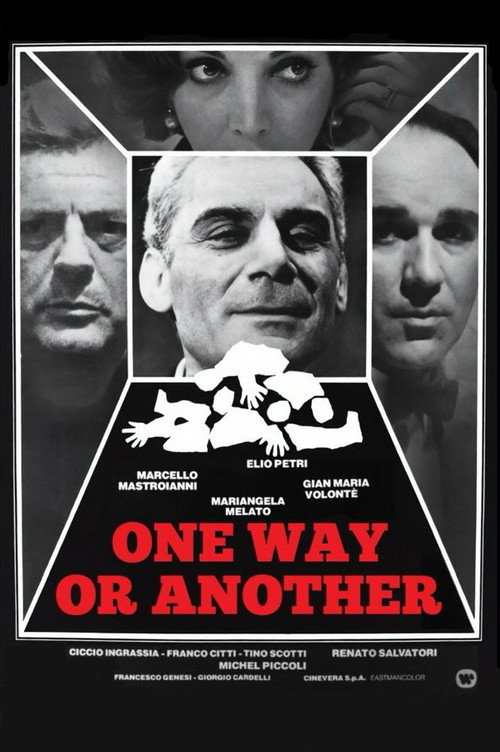
One Way or Another
1976 · Elio Petri
For when you want a film to chew on for days — an angry, brainy political nightmare. Firmly a challenge, not comfort; bring your appetite for venom.
What it's about
The entire ruling class of Italy's Christian Democrats descends into an underground hermitage for a retreat of spiritual exercises — praying, confessing, and conniving under a merciless party chief and a spider-like priest. Then the politicians begin to die, one by one, and the retreat becomes a locked-room mystery about power itself.
The experience
Claustrophobic, sardonic, and increasingly nightmarish — less a whodunit than a slow suffocation, with black comedy hissing through the concrete. It leaves you uneasy, and it means to.
Performances
Gian Maria Volonté delivers a merciless impersonation of real party chief Aldo Moro, and Marcello Mastroianni is unnervingly cast against type as the priest running the exercises.
The craft
Elio Petri abandons realism entirely for a subterranean purgatory of catacombs and fluorescent penance — corruption rendered as architecture, with the production design doing as much arguing as the script. Adapted from Leonardo Sciascia's novel Todo Modo, it turns a familiar mystery structure into an autopsy of a ruling class.
Why it matters
Reviled on release in 1976, then made to look chillingly prophetic two years later when Aldo Moro was kidnapped and murdered — after which the film all but vanished from circulation, to be rediscovered as one of the fiercest works of Italian political cinema.
Elio Petri's final political fury, adapted from Leonardo Sciascia's novel Todo Modo: the entire ruling class of Italy's Christian Democrats descends into a concrete bunker-hermitage for spiritual exercises, led by a party chief ('M.', a merciless Gian Maria Volonté impersonation of Aldo Moro) and a spider-like priest played by Marcello Mastroianni. As the politicians pray, confess, and connive, they begin to die, one by one — a locked-room mystery reimagined as an autopsy of power itself. Petri, who had dissected authority in Investigation of a Citizen Above Suspicion, here abandons realism entirely for a subterranean purgatory of catacombs and fluorescent penance, corruption rendered as architecture. The film was reviled on release in 1976; two years later Moro was kidnapped and murdered by the Red Brigades, and the film — suddenly unbearable prophecy — effectively vanished from circulation for decades, ending Petri's career in the process. Its rediscovery restored the missing terminus of Italy's great cinema of paranoia: the moment the genre stopped predicting the catastrophe and simply preceded it.
Reception
Savaged by Italy's political establishment on release in 1976, it effectively vanished from circulation after Aldo Moro's 1978 kidnapping and murder made it look horribly prophetic — decades later, restoration and reappraisal have recast it as one of the great buried works of Italian political cinema.
How One Way or Another was received, from release to now →
Influences: the films it descends from and the films it influenced
- We Still Kill the Old Way (A ciascuno il suo) (1967) — Petri's first Sciascia adaptation, which fixed his method of treating a Sicilian conspiracy as a sealed logical system the amateur investigator solves too late — the closed-set structure Todo modo inherits.
- Investigation of a Citizen Above Suspicion (1970) — The direct companion 'autopsy of power': Volonté plays authority as a preening neurotic while Morricone's needling ostinato scores institutional guilt as grotesque farce.
- Hands Over the City (1963) — Literalizes corruption-as-architecture: real-estate speculation and civic space as the physical body of political rot, documentary-inflected staging of institutions Petri later abstracts.
- The Exterminating Angel (1962) — The locked-room surrealist allegory where the bourgeoisie inexplicably cannot leave a room — the hermetic-chamber-as-power-trap structure Petri fuses with religious ritual.
- The Conformist (1970) — Storaro's fascist monumentalism and cold, oversized interiors frame moral cowardice architecturally — the visual thesis that power's spaces embody its corruption.
- Il Divo (2008) — Baroque caricature of Giulio Andreotti — the very Christian-Democrat archetype Todo modo lampooned — staging power as liturgical spectacle with grotesque, ritualized bodily performance direct from Petri.
- Good Morning, Night (Buongiorno, notte) (2003) — The locked-room political allegory (Moro's captivity apartment) as national autopsy, intertwining prayer and politics in a sealed hermitage exactly as Petri's bunker retreat does.
- Vincere (2009) — Operatic anti-realist staging of Italian power through expressionist lighting and hallucinatory formality, extending Petri's rejection of realism as the proper register for depicting the state.
- Loro (2018) — Berlusconi rendered as decadent allegorical set-piece, power dissected through excess and ritual spectacle — Petri's grotesque autopsy-of-power carried into the media era.
- The Working Class Goes to Heaven (1971) — Same Petri–Volonté engine pushing performance into caricatured physical tics and sweat as social diagnosis, the allegorical-body acting Volonté brings to the retreat.
- Illustrious Corpses (Cadaveri eccellenti) (1976) — A parallel Sciascia adaptation released the same year, using baroque interiors and deep-focus corridors so that architecture itself becomes the visual grammar of institutional conspiracy — corruption-as-architecture.
- The Mattei Affair (1972) — Volonté-fronted investigative reconstruction that builds the paranoid dossier form — power reconstructed forensically from fragments — feeding Petri's cinema-of-paranoia mode.
- Salò, or the 120 Days of Sodom (1975) — An enclosed villa as sadistic power laboratory, with ritualized degradation staged in liturgical, rule-bound formality — the same year's sibling in staging power as closed ceremonial rite.
- Z (1969) — The template European political-thriller autopsy of a state crime, dissecting institutional complicity as procedure — the genre Petri bends toward anti-realist allegory.
- The Parallax View (1974) — Cinema-of-paranoia visual scheme dwarfing the individual inside vast architectural voids, the conspiracy rendered as oppressive built space rather than exposition.
- The Conversation (1974) — Fuses Catholic guilt with surveillance paranoia in sound-designed claustrophobia — the confessional-religious anxiety braided into political dread that Petri's fluorescent penance shares.
Similar films
- Investigation of a Citizen Above Suspicion (1970) — influence & lineage
- The Working Class Goes to Heaven (1971) — influence & lineage
- The Exterminating Angel (1962) — influence & lineage
- Salò, or the 120 Days of Sodom (1976) — shared sensibility
- The Godfather Part II (1974) — shared sensibility
- The Godfather (1972) — shared sensibility
- Theorem (1968) — shared sensibility
- Salvatore Giuliano (1962) — shared sensibility