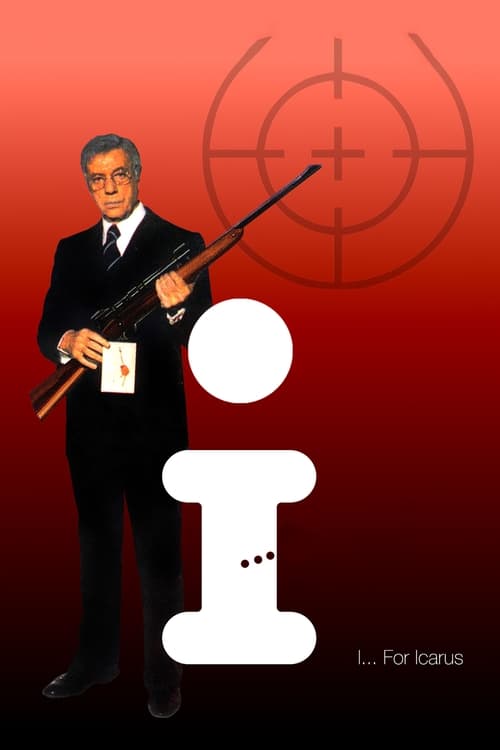
I... for Icarus
1979 · Henri Verneuil
For when you're in the mood to distrust everything — a smart, paranoid evening where you want the pleasure of watching a case get built, not comfort food. It's a film to argue about afterward.
What it's about
A president is assassinated during a motorcade, an official commission delivers its tidy lone-gunman verdict, and one prosecutor refuses to sign. His dissent becomes an investigation of his own, pulling threads that lead away from a single shooter and toward the machinery of the state itself — surveillance, cover stories, and people who know too much.
The experience
Cold, methodical, and steadily more suffocating — the tension comes not from chases but from the dawning sense of how big the thing being hidden is. It's a thinking viewer's thriller that keeps tightening until the architecture itself feels hostile.
Performances
Yves Montand anchors it with grave, unshowy authority — the weary moral weight he brought to his great political thrillers, a man of the system turning against it one document at a time.
The craft
Henri Verneuil, a master of polished French commercial cinema, builds paranoia out of brutalist concrete plazas, telephoto lenses, and Ennio Morricone's needling, insistent score. Its boldest move is a long, chilling set piece restaging a real psychology experiment about obedience to authority — a sequence people remember decades later. Sleek widescreen unease that rewards a big screen and good speakers for that score.
Why it matters
The French answer to the American conspiracy thriller and the boldest fictional riff on the Kennedy assassination, it remains a touchstone of European political cinema and a cult favorite among conspiracy-thriller devotees.
French cinema's boldest riff on the Kennedy assassination. A president is shot during a motorcade; a commission delivers its lone-gunman verdict; one prosecutor — Yves Montand, at the height of his political-thriller gravitas after Z and State of Siege — refuses to sign, and begins pulling threads that unravel toward the state itself. Henri Verneuil, a supreme craftsman of French commercial cinema usually associated with Gabin and Belmondo vehicles, here builds a paranoid machine in the American conspiracy mode of The Parallax View, all brutalist architecture, telephoto surveillance and Ennio Morricone's needling score. Its most famous sequence abandons the plot entirely to restage the Milgram obedience experiment — volunteers administering electric shocks on an authority's instruction — a ten-minute detour that lands like a thesis on how democracies produce complicit men. A major box-office success in France, where its title became shorthand for institutional cover-up, it remains oddly little-seen in the anglophone world: a conspiracy thriller about America that Americans never made.
Reception
A commercial hit in France in 1979 from a director critics often dismissed as merely 'commercial', it has since been reappraised as Henri Verneuil's masterpiece — the great French paranoid thriller that hardly anyone outside France has seen.
How I... for Icarus was received, from release to now →
Influences: the films it descends from and the films it influenced
- Z (1969) — Verneuil lifts the investigating-magistrate structure whole — an incorruptible prosecutor reconstructing an assassination witness-by-witness, using docudrama flashback montage to visualize contradictory testimony as it is spoken.
- The Parallax View (1974) — Both frame the lone investigator as a small figure crushed inside vast brutalist and modernist interiors, and stage the climactic assassination in a public arena honeycombed with sightlines and telephoto vantage points.
- Executive Action (1973) — Supplies the multiple-gunmen / crossfire reconstruction and the mock-commission report device that Icarus adopts as its entire premise — a blue-ribbon inquiry the protagonist alone refuses to sign.
- Investigation of a Citizen Above Suspicion (1970) — Shares the Morricone motif of obsessive institutional power set to a mocking, mechanical ostinato, and the theme of authority that manufactures its own immunity — the sonic and thematic template for the obedience material.
- The Manchurian Candidate (1962) — Origin of the psychology-experiment-as-conspiracy set piece — the clinical demonstration of manufactured obedience staged as cold theater, which Icarus reprises literally in its Milgram sequence.
- Seven Days in May (1964) — Model for the paranoid procedural in which the enemy is a shadow apparatus inside the state itself, dramatized through terse cabinet-room and corridor staging rather than action.
- The Day of the Jackal (1973) — Establishes the forensic, procedural cool — the assassination and its investigation rendered as methodical technical craft, with telephoto long-lens framing of the marksman's line of fire.
- The Conversation (1974) — Source for the surveillance grammar Icarus quotes — long-lens observation across open plazas, the watcher becoming the watched, framed against blank institutional geometry.
- Blow Out (1981) — Extends the assassination-reconstruction craft into the sound domain — a lone technician rebuilding a political killing frame-by-frame from recorded evidence, defeated by the same institutional inertia.
- JFK (1991) — Carries forward the prosecutor-versus-commission structure and the courtroom/blackboard reconstruction of crossfire trajectories, indicting an official inquiry as itself the cover-up.
- The Ghost Writer (2010) — Inherits the brutalist-architecture paranoia — a lone investigator swallowed by cold modernist interiors and windswept geometry as the conspiracy closes around him.
- Michael Clayton (2007) — Continues the institutional-complicity thriller in which the conscientious insider must decide whether to sign off, staged in glass-and-steel corporate spaces that render individual conscience minuscule.
- Experimenter (2015) — Directly dramatizes the Milgram obedience study that Icarus embedded as its central detour, formalizing the shock-generator demonstration into a full film about the mechanics of obedience to authority.
- Compliance (2012) — Extends the Milgram material into narrative form — ordinary people executing cruel orders from an unseen authority, the obedience experiment restaged as real-time thriller.
- All the President's Men (1976) — Parallel procedural of documentary patience — the cover-up unraveled through paperwork, phone calls and archival cross-checking, with power expressed as monumental architecture dwarfing the seeker.
- Three Days of the Condor (1975) — Same lone-man-versus-agency structure and telephoto urban surveillance, where the protagonist's competence only deepens his isolation against an institution that anticipates him.
- State of Siege (1972) — Shares Yves Montand as the grave moral center of a political thriller built from reconstructed interrogation and the anatomy of state complicity.
Similar films
- The Conversation (1974) — influence & lineage · same viewing thread
- The Parallax View (1974) — influence & lineage · same viewing thread
- State of Siege (1972) — influence & lineage
- Z (1969) — influence & lineage
- Investigation of a Citizen Above Suspicion (1970) — influence & lineage
- The Day of the Jackal (1973) — influence & lineage
- JFK (1991) — influence & lineage
- The Manchurian Candidate (1962) — influence & lineage
All the films related to I... for Icarus →
Watch it with: curated runs of related films
- The Paranoid and the Obsessed — A run of stylish thrillers about lone men consumed by a hidden pattern, a betrayal, or a truth they can't stop chasing — each staged with more virtuosity than the plot strictly needs.