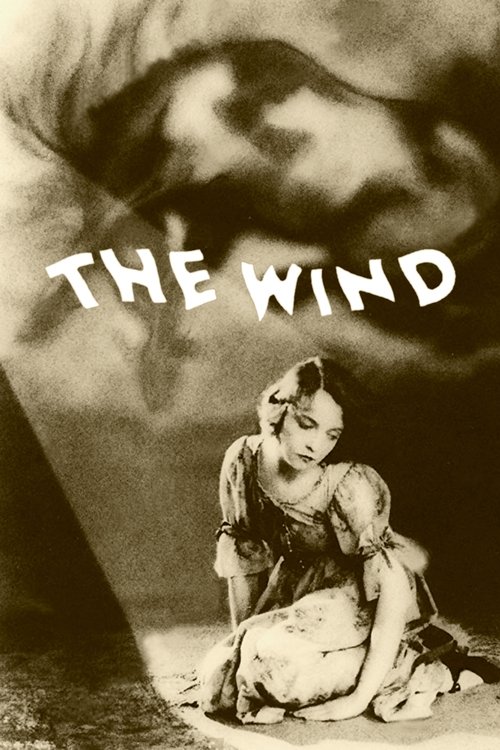
The Wind
1928 · Victor Sjöström
For when you want to be shown that a film from 1928 can still rattle you — a challenge worth taking, best with full attention and the lights down. Not a cozy pick; an elemental one.
What it's about
A sheltered young woman from Virginia travels alone to the West Texas plains to live with her cousin's family, and finds a world scoured raw by wind and sand that never, ever stops. Her cousin's wife wants her gone, three suitors circle her, and the marriage she's pushed into offers no shelter — while outside, the wind keeps working on her nerves like a hand at the door.
The experience
A silent film that plays like a slow-building psychological thriller: the constant wind becomes almost a character, and the tension tightens until the climactic storm sequences are genuinely harrowing. Expect to feel the grit in your teeth.
Performances
Lillian Gish, in one of the most physically and emotionally punishing performances of the silent era, charts a woman's unraveling with her face and body alone — it's a masterclass in acting without words.
The craft
Victor Sjöström shot much of it in real desert conditions, with airplane propellers and sand hurled at the actors, and the result is a sensory assault decades ahead of its time: you can practically hear the film even in silence. The storm imagery is some of the most powerful ever put on screen, and it rewards the biggest screen and best musical accompaniment you can find.
Why it matters
Arriving just as sound cinema swept the industry, it stands as one of the summit achievements of American silent film — proof of how expressive the form had become at the very moment it ended.
Snapshot
The Wind is a late-silent MGM production directed by the Swedish master Victor Sjöström (billed in Hollywood as Victor Seastrom) and built around one of Lillian Gish's most physically and emotionally punishing performances. Adapted from Dorothy Scarborough's 1925 novel by the pre-eminent screenwriter Frances Marion, it tells of Letty Mason, a fragile young Virginian who travels west to live with a cousin's family in the wind-scoured Texas plains, is driven from that household by jealousy, marries a rough rancher she does not love, and is finally pushed to a killing and near-madness by the relentless environment. Completed in 1927 but held from release until 1928, it arrived just as sound was overturning the industry, and it is widely regarded today as one of the summit achievements of American silent cinema and of the collaboration between Gish and Sjöström.
Industry & production
The film was produced by Metro-Goldwyn-Mayer during the tenure of production chief Irving Thalberg, in the period when MGM had brought both Gish and Sjöström under contract and was pairing them on prestige literary adaptations — most notably The Scarlet Letter (1926), also scripted by Frances Marion and co-starring Lars Hanson, immediately preceding The Wind. Gish, by this point one of the most respected and highest-status actresses in Hollywood, had substantial say in her vehicles, and the project reflected her appetite for serious dramatic material drawn from prestige fiction.
Production was notoriously grueling. Interiors were shot on MGM's Culver City stages, but the exteriors were filmed in the California desert near the Mojave, in the vicinity of Bakersfield, under extreme summer heat. To manufacture the ever-present wind and blowing sand, the crew used aircraft propellers and smoke pots throwing up sand, cinders, and sawdust; accounts of the shoot — many recounted by Gish herself in later interviews and her memoirs — describe punishing temperatures and physically hazardous conditions. This effort to render an intangible force (wind) as a concrete, oppressive screen presence is central to the film's identity.
The film's release history is bound up with the coming of sound. Shot in 1927, it was shelved and only released in 1928, by which point audiences were rapidly turning toward talkies. It is generally understood to have been a commercial disappointment on release; precise box-office figures are not something I can responsibly quote, but the consensus of film history is that its late-silent status hurt it commercially, and it effectively marked the end of the Gish–Sjöström–MGM cycle. Sjöström would return to Sweden not long after, and Gish's MGM contract wound down in this same period.
The best-documented production controversy concerns the ending. Scarborough's novel closes bleakly, with Letty walking out into the storm — read by most as a walk to her death. Film history strongly and consistently holds that MGM imposed a more reconciliatory finish, in which Letty and her husband Lige come to an understanding and she accepts her life on the plains. Gish spoke in later years of the studio's insistence on a less despairing conclusion. The exact chain of decisions is not fully documented, so the safest statement is that the surviving film ends on reconciliation rather than the novel's darker note, and that this softening is generally attributed to studio pressure rather than to Sjöström's or Marion's preference.
Technology
The Wind is a product of the mature silent apparatus at the precise moment it was being superseded. It was shot on orthochromatic black-and-white stock with the panchromatic transition already underway across the industry; the film's handling of skin tone, sky, and blowing particulate reflects the high technical polish MGM commanded at the end of the silent era. Its most consequential "technology," however, is practical rather than photochemical: the wind-and-sand effects generated by propellers and smoke pots, which turned the natural environment into what is effectively a special effect sustained across the entire picture.
On the exhibition side, the film sits on the cusp of synchronized sound. Like several prestige MGM titles of 1927–28, it was prepared for release with a synchronized recorded musical accompaniment and sound effects rather than live orchestra alone, but it contains no spoken dialogue and remains a silent film in every dramaturgical sense. I would not want to overstate the specifics of that original track, as the details of the 1928 synchronized score are thinly documented in the accessible record; the film is today most often screened silent or with later-composed accompaniment.
Technique
Cinematography
The photography is credited to John Arnold, an MGM staff cinematographer who would later head the studio's camera department. The visual scheme is organized around a single idea: making wind visible. Sand streams continuously across the frame; light rakes through blowing grit; the flimsy shack Letty shares with Lige is photographed so that the environment seems to invade the interior, dust and motion pressing at the windows and doors. The camera favors Gish's face in close-up as the register on which the storm's psychological toll is read, alternating intimate framings with wide shots that dwarf the human figure against an empty, hostile horizon. Superimposition is used for the film's key symbolic image — a ghostly white stallion galloping in the clouds, drawn from a Native American legend about the "norther," the demon wind of the plains — layering myth directly onto the naturalistic surface.
Editing
Editing is credited to Conrad A. Nervig, another MGM craftsman of standing. The cutting builds the film's mounting hysteria through accumulation and acceleration: recurring shots of the shack buffeted by wind, of sand sifting through gaps, of Letty's escalating agitation, are returned to and intensified so that the environment functions almost as a rhythmic antagonist. In the climactic sequences — the killing of the predatory Roddy Wirt, the burial of his body, and the wind's uncovering of the corpse in the sand — montage and superimposition drive Letty's collapse and near-madness, subordinating continuity to subjective psychological state.
Mise-en-scène / staging
The staging concentrates a small cast into cramped, wind-lashed interiors set against vast exteriors, a deliberate compression that traps Letty both socially and spatially. The bare shack, the ranch household ruled by the jealous Cora, and the open plain form a tightening set of enclosures. Sjöström stages the human drama — the cold welcome, the unwanted attentions of three suitors, the loveless marriage of convenience — within a frame where the wind is always the dominant compositional element, never fully offstage. Props and gesture carry heavy symbolic weight: the sand that will not stay buried, the door that will not stay shut.
Sound
As a silent film, The Wind dramatizes sound by wholly visual means — the paradox of a picture whose subject is an incessant, maddening noise it can never let us hear. The howling wind is "sounded" through image and rhythm alone: streaming particulate, straining structures, and Gish's reactions stand in for the auditory assault. Whatever synchronized effects accompanied the 1928 release, the film's power lies in this visual-only evocation of an overwhelming acoustic environment, which is part of why it is often cited as a demonstration of how much silent technique could achieve at its peak.
Performance
Lillian Gish's Letty anchors the film and is among the most admired performances of the silent era. Gish externalizes an interior disintegration — from delicate displacement, through fear and revulsion, to a breakdown bordering on madness and a hard-won recovery — largely through face, posture, and physical endurance under genuinely hostile shooting conditions. Lars Hanson, Sjöström's countryman and Gish's co-star from The Scarlet Letter, plays Lige, the coarse but ultimately sympathetic rancher; Montagu Love plays the predatory Wirt, and Dorothy Cumming the jealous Cora. The ensemble is deliberately spare, keeping the focus on Letty's subjectivity.
Narrative & dramatic mode
The narrative mode is psychological melodrama fused with naturalism. On the surface it follows a clear melodramatic arc — an innocent transplanted to a hostile place, menaced by suitors, forced into an unwanted marriage, driven to violence, and finally redeemed — but Sjöström pushes it toward the interior, so that the true drama is the erosion and near-collapse of a mind under environmental and social pressure. The wind operates as an externalized psychological force, a naturalist agent (the indifferent, destructive environment of literary naturalism) that doubles as an expressionist projection of Letty's dread. The story is told with great economy, its events few and its emphasis placed on states of feeling rather than incident.
Genre & cycle
The Wind sits at an unusual intersection of genres — it can be read as Western, frontier drama, romance, and psychological thriller at once. It uses the iconography of the Western (the plains, the ranch, the pioneer household) but inverts the genre's usual mastery-of-the-land triumphalism: here the frontier is not conquered but endured, and it very nearly destroys its heroine. In this it belongs less to the heroic Western cycle than to a strain of frontier naturalism about the psychic cost of the land on those, especially women, who settle it. It also belongs to the late-1920s cycle of prestige literary adaptations at MGM and to the Gish–Sjöström films specifically.
Authorship & method
The film is above all a Sjöström work, and it distills the sensibility he had developed in Sweden: the use of landscape and the elements as active moral and psychological forces, a hallmark of his Swedish films such as The Phantom Carriage (1921) and the earlier Ingeborg Holm. Sjöström brought Nordic naturalism — nature as fate — to a Hollywood studio picture and made the environment the true antagonist.
He is inseparable here from three key collaborators. Frances Marion, one of the most important screenwriters of the era and Sjöström's writer on The Scarlet Letter, adapted Scarborough's novel and shaped its dramatic compression. Cinematographer John Arnold realized the film's central technical problem — the visibility of wind — and editor Conrad A. Nervig cut its escalating psychological rhythm. And Lillian Gish's authorship should not be understated: as a powerful contract star with real creative influence, she was instrumental in the choice of material and in the film's uncompromising conception of its heroine's ordeal. On music, the record available to me is thin regarding the original 1928 synchronized accompaniment; a well-known later orchestral score by Carl Davis has accompanied modern restorations, but I will not attribute an original composer I cannot verify.
Movement / national cinema
The film is a fascinating hybrid of national cinemas: an American studio production carrying the imprint of the Swedish "golden age." Sjöström and Hanson were both leading figures of Swedish silent cinema, and Sjöström's method — landscape naturalism, elemental fatalism, restrained but intense psychological realism — belongs to that tradition even as it is executed within the MGM system. The result is often cited as evidence of how European émigré talent enriched late Hollywood silent art, and of the cross-pollination between Scandinavian naturalism and American melodrama.
Era / period
The Wind is a definitive artifact of the very end of the silent era — a film of exceptional visual sophistication made just as that entire mode of expression was rendered commercially obsolete by the talkies. Its release in 1928 places it in the brief, poignant window of "last silent masterpieces," productions of full technical maturity stranded by the industry's abrupt pivot to sound. This timing is inseparable from its history: its artistry and its commercial fate both belong to the same transitional moment.
Themes
The film's governing theme is the human being against an indifferent, hostile nature — the wind as an implacable force that grinds down the fragile individual. Bound to this is a strongly felt account of female vulnerability and endurance: Letty's displacement, her lack of economic and social autonomy, the marriage entered from necessity rather than love, and the sexual menace she faces all frame the frontier as particularly brutal to women. Madness and psychological disintegration form a third thread, with the environment functioning as both cause and mirror of mental collapse. The recurring motif of the ghost stallion in the clouds ties these to myth and superstition, casting the wind as a demonic, almost supernatural fate. Finally, the film weighs the possibility of endurance and reconciliation — Letty's ultimate accommodation to her life — though the film's own tortured history reminds us that this resolution was shaped by forces outside the artists' full control.
Reception, canon & influence
On release the film is generally understood to have underperformed, its silent form out of step with a market rushing toward sound; it did not receive the popular reward its artistry might otherwise have won, and it stands as a notable case of a masterwork undone by timing. Critical estimation, however, has risen enormously over the intervening decades. The Wind is now routinely ranked among the greatest silent films and among the finest American films of the 1920s, and it is treated as a peak of Gish's career and of Sjöström's Hollywood period.
Looking backward, the film's influences are legible: Scarborough's naturalist novel supplied the story; the literary naturalism of environment-as-fate underlies its conception; and Sjöström's own Swedish films, with their elemental landscapes and moral gravity, are its clearest artistic antecedents. Looking forward, its legacy lies in its demonstration that a physical environment can be rendered as a sustained psychological and dramatic antagonist — a lesson visible in later films that use landscape and weather expressionistically — and in its enduring status as a touchstone of silent-era acting and of the integration of European art-cinema sensibility into Hollywood. It remains a fixture of film-school curricula, archival restoration, and silent-film canon, and Gish herself long championed it as one of the works she was proudest of. Where specific claims about its immediate reception or its original musical accompaniment are concerned, the accessible record is thinner than one would like, and those points are best treated with corresponding caution.
A Deleuzian reading
Sand comes in under the door.
The full Deleuzian reading of The Wind →
Reception
MGM dumped it into theaters in late 1928 with talkies already sweeping the industry, and it flopped — Sjöström soon went home to Sweden. Now it's routinely called one of the last, greatest achievements of the silent era, the masterpiece silence produced on its way out the door.
How The Wind was received, from release to now →
How to watch The Wind: what to notice on a first viewing
- Watch sand stream continuously through every frame. Wind and grit move across nearly every shot, inside the shack as much as outdoors, so the environment never lets up even indoors. Making wind visible this consistently turns weather into a character with its own presence in every scene.
- Notice close-ups of Gish's face against huge empty shots. The film alternates tight framing on her reactions with wide shots that dwarf her against an empty horizon. The contrast in scale is how a silent film shows pressure: the bigger the land, the smaller she gets.
- Notice how thin and exposed the shack's walls seem. Doors won't stay shut, gaps let sand through, and the flimsy interior seems constantly on the edge of being breached from outside. A house that can't keep the wind out becomes a way of showing a life that can't keep trouble out either.
- Watch for a ghostly horse appear inside the clouds. A superimposed white stallion gallops through the sky at key moments, drawn from local legend about the wind itself. Layering a myth directly onto the naturalistic image lets the film show you dread as something almost seen.
The whole guide to watching The Wind, with the keys for a rewatch →
Influences: the films it descends from and the films it influenced
- The Phantom Carriage (1921) — Sjöström's own double-exposure/superimposition technique for rendering the intangible (there, ghostly figures) is the direct precedent for the layered dissolves that make the invisible wind materialize on screen in the later film.
- Ingeborg Holm (1913) — Establishes Sjöström's naturalist method of restrained, unmelodramatic staging in which social and physical environment operates as an impersonal fate crushing the protagonist.
- The Outlaw and His Wife (1918) — Sjöström films real landscape and weather on location as an active dramatic antagonist rather than backdrop, the elemental-fate approach he transplants wholesale to the Texas desert.
- The Scarlet Letter (1926) — The immediate Gish–Marion–Sjöström production unit, whose method of compressing a canonical literary source into intimate psychological melodrama built at MGM is reprised almost identically.
- Broken Blossoms (1919) — Gish's signature performance vocabulary of physical terror in a trapped interior—the spinning, cornered hysteria—is the acting technique she extends into the storm-besieged shack.
- Way Down East (1920) — Griffith stages Gish herself against genuinely dangerous weather (the ice-floe blizzard), pioneering the star-endangered-by-real-elements shooting method the desert production repeats.
- Wild Strawberries (1957) — Bergman casts the aged Sjöström as his lead and inherits his Swedish naturalism, using superimposed dream/memory imagery in the same tradition of externalizing a mind's disintegration.
- The Night of the Hunter (1955) — Laughton recalls Gish to anchor a film that revives silent-era pictorialism and turns the river landscape into an expressionist moral force in the Sjöström manner.
- Woman of the Dunes (1964) — Sand relentlessly invades the interior dwelling and the psyche, extending the device of an environment that physically breaches the domestic space and drives its occupant toward breakdown.
- Days of Heaven (1978) — Malick renders prairie wind, locusts and fire as an expressive antagonist shaping a frontier melodrama, the direct legacy of weather filmed as sustained dramatic force.
- Picnic at Hanging Rock (1975) — Weir treats landscape as a malevolent psychological presence that overwhelms and unbalances its characters, the expressionist nature-as-antagonist approach applied to a female ordeal.
- Repulsion (1965) — A woman's madness and disintegration are staged through interiors that seem to distort and physically assault her, the same fusion of enclosed space with a mind coming apart.
- The Turin Horse (2011) — An unceasing wind battering an isolated dwelling becomes the film's central antagonistic force and organizing principle, the purest modern descendant of wind rendered as fate.
- The Revenant (2015) — Iñárritu's insistence on practical natural elements and punishing real-location shooting to make weather the antagonist revives the Way Down East/The Wind tradition of star-versus-nature production.
- City Girl (1930) — Demonstrates landscape and weather as an active psychological antagonist pressing on the drama — the same fusion of open nature and inner emotion City Girl achieves in its fields.
- Greed (1924) — Von Stroheim's Death Valley finale uses extreme location heat as a literal killing antagonist, the same 1920s Hollywood commitment to naturalist environmental extremity filmed on punishing real terrain.
- Sunrise (1927) — A parallel case of imported European art-cinema sensibility inside a Hollywood studio, deploying an expressionist storm and elemental menace as externalized psychology.
- The Docks of New York (1928) — Contemporary late-silent film built on atmospheric, environment-saturated mise-en-scène—fog, water, enclosing space—as the medium of a woman's emotional ordeal rather than plot exposition.
Similar films
- The Turin Horse (2011) — influence & lineage
- Days of Heaven (1978) — influence & lineage
- Sunrise: A Song of Two Humans (1927) — shared sensibility
- Meek's Cutoff (2011) — shared sensibility
- Paris, Texas (1984) — shared sensibility
- Wind River (2017) — shared sensibility
- The Emigrants (1971) — shared sensibility
- Spirit: Stallion of the Cimarron (2002) — shared sensibility