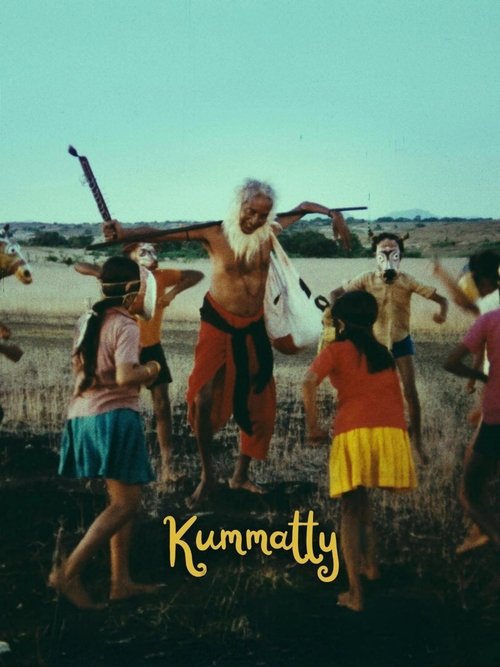
Kummatty
1979 · Govindan Aravindan
For a calm evening when you want wonder without noise — something to watch with kids or with your own childhood in mind. Pure comfort on the surface, with a soft ache underneath.
What it's about
A stranger clad in grass walks out of the hills into a village in Malabar, singing, and the local children fall in behind him. He may be Kummatty, the trickster-bogeyman of Kerala folklore — and his games with the children shade into real magic, which carries one boy further from home than the others. It's a children's fable told with the strangeness of an actual folk tale, not a sanded-down one.
The experience
Gentle, unhurried, and quietly enchanted — closer to a song or a remembered summer than a plotted story, with an undercurrent of melancholy about time passing. It casts a spell if you let it set the pace.
The craft
Aravindan shoots the Kerala landscape in natural light with an almost documentary tenderness, weaving in the region's Kummattikali masked-dance tradition and folk songs that the children carry through the film. Recently restored, its images of wind, grass, and monsoon light are ravishing and worth seeing in the best quality you can find.
Why it matters
A jewel of the Malayalam art cinema of the 1970s whose international restoration brought Aravindan's work to a new global audience, securing its standing as one of the great films about childhood.
Snapshot
A grass-clad stranger walks down out of the hills into a village in Malabar, singing. The children follow him. He shows them tricks, teaches them songs, and then — casually, without menace or explanation — turns them into animals. He turns them back. One boy, transformed into a dog, bolts before the spell can be lifted and lives out a long stretch of animal time before he is restored to a village that has moved on without him. Then the stranger leaves, as unaccountably as he came.
That is nearly the whole of Kummatty, roughly ninety minutes of Malayalam-language cinema built out of a bogeyman with whom Kerala parents have frightened children for generations, and out of the Kummattikali masked dance of northern Kerala, in which performers in painted wooden masks and suits of grass move through villages at Onam. G. Aravindan takes that figure at his word: not as folklore to be illustrated but as a presence still available to be filmed. The result is one of the least didactic children's films ever made — a film about a child's encounter with the non-human that declines to translate the encounter into a lesson. It won the National Film Award for Best Children's Film, sat for four decades as a connoisseur's title known mainly through festival retrospectives and poor prints, and re-entered international circulation in the early 2020s through a 4K restoration by Martin Scorsese's Film Foundation and its World Cinema Project, where it was received by many critics as a discovery on the order of a lost major work.
Industry & production
Kummatty belongs to the second wave of state-and-patron-supported art cinema in Kerala. The Malayalam new wave is conventionally dated to Adoor Gopalakrishnan's Swayamvaram (1972), financed through the Film Finance Corporation, the central body that in 1980 became the National Film Development Corporation. By the late 1970s a parallel infrastructure existed: FFC loans, the Kerala State Film Development Corporation (established 1975), a dense and politically literate film-society network, and — crucially for Aravindan — a handful of private patrons willing to fund films with no commercial prospect.
The most important of these was the cashew exporter K. Ravindranathan Nair, whose General Pictures banner underwrote a remarkable run of Malayalam art films across the late 1970s and 1980s, including Adoor's Kodiyettam and Elippathayam and Aravindan's Thampu (1978). Kummatty was made inside that same patronage economy, on the scale it implies: small crew, location shooting, non-professional and semi-professional casts, no stars, budgets that in commercial Malayalam terms were rounding errors. Aravindan himself never worked as a full-time filmmaker; he held a post with the Rubber Board, and the films were made in the interstices of a salaried life. This is not incidental to the work — it is why the films could afford to be as uncommercial as they are.
Distribution for such films ran through festival slots, the National Film Awards circuit, film societies, and later Doordarshan. There was effectively no theatrical market for Kummatty outside Kerala, and inside Kerala only a marginal one. Its designation as a "children's film" gave it an institutional home — India had a state apparatus for children's cinema, including a dedicated National Award category — without which its circulation would have been thinner still.
Technology
Kummatty was shot on 35mm color negative and processed, as nearly all south Indian production of the period was, through Madras laboratories. Aravindan's previous feature, Thampu, had been in black and white; the move to color here is a substantive choice rather than a default, since the film's whole sensory argument rests on the greens and wet ochres of Malabar landscape and on the difference between a village in daylight and a village at dusk.
The dominant technical constraint is the one that shaped nearly all Indian filmmaking before the 1990s: no synchronous sound. Dialogue, effects and much of the ambience were built in post-production and married to an optical mono track. Directors of Aravindan's disposition turned that limitation into a method — if sound must be constructed anyway, it need not be naturalistic, and Kummatty's track is composed rather than recorded.
Equally important is what the film does not have: an effects budget. The transformations of children into animals are achieved with cuts, framing, real animals, and the audience's willingness — no optical printing spectacle, no dissolve-heavy magic. The film's fantasy is materially poor and therefore, paradoxically, unusually convincing; nothing on screen is asking to be admired as a trick.
The final technological chapter is preservation. Indian film elements from this period survive erratically; the National Film Archive of India suffered serious losses over the decades, and independently produced art films were rarely stored well. Kummatty was restored in 4K under the Film Foundation's World Cinema Project, the initiative Scorsese founded to rescue films from underserved cinemas, and the restoration is what put the film in front of a twenty-first-century international audience for the first time. The specifics of which elements survived and were used are best taken from the Film Foundation's own documentation rather than asserted here.
Technique
Cinematography
The camera is Shaji N. Karun's, and Kummatty is one of the central works of his pre-directorial career — he shot most of Aravindan's major films before making Piravi (1989) himself. His work here is patient, wide, and heavily reliant on available light: long-held compositions of hill, paddy, path and courtyard in which figures are small and often entering or leaving frame rather than occupying its center. Depth is used ethnographically; the village is legible as a place with distances in it, and the children are frequently filmed at a remove, as one would film animals, without the coverage-and-close-up grammar that normally signals "child protagonist."
Two registers alternate. In the human village, the camera is stable, frontal, respectful of architecture and daily labor. Once Kummatty's magic takes hold, the camera drops closer to the ground and to animal eye level, and the landscape becomes something traversed rather than surveyed. The film's most quoted images — the stranger silhouetted on a ridge, the boy-as-dog moving through a world that has ceased to recognize him — come from this shift in altitude, not from any change in lighting or lens rhetoric.
Editing
The cutting is unhurried and paratactic: shots are held past the point where narrative information has been delivered, and scenes are joined by juxtaposition rather than by cause. The film's single most radical edit is an ellipsis — the long span the boy spends as a dog is not dramatized as an ordeal so much as elided into it, so that his restoration lands as a temporal shock rather than a rescue. Editing credits on Aravindan's films of this period are recorded inconsistently across circulating sources, and rather than guess at attribution it is more useful to note that the rhythm is unmistakably of a piece across Thampu, Kummatty and Esthappan, which suggests a director closely governing the cut.
Mise-en-scène / staging
Aravindan stages almost nothing in the theatrical sense. Groupings of children form and dissolve as they actually do; adults work in the background of shots that are not about them. Kummatty himself is the one designed element: hair and beard unshorn, body hung with grass and beads, a stick, a bearing that reads simultaneously as mendicant, tribal performer, and ritual mask-figure. The costume is a direct citation of Kummattikali, where dancers wear grass over the body and carved masks over the face — but the film withholds the mask, giving the figure a human face and thereby leaving permanently open the question the synopsis poses: he may be Kummatty.
Sound
The soundtrack is the film's other author. The score is credited to M.G. Radhakrishnan, working in a folk-derived idiom rather than the film-song idiom of contemporary Malayalam commercial cinema, and at least one of its songs — "Karutha Penne" — has had a life in Kerala well beyond the film. Song here is not interruption but the medium of Kummatty's power: he sings the children into his orbit and, effectively, sings them into their animal bodies. Around the music, the constructed track privileges wind, birds, water and distance over dialogue, and the film's silences are long enough to be felt as authored. Because everything was post-synchronised, the ambience has a slightly abstracted, floating quality — a limitation Aravindan uses to keep the village a half-step outside documentary.
Performance
The title role is taken by Kadammanitta Ramakrishnan, one of the major Malayalam poets of the period and a celebrated public reciter whose verse drew on folk rhythm and incantation. Casting him is a conceptual act: the film's magician is played by a man whose actual vocation was the oral, performed word. He acts almost entirely through presence, gait and voice, with no interiority offered and none needed. The children, drawn from the locality, are directed toward behavior rather than expression — running, watching, being bored, being frightened — and the film's credibility depends on their never appearing to perform childhood. The adults are handled at documentary distance.
Narrative & dramatic mode
Kummatty uses the oldest available structure: a stranger arrives, disturbs, departs. It is the armature of Teorema, of the western, of countless folk tales; Aravindan strips it of consequence-logic. There is no antagonist, no moral test, no restoration of order that the film endorses. The transformation is not punishment for a transgression, and the boy's year as a dog is not earned by disobedience — the tale's usual causal joints are simply absent.
What replaces them is a mode closer to folk narration than to drama: episodes accumulate, motifs return, and the film ends on an image rather than a resolution. The boy releases a caged bird. The gesture has been read, almost universally, as the film's thesis — that having been an animal, he can no longer participate in the ordinary human business of keeping one. It is offered without underlining, and it is the only thing in the film that functions as a moral, which is why it carries.
Genre & cycle
Formally the film sits at the crossing of three cycles. First, the state-sponsored Indian children's film, a category with its own funding bodies and award, whose masterworks — Satyajit Ray's Goopy Gyne Bagha Byne (1969) foremost — had already demonstrated that a children's film could be a major work. Second, the folk-fantasy strand of the Indian New Wave, in which filmmakers turned to oral and mythic material for non-realist form: Mani Kaul's Duvidha (1973) is the closest cousin, and Aravindan's own Kanchana Sita (1977), a Ramayana filmed with Adivasi performers and with Sita dispersed into landscape, is the immediate precedent within his filmography. Third, regional ethnographic cinema, the impulse that produced Thampu's near-documentary account of a traveling circus.
Kummatty is unusual in refusing the didacticism that the children's-film category invited. It is a children's film in the sense that The Spirit of the Beehive is one: a film organized around a child's perception, addressed at least as much to adults.
Authorship & method
Aravindan (1935–1991) came to cinema sideways and late. He was, before anything else, a cartoonist: his strip Cheriya Manushyarum Valiya Lokavum ("Small Men and the Big World") ran in Mathrubhumi weekly through the 1960s and into the early 1970s, following its characters in something like real time, and remains a landmark of Malayalam graphic satire. He was deeply involved in music and in theater, working in the orbit of the poet-playwright Kavalam Narayana Panicker, whose Sopanam company was then rebuilding Malayalam drama out of ritual and folk performance rather than out of European naturalism. That theater project — indigenous form, chant, mask, rhythm — is the direct intellectual context for Kummatty.
He had no film-school training and no apprenticeship in the industry; he made his first feature, Uttarayanam, in 1974. The films that follow constitute one of the most consistent bodies of work in Indian cinema: Kanchana Sita (1977), Thampu (1978), Kummatty (1979), Esthappan (1980), Pokkuveyil (1981), Chidambaram (1985), Oridath (1986), Marattam (1988), and Vasthuhara (1991), completed shortly before his death. He also made documentaries, including one on J. Krishnamurti, whose thought — attention without doctrine, the suspicion of accumulated authority — is a recognizable pressure on the films' refusal to explain themselves.
The key collaborators are few and constant: Shaji N. Karun behind the camera, a musical practice that drew on Carnatic, Hindustani and Kerala folk sources rather than on playback convention, and, on Kummatty, a poet cast as the magician. Aravindan's method was reportedly to work with minimal script and to let sequences find their length on location — an approach the surviving films support, though detailed production documentation of the kind available for canonical European directors of the same period simply does not exist for him.
Movement / national cinema
The film belongs to the Indian New Wave and, more specifically, to its Malayalam chapter — the most sustained regional art-cinema movement in India, enabled by Kerala's exceptional literacy, its strong left political culture, and a film-society movement that had built an audience capable of watching this kind of work. Aravindan and Adoor Gopalakrishnan are the movement's twin figures, and their difference defines it: Adoor the architect of tightly composed, socially diagnostic narratives; Aravindan the intuitive, musical, anti-narrative one, closer in temperament to Mani Kaul and Kumar Shahani than to any Malayalam contemporary. Around them stood John Abraham, P.A. Backer and K.G. George, and beneath them a "middle cinema" of Bharathan, Padmarajan and M.T. Vasudevan Nair that carried some of the new wave's seriousness into commercially viable film.
Era / period
1979 was the trough between Indira Gandhi's Emergency (1975–77) and her return to power in early 1980 — a period of political exhaustion in which the confident developmental narrative of the Nehruvian decades had visibly frayed. Kerala in the same years was being transformed less by politics than by migration: the post-1973 Gulf boom was pulling labor out of Malabar villages and pushing remittance money back in, remaking exactly the kind of settlement Kummatty films. The film registers none of this explicitly. But its subject — an oral, ritual, animist inheritance encountering a village that will not much longer have room for it — is inseparable from that moment, and its Malabar setting places it in the part of Kerala where living ritual performance traditions, Theyyam among them, were most intact.
Reception, canon & influence
Domestically, Kummatty was recognized through the state apparatus that existed for exactly this purpose: the National Film Award for Best Children's Film. Aravindan accumulated national honors across his career and was, by the early 1980s, unambiguously canonical within India — while remaining almost unseen abroad, a fate shared by most of the Indian New Wave outside Ray. Detailed contemporary critical reception is thinly documented in accessible English-language sources, and it would be dishonest to reconstruct it.
Backward, the film's debts are to non-cinematic sources first: the Kummattikali masked dance and the domestic bogeyman that shares its name; the folk-tale morphology of ordeal and restoration; the Sopanam theater project's recovery of ritual form; and, as an antecedent within Indian cinema, Ray's demonstration in Pather Panchali that a child's perception could organize a film's entire visual logic, together with the New Wave's folk-fantasy experiments of the early 1970s.
Forward, its influence ran through people before it ran through films. Shaji N. Karun's directorial career — Piravi (1989), which took a Caméra d'Or mention at Cannes — grows directly out of this apprenticeship, and the contemplative, landscape-forward Malayalam image has an unbroken line back to these shoots. Within India, Aravindan became the permission-granting figure for filmmakers pursuing ritual, myth and non-psychological narrative; critics have repeatedly placed the recent Malayalam resurgence — Lijo Jose Pellissery's work on crowds, animals and ritual frenzy above all — in his shadow, though this is better described as affinity and inheritance than as documented debt.
The decisive event in the film's afterlife is the World Cinema Project restoration. Restored in 4K and returned to festivals and specialist theatrical release in the early 2020s, Kummatty was received not as a rediscovered curiosity but as a first-rank film about childhood, spoken of alongside The Spirit of the Beehive and Pather Panchali — which is to say that its canonization is happening now, more than forty years after it was made, and outside the culture that produced it. That is a common shape for films from underserved cinemas, and it should temper any account of the film's "legacy": for most of its life, Kummatty had almost no reach at all. What it had instead was durability.
A Deleuzian reading
He comes down out of the hills wearing grass.
The full Deleuzian reading of Kummatty →
Reception
For decades this was a film Malayalis grew up on but the wider world couldn't see — the elements had decayed almost to nothing. Then the 2021 4K restoration by Scorsese's World Cinema Project and India's Film Heritage Foundation premiered at Bologna's Il Cinema Ritrovato, and it was reborn as a global rediscovery, now routinely called one of the greatest children's films ever made.
How Kummatty was received, from release to now →
How to watch Kummatty: what to notice on a first viewing
- Watch how small the figures stay against hill, paddy, and path. Karun holds wide, patient compositions in available light, with people entering and leaving frame rather than centered in it. The land gets equal weight with the people, so the village feels like a place with real distances, not a set.
- Listen for how often Kummatty sings instead of speaks. Song is how he pulls the children into his orbit, not something that interrupts the story around him. The music is the mechanism of his power, not accompaniment to it.
- Notice how long shots hold after the action in them seems finished. Aravindan keeps the camera on hill, courtyard, or path past the point where the scene has told you what you need, then joins scenes by juxtaposition rather than cause. The stillness is a technique from folk narration, where episodes accumulate rather than argue toward a conclusion.
- Watch Kummatty's costume: grass over the body, an unshorn beard, no mask. It directly copies the Kummattikali masquerade dancers of Kerala, but withholds the carved mask that would confirm what he is. Keeping his face human keeps open whether he is really the folk figure the children believe him to be.
- Watch the children run, wait, and get bored rather than act. The local children are directed toward ordinary behavior, filmed at a remove, without the close-up grammar that usually announces a child protagonist. Filming them like this keeps their world credible instead of performed.
The whole guide to watching Kummatty, with the keys for a rewatch →
Influences: the films it descends from and the films it influenced
- Pather Panchali (1955) — Ray and Subrata Mitra pegged the entire visual logic to a child's height and attention span and let the arrival-and-departure of itinerant figures — the sweetmeat seller, the jatra troupe — stand in for plot; Aravindan reproduces both the bounce-lit available-light exteriors and that arrival/departure morphology, with the sorcerer occupying the structural slot Ray gave the traveling performer.
- Au hasard Balthazar (1966) — Bresson's method of framing an animal at its own eye level and letting it carry the film's moral attention without anthropomorphising it — combined with the 'model' register of affectless non-professional performance and hard elliptical cuts between episodes — is the exact grammar Aravindan switches into once the children are turned into dogs and the camera stays down at dog height.
- Kes (1969) — Loach and Chris Menges shot a non-professional boy's handling of a captive bird in continuous available-light takes rather than cutting around the animal, and made the bird's fate the film's structuring gesture; Kummatty runs the same device in reverse — the caged bird released as redemption rather than wound.
- Swayamvaram (1972) — Established the Malayalam feature shot wholly on location in natural light, without playback song sequences or melodramatic scoring, and built through the co-operative/KSFDC funding route — the production grammar and the financing model that made an unsaleable children's folk-fantasy like Kummatty possible at all.
- Duvidha (1973) — Kaul transposed folk-tale morphology to film without psychologising it — frontal near-static compositions, folk song deployed as narration rather than accompaniment, and a supernatural figure the film simply accepts as fact; Kummatty's song-as-incantation and its flat refusal to explain the sorcerer descend from this early-70s New Wave folk-fantasy experiment.
- Nirmalyam (1973) — Filmed the velichappadu's possession dance as lived Kerala ritual practice rather than exotic insert, letting the rite's own duration dictate the length of the scene — the direct precedent for staging Kummattikali in full grass costume at unbroken length inside a fiction film.
- Kanchana Sita (1977) — Aravindan worked out the Sopanam method here two years earlier — casting non-professional Adivasi performers, and replacing dialogue-driven psychology with landscape, wind and percussion as the register of interior state — then applied it wholesale to Kummatty.
- Thampu (1978) — The immediately preceding Aravindan/Shaji N. Karun collaboration: a traveling circus arrives at a village and leaves, shot documentary-style with the watching villagers' faces as the real subject, in available-light monochrome with post-synchronised ambience — Kummatty is that structure recast in color with a sorcerer in the tent's place.
- Esthappan (1980) — Takes Kummatty's arriving-stranger structure to its limit, assembling a possibly-miraculous figure entirely out of contradictory village testimony, so the paratactic cutting that merely withheld explanation in Kummatty becomes the film's whole method.
- Piravi (1989) — The direct hand-down: Kummatty's cinematographer's own debut carries over the wide available-light monsoon composition with a small figure held at the far edge of the frame, and lets shot duration run well past narrative need — shooting habits formed on Aravindan's sets.
- Vanaprastham (1999) — Extends Kummatty's mask logic — Kathakali make-up and costume filmed as a transformation that genuinely alters the wearer's being, with performance sequences granted their full ritual duration instead of being cut down for narrative economy.
- Ottaal (2014) — The most literal recent restatement: a non-professional child lead, Kuttanad backwater landscape shot in available light with the camera held at the boy's height, and birds as the governing figure of captivity and release.
- Ee.Ma.Yau (2018) — Uses ritual as structural spine rather than subject — a funeral's protocol dictates scene order and duration — and handles the coastal village crowd as a single choreographed body over post-synchronised ambience, the Aravindan inheritance the recent Malayalam resurgence keeps being measured against.
- Jallikattu (2019) — Girish Gangadharan's camera tracks the escaped buffalo at animal eye level through torchlit night while the village crowd churns as one ritual mass — affinity rather than documented debt, but the clearest current extension of Aravindan's non-psychological animal-and-ritual cinema.
- The Spirit of the Beehive (1973) — Parallel invention rather than debt: Luis Cuadrado's honeyed available-light interiors, a child's face held in close-up as the film's only interpretive instrument, and a monster kept almost entirely offscreen so that the child's belief — not the effect — carries the fantasy.
- Agraharathil Kazhutai (1977) — The Malayali director's Tamil-language film puts a donkey at the center of a village's moral economy and frames it at its own eye level, letting the community's reaction to a non-human intruder generate the entire structure — the same animal-eye-level ethic Aravindan applies to the transformed children.
- Ghatashraddha (1977) — Organizes a whole film around a boy watching ritual punishment he cannot interpret, using the non-professional child's uncomprehending look as the editing principle — Indian New Wave's other proof that child perception can sustain non-psychological narration.
- Elippathayam (1981) — Same Malayalam New Wave production ecology and craft economy — Mankada Ravi Varma's controlled natural-light interiors, near-total reliance on post-synchronised ambience in place of score, and a human figure literalised through animal figuration (the rat in the trap) rather than through dialogue.
Similar films
- Pather Panchali (1955) — influence & lineage
- Kishkindha Kaandam (2024) — shared sensibility
- Tumbbad (2018) — shared sensibility
- Manjummel Boys (2024) — shared sensibility
- Kumbalangi Nights (2019) — shared sensibility
- Kadaisi Vivasayi (2022) — shared sensibility
- Manichitrathazhu (1993) — shared sensibility
- Thaniyavarthanam (1987) — shared sensibility